1.
Essays
concerning the census
conducted in the year
1769
within the
Royal Danish States in Europe;
by
Mr. Stiftamtmand von Oeder
at Oldenburg.
(From the manuscript communicated by the author to the editor.)
Preface.
These essays are the result and execution of a commission that was assigned to me shortly after the census lists had arrived, to extract results from these lists; to make reflections upon them; and to present a plan for future censuses that might be undertaken,whereby Essay A belongs to the second, Essay B to the first, and Essay C to the third part of this commission.
I submit these essays to the press pursuant to a permission received in the past year, which I—being, in general, a friend only of publicity within proper bounds—deemed all the more necessary, since I did not regard the fruit of such a commission as entirely my literary property.
I submit them to print just as they once flowed from my pen, and I hope that they, with all the shortcomings I am well aware of, may nevertheless not be unwelcome to the public both within and beyond the Danish states.
Fragments thereof are to be found in the second volume of the Materials for the Statistics of the Danish States, which were published—entirely without my involvement—by benevolent, yet wholly unknown, men through the Kortensche Bookshop in the years 1784 and 1786, as the surprising note in the preface, pages V–VII, attests.
Without the knowledge of Prof. Crome, and undoubtedly to his own satisfaction, I cannot here refrain from correcting the errors found in the table on page 42 of his book entitled "Europe’s Products" (Edition 1784), regarding Denmark and Norway.
It states there, in the column headed "various data":
for Denmark: "808 according to Oeder, 952 according to a newer and more accurate report from Copenhagen",
for Norway: "7000. 723, 141 according to a report communicated to me from Kiel in the year 1784",.
The correction is as follows: The figures 808 and 952 are both my own. The figure 808 is to be understood as referring to Denmark and the Duchy of Schleswig dependent thereon; the figure 952 includes, in addition to these 808 square miles, also the Duchy of Holstein belonging to the then Royal privative share, together with the then Counties of Oldenburg and Delmenhorst. The figure 723,141, which as an area makes no sense whatsoever, is in fact the number of inhabitants in Norway.
Oldenburg, 18 February 1789G.
C. von Oeder
A.
Submitted by order of the Royal Rentekammer in the year 1772.After long and laborious processing of the lists that were received following the census of the inhabitants of the Royal States in Europe, conducted on the 15th of August 1769, I now find myself in a position to present the results of this census, along with reflections thereon.
I also provide an expanded plan for such censuses, which ought rightly to be repeated from time to time, for only the comparison of the results of various censuses becomes truly instructive.
With this, I thus fulfill the commission that was granted to me by Supreme Royal command from the Royal Rentekammer on the 18th of April 1770. I have undertaken more than this commission strictly required, namely also a comparison of the annual changes in the human population with the total number of people living at a given time, through which comparison rules may also be established by which one can deduce the total from the annual changes; and to this end I have caused extracts to be made from the church registers for the ten years from 1760 to 1769. But as the processing of these still requires some time, I did not wish to delay the part that was properly assigned to me, and the results and conclusions from the extracts of the church registers may, after some time, follow as an addition to the main matter.
I hope that the extensive labour hidden within the appended tables—especially in the many calculations undertaken to indicate, everywhere, the necessary scale for comparisons—will not go unrecognized, and I flatter myself that in this manner I have fulfilled my commission to the highest satisfaction.
The reflections upon the census conducted on the 15th of August 1769 are, according to the method of the schema employed therein, divided into the following sections:
I. Reflections on the number of inhabitants in itself, and in general, without reference to particular circumstances.
II. Reflections prompted by the comparison of the number of inhabitants with the space they occupy, or the area of the countries; as well as reflections arising from the comparison of the number of inhabitants with the state's revenues.
III. Reflections on the comparison between the population of the towns and that of the countryside.
IV. Reflections on the ratio of the two sexes to each other.
V. Reflections on the proportion of people in each of the seven stages of life, as adopted in the census schema.
VI. Reflections on the ratio between the married and the unmarried.
VII. Reflections on the classes according to their means of livelihood.
VIII. Reflections upon a closer comparison of the productive members of the citizenry, the peasantry, and maritime occupations, with the consuming servants of the King and the State in both ecclesiastical and civil estates, and with the indigent.
Finally, follow:
IX. some remarks on the schema used and the method employed in the operation.
First Section.
Reflections on the number of inhabitants in itself and in general, without reference to particular circumstances. Table 1.Native and foreign writers usually estimate the presumed number of inhabitants of the Royal Danish States in Europe at 2½ million. It is here as it so often is with offhand estimations: countries and cities are thought to be more populous, and people reputed to be wealthy are believed to be richer, than later proves to be the case upon actual enumeration. From this arises the necessity of proper censuses.
Since many Royal subjects are constantly at sea, and the census was conducted in the middle of summer, there is reason to believe that many who were absent at precisely that time were not counted; and this supposition is made even more plausible by the considerable excess of females over males, since those absent are, for the most part, of the male sex.
At the same time, we are not certain that here and there some individuals may not have been counted twice.
If we allow for those absent at the time of the census, and for the armed forces not listed in the census rolls, a total addition of 83,000 persons in both categories to bring the number to 2,100,000, we are, without doubt, reckoning generously.
A population of 2,100,000 souls does not, to be sure, make one of the great states among the European nations; yet neither we subjects nor our Most Gracious King should take this as a misfortune. The subjects of the great states, in whose histories a fifty-year peace is something unheard of, are not therefore happier for being members of a vast and boundless body politic; and for a friend of mankind upon the throne, the vocation of rendering 2,100,000 human beings as happy as possible is great and exalted enough.
These reflections should serve to remind our statesmen never to lose sight of the rule Horace prescribes to poets who undertake an epic: "Versate diu, quid ferre recusent, quid valeant humeri" — Consider long what shoulders can bear, and what they must refuse — so that they shape their plans carefully in accordance with the needs which nature permits to be fulfilled, and with the strengths which nature has allotted to us.
A number of 2,100,000 persons always deserves the name of a nation, and as a nation it ought rightfully to be equal to the world at large, within its own home. This security, both external and internal — which is the first and primary aim of civil life — this dependable state, which does not rest upon the world’s friendship or the turns of worldly fortune, but upon the inherent strength of the state itself, is the basis of all other well-being. Nature, which has fortified Norway with a wall of rock, and which has connected the Danish peninsula to the great solid German mainland by means of a not very broad isthmus between Travemünde and Hamburg, aids us in this regard. But we must remain vigilant in the defence of this our vulnerable flank, and remember the years 1629, 1658, and 1762. Without this connection to the continent, Denmark would be wholly a sea power, like Great Britain; and even with this connection, sea power must remain our chief strength — without, however, neglecting our security on the landward side. And since we cannot, alongside the required naval force, maintain a standing land force as large as would be necessary, the necessity becomes evident of forming a viable national force, which may readily be drawn forth from the bosom of a nation numbering 2 million.
The Danish state has had its borders, in terms of territory, assigned by nature; and unless I am greatly mistaken, even the possession of the lost provinces beyond the Sound would only give the state an additional weak flank. But within the present borders—how much remains to be done, how many significant peaceful conquests are still possible? A fertile soil, disadvantageously distributed among its cultivators; chains still borne by the estate that makes up three-quarters of the nation; a large and wholly neglected province such as Iceland; the most advantageous location at sea, and the vocation imposed by nature in that location; urban industry, still in its infancy, and whose expansion — from the ratio 13:100 to 43:100 — that is, a tripling — is entirely feasible! What prospects do we not see here for an expanded population — an expansion all the more desirable, since, according to a well-established principle of political economy, a state’s strength must be measured not only by the number of its inhabitants, but also in relation to the territory they occupy, in inverse proportion to the extent of that territory!
Sweden had, according to the census taken in 1757, 2,317,599 souls across approximately 5,000 Swedish, or 10,368 geographical, square miles.
France, according to Vauban in the Dixme royale, had 19,094,000 people; but according to the newer author of L’intérêt de la France mal entendus, only 17 million.
Spain, according to Ustaris: 7 million.
Asturias: 300,000.
In Portugal, according to Büsching: 1,742,230 souls, presumably excluding the clergy.
England, according to King: 5½ million.
Ireland, according to a census taken in the previous century: 1,034,102.
Province of Holland, according to Leuwenhoek: 1 million.All seven provinces of the United Netherlands contain about 2 million, according to Stryck: 2½ million. The population of the province of Holland has otherwise been estimated at approximately 1.2 million.
Naples and Sicily, according to Süßmilch’s estimate: 4½ million.Sicily alone: 1,600,000.
In the city of Lucca and its 150 associated villages, one reckons, according to Büsching, over 120,000 people.
On Malta, the population is reckoned at about 60,000.
Germany as a whole, according to Büsching's estimate: 24 million.
Prussia in the year 1757: 700,000 people.
Kurmark, Neumark, and Pomerania in 1755, according to Süßmilch: 1,315,878.
Duchy of Magdeburg: approximately 330,000 by some estimates; according to Süßmilch: 210,000.
Halberstadt: 81,000.
The remaining Prussian territories, excluding Silesia: approximately 600,000; altogether, without Silesia, not quite 3 million.
The population of the Margraviate of Brandenburg was estimated in 1756 at about 800,000.
In Bohemia, 1,966,062 people were counted in 1766, and in 1767: 1,978,193.
The population of Silesia is said to exceed 1½ million.
In all Electoral Hanoverian lands, 750,000 people were counted in 1756.
In the Duchy of Württemberg, a count in 1754 found 477,115 people.
In Alsace, according to Boulainvilliers: 257,000.
In the Principality of Schwarzburg, one reckons around 100,000 people.
Switzerland: 1,847,000; Graubünden: 250,000; Zurich: 175,000.
The four Italian bailiwicks of the twelve cantons: 120,000 people.
Estonia, according to the author of the treatise on the export of grain from Estonia: 158,000 people over 381 square miles, including 18,000 urban dwellers.
Second Section.
Reflections prompted by the comparison of the number of inhabitants with the area they occupy. Tables II–XIV; also reflections arising from comparing the number of inhabitants with the state’s revenues.In order to judge the population of countries, one must have precise notions of their geographical extent or area, and be able to state how many people fall within a given unit of surface — for example, per square geographical mile (15 geographical miles to one degree of the equator). These figures, which express the number of inhabitants per common surface measure, thus show the ratio of population density in the various countries to be compared. And only after such ratios have been determined can one inquire into the causes of these differences in population — causes to be sought in the varying fertility of the soil, the yield from land and water, the climate, the location, the industries, the diligence of the inhabitants, the domestic political constitution of the countries, and the vicissitudes of world events.
Even before I received the present commission from the Royal Rentekammer, I had happened upon a method of investigating the area of countries that is as simple as it is little known; and about two and a half years ago, His Majesty received a determination of the area of Denmark, the duchies, and the counties of Oldenburg and Delmenhorst, carried out down to each individual district (Harde).
More recently, I have extended these investigations to the entire globe, and intend shortly to present the results of these inquiries to His Majesty in all due humility.
If I set aside the measurements of Tempelmann — which are eagerly recopied in geographies and other collections of curiosities, but are nonetheless superficial and summary — then these investigations of mine are entirely new, and as little known among foreigners as they are among ourselves.
Once the area has been thus determined, the next matter is to have reliable information concerning the number of inhabitants — such information, however, is rarely available for other countries. In order to compare our own lands with others, at least to some extent, I will therefore begin by assembling and presenting the few pieces of information I have been able to gather, including calculations of the number of people per square mile. I shall also provide the area for some countries whose population figures are unknown.
| Region | Inhabitants | Area | People per square mile |
|---|---|---|---|
| Böhmen | 1,978,193 | 932 | 2122 |
| Brandenburgisch-Schlesien | 1,500,000 | 700 | 2143 |
| Frankreich | 19,000,000 | 9700 | 1958 |
| Frankreich | 17,000,000 | - | 1752 |
| Spanien | 7,500,000 | 9000 | 834 |
| Asturien | 300,000 | 259 | 1235 |
| Portugal | 1,742,230 | 1850 | 942 |
| Elsaß | 257,000 | 127 | 2024 |
| England | 5,500,000 | 2750 | 2000 |
| Schottland | 1,500,000 | 1750 | 857 |
| Irland | 1,034,102 | 1430 | 723 |
| Holland | 1,000,000 | 109 | 9174 |
| 7 vereinigte Provinzen | 2,333,500 | 580 | 4022 |
| Neapel und Sicilien | 4,500,000 | 2020 | 2228 |
| Sicilien | 1,600,000 | 550 | 2909 |
| Neapel | 2,900,000 | 1470 | 1973 |
| Deutschland | 24,000,000 | 10,120 | 2388 |
| Preußen | 700,000 | 720 | 972 |
| NeuPreußen | - | - | - |
| Churmark u. Pommern | 1,315,878 | 1230 | 1070 |
| Churmark | 800,000 | 753 | 1062 |
| Magdeburg | 210,000 | 105 | 2000 |
| Halberstadt | 81,000 | 30 | 2700 |
| Würtemberg | 477,115 | 140 | 3402 |
| Churhannöverische Lande | 750,000 | 730 | 1028 |
| Schweiz | 1,847,000 | 840 | 2198 |
| Zürich | 175,000 | 27 | 6480 |
| Graubündten | 250,000 | 205 | 1220 |
| Schweden | 2,307,599 | 10,368 | 222 |
| Gothenburg und Bahuslehn | - | - | 1151 |
| Malmöehuus und Christianstadt | - | - | 1034 |
| Halland | - | - | 914 |
| Bleking | - | - | 868 |
| Skaraborg | - | - | 896 |
| Upsala | - | - | 685 |
| Oster Oerland | - | - | 650 |
| Elfsborg | - | - | 624 |
| Stockholm | - | - | 525 |
| Södermanland | - | - | 484 |
| Westmanland | - | - | 473 |
| Croneburg | - | - | 468 |
| Jönköping | - | - | 381 |
| Nerika und Wermaland | - | - | 338 |
| Calmar | - | - | 338 |
| Gotland | - | - | 324 |
| Finland | - | - | 143 |
| Kopparberg | - | - | - |
| Westmanland | - | - | 48 |
| Westbotten | - | - | 48 |
| Lionnois | - | - | 2408 |
| Auvergne | - | - | 1777 |
| Normandie | - | - | 3494 |
| Churfürstliche Lande | - | 729 | - |
| Estland | 158,000 | 381 | 414 |
| I byerne. | 18,000 | - | - |
Now, after these conducted comparisons — both among our own domestic population between province and province, as well as between our domestic population and that of foreign European countries — should one wish to attentively engage in reflections thereupon, such a multitude of considerations present themselves that I, not being called to write an entire book, must limit myself to but a few.
I have always, insofar as I could judge based merely on outward observation during my travels, held the opinion that Denmark, in so far as it consists of islands, is more densely inhabited than Schleswig; Schleswig more so than Holstein — and this now proves to be true. One of the causes, according to my further belief, is this: regarding the parts of these lands made up of noble estates, in Denmark 7/8 or 5/6 of the area of an estate is occupied by peasant farms, whereas in the duchies it is only half, if that. The subdivision of the royal domains in the duchies already contributes somewhat to their further population.
One should not fail to note the pronounced population of the counties of Oldenburg and Delmenhorst, as well as the islands of Fehmarn, Als, and Ærø, nor the superiority of the Oldenburg marshland over that of Holstein and Schleswig — likely because in the former more land is kept under the plough, whereas in the latter more is left for grazing. And in Zealand, Amager, and Sokkelund Herred, one may observe the influence of proximity to a great city.
Whence comes the exceptionally high population of Ring Herred in Aarhus Diocese (3246)?
In Norway. The Nordland provinces — such a vast region (2082 square miles), with its expansive, fish-rich coast, and where the land, at least in the case of the bailiwicks of Helgeland and Salten, is no worse than other coastal valleys in the dioceses of Trondheim and Bergen — have only 26 people per square mile. And yet prejudice and monopolies must eternally carry more weight than sound reason, which, at the very first glance at the map, declares that there ought to be a town in Nordland!
And Iceland (which ought still to be for us what Newfoundland once was for all of Europe, before the Grand Banks were frequented, and which in the year 1615 was visited by 120 English ships in a single summer) — Iceland (2904 square miles) has only 16 people per square mile; and Finnmark (1244 square miles) has merely 5 — even though it was undoubtedly more populous in ancient times and had 12 now-vanished parishes! Fruits of monopoly trade!
I cannot refrain from making another remark about Iceland; for such a vast province ought rightly one day to become what it has the potential to be: more valuable to the state. Iceland has 46,201 inhabitants, Nordland 53,500 — admittedly 16% more; but just compare the trade of Nordland, conducted as it is despite all the oppression this province endures, with that of Iceland! What are 23 or 24 shiploads — admittedly sizable vessels, as the Icelandic Company’s ships are — when compared to 300 cargoes carried by Nordland sloops, vessels which can also bear much? And upon this meagre quantity of bulky exports, amounting to no more than 24 shiploads, rests the entire welfare of the Icelandic nation! Poor people!
Let one compare the population of the coastal bailiwicks in the dioceses of Christianssand, Bergen, and Drontheim with those further inland in the same dioceses, as well as with the similar bailiwicks of the diocese of Aggershus (the grain-rich bailiwicks of this diocese must be set aside in this consideration), in order to recognize the advantages and importance of the fisheries.
They constitute by far the most important branch of industry in this kingdom, and trade in fishery products is, in particular, the most stable — precisely because these products cannot be stored in warehouses, but the necessity of procuring them renews itself each year. Thus, foreign nations do not have the same power to dictate prices as they do with respect to other Norwegian products — metals, and especially timber.
Comparison with Foreign States
If we choose only to compare ourselves with those European states that are commonly reputed to be modestly or even poorly populated, then certainly the figure of 1305 — the average population per square mile in the Kingdom of Denmark and the German provinces combined — appears fairly reasonable. But when we look to other states where more developed industry prevails, we are undoubtedly far behind. We must strive to catch up with these more flourishing nations, just as anyone seeking improvement must not compare himself with those behind him, but with those ahead. This we must do — and this we can do.We must do it; for (what use is flattery?) we make up, as said, with our 2,100,000 heads only a rather moderate state; and on the German side, nature, as also mentioned, has set a boundary for us — we must therefore seek the enlargement of the state internally. And we can do this. For although it is true that northern lands can never, under otherwise equal circumstances, match southern lands in population — for the simple reason that the inhabitants of northern countries require more fuel, and all forms of fuel (except for coal, which comes from underground) — even peat, which requires less than wood, but still a notable portion of land to produce — consume part of the national area, we nevertheless must not neglect the benefits kindly nature has bestowed upon us: land that, throughout the Kingdom of Denmark and the German provinces, is entirely cultivable and in many and not small places remarkably fertile; and above all, the advantageous maritime location, which delivers foodstuffs for domestic use, facilitates the export of our products, and — even without native goods or commerce in proprietary wares — provides the opportunity to earn by exchanging foreign goods for foreign goods and through freight shipping.
We must therefore take Great Britain and Holland as our model, without being discouraged by the vast leap ahead they have taken: for even if we do not reach them in totum, we may still reach them in tantum. But we must also follow the road to wealth which those nations have taken, and follow our calling in the right order. Our calling, our chief occupation, must be first: agriculture and animal husbandry, fisheries and seafaring; manufacturing may follow if it can — that is, to the extent that hands for it are found, which naturally, in a land of fisheries and shipping, will always be fewer than in landlocked countries.
Among the means to promote the industry of the subjects, this is the chief: the less direct intervention by government, the more freedom. In particular, I would wish — to promote our natural vocation, the entrepôt trade in the Baltic and to the White Sea, indeed all kinds of trade — a reduction of duties, such that customs duties no longer form a chief part of state revenues, but are rather regarded as a moderation and regulation of commerce. Then, instead of the proposed special free zone for entrepôt trade in Copenhagen, the entire city of Copenhagen could become the staple port of the entrepôt trade.
I consider it entirely possible to make up for the loss of customs revenue through increased consumption among all subjects, through a trade tax on those engaged in commerce, and through a levy on the houses and lots of a free port. And the crucial difference — for trade — between these different types of taxes lies in this: that customs duties directly affect goods and influence their prices, thereby impeding their circulation; whereas taxes on consumption, trade, and property allow each person to adapt as best they can — and will gladly do so, when in exchange all goods are freely and unrestrictedly available for enjoyment or speculation, and thus can be more easily passed on in broader trade.
Observations in comparing the number of inhabitants with the revenue of the state.
To this end, I have drawn up the following table, which I shall explain with but a few remarks.
| Region/Category | Population | Revenues |
|---|---|---|
| a. Total | 10,000 | 10,000 |
| b. Denmark (100:11.1) | 3,885 | 4,589 |
| c. Norway (100:61.8) | 3,585 | 2,216 |
| d. Duchies (100:149.8) | 1,876 | 2,811 |
| e. Counties (100:122.7) | 312 | 383 |
| f. Iceland (100:11.36) | 229 | 26 |
| g. Customs revenues in Denmark | 714 | 784 |
| h. Customs revenues in Norway | 255 | 1,049 |
| i. Mining duties and tithes | - | 149 |
| k. Customs in the duchies | 348 | 277 |
| l. Consumption, excise, poll and family tax in Denmark | - | 1,434 |
| m. Consumption, excise, poll and family tax in Norway | - | 158 |
| n. Customs revenues from Copenhagen | 350 | 534 |
| o. Consumption and excise from Copenhagen | - | 806 |
| p. Land tax in Denmark | 3,180 | 1,881 |
| q. Land tax in Norway | 3,264 | 704 |
| r. Land tax in the duchies | 1,528 | 1,137 |
| s. Land tax in the counties | 369 | 383 |
| t. Royal domains in Denmark | - | 267 |
| u. Royal domains in Norway | - | 134 |
| v. Royal domains in the duchies | - | 140 |
The total population and revenue across all the states has been assumed to be 10,000; that is to say, out of every 10,000 souls — all inhabitants taken together — 3885 are from Denmark, and out of every 10,000 Rixdollars of state revenue, 4589 Rixdollars come from Denmark.
In determining the total amount of revenue, I have only considered the local revenues, and excluded all general revenues of the state which cannot be attributed to any particular region or province, such as: postal income, stamp duties, fees, the Sound Toll, the Elsfleth Toll — since, regarding the two latter items, the majority is collected from the subjects of foreign realms, and, regarding the other items, it is difficult to determine how much each part of the royal dominions specifically contributes. The population listed under the items p. q. r. s. is to be understood as the population of the rural areas.
This table is altogether too fruitful in considerations regarding the internal strength of the different parts of the state — considerations which must be the foundation of any thorough theory of taxation — for me to presume to exhaust them here; instead, I must limit myself to a few observations that concern Norway.
The population of Norway stands in relation to that of Denmark as 3585 to 3885, but the revenue from Norway stands in relation to that from Denmark as 2216 to 4589. If revenues were proportional to population, then, if Denmark yields 4589 Rixdollars, Norway ought to yield 4235 Rixdollars, or 92 2/100 Rixdollars for every 100 Rixdollars Denmark contributes. However, Norway in fact yields only 48 29/100 Rixdollars.
Now we can rightfully assume — and indeed we must humbly believe — that our forefathers, in regulating tax arrangements, acted as thoughtfully as we ourselves would, according to their best insight and knowledge, and in accordance with the circumstances of their time. Circumstances change constantly in this sublunar world; there is always something to be improved or corrected in our understanding, and knowledge continually expands. Thus, improvements in our tax systems are not only possible but absolutely necessary; we must endeavour to identify every blemish and point where a true improvement is possible — where one of the sources of state revenue may be opened, extended, or purified, where an inequality in the burdens imposed upon the subject may be avoided or rectified.
However, we must be very cautious not to fall into sudden and severe deviations from what has been established and become customary, and bear in mind that, just as over time taxes gradually and often imperceptibly — even to the government itself — adjust to the means of livelihood, so too all aspects of common life and the entire economy of the subjects arrange themselves around the system of taxation.
Should a tax suddenly be introduced which is not properly suited to the means of livelihood, undesirable consequences will inevitably arise — and that such consequences have arisen from the head tax, especially in Norway, should not surprise us. And I beg, from me — whose intention, God knows, is not to offend — to kindly accept this explanation of why such unpleasant consequences could hardly have been avoided.
The head tax is a levy based on the number of inhabitants, but the means of livelihood do not correspond to the number of people. This type of tax may be suitable in a country such as Russia still is — where other taxes are fewer, and particularly where the immovable sources of income, namely land and soil, do not yet have a fixed value that the legislator might base taxes upon. But for the Danish states this tax is not appropriate — precisely because they are more orderly governed than Russia generally still is. And as Russia improves internally, as it inevitably will, the head tax will also become increasingly inappropriate there — though under generally low taxes it may not be burdensome.
But with us, it is burdensome — and, caeteris paribus, to the Norwegian more than to the Dane — because the Norwegian, under ordinary taxes (hopefully in proportion to his lesser means of livelihood), is used to paying only half as much as the Dane, but under the head tax is placed on equal footing with the Dane, to whom nature has allotted greater means of earning a living.
The difference becomes all the more evident when we consider the peasant in Norway, who in this kingdom constitutes 9/10 of the nation. Their number compares to the rural population in Denmark as 3264 : 3180, but the land tax in Norway compares to that in Denmark as 704 : 1881. According to the population, if Denmark contributes 100 Rixdollars in taxes from the land, Norway should contribute 102 60/100 Rixdollars, yet in fact it only yields 36 28/100 Rixdollars. If the Norwegian farmer, whose livelihood depends solely on the productivity of the farm he inhabits, and who typically pays only 36 28/100 Rixdollars, is to pay the head tax on the same basis as the Danish farmer, who contributes an average of 100 Rixdollars, then clearly it must weigh disproportionately more heavily on him, relative to his means.
Let us add here further relevant reflections: that the government incurs no particular expenses in Norway, and thus a large portion of the revenue it draws from Norway exits the country and is lost to its internal circulation. These funds can return to the hands of the Norwegians – and from there to the hands of the king – only through a profitable trade with other nations. But due to a misfortune (which God in His grace may soon avert), the export of Norwegian goods has in recent years not been able to offset the influx of imports. Hence it becomes understandable how complaints about the extra tax and the lack of money in Norway have grown so extensive.
More still: just as the peasantry is numerous in Norway, so the land tax is slight, while the customs duties in Norway are, more than in any other royal land, especially significant, and constitute by far the greatest part of the royal revenue from this realm. Naturally, the best means of livelihood are in the hands of those who pay these duties — namely, in the hands of those involved in trade — that is, the town dwellers, and within those, not the common man, but the merchants and owners of the forests, mines, and all the primary sources of export in this realm. Therefore, a financier must in Norway direct his attention less to the peasant and more to the townspeople; and if he will consider the matter maturely and follow the path I here indicate, he will find an opportunity to achieve something worthwhile.
Above all, let us take care not to let ourselves be led — just because Norway, relatively speaking, is not especially productive and does not yield vast sums to the royal treasury — into a contempt for this realm: it provides us with men for the army and the navy!
My particular destiny draws me away from the affairs of this kingdom, but never will my appreciation for them be lost, nor my sincere participation in its best hopes — any more than my deep respect for this honourable nation!
Third Section.
Reflections upon comparing the population of towns and rural areas. Tables XV and XVI.Already in the first section, I mentioned that Davenant gives the ratio of urban to rural population in England as 3:4, or the proportion of town inhabitants to the total population as 4,285 to 10,000. In the United Netherlands, and especially in the province of Holland, the proportion is certainly even higher — indeed, it is likely that in said province, the number of city and town dwellers, or in other words, those engaged in urban trades, exceeds the number of those in rural areas, i.e., those engaged in agriculture. However, I will set aside the example of Holland entirely, as this state is a very special case which does not nourish its inhabitants through its own native products, but with the products of the entire world — it is almost entirely urban, and in relation to Europe as a whole, it is what a populous city is to a country. But England, which nourishes its people through its own products, can rightfully and justly be presented to us as a model.
Now, how far removed is the ratio 333:1000, as found in the small province of Zealand, from the ratio 428:1000 — and that even when we count Copenhagen merely as a Zealandish city, which would indeed be inaccurate, since it is the capital not only of this province, but of both kingdoms and of the entire state! And if we leave out Copenhagen and consider only the remaining towns of the Diocese of Zealand against the rural population of this diocese, how pitiful is the ratio 113:1000? It is thus true and obvious that the industry of the smaller Zealandish towns is swallowed up by Copenhagen; they have, without doubt, all once had more trade and industry, as can be inferred from the many decaying large farmhouses (gaarde) visible in all these towns.
As soon as we remove Copenhagen from the equation, how greatly do not all the provinces of the Kingdom of Denmark — even Funen, where the ratio is still 126:1000 — fall behind Schleswig, where, to be sure, there are factories just as well, but admittedly more commercial freedom than in Denmark.
Holstein owes its considerable proportion of 254:1000 to the city of Altona; for if we subtract Altona and its 18,050 inhabitants from the total of 34,112 urban residents, the remaining 16,062 in relation to the total population of 134,665 gives only 119:1000.
But Norway — which has only 89 townspeople per thousand inhabitants! Norway, which undoubtedly engages in more trade than any other royal province, if we count the turnover of many exported and imported goods as trade. From the very beginning, as long as I have known Norway — and I have now known it for quite some time and had many reasons and opportunities to inquire into its condition — and in many reports I submitted to a few of the foremost men in the ministry during the reign of Frederick V, particularly on the occasion of the proposal to settle colonists in Norway, I have said again and again: If one wants to help Norway, one must not begin with agriculture, but with urban industry. Agriculture in Norway — where there is no poor peasant system as in Denmark to hinder it — has progressed about as far as it can go on its own, under current circumstances, and with little encouragement from the towns. Undoubtedly, it can be developed further; countless areas can be brought under cultivation which are not yet so; undoubtedly, the peasant class can increase in number — and all this will happen if urban trade expands, but not before.
Already in 1755 I said: nothing will come of the land-clearing initiative, which was being pursued with great zeal at the time — and experience has shown how right I was. I thought the same of the colonist project in Jutland and Holstein, as I have always been — and still am — convinced that the method of population increase applied in America, in Prussia and Prussian Lithuania under the previous king, and in certain provinces of the Russian Empire under Catherine II, cannot be applied to the Danish states — or to any states at all which are already significantly populated, where the good land is claimed and only the poor remains.
The advantages that arise from urban industry for agriculture are: a secure and nearby outlet for all and any agricultural products, which encourages the farmer to produce more and more; likewise, a nearby opportunity to purchase all the necessities the farmer requires on his side; the time saved from such a nearby exchange, and the concentration of diligence and use of time upon the farmer’s proper business — all circumstances, the opposite of which are found in the condition of the farmer in Norway, which has no towns except seaports, and not one of significance beyond Drontheim; none inland, not even along the long route between Drontheim and Christiania, where still in the time of Christian II, the populous town of Hammer stood in Hedemarken.
But how is urban trade to be expanded? In no other way than through greater freedom — that better mother, more than mere necessity ever was, of industry, inventiveness, the arts, refinement, emulation, frugality, low prices, and general and particular prosperity. How can industry otherwise flourish in any noticeable way in a state where duties and taxes on goods, decrees and prohibitions, restrictions and observances are so numerous and varied, that an entire code of law could arise from the customs regulations alone; where smuggling has precisely for that reason become the most profitable form of trade; where the monopolism of company trade, exclusive privileges, forced manufactories, and imagined conveniences always favour a small portion of the population at the expense of the many, one province at the cost of one or more others; where the field for speculation for an active merchant is so small and so uncertain, due to the concern that his plans might be upended any day by one regulation or another; where certain considerable provinces, due to their special constitutional status, are in commercial matters practically foreign to the state; where the ambition for titles has corrupted the spirit of commerce, and some of the best-established houses — which by their accumulated wealth could best engage in speculation and trading ventures — are daily lost to commerce, being replaced by beginners without means, and so on.
In the Danish states there are 133 townspeople for every thousand inhabitants, that is, 867 rural dwellers. Suppose it reached the ratio 428:1000, which according to Davenant is found in England, meaning 572 rural dwellers per thousand: then, if 867/1000 are to become 572/1000, the total population must grow in the ratio 572:867, or as 100:151.5. Thus, from 2,100,000 inhabitants we must reach 3,057,200. Even if we only reached the ratio 200:1000, the total would still grow in the ratio of 800:867 = 100:108, to 2,186,030 — a growth of 169,000 people.
Fourth Section
Considerations on the Ratio Between the Sexes. Tables XVII—XXI.It is much to be regretted that this census was conducted at such an inopportune time of year as mid-summer (August 15), and according to a poorly arranged scheme.
In states such as the Danish dominions, a great number of male persons are abroad at that time of year, especially those at sea, but also many who pursue their trade on land abroad — particularly in the County of Oldenburg, many of whom travel to the United Netherlands during the harvest season. The operation should therefore have been conducted in winter, or a special column should have been included in the census schema for those absent — and indeed subdivided: one for those absent abroad, and one for those absent in other royal states. As it stands, I do not know how many men may have been at sea or otherwise abroad at the time, nor whether those males who were not abroad but merely absent from their home district in other royal states — for example, the many Jutlanders and residents of the geest districts in the duchies who travel to the marshes during harvest time — were counted in their home region, at their temporary place of stay, in both, or in neither.
Nor do I know the number of men who, being under arms, were omitted from the census — which constitutes another major flaw in the scheme.
In this manner, the results of the censuses, and the conclusions that may be drawn from them regarding the matter of the ratio between the sexes, are misleading, and I would therefore prefer to attribute the surplus of 89 females for every 1,000 males to the census having been imprecisely conducted, and to the temporary emigration of male persons, rather than to an actual, absolute shortage of men of such magnitude — and among the causes of this shortage, I would assume some emigrations to be permanent.
It is indeed true that there is usually a surplus of females in all countries, even though more boys are born than girls, and this may be due to the nature of men’s occupations, which tax the body more and expose them more frequently to danger; and it is perhaps for this reason that the Ruler of the World ordains more boys to be born than girls. But a surplus of nearly 9 percent is surely too much.
And it is, unfortunately, all too true that many men along the coast of Norway, from Jutland, the duchies, the islands, and the western coast, emigrate and are lost forever to the state; and perhaps the head tax is one of the causes. Yet I would not wish to believe that such permanent emigration goes so far as the apparent 9 percent surplus might at first glance suggest.
Nevertheless, this apparent imbalance should surely awaken the vigilant attention of the government; for the lack of so many men is a grave harm to the state — both because those who emigrate or are lost to other circumstances belong to the core of the nation and the part upon which economic productivity depends, and because so many women are deprived of husbands, which loss can only, unavoidably, lead to disordered conduct among the remaining women.
From this follows one among many unfortunate consequences of the standing army: the unmarried state of so many men well suited to marriage.
In particular, the ratio of females to males in Iceland — 1186:1000 — is striking. I also recall a remark previously made by Dr. Hensler in a printed treatise, namely that in Iceland an especially large number of illegitimate children are baptized. The cause of this surplus can hardly be emigration of males, for, to my knowledge, few Icelanders leave the island — except for students, whose small number is irrelevant to the matter. I therefore see no other reason than that many Icelanders likely fall victim to the waves of the sea during fishing expeditions, owing to the poorly equipped state of their seafaring vessels.
Also in Norway, the ratio of 1107:1000 is considerable, but is hopefully due only to temporary emigration.
When comparing the ratios 1082:1000 in the duchy of Schleswig and 1025:1000 in Holstein, the greater surplus in Schleswig appears to stem from its maritime activity — whereas in Holstein, only Altona engages in seafaring (Itzehoe scarcely deserves mention in this regard), Schleswig, by contrast, has multiple ports on both the North and Baltic Seas, and the islands in the North Sea are filled with sailors. The exceptionally small surplus in Holstein — only 25 per thousand — is presumably due to the fact that this duchy sends many maidservants to Hamburg and Lübeck.
That there are comparatively more women in the towns than in the countryside is understandable, since even every modest citizen’s wife keeps a maidservant, and the wealthier often several; also, widows are fond of settling in the small towns. However, I do not believe that the excessively high surplus in Copenhagen — 349 over every thousand men — arises solely from this, but rather because the garrisoned soldiers are not included in the total count of residents of both sexes. But where a nearly equal surplus in Drontheim — 341 — comes from, I cannot comprehend. Indeed, Table XX shows several ratios just as high or even higher, but the total populations in the small towns are too insignificant for the ratios between the sexes to be considered conclusive; a few widows more or less among so small a number of inhabitants immediately causes a fluctuation.
In Kongsberg, where the total population is fairly considerable, the number of women falls below parity — only 905 — because the miners cannot easily marry, and in recent years many laborers from surrounding regions were employed in the mines. Since this significantly disadvantaged the proper mining class and deprived them of earnings, the Norwegian chamber during my time arranged for these outsiders to be sent back to their homelands — a decision that, unjustly, was seen by uninformed persons as a sign of the mine’s decline. Measures were also taken to provide work for the wives and daughters of the miners, which — given the generally modest household economy of the miner — they could otherwise hardly find, to the great grievance of household heads.
From Table XXI, one sees in general that also in rural districts populated by seafarers, the surplus of females persists. In the hundreds (herreder) belonging to the diocese of Ribe, near Tønder, the lace industry is apparent. But where the excessive surplus in the northern hundred of Langeland — 1532 — stems from, I cannot understand.
Fifth Section
Reflections on the ratio of the number of people in each of the 7 stages of life, as adopted in the census schema. Tables XXI–XXXV.If we were better assured of the correctness and accuracy of the census lists with regard to the stages of human age, and if, generally, these stages were not so extensive, but more precisely delineated — especially the 7th stage, which includes the age from 49 years to life’s utmost limit, and is far too summary and superficial — then such a census could serve to accurately revise the laws by which the Lord of Life brings about changes in the human race, letting one generation arise and another pass away. But as sufficient reliability is lacking, it is not of much use to delve into deeper reflections hereon; however, I shall attempt to draw from the obtained information as much as can reasonably be drawn.
Out of every thousand individuals, 202 belong to the first age group, 160 to the second; thus, among every thousand people, 362 are sixteen years old or younger, and the remaining 638 are over 16 years of age. If we halve the number of people in the second group and count 80 as aged 9 to 12 inclusive, and another 80 as aged 13 to 16 inclusive — which likely is not entirely accurate, and it is more probable that more belong to the 9–12 range than to the 13–16 range — then we find the ratio of children aged 12 and under to the rest of the population to be 282 : 718.
Thus, among 723,141 souls in Norway, where tax liability begins after the 16th year, there are 461,363 taxable individuals; and among 1,293,886 souls in the other states, where tax liability begins after the 12th year, there are 929,010 taxable individuals — making a total of 1,390,373 taxable persons.
It is, however, far from the case that the current extra tax, head tax, percentage tax, and rank tax, all taken together, bring in that much revenue. As this tax is currently levied, it is a completely arbitrary tax, utterly lacking the principle of proportionality, which ought to serve as the foundation for all taxation systems.
Of every thousand heads, 202 are to be counted in the first stage of life, and 160 in the second; whence it follows, that under every thousand persons, 362 have not yet attained the sixteenth year, and the remaining 638 have passed beyond it. If, furthermore, we be willing to suppose that the number of persons in the second stage may be evenly divided — namely, 80 for those between the ninth and the twelfth year inclusive, and again 80 for those between the thirteenth and the sixteenth inclusive — though such a distribution may scarcely be exact, and it is rather probable that a greater portion belongs to the younger range, then do we find the proportion of children under the age of twelve to the rest of the population to be as 282 to 718.
Accordingly, we have, among the 723,141 souls in Norway, where taxability commences after the sixteenth year, a number of 461,363 liable to the head-tax; and among the 1,293,886 souls in the other Royal States, where liability begins after the twelfth year, 929,010 are reckoned as taxable heads. This makes together 1,390,373 taxable persons.
But it is far from the case that the present Extra Tax, the Head Tax, the Percentage Tax, and the Rank Tax, all taken jointly, should yield so considerable a sum. As such tax is at present levied, it must be deemed a wholly arbitrary imposition, entirely devoid of that principle of proportional equity, which ought in all financial systems to be held inviolable.
We have 1,737,988 inhabitants residing in the countryside, of whom 838,787 are of the male sex. The males in the third stage of life, that is to say, from the 16th to the 24th year, amount to 63 per thousand, and we shall reckon, for those in the latter half thereof — namely from the 21st to the 24th year — 31 per thousand; thus, among 1,737,988 rural inhabitants, we have 53,870 males of the age 21 to 24 years.
From the fourth stage, ages 25 to 32, we have 54 males per thousand persons, which yields, among 1,737,988 individuals, 93,850 males.
From the fifth stage, ages 33 to 40, we find 52 males per thousand, yielding 90,370 males.
From the sixth stage, ages 41 to 48, 40 males per thousand are reckoned, which amounts to 69,520 males among the said population.
Let us now recapitulate:
Males aged 21–24 years: – 53,870
25–32 years: – 93,850
33–40 years: – 90,370
41–48 years: – 69,520
Sum of all males aged 21–48 years: 307,610
and sum of those aged 21–40 years only: 238,090
This, then, is our martial manpower, from which we are to draw the crews for our fleet and form our national army. Yet we may still reckon somewhat upon the towns, which always provide a number of recruits, and even more sailors, since the so-called fixed stock of royal sailors in Copenhagen, in a manner, recruits itself.
We have 141,443 seamen with their families: according to the ratio 1,737,988 : 307,610, there would be 25,030 seamen aged 21 to 48 among the 141,443; or, by the ratio 1,737,988 : 238,090, there would be 19,376 seamen aged 21 to 40. If now we reckon 3,000 of these 19,376 into service of the royal fleet, alongside and beyond those of the navy present in Copenhagen, I would think we are in a tolerable state of readiness for the usual course of warlike times.
From the above 307,610, we must deduct the 25,030 seamen, whereby there remain 282,580; and from 238,090, subtracting 19,376, there remain 218,714. Furthermore, deducting 218,714 from 282,580 leaves 63,866.
Now, if we were to maintain on standing foot 15,000 men of enlisted troops — about 12,000 infantry and 3,000 cavalry; and if we drew from the 218,714 a body of 30,000 men, roughly every eighth man, for national regiments destined for field service, from which annually 3,000 would exit and 3,000 enter, so that the obligation endured for ten years; and if we further drew from the 63,866 a number of 6,000 men, not even one in ten, for a reserve, like the former landværn, of which yearly 1,200 would exit and the like number enter — so that the obligation lasted five years, thus 15 years in total — we should possess 51,000 martial men, and such an army, methinks, could be maintained in serviceable condition for a lesser sum than our present land-military budget consumes.
How this army, consisting of 12/17 national and 5/17 enlisted troops, should be formed so as to become truly serviceable, I leave to our generals to determine; I but wish, out of love for the State, whose strengths I somewhat know, that we may be content with the resources allotted to us by Nature; that we not despise our national troops, but earnestly strive to form them rightly, for it is certain and remains so, that we are not able to maintain a sufficient army entirely of standing troops; and that we aim to make do with a lesser fund than now is expended upon the land-military.
For if in our state administration we cannot so order matters that a surplus of ordinary revenues over ordinary expenses is realized — which necessitates retrenchment in all departments, and naturally in that which absorbs so considerable a portion of the State’s income — then shall the State’s debt never be extinguished; for it is altogether impossible, by extraordinary tax alone, without the aid of such surplus and such savings from the ordinary revenues, to manage that burden.
We shall incessantly, even in times of peace, feel the weight of a war's expenditure; and when the moment of seriousness, the true outbreak of war, arrives: the State, already depleted and exhausted beforehand, shall be unable to withstand it.
I know well that I say naught that is pleasing, but I also know that in saying this, I fulfil my duty.
Let us not forget — and let our statesmen and men of war not forget — that we number but around two million souls, and thus form only one of the middling powers among the states of Europe! If we place our fleet alongside some 25,000 men of land forces, we arrive at 70–80 thousand men in arms for a State of only two million people.
Which of the great powers contributes proportionally more? Not France with its 20 million; not mighty Austria; not vast Russia; not even Prussia, which — though it is said to expend 11/13 of its revenues upon its forces — has 5–6 million souls, and under a single monarch has conquered Silesia and West Prussia — those fair and populous lands, which encompass 1,300 square miles, while Denmark and our German provinces comprise but 952.
I shall now append a few lesser, though not altogether unimportant, observations, according to the order of the tables.
Table XXII. Where the number of children is lower, either marital fertility must be lower, or the number of marriages is smaller: the latter is commonly the case in towns, where unmarried persons are ever more numerous than in the countryside. But whence comes the remarkably low number of children in the first age class, only 139, in the Faroe Islands — where there is no town, and where, according to Table XXXVI, a notably large number of married couples is found? The decline from the average proportion of 202 to merely 139 is far too great, and the lack of marital fertility most striking — which indeed must be the sole cause of such a drop.
Likewise in Schleswig, the number of children lies below the average, although the number of marriages slightly exceeds the mean.
Conversely, in Holstein, the number of children is considerable, despite the number of marriages being close to the average — thus, greater fertility than in Schleswig.
Greater still is the number of children in Iceland, where, according to Table XXXVI, there are exceedingly few marriages. I therefore suspect errors in the census lists — all the more since Iceland, in Table XXIII, lags significantly in the number of children aged 9 to 16.
The very highest number of children is found in Oldenburg and Delmenhorst, where the number of marriages lies somewhat below the mean.
Table XXIII. Here, Norway distinguishes itself — as it already did in Table XXII by standing above the mean — before all other states by a numerous youth in the age class from 9 to 17 years, particularly in the countryside.
Tables XXVI & XXVII. In these age groups, the Faroe Islands and Iceland are most notable.
Table XXVIII. And yet more so the Faroes in this class. Norway, on the other hand, lags behind — although it most certainly has, as is known, a great number of elderly persons. Yet the age class is too broadly defined.
Table XXXI. Here, the surplus of the female sex is, without exception, remarkable in all the states.
Table XXXII. Likewise here, and particularly in the towns.
Table XXXVI. And most prominently in this class, from which it seems to follow, on the one hand, that women generally live longer than men; on the other, that towns are especially inhabited by elderly women (widows).
Sixth Section
Considerations on the proportion of the married and the unmarried. Tables XXXVI–XLV.Here I have little else to add, save that I must express my regret that it never occurred to the author of the schema how proper it would have been — and indeed of no small utility — to know how many widowers and widows there are in the state. And since no distinction has been observed between those who yet live in matrimony and those who have once been married but now live in widowhood, the entire division between the married and unmarried — to speak plainly — renders the whole operation, in this regard, of little to no use.
I especially found cause to lament this want of information concerning widowers and widows when I was instructed to investigate the matter of widows’ funds, wherein the proportion of widows to subsisting marriages, and other such matters and questions, is of considerable consequence. To remedy this deficiency in some measure, I have caused an inquiry to be made regarding these circumstances in the city of Copenhagen and throughout the island of Zealand, the results of which, so far as Copenhagen is concerned, are already corrected, and as soon as the work is completed in full, all shall be laid forth — with the appropriate reflections — to serve as an appendix to this part of the census.
All that may be derived from the census-lists, as they now stand, with respect to matrimonial life, is the number of married couples, which may be taken as equal to the number of married women, it being unlikely that many wives were absent from their dwellings at the time of the enumeration.
Among a total of 1,911,440 persons, there are recorded 368,755 married women. I could not here make use of the full total of 2,017,027 persons, since some of the lists were manifestly carelessly drawn, and thus invalid, so that it was best to exclude all persons therein recorded, together with the married women noted therein.
From this it follows that, among every thousand souls — taking all states together — there are 193 married couples. If we now add the unmarried persons of the 4th to 7th stages of life — in all 114 — to twice the number of married couples, i.e. 386 (whose children those unmarried persons can hardly be), we obtain the number 500, and the other half may rightly be regarded as the children of these married couples.
Against 368,755 wives there are recorded but 347,979 husbands; yet these 20,776 lacking husbands cannot all be considered as merely absent, for among them are included the married royal sailors and soldiers standing under arms.
But in Iceland and the Faroe Islands there are no such military persons, and yet in Iceland 57 husbands are wanting for every thousand couples, and in the Faroes even 76 husbands. Were they emigrated? Or have they perchance not been enumerated?
— In Oldenburg and Delmenhorst, 43 husbands are lacking in every thousand couples, and these were doubtless, for the most part, absent in Holland, where they may nonetheless not have been forgotten.
In Norway, 67 husbands are wanting per thousand; in Denmark, 66.
In Holstein, none are lacking, notwithstanding the garrisons in Rendsburg and Glückstadt.
Seventh Section.
Reflections on the Classes according to Means of Subsistence. Tables XLVI–LIX.Table XLVI.Norway, above other states, possesses but few servants, both in the civil and in the ecclesiastical estate (as appears also in Table XLIX). Yet Iceland and the Faroe Islands have an exceedingly great number, presumably because the inhabitants live so far apart and scattered, that, owing to the many small districts, a considerable number of attendants is nevertheless required.
Table XLVII.Oldenburg and Delmenhorst show an extraordinary number of civil officers within the towns, for there are only two towns, and these but small, whereas the country enjoys its own separate and fairly well-furnished government.
Table XLIX.Denmark has, in particular, a numerous clergy, while Norway has but a weak one; for in the former, the parishes are small and many, whereas in the latter, the parochial districts (præstegjeld) are few and extensive, and encompass many annex churches, which are served by chaplains who, on such scant provision, are not in a condition to marry.
Table LIII.Here it becomes even clearer than before what I have said regarding Norway: that it is lacking in the pursuits of urban trade. It has, in total, only 89 townsmen per thousand inhabitants, town and country taken together, and of actual tradesmen, but 47. From this it follows, that the Norwegian peasant is obliged to produce for himself all that in other lands the countryman purchases ready-made in towns; that it is thus no wonder if to the Norwegians are imported shoes, stockings, and an endless variety of household goods; and that herein lies a most proper occasion for the founding of manufactures and for opportunities of sale—if only the more affluent Norwegians would be inclined to speculate a little more in this regard.
The average proportion is 121, and Denmark indeed possesses somewhat more, namely 139, but it falls far behind the duchies, which boast 225, and likewise behind Oldenburg and Delmenhorst. Thus vastly greater is the urban industry in the German provinces—not only in the towns, but as may be seen from Table LIV, also in the countryside, namely in villages and market towns, of which there exist in said provinces several of greater significance than the small towns of Denmark.
Table LV.Here is lacking a precise distinction between a manufacturer and an ordinary tradesman.
Table LVI.I fear that the persons employed in the census did not, throughout, attach the same conception to the word “peasant,” and that in some provinces both the higher and lower ranks of rural dwellers were counted, whereas in others only the lower class thereof was entered under this heading. I draw this inference from the low ratio of 329 or 363 found in the German provinces. Likewise, uncertainty prevails regarding those who combine agriculture with seafaring or fishing, as to whether they were counted among the peasants, the seamen, or both.
Table LVII.From this it results that conjugal fertility is greatest among the peasantry in the counties, next in Norway, and by far the lowest in Denmark.
Table LVIII.It is worthy of remark what we learn from this table: namely, that by far the greater part of our seamen are native to Norway, and that Denmark, though composed of islands and a peninsula, possesses fewer—indeed, even fewer than the German provinces. Moreover, Denmark’s seamen dwell chiefly in the towns, whereas Norway has more of them even in the countryside than in the cities, both by reason of its seafaring and its fisheries.
Table LX.Likewise among the seafaring class, as formerly among the peasantry, conjugal fertility is manifestly greater in Norway than in Denmark, and everywhere greater in the countryside than in the cities. Otherwise, compared with the peasant class (as in Table LVII), no particular superiority is to be discerned among the seamen, though Buffon ascribes such to the consumption of fish.
Tables LX through LXVIII.When I compare the great number of domestic servants listed for the German provinces with the modest tally of peasants in Table LVI, it appears to me probable that, in said table, the farmhands and servants were counted together with the peasantry in the kingdoms, but not so in the German provinces.
Everywhere we observe more female than male servants, especially in the cities, and most notably in Norway. Particularly striking is the extremely low number of servants in Altona, especially of the male sex. This, indeed, may be attributed to the multitude of lesser families who cannot afford to keep servants—particularly among the Jewish population—but also, I would suggest, to a certain frugality prevailing among the inhabitants of Altona in this matter.
Tables LXIX through LXXVII. Here again, Altona most honorably distinguishes itself by the remarkably low number of indigent persons, as do likewise Oldenburg and Delmenhorst. On the contrary, Iceland and the Faroe Islands, and in particular Copenhagen and Bergen, stand out most unfavorably in this regard.
Eighth Section.
Reflections upon a Comparison between the Consuming Class, composed of civil officers, ecclesiastical ministers and the indigent, and the Nourishing Class, composed of citizens, peasants and seamen. Table LXXVIII.Here above all, Altona commands our attention, which presents only 52 consuming members of the civil community, against 948 nourishing. Few state officials, few domestic servants, few poor persons burdening the public. Truly, Altona is deserving of observation!
Indeed, civil liberty, wherever it is permitted to take root, on such a stage of human diligence, draws together many mortals of modest means, who must toil sorely to maintain a meagre subsistence; but, as we plainly see, they do subsist, and under the feeling of liberty—which allows each man his freedom, but also lays upon each the necessity to do his utmost—they find contentment in life, each contributing his share to the treasury of the state, and become a burden neither to the state nor to one another.
So it is likewise in Amsterdam, where there are thousands of poor souls who throughout the year scarcely taste a true morsel of bread—bread made of grain—and yet there are no beggars to be found.
I challenge the restless science of statecraft, which so gladly entangles government in the industrious pursuits of its subjects, and everywhere lays obstacles in the path of men’s free striving, with commands and prohibitions—I challenge it to show whether its anxious refinements have ever brought about that which almighty freedom, from Altona to Canton, freely and rightly produces.
And I remain firm in my principle: Let there be little interference of government in the industry of its subjects—save for protection and justice—and the more freedom, the better!
In Iceland, however, and in the Faroe Islands, the number of consuming members of society is particularly great; but these provinces are also weighed down by the yoke and tutelage of company and monopoly trade, and are deprived of the benefits of commercial competition.
Norway, in comparison with Denmark and the German provinces, possesses the fewest consuming members of the state.
Let it be remembered that in this Table LXXVIII, there is no mention whatsoever of the military establishment. How much might be said on that burden — admittedly a necessary one, yet also the heaviest of all burdens upon the state — which has become intolerable for all European nations since the establishment of standing armies! But — sat prata biberunt; I must content myself with referring to the few thoughts I have expressed on this subject in my Consideration on Freedom and Property in the Peasant Estate, pages 40 to 42 (or pp. 25–26 of the new edition).
On the other hand, I cannot pass over in silence a wholly superfluous enlargement of the consuming class, which has arisen quite recently through the introduction of numerical lotteries.
All the reasons of policy and of morality unite — to the shame of human understanding — in opposition to this pernicious invention.
I know not how any man could more poorly spend his time than by poring over the lottery listings, and I truly pity those who, by virtue of their office, must ruin their hours with such affairs. It is positively revolting to behold in Hamburg and Altona the countless collector placards, and in the newspapers the endless lottery advertisements.
The entire lottery is, in truth, nothing but a “jeu de dupe”, where there exists no proportion between the great hazard of the players and their faint chance of success; and it gives rise to that widespread evil, whereby the common man, instead of applying himself to honest gain by industry and thrift, is infected with a spirit of idle illusion, dreaming of wealth without labour, and thereby drawn into dishonest behaviour.
For what in all the world — I ask — does a man, who earns his bread in the service of the lottery, truly contribute to the common good? And yet he lives at the expense of that very commonwealth!
The ninth section is missing; also, the remarks that constitute it have been occasionally inserted in the other sections.
B.
Tables concerning the Population of His Majesty’s Royal
Danish States in Europe,as they were foundat the census of
inhabitants conducted on the 15th of August, 1769.
Table 1.
Number of inhabitants by itself, without reference to particular circumstances.
| Districts. | People. |
|---|---|
| Total population of all Royal States in Europe | 2,017,027 |
| In the Kingdom of Denmark | 785,590 |
| On the Islands | 427,454 |
| On the Jutland Peninsula | 358,136 |
| In the Diocese of Zealand | 283,466 |
| Fünen | 143,988 |
| Aarhuus | 117,942 |
| Ribe | 99,923 |
| Aalborg | 80,872 |
| Viborg | 59,399 |
| On the Faroe Islands | 4,754 |
| In the Kingdom of Norway | 723,141 |
| In the Diocese of Aggershus | 315,044 |
| Christiansand | 113,024 |
| Bergen | 130,352 |
| Drontheim | 164,722 |
| In Island | 46,200 |
| In the Diocese of Skalholt | 34,216 |
| Holum | 11,985 |
| In the Duchy of Schleswig | 243,606 |
| In the Royal Part of the Duchy of Holstein | 134,665 |
| In the Counties of Oldenburg and Delmenhorst | 79,071 |
| ounty of Oldenburg | 62,854 |
| Delmenhorst | 16,217 |
Table II.
Number of inhabitants, compared with the area they inhabit, or the extent of the territories, given only in general by provinces.
| Region | Inhabitants | square mile | People per square mile |
|---|---|---|---|
| Total von Dänemark (ohne Färöe), den Herzogthümern und den Grafschaftern Oldenburg u. Delmenhorst | 1,242,931 | 952,384 | 1305 |
| Dänemark | 785,590 | 643,693 | 1220 |
| Die Inseln | 427,454 | 220,494 | 1939 |
| Jütland | 358,136 | 423,199 | 846 |
| Stift Seeland | 283,466 | 131,930 | 2149 |
| Fünen | 143,988 | 86,676 | 1661 |
| Aarhuus | 117,942 | 105,922 | 1113 |
| Ribe | 99,923 | 150,866 | 583 |
| Aalborg | 80,872 | 90,981 | 889 |
| Viborg | 59,399 | 75,346 | 788 |
| Königreich Norwegen | 723,141 | 7,558 | 96 |
| Stift Agershuus | 315,043 | 2,084 | 151 |
| Island | 45,201 | 2,904 | 16 |
| Schleswig | 244,928 | - | - |
| mit Einschluß d. vermuthlichen Glücksburgischen Unterthanen | 255,000 | 165,675 | 1539 |
| Holstein | 134,665 | - | - |
| mit Einschluß d. vermuthlichen unter gemeinschaflich. Herrschaft stehende klösterlich u. adelichen | 140,000 | 97,474 | 1333 |
| Grafschaften Oldenburg und Delmenhorst | 79,071 | 45,542 | 1736 |
| Oldenburg | 62,854 | 38,180 | 1646 |
| Delmenhorst | 16,217 | 7,362 | 2202 |
Table III.
Closer comparison of the population with the area for the Diocese of Zealand.
| Region | Inhabitants | square mile | People per square mile |
|---|---|---|---|
| In Dänemark überhaupt | - | - | 1220 |
| Das ganze Stift, mit Inbegriff der Inseln Bornholm u. Möen | 283,466 | 131,930 | 2149 |
| Seelland für sich mit Inbegriff der Städte | 259,929 | 115,843 | 2244 |
| Möen mit Einschluß seiner Stadt | 6,437 | 3,973 | 1620 |
| Bornholm mit Einschluß der Städte | 17,100 | 10,010 | 1708 |
| Das platte Land in Seelland | 171,085 | 115,843 | 1477 |
| auf Möen | 5,646 | 3,973 | 1421 |
| auf Bornholm | 12,047 | 10,010 | 1203 |
| Harden: Alsted | 6,321 | 5,268 | 1198 |
| Ars | 4,771 | 3,875 | 1237 |
| Baarse | 9,143 | 6,703 | 1364 |
| Bieverstkov | 5,180 | 2,961 | 1749 |
| Faxse | 5,565 | 3,731 | 1760 |
| Hammer | 5,505 | 2,925 | 1903 |
| Holboe | 6,783 | 4,537 | 1495 |
| Horns | 4,910 | 2,960 | 1659 |
| Liuge Cronborg | 8,600 | 6,766 | 1272 |
| Friedrichsborg | 4,310 | 2,751 | 1567 |
| Löve | 6,701 | 4,814 | 1392 |
| Meerløse | 8,059 | 5,270 | 1528 |
| Odds | 5,875 | 5,853 | 1004 |
| Ramsøe | 4,335 | 2,967 | 1461 |
| Ringsted | 7,163 | 6,420 | 1116 |
| Skippinge | 4,220 | 2,780 | 1518 |
| Slagelse | 5,484 | 4,652 | 1179 |
| Smörum | 5,864 | 3,969 | 1428 |
| Sockelund | 12,169 | 4,674 | 2604 |
| Amager | 4,551 | 905 | 5029 |
| Stevns | 4,442 | 3,034 | 1464 |
| Strøe | 5,488 | 4,048 | 1355 |
| Sømme | 4,313 | 3,056 | 1411 |
| Thüne | 3,225 | 1,826 | 1766 |
| Tüße | 5,872 | 2,751 | 2134 |
| Tyberg | 4,865 | 4,439 | 1096 |
| Woldborg | 4,641 | 3,231 | 1436 |
| Vester Flackebierg | 6,148 | 3,695 | 1663 |
| Öster Flackebierg | 6,812 | 4,111 | 1657 |
| Ölstykke | 3,471 | 1,842 | 1884 |
Table IV.
Closer comparison of the population with the area for the Diocese of Funen.
| Region | Inhabitants | square mile | People per square mile |
|---|---|---|---|
| In Dänemark überhaupt | - | - | 1220 |
| Das ganze Stift Fünen | 143,988 | 86,676 | 1661 |
| Die Insel Fünen für sich, mit ihren Städten | 92,545 | 52,873 | 1750 |
| Laaland | 31,247 | 18,753 | 1666 |
| Falster | 12,123 | 9,405 | 1289 |
| Langeland | 8,073 | 5,645 | 1430 |
| Harden in Fünen: Oensee | 6,234 | 4,043 | 1542 |
| Aasum | 4,379 | 2,881 | 1520 |
| Salling | 10,494 | 9,565 | 1097 |
| Sunds | 8,649 | 3,111 | 2780 |
| Gudme | 6,528 | 4,732 | 1380 |
| Winding | 7,004 | 5,691 | 1231 |
| Bierge | 5,108 | 4,120 | 1240 |
| Stam | 3,212 | 2,169 | 1481 |
| Lunde | 3,078 | 1,533 | 2008 |
| Skovbye | 5,032 | 3,640 | 1382 |
| Wends | 8,890 | 4,495 | 1978 |
| Baag | 10,612 | 6,893 | 1540 |
| in Falster: Norder | 5,339 | 4,224 | 1258 |
| Süder | 5,262 | 5,161 | 1020 |
| in Laaland: Norder | 5,309 | 3,375 | 1573 |
| Süder | 6,921 | 4,564 | 1516 |
| Fuglse | 6,672 | 3,752 | 1778 |
| Musse | 8,997 | 7,062 | 1274 |
| in Langeland: Süder | 4,431 | - | - |
| Norder | 3,642 | 5,645 | 1430 |
Table V.
Closer comparison of the population with the area for the Diocese of Aahuus.
| Region | Inhabitants | square mile | People per square mile |
|---|---|---|---|
| In Dänemark überhaupt | - | - | 1220 |
| Das ganze Stift, mit Inbegriff seiner Städte | 117,942 | 105,922 | 1113 |
| Das ganze platte Land | 106,863 | 105,922 | 1009 |
| Harden: Bierge | 7,225 | 5,843 | 1237 |
| Framlev | 2,060 | 3,063 | 711 |
| Galten | 3,952 | 2,512 | 1573 |
| Gierlev | 3,225 | 2,600 | 1238 |
| Giere | 4,215 | 4,217 | 1000 |
| Hads | 6,661 | 3,618 | 1841 |
| Hasle | 2,944 | 2,457 | 831 |
| Hatting | 3,398 | 2,700 | 1258 |
| Hids | 1,752 | 7,438 | 232 |
| Hielmslev | 3,713 | 3,476 | 1068 |
| Hvolberg | 3,408 | 2,856 | 1193 |
| Lysgaard | 4,565 | 4,549 | 1004 |
| Mols | 3,606 | 4,073 | 885 |
| Niim | 2,148 | 2,955 | 727 |
| Ning | 4,489 | 1,383 | 3246 |
| Nörre | 4,211 | 4,603 | 915 |
| Nörre Hald | 2,789 | 4,006 | 696 |
| Onsild | 2,002 | 3,253 | 615 |
| Ost-Liisberg | 4,859 | 4,844 | 1003 |
| Rougsöe | 2,254 | 2,733 | 825 |
| Sabroes | 2,241 | 2,513 | 892 |
| Samsöe | 3,638 | 2,072 | 1754 |
| Sönder | 4,330 | 5,091 | 851 |
| Sönder Hald | 7,207 | 7,284 | 986 |
| Stövring | 2,639 | 2,213 | 1192 |
| Thörsling | 2,848 | 1,616 | 1762 |
| WestLiisberg | 1,653 | 1,085 | 1524 |
| Woer | 5,669 | 4,536 | 1223 |
| Wrads | 3,403 | 7,635 | 446 |
| Anholt Oe | 113 | - | - |
Table VI.
Closer comparison of the population with the area for the Diocese of Ribe.
| Region | Inhabitants | square mile | People per square mile |
|---|---|---|---|
| In Dänemark Überhaupt | - | - | 1220 |
| Das ganze Stift, bie in Herzogthum Schleswig wohnenden Unterthanen mit besrechnet | 99,923 | - | - |
| Das ganze Stift, mit ausschluß derselben | 87,999 | 150,866 | 583 |
| platte land obige angeschlossen | 79,107 | 150,866 | 524 |
| Harden: Giörding | 2,877 | 3,574 | 524 |
| Schads | 7,296 | 8,942 | 816 |
| Malt | 2,220 | 4,388 | 506 |
| Wester | 4,830 | 9,236 | 496 |
| Andst | 3,720 | 6,999 | 610 |
| Brusk | 3,388 | 5,230 | 648 |
| Eldboe | 2,322 | 1,918 | 1211 |
| Hollmanns | 2,973 | 2,705 | 1099 |
| JerlövSlaus | 2,904 | 6,127 | 474 |
| Nörvang | 5,422 | 12,275 | 442 |
| Tyrrild | 3,347 | 6,444 | 519 |
| Bölling | 3,755 | 8,100 | 451 |
| Hammerum | 5,561 | 16,187 | 344 |
| Hierum | 4,454 | 4,347 | 1025 |
| Nörre | 2,765 | 9,204 | 300 |
| Oster | 2,417 | 5,365 | 451 |
| Ginding | 3,325 | 8,142 | 408 |
| Hind | 4,128 | 13,827 | 299 |
| Skodborg | 5,111 | 6,326 | 808 |
| Vandfuld | 2,139 | 47,751 | 448 |
| Ulfborg | 3,207 | 6,955 | 461 |
Table VII.
Closer comparison of the population with the area for the Diocese of Aalborg.
| Region | Inhabitants | square mile | People per square mile |
|---|---|---|---|
| In Dänemark überhaupt | - | - | 1220 |
| Das ganze Stift mit seinen Städten | 80,872 | 90,981 | 889 |
| Das platte Land | 73,567 | 90,981 | 809 |
| Harden: Kior | 7,637 | 12,889 | 593 |
| Jerslöv | 8,632 | 11,466 | 753 |
| Borglum | 9,355 | 13,416 | 697 |
| Wenneberg | 7,246 | 6,454 | 1123 |
| Horns | 6,481 | 10,179 | 637 |
| Hvetboe | 3,675 | 4,875 | 754 |
| Oster Han | 3,833 | 39,391 | 973 |
| Wester Han | 4,314 | 3,763 | 1146 |
| Hillerslöf | 4,575 | 6,454 | 709 |
| Hundborg | 2,710 | 4,543 | 597 |
| Hassing | 3,801 | 5,011 | 759 |
| Refs | 4,326 | 3,159 | 1369 |
| Sönder | 30,289 | 2,691 | 1063 |
| Nörre | 2,684 | 2,142 | 1025 |
Table VIII.
Closer comparison of the population with the area for the Diocese of Wiborg.
| Region | Inhabitants | square mile | People per square mile |
|---|---|---|---|
| In Dänemark überhaupt | - | - | 1220 |
| Das ganze Stift mit seinen Städten | 59,399 | 75,346 | 788 |
| Das platte Land | 55,453 | 75,346 | 736 |
| Harden: Aars | 2,798 | 3,549 | 788 |
| Fiends | 3,677 | 6,820 | 539 |
| Fleschum | 3,641 | 4,290 | 849 |
| Gislum | 3,648 | 8,502 | 429 |
| Harre u. Norre | 4,821 | 4,013 | 1201 |
| Hellum | 3,994 | 3,744 | 1066 |
| Hindborg u. Rôdding | 3,986 | 3,979 | 1002 |
| Hindstedt | 5,810 | 7,059 | 823 |
| Horum | 4,871 | 6,825 | 715 |
| Middelsom | 3,844 | 3,464 | 1110 |
| Nörling und Lessöe | 4,055 | 6,848 | 592 |
| Rinds | 3,725 | 7,759 | 480 |
| Slett | 3,607 | 5,265 | 685 |
| Sönder Liung | 2,976 | 3,229 | 921 |
Table IX.
Closer comparison of the population with the area for the Duchy of Schleswig.
| Region | Inhabitants | square mile | People per square mile |
|---|---|---|---|
| Das ganze Land mits seinen Städten und mit Einschl. der vermuthlichen Glücksburgischen Unterthanen | 255,000 | 165,675 | 1539 |
| Das platte Land ohne die Städte | 218,925 | 165,675 | 1321 |
| Alsen mit der Stadt Sonderburg | 15,046 | 6,009 | 2485 |
| Aerröe mit Stadt Araröeskiöping | 5,158 | 1,112 | 4638 |
| Svansen | 5,339 | 3,170 | 1680 |
| Danischwold | 4,855 | 3,400 | 1428 |
| Fehmern mit der Stadt Burg | 7,063 | 2,802 | 2520 |
| Eiderstädt mit den Städten | 15,892 | 6,060 | 2605 |
| Hviding und Böking Harde | 8,365 | 4,258 | 1964 |
| Satrupholm | 1,068 | 745 | 1433 |
| Amt Hadersleben ohne die Stadt | 30,850 | 32,057 | 962 |
| Warniß | 546 | 314 | 1433 |
| Föhrde | 3,796 | 1,692 | 2243 |
Table X.
Closer comparison of the population with the area for the Duchy of Holstein.
| Region | Inhabitants | square mile | People per square mile |
|---|---|---|---|
| Das ganze Land mit den Städten u. mit Einschluß der vermuthlichen klösterlichen und adelichen Unterthanen | 140,000 | 97,474 | 1333 |
| Das platte Land | 105,888 | 79,474 | 1086 |
| Amt Steinburg | 12,522 | 9,163 | 1366 |
| Wilster Marsch | 8,553 | 2,578 | 3341 |
| Cremper Marsch | 3,907 | 1,912 | 2043 |
| Ditmarschen | 18,170 | 11,818 | 1537 |
| Pinneberg und Ranzau | 33,196 | 21,896 | 1516 |
| Plõnische Aemter | 13,532 | 9,536 | 1419 |
| Amt Rendsburg | 14,050 | 22,039 | 637 |
Table XI.
Closer comparison of the population with the area for the Counties of Oldenburg and Delmenhorst.
| Region | Inhabitants | square mile | People per square mile |
|---|---|---|---|
| Beide Grafschaften mit ihren Städten | 79,071 | 45,542 | 1736 |
| Grafschaft Oldenburg mit ihrer Stadt | 62,854 | 38,180 | 1646 |
| Grafschaft Delmenhorst mit ihrer Stadt | 16,217 | 7,362 | 2202 |
| Platte Land beider Grafschaften | 74,378 | 45,542 | 1632 |
| Platte Land der Grafschaft Oldenburg | 59,687 | 38,180 | 1563 |
| Platte Land der Grafschaft Delmenhorst | 14,591 | 7,362 | 2032 |
| Hausvogtei Oldenburg | 3,792 | 3,783 | 1002 |
| Vogtei Wüstenland | 1,531 | 1,147 | 1334 |
| V. Mohriem | 4,561 | 2,148 | 2132 |
| V. Oldenbrok | 1,804 | 6,860 | 2615 |
| V. Strükhausen | 1,146 | 540 | 2122 |
| V. Hammelworden | 1,936 | 403 | 4803 |
| V. Hatten | 2,562 | 2,588 | 999 |
| V. Wardenburg | 1,621 | 2,025 | 800 |
| Amt Rastede | 3,294 | 3,238 | 1017 |
| V. Jahde | 2,223 | 1,560 | 1425 |
| V. Zwischenahn | 3,267 | 3,458 | 944 |
| Amt Ape | 1,424 | - | - |
| V. Westerstede | 3,475 | 5,538 | 884 |
| V. Bochhorn, V. Zetel Amt Neuensburg | 5,091 | 3,280 | 1552 |
| V. Golzwarden | 1,656 | 382 | 4335 |
| V. Rothenkirchen | 2,719 | 943 | 2883 |
| V. Abbehausen | 1,282 | 655 | 1972 |
| V. Blexen | 2,018 | 812 | 2485 |
| V. Burhabe | 1,925 | 801 | 2403 |
| V. Eckwarden | 1,896 | 933 | 2032 |
| V. Stollhamm | 1,095 | 995 | 1100 |
| V. Schwei | 3,359 | 1,615 | 2079 |
| Landwührden | 1,425 | 650 | 2184 |
| Amt Warel | 4,358 | 2,230 | 1954 |
| Haus-Vogtei Delmenhorst | 7,648 | - | - |
| V. Stuhr | 1,098 | 5,842 | 1497 |
| V. Berne | 3,257 | 713 | 4554 |
| V. Altenesch | 2,688 | 2,080 | 3330 |
| Oldenburger Geeft im Durchschnitte | - | - | 1079 |
| Oldenb. Marsch | - | - | 3401 |
| Butjadinger Marsch | - | - | 2280 |
| Stedinger | - | - | 3907 |
| Oldenburger Weeser Marsch im Durchschnitte | - | - | 3652 |
Table XII.
Closer comparison of the population with the area for the Kingdom of Norway.
The area determined according to the Wangenstein General Map of Norway.
| Region | Inhabitants | square mile | People per square mile |
|---|---|---|---|
| Ganz Norwegen mit seinen Städten | 723,141 | 7,558 | 96 |
| Das platte Land | 658,394 | 7,558 | 87 |
| Stift Aggershuus | 315,043 | 1,798 | 175 |
| Christiansand | 113,024 | 698 | 162 |
| Bergen | 130,352 | 669 | 195 |
| Drontheim mit Finmarken und den Nordlanden | 164,722 | 4,393 | 37 |
| Drontheim ohne Finmarken und den Nordlanden | 95,902 | 1,067 | 90 |
| Norlande | 53,500 | 2082 | 26 |
| Platteland im Stifte Christiansund | 105,365 | 698 | 151 |
| Bergen | 116,617 | 669 | 174 |
| Drontheim | 155,386 | 4,393 | 35 |
| Propsteien der drei letzten Stifte | |||
| Stift Christiansand | |||
| Pr. Mandal | 10,688 | 34 | 314 |
| Lister | 16,845 | 70 | 241 |
| Dalernes | 12,179 | 67 | 251 |
| Jedderens | 6,060 | - | - |
| Stavanger | 5,033 | 44 | 252 |
| Ryefylke | 9,972 | - | - |
| Carmsund | 4,845 | 61 | 239 |
| Nedenas | 19,918 | 78 | 255 |
| Raaboygde Lauget | 6,206 | 117 | 53 |
| Ovre Tellemarken | 13,619 | 229 | 60 |
| St. Bergen Propstei: | |||
| Nordhordlehn | 29,034 | 108 | 269 |
| Südhordlehn | 18,316 | 58 | 316 |
| Hardanger | 6,503 | 80 | 81 |
| Soge | 14,919 | 142 | 105 |
| Söndfiord | 13,258 | 77 | 177 |
| Nordfiord | 12,496 | 79 | 158 |
| Söndmör | 22,091 | 126 | 175 |
| St. Drontheim Propst.: | |||
| Nordmör | 15,087 | 105 | 144 |
| Römsdalen | 10,295 | 88 | 117 |
| Fösen | 11,106 | 61 | 182 |
| Dalerne | 26,138 | 221 | 119 |
| Nummedal | 8,114 | 95 | 85 |
| Indherret | 25,162 | 497 | 51 |
Table XIII.
Closer comparison of the population with the area for Aggershus Diocese.
The area determined according to the special map of Aggershus Diocese.
| Region | Inhabitants | square mile | People per square mile |
|---|---|---|---|
| Das ganze Stift mit seinen Städten | 315,043 | 2,084 | 151 |
| Das platte Land | 281,026 | 2,084 | 135 |
| Civils Jurisdictions Districte: Osterdalen Propstei | 12,817 | 573 | 22 |
| Hedemarken | 18,870 | 50 | 377 |
| Sygdal, Mоdum, Lier, Hurum, Numedal, Sandevord | 28,533 | 156 | 183 |
| Sygdal, Mоdum, Lier, Hurum, überh. fast ganz Bragnes Propftei | 20,097 | 79 | 254 |
| Numedal, Sand vord und fast ganz Kongsbergs Propstei | 8,436 | 77 | 110 |
| Guldbrandsdal | 24,891 | 423 | 859 |
| Loten, Walders, Biri | 10,377 | 48 | 216 |
| Hallingdal | 8,085 | 99 | 82 |
| Laurwig | 11,065 | 27 | 410 |
| Jarlsberg | 15,936 | 28 | 573 |
| Nedre Tellemarken | 21,250 | 95 | 224 |
| Oudal und Sölve | 16,652 | 109 | 153 |
| Ringerike | 7,893 | 47 | 168 |
| Walders und Hadeland | 20,985 | 263 | 80 |
| Folloug und Agger | 9,709 | 32 | 303 |
| Ovre Rommerige | 15,205 | 43 | 353 |
| Neder Rommerige | 15,042 | 62 | 243 |
| Smaalonene | 43,716 | 115 | 380 |
Table XIV.
Closer comparison of the population with the area for Iceland.
| Region | Inhabitants | square mile | People per square mile |
|---|---|---|---|
| Ganz Island | 46,201 | 2,904 | 16 |
| Holum Stift | 11,985 | 814 | 15 |
| Skalholt Stift | 34,216 | 2,090 | 10 |
| Syßeln in Skalholt Stift: | |||
| Muhle | 3,470 | 365 | 10 |
| Skaftefeld | 1,279 | 708 | 4 |
| Rangervalle | 4,449 | - | - |
| Arnes | 4,828 | 319 | 29 |
| Guldbringe | 3,470 | 60 | 58 |
| Borgefiord | 169 | 35 | 48 |
| Myre | 1,918 | 88 | 22 |
| Snefieldenes | 3,394 | - | - |
| Dale | 1,704 | 9,211 | 35 |
| Bardestrand | 2,288 | - | - |
| iisefiord | 3,338 | 174 | 19 |
| Strande | 954 | 130 | 2 |
Table XV.
Comparison of the population of the countryside and the towns in all the states.
| Districte | Total number of people | Inhabitants of the towns | Among every thousand people are townspeople |
|---|---|---|---|
| In allen Staaten zusammen | 2,017,027 | 279,039 | 133 |
| In Dänemark ohne Färöe, nebst den Herzogthüm. u. Grafschaften Oldenburg und Delmenhorst | 1,242,931 | 214,292 | 172 |
| In Dänemark | 785,590 | 144,105 | 183 |
| Inden Stiften Sielland u. Fühnen | 424,454 | 112,879 | 264 |
| In Jütland | 358,136 | 31,222 | 87 |
| Im Stifte Sielland Kopenhagen eingerechnet | 283,466 | 94,684 | 333 |
| In demselben mit Ausschluß v. Kopenhagen im Total und in der Zahl der Städte | 212,952 | 24,170 | 113 |
| Im Stifte Fühnen | 143,988 | 18,495 | 126 |
| Aarhuus | 117,942 | 11,079 | 94 |
| Riibe | 87,999 | 8,892 | 101 |
| Aalborg | 80,872 | 7,305 | 90 |
| Wiborg | 59,399 | 3,946 | 67 |
| In Norwegen | 723,116 | 64,747 | 89 |
| Im Stifte Aggershuus | 315,043 | 34,017 | 108 |
| Christiansand | 113,024 | 34,017 | 108 |
| Bergen | 130,352 | 13,735 | 90 |
| Drontheim | 164,697 | 9,336 | 56 |
| In dem Herzogthume Schleswig | 243,605 | 36,075 | 148 |
| Schleswig | 243,605 | 36,075 | 148 |
| Holstein | 134,665 | 34,112 | 254 |
| In den Grafschaften Oldenburg u. Delmenhorst | 76,071 | 4,639 | 58 |
Table XVI.
Population of the towns.
| Name of the Town | Population of the town |
|---|---|
| Aakirkeye | 357 |
| Aalborg | 4,160 |
| Aarhuus | 3,597 |
| Arröes Köping | 1,138 |
| Allinge | 301 |
| Altona | 18,050 |
| Apenrade | 2,701 |
| Arendahl | 1,540 |
| Assens | 1,139 |
| Bergen | 13,735 |
| Bogense | 430 |
| Bragenes | 2,405 |
| Brevig | 195 |
| Burg | 1,430 |
| Callundborg | 1,264 |
| Colding | 1,396 |
| Corsöer | 1,280 |
| Christiania | 7,496 |
| Christiansand | 3,034 |
| Christiansund | 1,151 |
| Crempe | 791 |
| Delmenhorst | 1,526 |
| Ebeltoft | 562 |
| Eckernförde | 2,091 |
| Faaborg | 1,136 |
| Flensburg | 6,842 |
| Friderichshald | 3,834 |
| Friderichstadt in Schleßw. | 2,260 |
| Friderichstadt in Norw. | 1,375 |
| Friderichsund | 216 |
| Fridericia | 2,528 |
| Garding | 838 |
| Glückstadt | 2,483 |
| Grenae | 702 |
| Hadersleben | 3,141 |
| Hasle | 428 |
| Heiligenhafen | 1,199 |
| Helsingör | 3,381 |
| Hilleröe | 1,040 |
| Hiöring | 596 |
| Hobroe | 492 |
| Holbek | 1,211 |
| Holmestrand | 688 |
| Holstebroe | 679 |
| Horsens | 2,584 |
| Husum | 3,342 |
| Itzhoe | 2,320 |
| Kierteminde | 696 |
| Kjöbenhavn | 70,514 |
| Kiöge | 1,340 |
| Kongsberg | 808 |
| Krageröe | 94 |
| Langesund | 58 |
| Laurvig | 2,424 |
| Lemvig | 316 |
| Lütjenburg | 1,006 |
| Mariager | 402 |
| Mariboe | 504 |
| Middelfarth | 736 |
| Molde | 707 |
| Moss | 1,196 |
| Naschau | 1,284 |
| Nestved | 1,317 |
| Nexöe | 1,172 |
| Nibe | 1,029 |
| Nyborg | 1,451 |
| Nykjöping auf Falster | 1,038 |
| Nykjöping in Jütland | 547 |
| Nykjöping in Seeland | 500 |
| Nysted | 486 |
| Odense | 5,209 |
| Östre Risör | 931 |
| Oldenburg | 3,167 |
| Oldeslohe | 1,434 |
| Plön | 1,094 |
| Porsgrund | 192 |
| Praestöe | 379 |
| Randers | 2,718 |
| Rendsburg | 3,586 |
| Riibe | 1,926 |
| Ringkiöping | 506 |
| Ringstedt | 703 |
| Rödbye | 650 |
| Rönne | 2,019 |
| Roskilde | 1,620 |
| Rudkiöping | 814 |
| Saebye | 483 |
| Sandvig | 217 |
| Saxköping | 424 |
| Schagen | 704 |
| Schanderburg | 514 |
| Scheen | 1,809 |
| Schielschiör | 568 |
| Schleswig | 5,029 |
| Segeberg | 563 |
| Skive | 435 |
| Slagelse | 1,289 |
| Slangerup | 414 |
| Soer | 522 |
| Sönderburg | 2,692 |
| Stavanger | 2,154 |
| Steege | 791 |
| Store Heddinge | 514 |
| Strömsöe | 2,034 |
| Stubbeköping | 484 |
| Svannike | 559 |
| Svendburg | 1,714 |
| Thisted | 815 |
| Tönningen | 1,487 |
| Töndsberg | 1,281 |
| Trundheim | 7,478 |
| Tundern | 2,584 |
| Varde | 690 |
| Weyle | 950 |
| Wiborg | 1,990 |
| Wilster | 1,581 |
| Wordingborg | 765 |
Table XVII.
Comparison of both sexes with one another, without regard to the distinction between towns and countryside.
| Males | Females | For every 1000 males there are [x] females | |
|---|---|---|---|
| In allen Staaten zusammen | 965,646 | 1,051,381 | 1089 |
| In Dänemark | 377,129 | 408,461 | 1083 |
| In den Färöischen Inseln | 2,341 | 2,413 | 1031 |
| In dem Königreiche Norwegen | 343,062 | 380,054 | 1107 |
| In Island | 21,129 | 25,072 | 1186 |
| Im Herzogth. Schleswig | 116,999 | 126,606 | 1082 |
| Im Herzogthum Holstein | 66,487 | 68,178 | 1025 |
| In den Grafschaften Oldenburg und Delmenhorst | 38,499 | 40,572 | 1053 |
Table XVIII.
Comparison of the sexes with one another in the towns.
| Males | Females | For every 1000 males there are [x] females | |
|---|---|---|---|
| In allen Staaten überhaupt | 126,859 | 156,873 | 1236 |
| In Dänemark | 63,040 | 81,065 | 1286 |
| In Norwegen | 29,131 | 35,616 | 1220 |
| In den Herzogthümern | 32,510 | 37,677 | 1159 |
| In den Grafschaften Oldenburg und Delmenhorst | 2,178 | 2,515 | 1154 |
| In Copenhagen | 30,019 | 40,495 | 1349 |
| In Odensee | 2,295 | 2,914 | 1270 |
| In Altona | 8,565 | 9,490 | 1108 |
| In Schleswig | 2,533 | 3,096 | 1222 |
| In Christiania | 3,291 | 4,205 | 1160 |
| In Bergen | 6,074 | 7,660 | 1261 |
| In Drontheim | 3,194 | 4,284 | 1341 |
| In den übrigen kleinern Städten in Dänemark | 30,726 | 37,656 | 1226 |
| In den übrigen kleinern Städten in Norwegen | 16,572 | 19,467 | 1175 |
| In den übrigen kleinern Städten in den Herzogthümern | 21,412 | 25,091 | 1172 |
Table XIX.
Comparison of the sexes with one another in the countryside.
| Males | Females | For every 1000 males there are [x] females | |
|---|---|---|---|
| In sämmtl. Staaten überhaupt | 838,787 | 894,708 | 1066 |
| Im Königreiche Dänemark | 314,089 | 327,396 | 1042 |
| In Norwegen | 314,931 | 344,463 | 1042 |
| In dem Herzogthume Schleswig | 100,545 | 106,985 | 1064 |
| In dem Herzogthume Holstein | 50,431 | 50,122 | 994 |
| In den Grafschaften Oldenburg u. Delmenhorst | 36,321 | 38,057 | 1048 |
| In Norwegen an der Küste an der Nordsee | - | - | - |
| In den Herzogthumern auf den Inseln der West-See | - | - | - |
| In den Marschen In Jütland | - | - | - |
Table XX.
Particulars concerning the ratio between the sexes in the towns.
| Males | Females | For every 1000 males there are [x] females | |
|---|---|---|---|
| Allgemeines Verhältniß | - | - | 1236 |
| In Dänemark überh. | - | - | 1286 |
| Stift Seeland: | |||
| Kopenhagen | 30,019 | 40,495 | 1349 |
| Uebrige Städte | 8,263 | 10,067 | 1218 |
| Callundborg | 558 | 706 | 1265 |
| Slagelse | 574 | 715 | 1246 |
| Corsöer | 564 | 716 | 1270 |
| Schielschör | 243 | 325 | 1337 |
| Nestved | 578 | 739 | 1279 |
| Wordingborg | 322 | 443 | 1388 |
| Prästöe auf Möen | 163 | 216 | 1325 |
| Bornholm überh. | - | - | 1265 |
| Rönne | 861 | 1,158 | 1345 |
| Svannike | 237 | 322 | 1359 |
| Sandvig | 116 | 101 | 808 |
| Insel Fyhn überh. | - | - | 1257 |
| Nyborg | 622 | 829 | 1332 |
| Kierteminde | 301 | 395 | 1312 |
| Falster | - | - | 1299 |
| Nyekiöping | 446 | 592 | 1327 |
| Stubbekiöping | 216 | 268 | 1407 |
| Halb-Insel Jütland | - | - | 1226 |
| Stift Aarhuus überh. | - | - | 1199 |
| Aarhuus | 1,574 | 2,023 | 1285 |
| Horsens | 1,156 | 1,428 | 1235 |
| Mariager | 180 | 222 | 1233 |
| Stift Riibe überh. | - | - | 1224 |
| Colding | 609 | 787 | 1292 |
| Ringkiõping | 219 | 287 | 1311 |
| Lenwig | 137 | 179 | 1306 |
| Holstebroe | 283 | 396 | 1399 |
| Stift Aalborg überh. | - | - | 1284 |
| Aalborg | 1,803 | 2,357 | 1317 |
| Hiörnig | 258 | 338 | 1310 |
| Nyekiöping | 238 | 309 | 1298 |
| Stift Wiborg überh. | - | - | 1205 |
| Skive | 187 | 248 | 1326 |
| In Norwegen überh. | - | - | 1220 |
| Stift Aggershuus überhaupt | - | - | 1160 |
| Kongsberg | 4,235 | 3,833 | 905 |
| Christiania | 3,291 | 4,205 | 1238 |
| Friderichshald | 1,670 | 2,164 | 1296 |
| Moß | 524 | 672 | 1282 |
| Bragernäs | 1,033 | 1,372 | 1328 |
| Strömsöe | 894 | 1,143 | 1279 |
| Brevig | 101 | 194 | 1921 |
| Krageröe | 413 | 528 | 1279 |
| Holmestrand | 284 | 404 | 1423 |
| Stift Christiansand überh. | - | - | 1313 |
| Oster Risöer | 425 | 506 | 1190 |
| Stift Bergen: | |||
| Stadt Bergen | 6,074 | 7,990 | 1261 |
| Stift Drontheim überh. | - | - | 1334 |
| Molde | 294 | 413 | 1404 |
| In den Herzogthümern überhaupt | - | - | 1159 |
| Schleswig überh. | - | - | 1193 |
| Hadersleben | 1,394 | 1,747 | 1253 |
| Tundern | 1,096 | 1,488 | 1358 |
| Holstein überhaupt | - | - | 1125 |
| Glückstadt | 1,131 | 1,352 | 1195 |
| Rendsburg | 1,610 | 1,976 | 1227 |
| Plöen | 491 | 603 | 1196 |
| In den Grafschaften überhaupt | - | - | 1154 |
| Stadt Oldenburg | 1,442 | 1,725 | 1196 |
Table XXI.
Particulars concerning the ratio between both sexes in the countryside.
| Males | Females | For every 1000 males there are [x] females | |
|---|---|---|---|
| Allgemeines Verhältniß | - | - | 1066 |
| In Dänemark überhaupt | - | - | 1042 |
| Stift Seeland | - | - | 1030 |
| Amack | 2,248 | 2,503 | 1222 |
| Liunge Cronborg Harde | 4,306 | 4,300 | 999 |
| Friderichsborg | 2,157 | 2,144 | 994 |
| Horns | 2,471 | 2,439 | 987 |
| Ramsöe | 2,182 | 2,153 | 987 |
| Thune | 1,632 | 1,593 | 976 |
| Tyberg | 2,434 | 2,431 | 999 |
| Stesns | 2,223 | 2,219 | 998 |
| Insel Möen überh. | - | - | 1028 |
| Bornholm | - | - | 1103 |
| Stift Fyhn überh. | - | - | 1040 |
| Bierge Harde | 2,563 | 2,545 | 993 |
| Langelands Noder-Harde | 1,715 | 1,927 | 1532 |
| Falster Norder-Harde | 2,675 | 2,664 | 999 |
| Halb Insel Jütland | - | - | 1048 |
| Stift Aarhuus überh. | - | - | 1019 |
| Hatting Harde | 1,725 | 1,673 | 970 |
| Hids Harde | 878 | 874 | 996 |
| Hielmslev | 1,858 | 1,855 | 998 |
| Hovlberg | 1,707 | 1,701 | 799 |
| Mols | 1,812 | 1,794 | 990 |
| Nörre Herred | 2,120 | 2,091 | 986 |
| Sönder | 2,207 | 2,123 | 962 |
| Anholt Oe | 58 | 55 | 948 |
| Sabro | 1,110 | 1,131 | 1190 |
| Stift Riibe überh. | - | - | 1091 |
| Loe Harde | 2,751 | 3,326 | 1217 |
| Maegel Tunder | 1,275 | 1,625 | 1275 |
| Hvidding | 494 | 596 | 1207 |
| Hammerum | 2,527 | 3,034 | 1201 |
| Vandfuld | 1,078 | 1,061 | 984 |
| Stift Aaborg überh. | - | - | 1046 |
| Horns | 3,253 | 3,228 | 992 |
| Hindborg | 1,356 | 1,354 | 999 |
| Nörre | 1,248 | 1,436 | 1150 |
| Wester Han | 2,007 | 2,307 | 1150 |
| Hillerslef | 2,131 | 2,444 | 1147 |
| Stift Wiborg überh. | - | - | 1039 |
| Aars Harde | 1,403 | 1,395 | 994 |
| Fleschum | 1,819 | 1,822 | 998 |
| Hindborg und Rödding | 1,882 | 2,104 | 1181 |
| Norwegen überhaupt | - | - | 1097 |
| Stift Aggershuus | - | - | 1028 |
| Bragnäs Probstei | 7,821 | 9,491 | 1214 |
| Kongsberg Probstei | 10,072 | 11,373 | 1129 |
| Stift Christiansand | - | - | 1134 |
| Mandal Probstei | 4,867 | 5,821 | 1196 |
| Lister Probstei | 7,500 | 9,339 | 1244 |
| Stift Bergen überh. | - | - | 1087 |
| Stift Drontheim überh. | - | - | 1082 |
| Oster Indherret | 7,976 | 9,162 | 1148 |
| West Finmarken | 2,107 | 2,050 | 973 |
| Island überhaupt | - | - | 1187 |
| Stift Holum | 5,463 | 6,522 | 1194 |
| Skalhold | 15,666 | 18,550 | 1120 |
| Herzogthum Schlesw. überhaupt | - | - | 1064 |
| Amt Gottorf, Mohrkirchen, Hütten, Stapelholm, Dom Capitel | 14,431 | 14,400 | 997 |
| Inseln der West See nebst Hallingen | 5,809 | 6,689 | 1153 |
| Herzogth. Holstein überhaupt | - | - | 994 |
| Plöenische Aemter | - | - | 1027 |
| Graffchaften | - | - | 1048 |
| Marschen in den Grafschaften | - | - | 1063 |
| Grafsch. Oldenburg überhaupt | - | - | 1057 |
| Delmenhorst | - | - | 1034 |
| Vogtei Wüstenland | 785 | 746 | 950 |
| Hatten | 1,310 | 1,252 | 956 |
| Wardenburg | 822 | 799 | 979 |
| Jade | 1,054 | 1,169 | 1109 |
| Abbehausen | 589 | 693 | 1176 |
| Burhave | 958 | 958 | 991 |
| Eckwarden | 953 | 953 | 989 |
Table XXII.
Ratio of the number of persons in the first stage of life to the total, both sexes taken together.
| Total | 1st stage | Ratio per 1000 | |
|---|---|---|---|
| In sämtl. Staaten überhaupt | 2,017,027 | 407,077 | 202 |
| Im Königreiche Dänemark | 785,500 | 157,216 | 200 |
| In den Färöischen Inseln | 4,754 | 618 | 139 |
| Im Königreich Norwegen | 723,141 | 147,656 | 204 |
| In Island | 46,201 | 9,897 | 214 |
| In dem Herzogthume Schleswig | 243,605 | 46,471 | 191 |
| In dem Herzogthume Holstein | 134,655 | 27,916 | 207 |
| In den Grafschaften Oldenburg u. Delmenhorst | 79,071 | 17,903 | 226 |
| Städte in allen Staaten | 283,732 | 50,166 | 177 |
| Städte in Dänemark | 144,105 | 25,597 | 178 |
| Städte in Norwegen | 64,747 | 11,833 | 183 |
| Städte in Schleswig | 36,075 | 5,916 | 164 |
| Städte in Holstein | 34,112 | 6,112 | 179 |
| Städte in Oldenburg und Delmenhorst | 4,693 | 758 | 162 |
| Platte Land in Dänemark | 641,485 | 131,019 | 204 |
| Platte Land in Norwegen | 658,394 | 135,873 | 206 |
| Platte Land in Schleswig | 207,530 | 40,555 | 191 |
| Platte Land in Holstein | 100,553 | 21,804 | 217 |
| Platte Land in Oldenburg und Delmenhorst | 74,378 | 17,145 | 230 |
| Platte Land in allen Staaten | 1,733,295 | 356,911 | 206 |
Table XXIII.
Ratio of the number of persons in the second stage of life to the total, both sexes taken together.
| Total | 2nd stage | Ratio per 1000 | |
|---|---|---|---|
| In sämtlichen Staaten überhaupt | 2,017,027 | 321,569 | 160 |
| Im Königreich Dänemark | 785,590 | 120,813 | 154 |
| In den Färöischen Inseln | 4,754 | 557 | 117 |
| In dem Königreiche Norwegen | 723,141 | 127,578 | 176 |
| In Island | 46,201 | 5,482 | 119 |
| Im Herzogth. Schleswig | 243,605 | 34,889 | 143 |
| Im Herzogthum Holstein | 79,071 | 12,353 | 155 |
| Städte in allen Staaten | 283,732 | 36,415 | 128 |
| Städte in Dänemark | 144,105 | 17,430 | 121 |
| Städte in Norwegen | 64,747 | 9,132 | 141 |
| Städte in Schleswig | 36,075 | 4,609 | 128 |
| Städte in Holstein | 34,122 | 4,536 | 133 |
| Städte in Grafschaften | 4,693 | 708 | 151 |
| Platte Land sämtlicher Staaten | 1,733,295 | 285,154 | 165 |
| Platte Land in Dänemark | 641,485 | 103,383 | 161 |
| Platte Land in Norwegen | 658,394 | 118,446 | 180 |
| Platte Land in Schleswig | 207,530 | 30,280 | 146 |
| Platte Land in Holftein | 100,553 | 15,361 | 153 |
| Platte Land in Grafschaften | 74,378 | 11,645 | 157 |
Table XXIV.
Ratio of the number of persons in the third stage of life to the total, both sexes taken together.
| Total | 3rd stage | Ratio per 1000 | |
|---|---|---|---|
| In sämmtlichen Staaten überhaupt | 2,017,027 | 274,305 | 136 |
| In Dänemark (Königreich) | 785,590 | 99,644 | 127 |
| In den Färöischen Inseln | 4,754 | 625 | 131 |
| Im Königreiche Norwegen | 723,141 | 101,787 | 141 |
| In Island | 46,201 | 6,207 | 134 |
| Im Herzogth. Schleswig | 243,605 | 34,661 | 142 |
| Im Herzogth. Holstein | 134,665 | 19,916 | 148 |
| In den Grafschaften Oldenburg u. Delmenhorst | 79,071 | 11,465 | 145 |
| Städte in allen Staaten | 283,732 | 39,600 | 140 |
| Städte in Dänemark | 144,105 | 20,161 | 140 |
| Städte in Norwegen | 64,747 | 7,991 | 123 |
| Städte in Schleswig | 36,075 | 5,569 | 154 |
| Städte in Holstein | 34,112 | 5,042 | 148 |
| Städte in Grafschaften | 4,693 | 867 | 185 |
| Platte Land sämmtl. Staaten | 1,733,295 | 234,705 | 135 |
| Platte Land in Dänemark | 641,485 | 79,483 | 124 |
| Platte Land in Norwegen | 658,394 | 93,793 | 142 |
| Platte Land in Schleswig | 207,530 | 29,092 | 140 |
| Platte Land in Holstein | 100,553 | 14,874 | 148 |
| Platte Land in den Grafschaften Oldenburg und Delmenhorst | 74,378 | 10,598 | 142 |
Table XXV.
Enumeration of the number of persons in the fourth stage of life, to the total, both sexes taken together.
| Total | 4th stage | Ratio per 1000 | |
|---|---|---|---|
| In sämmtl. Staaten überhaupt | 2,017,027 | 241,511 | 120 |
| Im Königreich Dänemark | 785,590 | 97,730 | 124 |
| In den Färöischen Inseln | 4,754 | 552 | 116 |
| Im Königreiche Norwegen | 723,141 | 79,307 | 110 |
| In Island | 46,201 | 5,465 | 118 |
| Im Herzogth. Schleswig | 243,605 | 31,447 | 129 |
| Im Herzogthum Holstein | 134,665 | 17,296 | 128 |
| In den Grafschaften Oldenburg und Delmenhorst | 79,071 | 9,714 | 123 |
| Städte in allen Staaten | 283,732 | 39,389 | 138 |
| Städte in Dänemark | 144,105 | 21,299 | 148 |
| Städte in Norwegen | 64,747 | 8,203 | 127 |
| Städte in Schleswig | 36,075 | 4,984 | 138 |
| Städte in Holstein | 34,112 | 4,366 | 128 |
| Städte in Grafschaften Oldenburg u. Delmenhorst | 4,693 | 537 | 114 |
| Platte Land sämmtlicher Staaten | 1,733,295 | 202,122 | 117 |
| Platte Land in Dänemark | 641,485 | 76,431 | 119 |
| Platte Land in Norwegen | 658,394 | 71,104 | 108 |
| Platte Land in Schleswig | 207,530 | 26,463 | 128 |
| Platte Land in Holstein | 100,553 | 12,930 | 129 |
| Platte Land in Grafschaften | 74,378 | 9,177 | 123 |
Table XXVI.
Ratio of the number of persons in the fifth stage of life to the total, both sexes taken together.
| Total | 5th stage | Ratio per 1000 | |
|---|---|---|---|
| In sämmtl. Staaten überhaupt | 2,017,027 | 215,436 | 107 |
| Im Königreich Dänemark | 785,590 | 84,625 | 108 |
| In den Färöischen Inseln | 4,754 | 588 | 113 |
| Im Königreiche Norwegen | 723,141 | 73,727 | 102 |
| In Island | 46,201 | 5,958 | 129 |
| Im Herzogth. Schleswig | 243,605 | 26,818 | 110 |
| Im Herzogthum Holstein | 134,665 | 15,155 | 113 |
| In den Grafschaften Oldenburg und Delmenhorst | 79,071 | 8,605 | 109 |
| Städte in allen Staaten | 283,732 | 33,335 | 117 |
| Städte in Dänemark | 144,105 | 16,897 | 117 |
| Städte in Norwegen | 64,747 | 7,717 | 119 |
| Städte in Schleswig | 36,075 | 4,111 | 114 |
| Städte in Holstein | 34,112 | 4,100 | 120 |
| Städte in Grafschaften Oldenburg u. Delmenhorst | 4,693 | 510 | 109 |
| Platte Land sämmtlicher Staaten | 1,733,295 | 182,101 | 105 |
| Platte Land in Dänemark | 641,485 | 67,728 | 106 |
| Platte Land in Norwegen | 658,394 | 66,010 | 100 |
| Platte Land in Schleswig | 207,530 | 22,707 | 109 |
| Platte Land in Holstein | 100,553 | 11,055 | 110 |
| Platte Land in Grafschaften | 74,378 | 8,095 | 109 |
Table XXVII.
Ratio of the number of persons in the sixth stage of life to the total, both sexes taken together.
| Total | 6th stage | Ratio per 1000 | |
|---|---|---|---|
| In sämmtl. Staaten überhaupt | 2,017,027 | 167,168 | 83 |
| Im Königreich Dänemark | 785,590 | 65,597 | 83 |
| In den Färöischen Inseln | 4,754 | 509 | 107 |
| Im Königreiche Norwegen | 723,141 | 60,508 | 84 |
| In Island | 46,201 | 4,865 | 105 |
| Im Herzogth. Schleswig | 243,605 | 19,239 | 79 |
| Im Herzogthum Holstein | 134,665 | 10,932 | 81 |
| In den Grafschaften Oldenburg und Delmenhorst | 79,071 | 5,511 | 70 |
| Städte in allen Staaten | 283,732 | 25,700 | 91 |
| Städte in Dänemark | 144,105 | 12,908 | 90 |
| Städte in Norwegen | 64,747 | 6,267 | 97 |
| Städte in Schleswig | 36,075 | 2,984 | 82 |
| Städte in Holstein | 34,112 | 3,094 | 84 |
| Städte in Grafschaften Oldenburg u. Delmenhorst | 4,693 | 537 | 114 |
| Platte Land sämmtlicher Staaten | 1,733,295 | 141,468 | 82 |
| Platte Land in Dänemark | 641,485 | 52,689 | 82 |
| Platte Land in Norwegen | 658,394 | 54,241 | 82 |
| Platte Land in Schleswig | 207,530 | 16,255 | 78 |
| Platte Land in Holstein | 100,553 | 7,792 | 77 |
| Platte Land in Grafschaften | 74,378 | 5,117 | 69 |
Table XXVIII.
Ratio of the number of persons in the seventh stage of life to the total, both sexes taken together.
| Total | 7th stage | Ratio per 1000 | |
|---|---|---|---|
| In sämmtl. Staaten überhaupt | 2,017,027 | 389,961 | 193 |
| Im Königreich Dänemark | 785,590 | 160,565 | 204 |
| In den Färöischen Inseln | 4,754 | 1,355 | 285 |
| Im Königreiche Norwegen | 723,141 | 132,578 | 183 |
| In Island | 46,201 | 8,317 | 180 |
| Im Herzogth. Schleswig | 243,605 | 50,080 | 206 |
| Im Herzogthum Holstein | 134,665 | 23,546 | 175 |
| In den Grafschaften Oldenburg und Delmenhorst | 79,071 | 13,520 | 171 |
| Städte in allen Staaten | 283,732 | 59,127 | 208 |
| Städte in Dänemark | 144,105 | 29,813 | 207 |
| Städte in Norwegen | 64,747 | 13,684 | 211 |
| Städte in Schleswig | 36,075 | 7,902 | 219 |
| Städte in Holstein | 34,112 | 6,809 | 200 |
| Städte in Grafschaften Oldenburg u. Delmenhorst | 4,693 | 919 | 196 |
| Platte Land sämmtlicher Staaten | 1,733,295 | 330,834 | 199 |
| Platte Land in Dänemark | 641,485 | 130,752 | 204 |
| Platte Land in Norwegen | 658,394 | 118,894 | 181 |
| Platte Land in Schleswig | 207,530 | 42,178 | 203 |
| Platte Land in Holstein | 100,553 | 16,737 | 166 |
| Platte Land in Grafschaften | 74,378 | 12,601 | 170 |
The tables from page 93 to 119 are illegible.
C
Plan
For the Enumeration of the People
In the
State
The plan I intend to propose is a standing plan for an operation that
must be repeated from time to time, if it is to be of use and provide
the government with useful knowledge: perhaps every five or every ten
years.
For the procedure in this operation, I adopt the following two principles:
First Principle: In such a survey, one gathers answers to ten or even a hundred questions just as easily as to one or but a few.
Second Principle: One must require nothing more from those employed in the survey than mere information and data regarding individuals; on the contrary, not only should they be excused from any classification, but they should even be forbidden from attempting it.
From this follows what might in some measure be called the third principle: the establishment of a permanent bureau for the management of this undertaking and for the processing of the collected data — such as the permanent Table Office Commission in Sweden.
If the small expense of a Table Office — which would be staffed by a registrar (a chamber secretary could serve in this role) and a clerk — should be considered objectionable, and if the whole matter is deemed indifferent or trivial, then it were better to abandon it entirely; for from incomplete and carelessly gathered data, there is ever but little to be gained.
The inquiry into all the various circumstances — the importance of which is easily discerned by anyone who understands the purpose of such enumerations and their wide-reaching influence on nearly all parts of state administration — may, at first glance, seem somewhat extensive. Yet the burden truly falls only upon the person tasked with processing the collected information. The gathering itself, at each of the countless individual places where the inquiry is conducted, remains but a minor effort.
If the one entrusted with the processing of the material understands order and method, he will easily find his way through even the largest heap of materials, provided that these materials are in themselves reliable, clear, and unconfused. This they can be, if nothing is demanded beyond answers to clear questions. But should those persons employed in collecting the data either wish or be required to compress and classify the individual responses under general headings, then they would each need to hold in their mind the method of the registrar as clearly as he himself does — which cannot reasonably be expected, nor ought it to be demanded.
§. 1.
The enumeration is conducted according to houses, and each house which stands independently on its own ground, and is not connected to others by shared space or common household, is listed under its own heading; thus, country houses and garden houses, if inhabited at the time of the census, as well as multiple houses belonging to one and the same owner, are all recorded as separate houses.
§. 2
By the term householder is understood any person who, whether as proprietor, as the proprietor’s authorized representative, or, if it be a public house, as its overseer, has authority over the premises.
§. 3
By the term party within a house is meant any person who stands in no household connection or dependency with the householder, such as exists between spouses, between parents and children still under their provision, between master or mistress and their servants, and generally among those who belong to one household or are counted as such. Each such person, even if alone and having none dependent upon them, shall be considered one party.
§. 4
The term stranger is here taken solely in the sense of being the opposite of a housemate. Thus, a person lodging for payment in an inn, though otherwise a foreigner, is not considered a stranger, but constitutes a party of the house. On the other hand, a person who happens to lodge, on the night of enumeration, with a relative — even a child with its parents, if no longer under their provision — is to be regarded as a stranger.
§. 5
Collectors are those persons who undertake the gathering of information from a certain number of individual houses or districts, and who compile the printed forms thus filled into bundles. Principal Collectors are those with whom the collectors’ bundles are deposited and assembled into larger main bundles.
§. 6.
The authorities assign to each collector and principal collector his designated district. The collector issues to every householder as many copies of the form for householders and parties, as outlined in Appendix Lit. A, as there are parties in the house—counting the householder himself as one party. The householder distributes these among the parties, and returns all forms duly filled with the required information to the collector. Should any party consist of more than 9 persons, an additional form is provided to the head of that party—or as many as are needed—and at the top is written Continuation.
§. 7.
The collector, who is presumed to possess knowledge of the houses and their inhabitants within his district, reviews the forms returned to him to ascertain whether they have been completed according to the directions given therein, and whether the reported details align with his own knowledge of the persons and circumstances. If any evident discrepancies are found, he is to inquire further with the householder. If no errors are discovered, he binds together the sheets belonging to different parties within the same house, and all sheets belonging to a given house—or a single sheet, where there is only one party—constitute a bundle.
§. 8.
The authority responsible for conducting the census ensures with great precision that the districts assigned to each collector are clearly defined, and that no house is omitted. To that end, the principal collector provides each collector required to submit their bundles to him with a detailed register of all houses located within each district, and furnishes to each a copy of the form for collectors, as listed in Appendix Lit. B. These forms, duly completed, are to be returned together with the house register to the principal collector, who examines them collectively to verify that no house has been overlooked.
§. 9.
The principal collectors repackage the bundles submitted to them by their designated sub-collectors into larger principal bundles, as previously stated, and attach to each such bundle a register of the collectors and their districts. These principal bundles are then submitted to the magistracy of the city or administrative office by which they were appointed; and from the authorities of the cities and administrative offices, the bundles are forwarded to the stiftamtmen (district governors) in the two kingdoms, to the governor in the duchies, and to the chief provincial administrator (Oberlanddrost) in the German counties. Thus, all information from each province arrives together and at once at the desk of the registrar appointed to process the material.
§. 10.
Each collector seals his own bundle, leaving open the form received from the principal collector pursuant to §. 8. Each principal collector likewise seals his principal bundle, but leaves open the register of collectors and their districts. The authorities of cities and administrative districts have the principal bundles packed into chests, which are sealed and marked with the name of the city or district, and simultaneously submit a register of the principal districts to the higher authorities. These higher authorities then number all chests in continuous sequence and forward them to the registrar, accompanied by a list corresponding to the assigned numbers.
§. 11.
This task is managed throughout the cities by the magistrates, and in the countryside by the administrative officers (Amtmänner), within whose jurisdiction the houses are situated, without regard to any alternative forum or special privileges of the inhabitants. Thus, in this operation, all royal castles—even those serving as court residences—garrison barracks, sailors' dwellings, and similar are placed under the authority of the magistrates; all counties and baronies, as well as noble estates, under the administrative officers; and likewise in the duchies, the monastic and noble districts, together with those of cathedral chapters, fall under the jurisdiction of the local Amtmänner, or under a special arrangement as circumstances may require by the governor. All this is so ordered, that the houses and their inhabitants, which are locally grouped, are not to be separated from their geographical connection due to considerations foreign to the purpose of the undertaking—for without this, no precise and reliable enumeration is possible.
§. 12.
It will be necessary, with regard to Copenhagen, that the foreign ministers, residents, and agents be properly requested to consent to this harmless inquiry, which in no way is prejudicial to them, being conducted in their residences. Concerning the joint sovereignty in the Duchy of Holstein, it may be necessary to seek an agreement with the Grand Ducal Court in that regard. Likewise, with respect to Schleswig, the Glücksburg territory should not be excluded.
§. 13.
Indeed, the operation can be carried out at any time of the year, since the instruction contained in the form for householders and parties ensures that absent natives and present foreigners are noted separately. However, it is undoubtedly always better to choose a day in winter, especially in states such as the Danish, where so many are engaged in seafaring. I therefore propose January 2nd, if it is a weekday, or January 3rd if the 2nd falls on a Sunday. Thus, every person shall be listed and counted in the house where they spend the night from January 2nd to 3rd—or, in the aforementioned case, from the 3rd to the 4th—whether as a household member or as a guest. If they are away from their usual residence, they are to be recorded in their home as absent but not counted there. In this manner, no person can be overlooked, and none counted twice, provided that the householders and parties give accurate information—which there is no reason to doubt, if the public is clearly informed of the true purpose of the operation and any suspicion is dispelled, and if the collectors omit no house and otherwise verify the data with due care.
§. 14.
As for the few travellers who may not spend the census night under a roof, but instead be on the road or at sea, it is to be ordered that they be recorded and counted as travellers in the house from which they departed before midnight on the evening in question, by land or by sea. In the houses where they might arrive after midnight, however, they shall not be recorded at all, but entirely omitted.
§. 15.
I would well wish that, in order to incite the Collecteurs and Chief Collecteurs to diligence and accuracy, they would be awarded a reward for their toil, and that one would not spare some expenses, which occur only every five or ten years. One might give the Collecteur half a Danish skilling for each form sheet received from the houseowners and parties, and the Chief Collecteurs half a Danish skilling for every ten such sheets, which, if we reckon the total number of people at about 2,100,000 heads, and five heads per party on average, might amount to 2406 1/4 Reichsthalers, and together with the costs of printing the forms and of transport in their distribution and return to the Registrar, about 3000 Reichsthalers; all once every five or ten years, whereby this operation would be carried out in a manner as yet unknown to any nation, and knowledge would be gathered, upon which both mankind in general, the state in particular, and the servants of the state in every part of its administration, have an infinite interest, and which, at the due time, when the operation has been repeated several times, by comparing the results of various enumerations, would shed a most extraordinary light upon the state economy.
§. 16.
A Registrar, who has method in his head and skill in this business generally, must, as said, know how to approach the matter; nevertheless, I will further give a regulation by which he may undertake the processing of the enumeration materials thus collected. He is furnished with a sufficient number of loose printed slips, according to the forms seen in Appendix Lit. C. He begins his work with the packages of the subordinate Collecteurs, and as soon as he takes a package, he assigns the Collecteurs a number in continuous series, enters the name of the Collecteur and his district in a special album kept for this purpose, and places this number on all slips he handles during this collection. When he has thus gone through all districts belonging to a chief collection and extracted the forms of the houseowners and parties, he packs these forms together again and lays them aside in good order, but in return takes another album, in which he numbers the chief districts in continuous series as he processes each one, also takes a new set of slips, writes the word "Chief" before the printed word "Collecteur" on each, and adds the number of the chief district. On these thus marked slips, the information from the first slips is gathered and concentrated; from the extracts of slips for the chief collections arise slips for entire towns and counties, from these for entire provinces, and finally for the entire state. What really costs effort and time are the first extracts from the sheets of the houseowners and parties; the remaining work then consists in addition of the numbers distributed on the special slips and filling in the columns.
Appendix Lit. A
Form Sheet for Householders and Parties
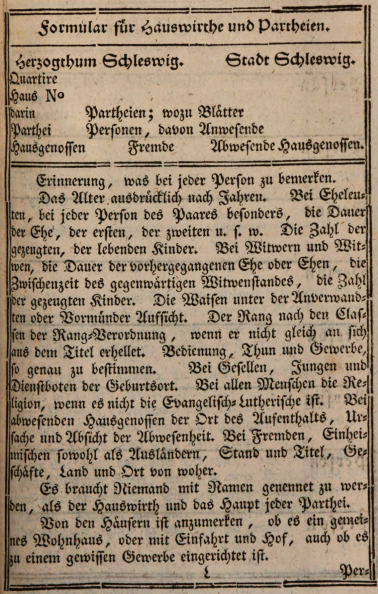
Duchy of Schleswig. Town of Schleswig.
Quarter:House No.:
Therein parties; thereto Sheet:
Party: Persons, whereof Present:
Household Members — Strangers — Absent Household Members.
Memorandum as to what shall be noted concerning each person:The age is to be expressly stated in years.In the case of married couples, for each party separately:— The duration of the marriage — whether first, second, &c.— The number of children begotten, and those presently living.For widowers and widows:— The duration of the former marriage(s),— The time elapsed in present widowhood,— The number of children begotten.Orphans under the care of relatives or guardians.Rank, according to the classes in the rank ordinance, where the same doth not clearly appear from the title.Service, occupation, and means of livelihood — to be specified with precision.For journeymen, apprentices, and servants: the place of birth.For all persons: religion, if it be not Evangelical-Lutheran.For absent household members: place of abode, reason and purpose of absence.For strangers, whether natives or foreigners: estate and title, occupation, land and place whence they come.
It sufficeth to state the name of the householder and the principal person of each party.
Concerning the houses:Let it be stated whether it be an ordinary dwelling house,or whether it hath entranceway and yard,and whether it be fitted for any particular trade or industry.
Appendix Lit. B
Form Sheet for the Collecteurs
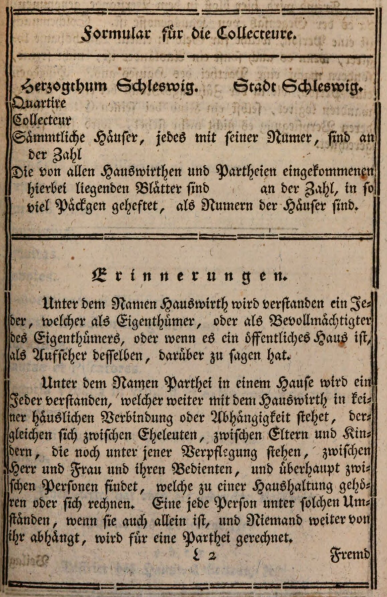
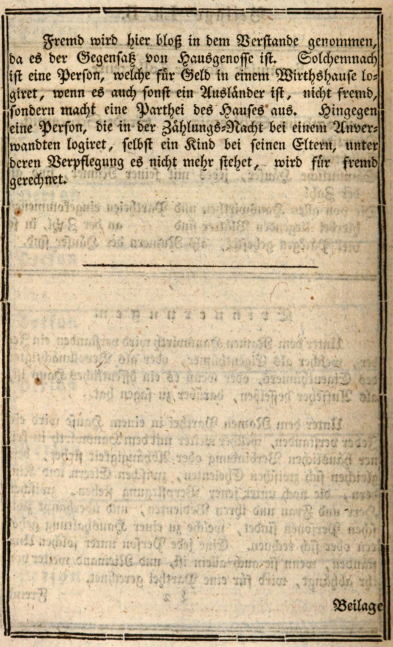
Duchy of Schleswig. Town of Schleswig.
Quarter:Collecteur:
All houses, each with its number, are in total _ in number.
The sheets received from all houseowners and parties, herewith enclosed, are _ in number, bound into as many bundles as there are numbers of houses.
Memoranda
By the name householder is understood every person who, either as proprietor, or as agent of the proprietor, or, if it be a public house, as overseer thereof, hath authority therein.
By the name party in a house is understood every person who stands in no domestic connection or dependence upon the householder — such connection as subsisteth between spouses, between parents and children who are yet under their care, between master and servant, and in general between persons belonging to a single household or accounting themselves such. Every person under such conditions, even though living alone and having none dependent upon them, shall be reckoned as a party.
Stranger is here taken solely in the sense opposed to housemate. Thus, a person lodging for money in an inn, even though otherwise a foreigner, is not considered a stranger, but constitutes a party of the house. On the other hand, a person lodging on the night of enumeration with a relative — even a child with his parents, provided he is no longer under their care — is to be reckoned a stranger.
Appendix Lit. C
Concerning the Forms for the Slips used by the Registrar
The various questions, the answers to which are sought in the forms of the householders and parties, may conveniently be reduced under the following rubrics, which I, for the sake of brevity, and that the headings of the slips may appear more distinctly, shall express by Latin terms:
Numerus Domiciliorum et Hominum (Number of Dwellings and Persons)
Nexus domestici (Domestic Relations)
Duratio Vitae (Duration of Life)
Conjugium (Marriage)
Viduitas (Widowhood)
Soboles (Offspring)
Honoratiores et Ministri publici (Dignitaries and Public Officers)
Negotia Subditorum generatim (Occupations of Subjects in General)
Ruricolae (Husbandmen)
Nautae et Piscatores (Seamen and Fishermen)
Negotia Urbana in urbibus et extra pomoeria urbium (Urban Pursuits within and without the City Bounds)
Pauperes (The Poor)
Extranei, advenae et incolae absentes (Strangers, Newcomers, and Absent Inhabitants)
Religio (Religion)
Each slip hath at its head the printed title:
District of the Collecteur No.or
District of the Chief Collecteur No.
Some are also printed with blank spaces for the inscription:
Town N. N. or
Jurisdiction N. N. or
Province N. N.
Thereafter followeth the rubric of questions, the answers to which upon the slip are copied from the enumeration form. Thereafter, the questions belonging under that rubric stand in vertical order beneath each other, and to the right a vertical line, behind which the numbers are to be written.