Thorough Illumination,
Of the so-called Defended Territorial and Jurisdictional Rights
of the Imperial City of Dinckelsbül, brought forth in the Year 1755,
And Refutation of the therein, in many Places contained,
to the Most Serene House of Brandenburg and
the Burgraviate of Nuremberg in Franconia,
by covert Truth offensive Propositions, untruthful Reports and Narrations;
with an appended Proof of the Most Serene Territorial and High-Justice,
as also Vogt-Rights, reaching unto the very Barriers of the City-Gates,
No less of the Escort-Right, in, at, and through the City, and its pretended Boundary,
together with a Geographical Delineation thereof, and Appendices from A unto XXX.
Printed in the Most Serene Court-Printing-House, 1771.
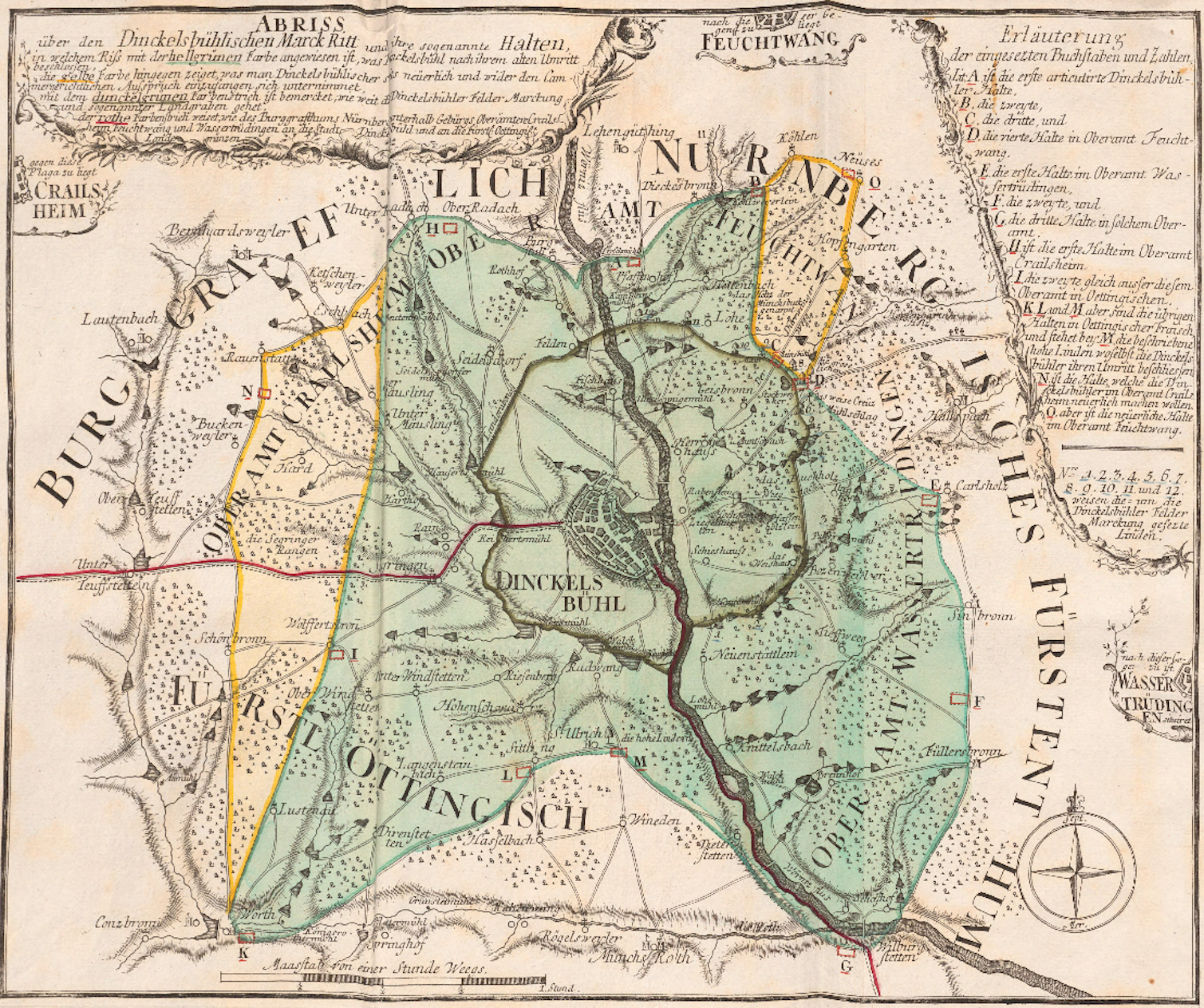
1.
2.
3.
Zoom
1.
Map.Outline of the Dinkelsbühl Market Ride and Its So-Called “Haltes”
In this map, the green color indicates what Dinkelsbühl decided according to its old patrol routes (Umritt).
The yellow color, by contrast, shows what has recently been undertaken on the Dinkelsbühl side to capture or assert territory against the ruling of the Chamber Court (Cammergericht).
The dark green line marks how far the Dinkelsbühl fields’ boundaries and the so-called Landgraben extend.
The red line shows how the Burgraviate of Nuremberg, below the mountain districts (Gebürgs Oberämtere) Crailsheim, Feuchtwang, and Wassertrüdingen, borders the city of Dinkelsbühl and the princely lands of Oettingen.
2.
Explanation of Letters and Numbers.Lit. A: The first articulated Dinkelsbühl Halte.
B: The second.
C: The third.
D: The fourth Halte in the Oberamt Feuchtwang.
E: The first Halte in Oberamt Wassertrüdingen.
F: The second.
G: The third Halte in that Oberamt.r
H: The first Halte in Oberamt Crailsheim.
I: The second, but outside this Oberamt, in Oettingen territory.
K, L, and M: The remaining Haltes in the Oettingen jurisdiction; M marks the high linden tree where Dinkelsbühl concludes its patrol route.
N: The Halte which Dinkelsbühl recently intends to make in Oberamt Crailsheim.
O: The recent Halte in Oberamt Feuchtwang.
Numbers 1–12 mark the linden trees set around the Dinkelsbühl fields’ boundaries.
3.
Scale: One hour’s walking distance.Chapter. I.
Deliberation upon the general Propositions set forth in the Printed Work, together with an Examination of the Privileges of Dinckelsbül.
§. 1.
According to the Title, the Most Serene House of Brandenburg-Onolzbach hath in the Dinckelsbül Polemical Writing no Part nor Share, but it should be intended solely against the Principality of Oettingen-Spielberg; which everywhere with Zeal is asserted, inasmuch as the Disputes of this Oettingen Neighbourhood, driven indeed unto Vehemence, might have stirred Contentions with the City.
Cause of the Dinckelsbül Polemical Writing: The Oettingen Disputes.
Yet, one need not read very far, ere Brandenburg-Onolzbach appeareth as a principal Object of the Dinckelsbül Legal-Friend; albeit, neither then in the Years 1753 and 54, nor at any other Time, was there Cause for so loud a Complaint, but only, in Defence of the Most Serene Rights, hath from Time to Time — yea already for well two Hundred Years — the constrained Occasion arisen, to fall into divers Justifications.
Brandenburg-Onolzbach is nevertheless therein likewise a principal Subject.
§. 2.
Yea, the very Situation of the City sheweth it of itself, as in the former as also in this latter Impression, with an annexed Map of the Land, is set forth: that Brandenburg-Onolzbach, in far more Places, indeed almost everywhere, even unto the City Walls, with three Superior Offices, namely Wassertrüdingen, Creilsheim, and Feuchtwang, doth border.
The City bordereth more upon the Most Serene Brandenburg Burgravial Offices, than upon Oettingen.
Consequently, one would soon draw upon oneself the bitter Complaint, already poured forth with the very first Syllables of the first Page, were it not rather that the, now indeed forgotten, Oppression then suffered from the Oettingen side, must have guided the Author’s Pen, whose just or unjust Grief here without Veil disclosed itself.
Even as therefore it is ever best to speak well of that which is already accomplished; so here, after the Lapse of seventeen Years, there shall be pronounced nothing less than a Judgment upon those former Events, which hath rather been rendered by the Imperial Court of the Realm, and long since hath Peace been restored.
Even as therefore it is ever best to speak well of that which is already accomplished; so here, after the Lapse of seventeen Years, there shall be pronounced nothing less than a Judgment upon those former Events, which hath rather been rendered by the Imperial Court of the Realm, and long since hath Peace been restored.
§. 3.
Impossible, however, is it that the Sentences, planted one after another in short Periods, from Page 5 onwards, should remain indifferent in the long run, not to say to one of Brandenburg-Onolzbach disposition, but not even to an impartial Juridical Reader.
The Offers of the Impressum at page 5 are noted for Refutation.
In particular hath the Most Serene Government at Onolzbach cause to take this Matter to heart, since with such bold Premises the Way is to be paved, to dispute away from Their Most Gracious Princes and Lords all the most important Rights; and men, with much confidence, proclaim against Brandenburg the so-called invincibly conquered Territorial Sovereignty as so notorious, that Oettingen must, as it were, take it as a Mirror and rather yield: per illud enim hujus latus petitur.
Yea, not only this, but because the City, proud upon such a so-called Defence, now even begins to cite this Work, in the unhappily still enduring Process-Matters at the highest Imperial Courts, as an auctor classicus, and thereby procureth for itself the Convenience of sparing the Proof, where instead it is said: “See the Defended Territorial Rights, in Fabri’s State-Chancery T. 108,” where it is inserted — therefore is it needful, to make known unto the same honoured Public, for its agreeable Consideration, that which with so good Reason may be said thereagainst; that none, least of all the supreme Judge himself, should think: hæc dici potuisse & non potuisse reselli. And to such Purpose the principal Passages, against which this Illumination hath taken Objection, are reprinted at the End, immediately before the present Appendices, for easier Perusal.
Yea, not only this, but because the City, proud upon such a so-called Defence, now even begins to cite this Work, in the unhappily still enduring Process-Matters at the highest Imperial Courts, as an auctor classicus, and thereby procureth for itself the Convenience of sparing the Proof, where instead it is said: “See the Defended Territorial Rights, in Fabri’s State-Chancery T. 108,” where it is inserted — therefore is it needful, to make known unto the same honoured Public, for its agreeable Consideration, that which with so good Reason may be said thereagainst; that none, least of all the supreme Judge himself, should think: hæc dici potuisse & non potuisse reselli. And to such Purpose the principal Passages, against which this Illumination hath taken Objection, are reprinted at the End, immediately before the present Appendices, for easier Perusal.
§. 4.
This Refutation is so much the more needful, inasmuch as from the Dinckelsbül side, with great Self-flattery, there is striven to spread abroad the boldest Propositions and untrue Narrations, to impress them upon the Readers, and thereby to ascribe unto themselves the Dignity or Weight of an irrefutable, incontestable Book. Nothing less, than that the Work, so confidently penned in Zeal, should be amended or retracted in the offensive Places or on its weak Side; nay, it appeareth anew with its full Title, as an Appendix and Support of a Dinckelsbül Exception-Writing una cum reconuentione &c. in the Cause of the Prince-Bishopric of Ellwangen and the Principality of Oettingen-Spielberg against the City, pto. Mandati, &c., which in June 1767 at Wetzlar was exhibited and printed in Folio; wherein without any Scruple one beholdeth the very Words and Thoughts of the Writing of Ao. 1755 copied out and amplified, with which the City thinketh to dispatch all its many Neighbours, but especially the Most Serene Brandenburg Offices, although these, in the first-named Exception-Writing, are not expressly named. Yea, since this hath already been reviewed in the Göttingen Learned Advertisements of Ao. 1767, St. 135., one seeth at once the false Impression which the Reviewer, and that nondum audita altera parte, most naturally conceived of the so-called Fraisch-District, as though thereby the painful Jurisdiction were competent to the City, whereas in truth it hath but, three Days in the Year, a few Hours, by virtue of a Sentence in possessorio momentaneo, obtained such Right. See below, Cap. VI.
Dinckelsbül Exception-Writing contra Oettingen.
Review in the Göttingen Learned Advertisements.
Review in the Göttingen Learned Advertisements.
§. 5.
Only, that the City of Dinkelsbül is a free City of the Holy Roman Empire, and moreover a State of the Empire and of the Swabian Circle, this in truth at the present Day no one desireth to doubt! Thereunder is to be understood the City Council and the Citizenry, as the Persons forming a Body, and as for the Place itself, all that which at present is encompassed with Walls, Gates, and Barriers; since every Thing hath its determinate Boundary.
The City of Dinkelsbül is a free Imperial City of the Swabian Circle.
But what then is the whole Complexus to signify, as the Words of the Impressum run?
All the Possessions which the entire Commune, and each Citizen in particular, hath in landed Pieces, lying without, in other Lordships, yea even in other Imperial Circles? This might yet for the present be spoken merely at Will! At least, it is at the Beginning still ambiguous, or rather, since the Equivoque in the following Lines is straightway removed, it, together with the Reason whereby this should be recognised, must be declared false.
All the Possessions which the entire Commune, and each Citizen in particular, hath in landed Pieces, lying without, in other Lordships, yea even in other Imperial Circles? This might yet for the present be spoken merely at Will! At least, it is at the Beginning still ambiguous, or rather, since the Equivoque in the following Lines is straightway removed, it, together with the Reason whereby this should be recognised, must be declared false.
For the pertaining Landscape, namely, is in the first place no Tractus vel tantillum continuus, but only single, albeit numerous, peasant- and smallholder-Estates, here and there purchased together; secondly, the Peace of Westphalia saith nothing more than that a City, like a princely or comital Estate, is capable of that which nowadays one is wont to call a Territory and Territorial Sovereignty; and thirdly, the Conclusion drawn from Collections and Taxes is doubly ill applied, inasmuch as the Matriculation regardeth only the Income, whether it proceed from Commerce, or from Subjects and their Houses, without engaging in the Examination of Imperial Estates into all the Particulas integrantes of a State, nor distinguishing, which Penny ariseth from the Citizen, and which from the dependent Peasant.
The City’s Properties without the Walls, in foreign Territory, are but single Farms, Fields, Meadows, Woods, and Lakes.
The Peace of Westphalia ascribeth to an Imperial City solely the Capacity for a Territory.
The Peace of Westphalia ascribeth to an Imperial City solely the Capacity for a Territory.
The annual Revenues, even from an Estate lying in another Territory, which yet may be sufficiently rich, are accordingly the Motive for the Matriculation, and it sufficeth where only the Estate which levies them, for itself, or taken in the whole as the Commune, representeth an Imperial Estate, for which the entire Citizenry is willingly accepted pro indiviso.
The Commune of the Citizenry maketh up the Imperial Estate, but not its Members upon the Country.
§. 6.
These hitherto advanced Dinckelsbül Criteria will now contribute little or nothing to the intended End, and the Peace of Westphalia speaks also merely of posse. Concerning the Conclusion a posse ad esse, more will be set forth below in Chapter III. Hence here the No of a Brandenburg Writer is to be held as much as the Dinckelsbül Yes.
But for the Purpose of adding somewhat to the End of page 5, one taketh the Liberty, in the Name of a summoned Publicist, truly to declare that he who hath Seat and Vote in the Imperial Diet, possesseth Territorial Supremacy only in potentia.
But for the Purpose of adding somewhat to the End of page 5, one taketh the Liberty, in the Name of a summoned Publicist, truly to declare that he who hath Seat and Vote in the Imperial Diet, possesseth Territorial Supremacy only in potentia.
Deliberation upon the Juris publici here involved.
Behold the Five Imperial Estates in the City of Regensburg, and count just as many Territories. Where are they? And conversely, the free immediate Imperial Nobility often possess the most of Territorial Dignity, even by virtue of the Peace of Westphalia, yet neither Seat nor Vote in the Imperial Diet.
Thereafter much hath indeed been derived from the territorial Lordship, Homage, Taxation, and the like, yet not all, so that he who receiveth such Revenues and is Possessor of such Regalia might forthwith be deemed an immediate Member of the Empire.
Particularly, Homage is manifold and diverse, as Hert. in differtat, de super. territ. § XIV. clearly teacheth, as also homagia limitata, ubi jura imperii fiunt divisa, and homagia, which are commonly wont to be called realia; and Taxation is equally far from an infallible Mark, since it is well known that many Private Persons, as so-called Proprietors, unimpededly exact the same from their vogtial, tithe- and tribute-paying Dependents.
Yet the Signum must never be severed from the Signato, or as the Ancients said: non probat hoc esse, quod ab hoc contingit abesse.
The aforementioned are such, and other Effects of the Territory, such as raising new Troops, building new Houses, altering a Fundus, granting Village-Rights, and the like, come yet closer in constituting a Whole, which, though in Thesis entirely correct, is far from being realized in the so-called Dinckelsbül Landscape, and is res facti, as Practici speak, which the theoretical Publicists here summoned cannot nor will assert.
In the following page, indeed, the same Language is confidently continued, yet no further Reason is added; and even if it should be greatly lacking in the Nota caracteristica territorii, it may nevertheless be believed, indeed assuredly held, that the Municipal Dependents under a foreign Lordship, be it Oettingen or Brandenburg, may in certain respects be subject.
The third and fourth Chapters will bring forth the Proofs; meanwhile, the Term Landsaß is by no means the most proper, so long as it is a Question of Peasants in the Country, as here.
Thereafter much hath indeed been derived from the territorial Lordship, Homage, Taxation, and the like, yet not all, so that he who receiveth such Revenues and is Possessor of such Regalia might forthwith be deemed an immediate Member of the Empire.
Particularly, Homage is manifold and diverse, as Hert. in differtat, de super. territ. § XIV. clearly teacheth, as also homagia limitata, ubi jura imperii fiunt divisa, and homagia, which are commonly wont to be called realia; and Taxation is equally far from an infallible Mark, since it is well known that many Private Persons, as so-called Proprietors, unimpededly exact the same from their vogtial, tithe- and tribute-paying Dependents.
Yet the Signum must never be severed from the Signato, or as the Ancients said: non probat hoc esse, quod ab hoc contingit abesse.
The aforementioned are such, and other Effects of the Territory, such as raising new Troops, building new Houses, altering a Fundus, granting Village-Rights, and the like, come yet closer in constituting a Whole, which, though in Thesis entirely correct, is far from being realized in the so-called Dinckelsbül Landscape, and is res facti, as Practici speak, which the theoretical Publicists here summoned cannot nor will assert.
In the following page, indeed, the same Language is confidently continued, yet no further Reason is added; and even if it should be greatly lacking in the Nota caracteristica territorii, it may nevertheless be believed, indeed assuredly held, that the Municipal Dependents under a foreign Lordship, be it Oettingen or Brandenburg, may in certain respects be subject.
The third and fourth Chapters will bring forth the Proofs; meanwhile, the Term Landsaß is by no means the most proper, so long as it is a Question of Peasants in the Country, as here.
§. 7.
Yet another Period runs, the “greatest Contradiction &c.” But what lies behind it? As much as the foregoing, and in such a Manner it is not Custom to compel the Acclaim of the Public. Now, however, it shall become clearer, since Dinckelsbül formerly was a Pars patrimonii Imperatoris, and indeed in its entire Complex.
Further Analysis of the Dinckelsbül Impressum.
The latter Addition contains most of it. Indeed, the City hath belonged to the Emperor, and is at length loosed from Alliances, becoming free of the Empire. Yet what, again, doth Complexus signify, and indeed suus?
The Phrase Complexus considered.
§. 8.
Evidently the City, like all others, and even later than the Rhenish and those where Bishops resided, had a small Beginning, as also the Name from Dinkelhof, and its Complexus may have been very narrow.
The Beginning of the City of Dinkelsbül younger than the Rhenish.
Hath it then once for all had a Mensur, and must absolutely an Imperial City, beyond its Houses, also possess lying Grounds with the same Dignity as those, or Subjects like the enfranchised? See the soon-to-be-cited Moser Passage from the Treatise on the German Imperial Estates, p. 32.
What then did suus signify at the Time when it was yet poor and small? It was nevertheless dominium imperii, and as soon as it became wealthy at that Time, it emancipated itself, and gradually attained its present State. Consequently, those scattered Money-Estates may have formerly belonged to other Lords, and the whole Complexus consisted doubtless of very few industrious Citizens.
What then did suus signify at the Time when it was yet poor and small? It was nevertheless dominium imperii, and as soon as it became wealthy at that Time, it emancipated itself, and gradually attained its present State. Consequently, those scattered Money-Estates may have formerly belonged to other Lords, and the whole Complexus consisted doubtless of very few industrious Citizens.
At that Time it was yet not to be thought of any Complexum.
That which one would present in a Question and Exclamation as Absurdum, now dissolveth, since on the other side it is said that no Complexus yet existed, and in all this there is no Contradiction in saying that the Imperial, yet not Reichs-free Citizens, had possessed some Estates in foreign Lands: they may yet have them.
But because page 7 would immediately remove a common, and hitherto by the City never advanced, Objection regarding the scattered Selden- and Tithe-Estates, under the Pretense that the City possessed entire Villages, it may only be briefly remarked that thereby it displays its very Weakness.
But because page 7 would immediately remove a common, and hitherto by the City never advanced, Objection regarding the scattered Selden- and Tithe-Estates, under the Pretense that the City possessed entire Villages, it may only be briefly remarked that thereby it displays its very Weakness.
For in so far as it is Truth, certain of its Citizens, as Private Persons, in Six respectively Parishes and Villages, namely with the Fortress Limburg, Wildburgstetten, Griesselbach, Bernhardswind, Illenschwang, Villersbronn, and Synbronn, possessed the several Houses and Estates specified in the Purchase- and Transfer-Charter, also certain individual Jurisdictions, far less than those Villages taken as a whole, occupied by foreign Lords, e.g., Dompriestly-Augsburgian, Würtemberg-Wailtingian, and even unsold Brandenburg-Onolzbachian persons, once first purchased by His Lordship the Elector of Brandenburg, Friederich, p.m. ao. 1431, and thereafter a small Portion, reckoned by the Purchase-Shilling, about the twelfth Part, again sold to their Lords and Superiors, that is, the common City, to the Imperial Estate.
Narration of the Purchase of the Estates in Wildburgstetten, etc.
Now, where then was the Domanium Imperii before this Purchase placed? The Imperial Freedom was by that Time already somewhat old, and yet the City could subsist. Had it not to thank the Most Serene Elector and Burgrave in such wise even for its Imperial Estate, because this Territory, as it conceives and fancies, should be a Signum caracteristicum? And how stood it with the City before the Year 1431? More need not be said here, since this Purchase is treated separately in Chapter V.
§. 9.
For in so far as it is Truth, certain of its Citizens, as Private Persons, in Six respectively Parishes and Villages, namely with the Fortress Limburg, Wildburgstetten, Griesselbach, Bernhardswind, Illenschwang, Villersbronn, and Synbronn, possessed the several Houses and Estates specified in the Purchase- and Transfer-Charter, also certain individual Jurisdictions, far less than those Villages taken as a whole, occupied by foreign Lords, e.g., Dompriestly-Augsburgian, Würtemberg-Wailtingian, and even unsold Brandenburg-Onolzbachian persons, once first purchased by His Lordship the Elector of Brandenburg, Friederich, p.m. ao. 1431, and thereafter a small Portion, reckoned by the Purchase-Shilling, about the twelfth Part, again sold to their Lords and Superiors, that is, the common City, to the Imperial Estate.
Now, where then was the Domanium Imperii before this Purchase placed? The Imperial Freedom was by that Time already somewhat old, and yet the City could subsist. Had it not to thank the Most Serene Elector and Burgrave in such wise even for its Imperial Estate, because this Territory, as it conceives and fancies, should be a Signum caracteristicum? And how stood it with the City before the Year 1431? More need not be said here, since this Purchase is treated separately in Chapter V.
Now, where then was the Domanium Imperii before this Purchase placed? The Imperial Freedom was by that Time already somewhat old, and yet the City could subsist. Had it not to thank the Most Serene Elector and Burgrave in such wise even for its Imperial Estate, because this Territory, as it conceives and fancies, should be a Signum caracteristicum? And how stood it with the City before the Year 1431? More need not be said here, since this Purchase is treated separately in Chapter V.
§. 10.
Suffice it that an honourable Public now knows since when the City would have acquired a Territory, which it lay in the Will of the Lord Seller to grant, whose Will yet never was to dispose of such in toto complexu, as the foregone Chapter V. hath shown.
Suffice also from this Example, whose Limitation is to be seen below, that the Imperial City once was without such Accession, and that necessarily the aforesaid Villages, of which it acquired most Houses, not in corpore, but only certain Citizens, and otherwise nowhere upon one Spot so many, belonged to another Lord. Wherefore then doth the entire Argument of page 6 lead?
Suffice also from this Example, whose Limitation is to be seen below, that the Imperial City once was without such Accession, and that necessarily the aforesaid Villages, of which it acquired most Houses, not in corpore, but only certain Citizens, and otherwise nowhere upon one Spot so many, belonged to another Lord. Wherefore then doth the entire Argument of page 6 lead?
§. 11.
Now yet something remains concerning Territorio clauso. Considered in Thesis, to deny it outright is contrary to Experience. The Imperial City Rotenburg on the Tauber, not distant from Dinckelsbül, hath one of considerable Extent, such that the high-princely Ansbachian Subjects residing therein are nevertheless subjected to the Imperial City’s Sovereignty and the Blood-Bann, yet notwithstanding, the Most Serene Lord Margrave remaineth an Imperial Estate.
Concerning Territorio clauso.
Thus there exists in the Franconian Circle a Territorium clausum, and in the Swabian, Dinckelsbül would enforce one with its so-called Landgraben, just as it indeed exists at Schwäbisch-Hall.
Moreover, the Controversy concerning Territorio clauso et non clauso is not unknown. But what would it effect here? Brandenburg-Burg-Anspach could at first sight in this Chapter make use of it against Dinckelsbül, because such a City is surrounded by High-Princely Offices. Oettingen far less. Meanwhile, one doth not base one’s argument thereupon, because better grounds exist, and because at last it alone comes down to praesumptionem, quae cedit veritati, so that even with such presumption alone, in the Bavarian-Austrian and Saxon Lands, it extendeth not.
The Brandenburg-Burg Comital Princes do not place their ground precisely upon the presumptive doctrine of territorio clauso.
But what gains the City, when the High-Princely House yet doth not leave an argument, not blameworthy, unused? Thereby its dreamed-of own Territory beyond the Walls doth not yet increase, but it must seek it by other Means.
It gains thereby nothing, if that argument is merely applied against others.
This it indeed finds, with the Judgment of Year 1572 recited in Chapter V, concerning the many Estates above mentioned, in the six Villages, somewhat within the narrowest comprehension; but beyond this, to seek a Territory upon each Selden-Estate becomes petty, yea soon ridiculous, and is entirely denied with the best Reason. See below Chapter IV.
§. 12.
After all this, the Author of the Dinckelsbül Impressi appears at last as a Coryphæum among Publicists, and denies to all those who do not revere him the Knowledge of the German System. Page 8 must a man, insignis imperitiae, hold himself guilty who believes that over a foreign Property another could be Territorial Lord, and merely to please, the trivial Cent, sub titulo servitutis juris publici in alieno, is conceded to a Lordship. We shall yet consider somewhat this Thesis, thus boldly advanced.
At that Time, namely before the Doctrine of the now-understood Territorial Sovereignty, with all Extension, was brought into formam artis, one may, with the Author’s Permission, say, about the Times before the Peace of Westphalia, and in earlier Ages, hardly any knew of a Distinction between the high and fraisch Authorities, and he who held the lesser, i.e., the Blood-Bann, might also unhesitatingly concern himself with all other Dignities, distinguished from the lower Vogtey Justice, so long as the Estates had to do with one another.
At that Time, namely before the Doctrine of the now-understood Territorial Sovereignty, with all Extension, was brought into formam artis, one may, with the Author’s Permission, say, about the Times before the Peace of Westphalia, and in earlier Ages, hardly any knew of a Distinction between the high and fraisch Authorities, and he who held the lesser, i.e., the Blood-Bann, might also unhesitatingly concern himself with all other Dignities, distinguished from the lower Vogtey Justice, so long as the Estates had to do with one another.
Only the Emperor, as Pars tertia, had reserved certain Sublimiora to himself, which were gradually incorporated into the Definition of Modern Territorial Law, confer. Henniges de super. terr. per totum.
He who exercised merum imperium over his own and foreign subjects, had thereby also the high Authority, and both expressions were promiscuously held as synonymous, unless one understands merely the Cent limited to the four high Cases, which is properly only a species generis.
He who exercised merum imperium over his own and foreign subjects, had thereby also the high Authority, and both expressions were promiscuously held as synonymous, unless one understands merely the Cent limited to the four high Cases, which is properly only a species generis.
High Authority and Fraisch Authority inseparable, from ancient Times.
Hertius at least notes this in dissert. de super. territ. §. 11, without fear of being called Ignorant, with the Distinction of newer and older Times, &c.: “In ancient Charts there is no doubt that the Word jurisdictionis, & meri imperii mixtique, Hals- and Upper-Courts or Blood-Bann, or High Authority, denoted superioritatem territorialem. Also Henniges 1, c. §. 34.”
Indeed, this Synonym was so common that even in the 16th Century, in the illustrious Controversy concerning the great famous xar'kog called Fraisch-Cause regarding the Lords Margraves and Burgraves with Nuremberg, this Imperial City yet perceived how, when the High-Princely House had received the Fraisch, it thereby at the same time exercised the High Authority, whence in later Times, after the well-known Years 1583 and 1587, when the City of Nuremberg had succumbed, the other Side also seeks, with such Distinction between High and Fraisch Authority, and between Cent and the same Fraisch, to provide itself against the Records.
Example from the famous Fraisch-Cause: Nuremberg versus the Burgraves.
§. 13.
Yet long ago in actis and in Imprefſis publicis it hath been sufficiently deduced, and quite recently Ao. 1766, Fol., it is shown under this Title:
“Gründliche Anzeige wie fälschlich zum gesuchten Nachtheil der Gerechtsamen der Hochfürstl. Häuser Brandenburg in Franken und vermeintlichen Gunsten der Reichsstadt Nürnberg in den Ao. 1764. herausgekommenen Land-Charten, die Gränzen bemerkt sind, &c.”
published Deduction, together with Brennophili, a historical and legal illumination of the Knopfian Land-Charts Ao. 1764. 8vo., among many others, that from Ao. 1525–83 in that Matter with Nuremberg, the High Justice was never separated from the Fraisch Justice.
Also the Cameral Sentences bear witness, no less than the Nuremberg Libelli, so that suprema superioritas by virtue of such Judgments is still exercised to this Day upon Nuremberg Estates by Brandenburg’s side.
Indeed, without any regard to the Dinckelsbül work newly made known through its Distribution, §. 21. of the Gründliche Anzeige appears as if a Parody of the same, which sets insignem rerum germanicarum imperitiam upon the Synonym, Fraisch and Territorial Sovereignty, in these Formalities, which a well-disposed Reader may consider whether they pass and sound with better Decorum than there in Dinckelsbül.
“Wherefore one must have not the least Knowledge of Rights, if one with the Nuremberg Author of the diplomatic History would pretend that the great Fraisch Cause did not touch the Territory, but only the Cent in a few certain Places.”
Upon this point, not less the Author of the Deduction:
“das unumstößliche Recht Sr. Königl. Mayestät in Preussen an denen durch Absterben der Herren Schencken von Limpurg erledigten Grav- und Herrschaften, &c.” Berlin Ao. 1719”
in §. 52., hesitated not to write.
“Accordingly, in the Limpurgian Letters of Fief from ages past, the Blood-Bann, as also the Hals-Court, was granted; the same had already, before it was undisputedly recognized as an Imperial Fief, and thence, as cited above §. 27. 28., shown what a high regale it was, wherefore many tried and learned Jurists previously held that in old Enfeoffments it ought to be equated with superioritati territoriali, and those did indicate the same.”
“Post Meichsner & Gylman, Wehner pract. obs. verb. Landsfürstl. Hoheit, pag. 326; Ming. de super. territ.; Hert. de super. terr., ubi scribit (already cited above), in ancient charts there is no doubt that the word jurisdictionis & meri imperii, Hals- and Upper-Courts or Blood-Bann, or High Authority, denoted superioritatem. Yet it is not necessary to resort to private Doctors; one need only hear Emperor Charles V. in a Penal Mandate to Elector John Frederick of Saxony, Bishop Julius Pflug at Naumburg not to hinder, sub dato 15 Oct. 1545, apud Hortleder de caus. belli, germ., T. I. L. 5. c. 21.”
“2c. 2c. And nothing can more clearly than this duly considered public Imperial Declaration incontrovertibly show, that superioritas territorialis in former times, and even about one and a half centuries past, lay under the Regalia and especially the Blood-Bann, and even involved and imparted the Character of an Imperial Prince, let alone a Count.”
“Gründliche Anzeige wie fälschlich zum gesuchten Nachtheil der Gerechtsamen der Hochfürstl. Häuser Brandenburg in Franken und vermeintlichen Gunsten der Reichsstadt Nürnberg in den Ao. 1764. herausgekommenen Land-Charten, die Gränzen bemerkt sind, &c.”
published Deduction, together with Brennophili, a historical and legal illumination of the Knopfian Land-Charts Ao. 1764. 8vo., among many others, that from Ao. 1525–83 in that Matter with Nuremberg, the High Justice was never separated from the Fraisch Justice.
Also the Cameral Sentences bear witness, no less than the Nuremberg Libelli, so that suprema superioritas by virtue of such Judgments is still exercised to this Day upon Nuremberg Estates by Brandenburg’s side.
Indeed, without any regard to the Dinckelsbül work newly made known through its Distribution, §. 21. of the Gründliche Anzeige appears as if a Parody of the same, which sets insignem rerum germanicarum imperitiam upon the Synonym, Fraisch and Territorial Sovereignty, in these Formalities, which a well-disposed Reader may consider whether they pass and sound with better Decorum than there in Dinckelsbül.
“Wherefore one must have not the least Knowledge of Rights, if one with the Nuremberg Author of the diplomatic History would pretend that the great Fraisch Cause did not touch the Territory, but only the Cent in a few certain Places.”
Upon this point, not less the Author of the Deduction:
“das unumstößliche Recht Sr. Königl. Mayestät in Preussen an denen durch Absterben der Herren Schencken von Limpurg erledigten Grav- und Herrschaften, &c.” Berlin Ao. 1719”
in §. 52., hesitated not to write.
“Accordingly, in the Limpurgian Letters of Fief from ages past, the Blood-Bann, as also the Hals-Court, was granted; the same had already, before it was undisputedly recognized as an Imperial Fief, and thence, as cited above §. 27. 28., shown what a high regale it was, wherefore many tried and learned Jurists previously held that in old Enfeoffments it ought to be equated with superioritati territoriali, and those did indicate the same.”
“Post Meichsner & Gylman, Wehner pract. obs. verb. Landsfürstl. Hoheit, pag. 326; Ming. de super. territ.; Hert. de super. terr., ubi scribit (already cited above), in ancient charts there is no doubt that the word jurisdictionis & meri imperii, Hals- and Upper-Courts or Blood-Bann, or High Authority, denoted superioritatem. Yet it is not necessary to resort to private Doctors; one need only hear Emperor Charles V. in a Penal Mandate to Elector John Frederick of Saxony, Bishop Julius Pflug at Naumburg not to hinder, sub dato 15 Oct. 1545, apud Hortleder de caus. belli, germ., T. I. L. 5. c. 21.”
“2c. 2c. And nothing can more clearly than this duly considered public Imperial Declaration incontrovertibly show, that superioritas territorialis in former times, and even about one and a half centuries past, lay under the Regalia and especially the Blood-Bann, and even involved and imparted the Character of an Imperial Prince, let alone a Count.”
Further Discussion of High and concurrently Fraisch Authority.
See also Moser, Tractat von den teutschen R. Ständen, 4to Ao. 1767, p. 32.
“With regard to the several Imperial Cities, the only and true ground of their Imperial Estate is the Immediacy, which no City, if it wishes to be an Imperial City, may lack, over which nothing further is required, since it matters not whether an Imperial City possesses a large or small, or outside its walls no territory at all, and whether it holds all or not all Parts of the Territorial Sovereignty.”
“With regard to the several Imperial Cities, the only and true ground of their Imperial Estate is the Immediacy, which no City, if it wishes to be an Imperial City, may lack, over which nothing further is required, since it matters not whether an Imperial City possesses a large or small, or outside its walls no territory at all, and whether it holds all or not all Parts of the Territorial Sovereignty.”
Moserian Doctrine on Territory beyond the Walls.
More Testimony, a learned Public will certainly not grant to the Brandenburg Author of this Treatise; rather, it may well marvel at the confident Boldness, whereby in the Dinckelsbül Defence, one would a priori convince or deter from the Error, to believe that the Fraisch Authority could be connected with Territorial Superiority, whereas it was in former Times indisputably not so.
§. 14.
Yet, how shall the city council’s own Confession Ao. 1539 be evaded, as extensively deduced below in Cap. III & IV, when the same excuses itself, that by the removal of the deceased to Hellenbach, although he were on Our Ground and Soil, to a Potentate or Lordship under his Fraisch and High Authority, something might be taken? Fraisch and high stand linked with the copula; both are ascribed to the High Princely House of Brandenburg without annotation, whilst it is known that the killing occurred on Dinckelsbül Ground and Soil, i.e., Property.
The phrase: Ground and Soil, according to the understanding of the Ancients at Dinckelsbül, signifies nothing more than Property.
Indeed, still stranger is to be seen below in the VIth Chapter, how the Author himself has forgotten, that from the arripitated, customarily in the three yearly fairs, Fraisch-Calculation, he argues with the utmost dexterity for the territorium!
§. 15.
This prelude may now soon instruct, whose conduct one must be prepared for, in consequence of a Spirit so self-satisfied, yet self-contradictory.
The execution itself, however, will often enough indicate to the Reader the sub & obreption, whereby many principal Circumstances are diligently concealed, and others entirely misrepresented.
Next follows a discussion of the alleged Privileges, and immediately thereafter the Condition of the Burgraviate of Nuremberg, also Landgericht, insofar as it extended to Dinckelsbül, in Cap. II.
The execution itself, however, will often enough indicate to the Reader the sub & obreption, whereby many principal Circumstances are diligently concealed, and others entirely misrepresented.
Next follows a discussion of the alleged Privileges, and immediately thereafter the Condition of the Burgraviate of Nuremberg, also Landgericht, insofar as it extended to Dinckelsbül, in Cap. II.
Closer Determination and Division of this Treatise.
Following this, in the IIIrd Chapter, comes the Destruction of the City Mark and of the thereby formed territorii clausi civitatensis, for whose better understanding a Map is here provided, executed with all diligence, and in conformity with the boundaries specified in the Privilegium Fridericianum, so that it may be said that these boundaries correspond fairly well with those devised by the Württemberg Subdelegation Commissioners Ao. 1590–99, and that since then no notable alteration is observable, though they are by no means of greater importance or permanence.
Geographical Map of the City and its Surroundings.
In the IVth [Chapter], the Condition of the Hintersassen-Properties situated in the High Princely Brandenburgian Offices is treated.
In the Vth, the Account of the Fortress of Limpurg and the thereto belonging Localities, as well as their Sales, is given.
In the VIth, the Brandenburg Escort, in, at, and through the City, together with the Dinckelsbül Penal-Riding on its three Year-Fairs, is discussed.
In the Vth, the Account of the Fortress of Limpurg and the thereto belonging Localities, as well as their Sales, is given.
In the VIth, the Brandenburg Escort, in, at, and through the City, together with the Dinckelsbül Penal-Riding on its three Year-Fairs, is discussed.
In these six Treatises, all previously advanced and still continuing Disputes are faithfully and sufficiently indicated, though not all specifically, since they all tend to the same point (whence especially the Cameral Sentences, concerning the small Waid-Work, that is, bird-catching, in the slightest extent, Maysen, Fincken, and the prior Process-Scripts, do not merit particular citation, because it is indeed not about a few decoy-birds, but concerning the Territory, in respect of which the nets were laid), the matters exhausted, and the impartial Judgment left free to the esteemed Public, until the higher Imperial Courts, the still undecided Rights, with Time and thoroughly, shall finally decide them.
Entire Treatise in six Principal Parts.
Hereby the Reader is forewarned, that the principal Pieces are yet in Litigation, and that nothing is decided according to the Dinkelsbül manner, which is untrue and thus boldly asserted, but rests rather on notoriety, that a High-Princely Brandenburgian House has had the Fraisch, not only the Cent, but also the Escort, the high Game-Ban (for the small Waid-work of Birds in the bushes and many lakes, and the City’s Flurmark, if it were present, signifies nothing), and thus the entire Territorial Lordship at all times, even though somewhat with Acts and unjustly executed mere Mandate-Sentences, without a single general Definitiva, for a hundred years more or less, might have been disturbed, in fact.
Finally, it is here necessary to make the general remark with Herr Cammer-Court Assessor von Cramer, that Mandata S. C., even the executed Paritoriæ, indeed the Partition itself, in no way affect the principal Cause or the Right itself, but solely touch and determine the indicted Factum, which under certain circumstances might not have been deemed admissible.
Thus the inclined Reader may judge the Verdict upon the Dinkelsbül ostentation of alleged rebus judicatis, which consist in nothing else but certain Paritoriæ, whereby certain Pledges, whether just or unjust, were settled, and especially such appear during the Austregal and even now ongoing Appeals concerning the City-Mark, so that these Paritoriæ could in no wise have influence over the Dissidium yet in diverse Rights remaining.
Now the cited Passage in System. proc. Imp. II. II. §. 586. justly commands all Attention, and the Reader perceives without fail the Worth of the Author.
Finally, it is here necessary to make the general remark with Herr Cammer-Court Assessor von Cramer, that Mandata S. C., even the executed Paritoriæ, indeed the Partition itself, in no way affect the principal Cause or the Right itself, but solely touch and determine the indicted Factum, which under certain circumstances might not have been deemed admissible.
Thus the inclined Reader may judge the Verdict upon the Dinkelsbül ostentation of alleged rebus judicatis, which consist in nothing else but certain Paritoriæ, whereby certain Pledges, whether just or unjust, were settled, and especially such appear during the Austregal and even now ongoing Appeals concerning the City-Mark, so that these Paritoriæ could in no wise have influence over the Dissidium yet in diverse Rights remaining.
Now the cited Passage in System. proc. Imp. II. II. §. 586. justly commands all Attention, and the Reader perceives without fail the Worth of the Author.
§. 16.
But what is now to be held regarding the Privileges, with which the City has been amply provided by the older Emperors? Every Imperial Estate, which acknowledges the Emperor as the Head of the Empire, desires such, possesses them indeed, and seeks to assert them.
Yet how does it comport, when at that Time, namely in the 14th and 15th Century, when already too much had been bestowed, when the Principalities and Lordships were already hereditary, and the liberality of the Emperors, especially toward the Cities who petitioned, was already so circumscribed, that they could not, without great Caution and Inquiry, say Yes to the unmeasured Requests of the Supplicants?
And how is it reconciled, as History and Experience teach, when Rights were to be granted to the Cities, which in their lawful Possession, also by Privileges or other Means, were already held by the Princes, whence unavoidable Collissiones legum must arise, and the Case must all too often have existed, that the Emperors, as in Leg. I. Cod. de petit. bon. subl., had to say: se plerumque inverecunda petentium inhiatione constringi, ut etiam non concedenda tribuant.
Yet how does it comport, when at that Time, namely in the 14th and 15th Century, when already too much had been bestowed, when the Principalities and Lordships were already hereditary, and the liberality of the Emperors, especially toward the Cities who petitioned, was already so circumscribed, that they could not, without great Caution and Inquiry, say Yes to the unmeasured Requests of the Supplicants?
And how is it reconciled, as History and Experience teach, when Rights were to be granted to the Cities, which in their lawful Possession, also by Privileges or other Means, were already held by the Princes, whence unavoidable Collissiones legum must arise, and the Case must all too often have existed, that the Emperors, as in Leg. I. Cod. de petit. bon. subl., had to say: se plerumque inverecunda petentium inhiatione constringi, ut etiam non concedenda tribuant.
Imperial Privileges of the City.
The nature of the Privileges, in and of themselves, is well known, and need not first be presented to an insightful Public with deliberate Consideration.
But how does it stand, when here in the Region of the Wernitz and Altmühl, the Lords Burgrave and Margrave were not only, by their own right, but by virtue of the Burgraviate, previously exercised Landes-Hoheit, or shortly before in the possession of other Imperial Estates, also respectively imperial-free Offices such as Feuchtwang, Crailsheim, and Wassertrüdingen, recognized as the general Lords?
But how does it stand, when here in the Region of the Wernitz and Altmühl, the Lords Burgrave and Margrave were not only, by their own right, but by virtue of the Burgraviate, previously exercised Landes-Hoheit, or shortly before in the possession of other Imperial Estates, also respectively imperial-free Offices such as Feuchtwang, Crailsheim, and Wassertrüdingen, recognized as the general Lords?
The Burgraves had long since been Landes-Herren along the Altmühl and Wörnitz.
Could it then have been possible that the City of Dinkelsbül might have been granted something, without taking it from the Lords Burgrave and Margrave?
It must at one time have occurred, when its city-mark, namely only in the Year 1476, after the offices already acquired in the preceding century, was obtained, and described to it by the Emperor from place to place.
It must at one time have occurred, when its city-mark, namely only in the Year 1476, after the offices already acquired in the preceding century, was obtained, and described to it by the Emperor from place to place.
Privilege of Emperor Frederick, Ao. 1476, concerning the City-Mark.
§. 17.
The salvo jure tertii was entirely overlooked; the Lords Margraves, as neighbors, were not consulted about the boundaries, and it is manifest periculo petentium that the otherwise venerable imperial letter was drawn up rather at random. For this reason, the city did not dare to make use of it until 60 or 80 years later, and rightly had to experience what, in the years 1585–99, was incontrovertibly objected to them in the process concerning Laux Meyern, as will be shown more fully and expressly in Cap. III.
Thus, the salvo jure tertii was in every case left out of account.
Likewise, it stands with a Wenceslasian letter of grace from Ao. 1398, which are known not to be the best warranted, in which the Dinkelsbühl subjects, even those of the hospital, were to be withdrawn from the burgravial and land-court jurisdiction, whereas it is notorious, and demonstrated in Cap. II (where the land court is treated), that before the year 1503 even the citizens of the city were subject to the same.
The Wenceslas privilege.
No less, however, will Cap. IV, from stately civic letters and admissions, demonstrate that several, and namely the hospital’s subjects, have willingly acknowledged themselves as belonging to the offices of Feuchtwang and Wassertrüdingen, not only in matters of advocacy but even more so in matters of territorial lordship.
§. 18.
The first and oldest, whereof any Notice is extant, is in truth one of Ao. 1373., Emperor Charles IV., de dato Büdischge upon Reminiscere-Sunday, where, albeit in no other, the Mark is made mention of: “of that End, whatsoever lieth therein, and hath with the same been taxed, with it shall be raised and laid.” – manifestly, that it denoteth the Field-Marking, the Acres and Meadows, wherein the Burgers pursued their Husbandry, even as Feuchtwang and many other Towns had; to which former small Imperial Townlet nevertheless, it is to be hoped, the Territorial Supremacy shall never on that account have appertained beyond its Walls, inasmuch as until Ao. 1476., a whole Century thereafter, such Field-Marking is of no Remembrance in other Privileges, until it befell the City, in the said Year, falsas preces, cum limite agri, to present, and thereby to surprize His Imperial Majesty.
Privilegium Caroli IV.
Hath the Field-Marking for its Subject.
Hath the Field-Marking for its Subject.
Besides this there is indeed N. XIV. of the Appendices of the Impressum one, but of so small Significance, or of so rare a Tenour, that one knoweth not what properly may be meant thereby: at least there standeth therein nothing prejudicial, and it may remain in that Worth which it may have. And when the aforesaid Appendix XIII relateth, how Count Palatine Rupert, as Imperial Vicar, in the Absence of Emperor Charles and in His Majesty’s Presence at Rome, Ao. 1354., did give a Confirmatory Charter of the Carolinian Privileges, so hath this also, with its general Phrases and own Condition, but little Weight.
After this followeth one de dato Pressburg 1435., of Emperor Sigismund, Appendix LXX. of the Impressum. Concerning the Marking mentioned in Ao. 1375. there standeth not a Syllable, but it is said to be an Exemption from all Provincial Courts, which however the much elder and more illustrious, and also in Practice exercised, Burgrave-Privileges directly oppose, and are of far greater Import.
After this followeth one de dato Pressburg 1435., of Emperor Sigismund, Appendix LXX. of the Impressum. Concerning the Marking mentioned in Ao. 1375. there standeth not a Syllable, but it is said to be an Exemption from all Provincial Courts, which however the much elder and more illustrious, and also in Practice exercised, Burgrave-Privileges directly oppose, and are of far greater Import.
The pretended Confirmatoria contain not a Syllable concerning the Marking.
Of Ao. 1494. there is likewise one, of Emperor Maximilian, produced before the Ducal Würtemberg Austregal-Commission in the Years 1585–99., to which the City hath given the Title: Copia Confirmationis King Maximilian I. touching the Freedom of the Dinkelsbühl City-Mark.
Yet not a Letter of Marking, but merely in general Fashion is it a Confirmation of former Charters of Grace, in such wise that the City may derive little Comfort therefrom. And of the same Stamp, albeit the Title would fain be forced upon the City-Mark, are the subsequent Confirmationes generales of Charles V. de dato Worms 22 Febr. 1521. Ferdinand I. de dato Augsburg 2 June 1559. Maximilian II. de dato Augsburg 9 Febr. 1566. Rudolph de dato Vienna 11 Sept. 1577., without inserting a single Word of Marking, so that one must indeed and of necessity doubt, whether to Their Imperial and Royal Majesties from the Frederician Charter of 1476. any Passage hath been presented.
That the Truth hereof may be brought to Light, and the perhaps purposely withheld Privileges, which were not altogether favourable to the City, may be laid open, they are here appended, as they are to be found in the Records produced on the other Side, and occurring in the present Acta austregalia, touching Laux Meyern, namely the Appendix A. cum nota, & B. Bentege.
Yet not a Letter of Marking, but merely in general Fashion is it a Confirmation of former Charters of Grace, in such wise that the City may derive little Comfort therefrom. And of the same Stamp, albeit the Title would fain be forced upon the City-Mark, are the subsequent Confirmationes generales of Charles V. de dato Worms 22 Febr. 1521. Ferdinand I. de dato Augsburg 2 June 1559. Maximilian II. de dato Augsburg 9 Febr. 1566. Rudolph de dato Vienna 11 Sept. 1577., without inserting a single Word of Marking, so that one must indeed and of necessity doubt, whether to Their Imperial and Royal Majesties from the Frederician Charter of 1476. any Passage hath been presented.
That the Truth hereof may be brought to Light, and the perhaps purposely withheld Privileges, which were not altogether favourable to the City, may be laid open, they are here appended, as they are to be found in the Records produced on the other Side, and occurring in the present Acta austregalia, touching Laux Meyern, namely the Appendix A. cum nota, & B. Bentege.
Appendix A. & B.
How is it possible, that such principal Grounds of the Dinkelsbühl Glory, to wit the Territorial Right, supposed to be connected with the City-Mark, should be suffered to fall into Oblivion, and remain only with such vague Phrases, as otherwise give nothing, take nothing?
§. 19.
On the contrary it is here to be noted, when the other Burggravial Favours are on another Occasion recounted in Cap. II., that one Privilege of Charles V., de dato Worms the 14th of April 1521., shall be adduced in Extract, but in Appendix C. in Extenso set forth, which was likewise on this Side coram Commissione Wurtenbergica dicta, in the Cause touching Laux Meyer, produced, and by the Dinkelsbühl Syndic acknowledged.
Privilege of Charles V. Granted to the Margraves d. d. 14 April 1521.
Appendix C.
Appendix C.
Remarkable it is, not only for the sake of its Contents, but also for the Time and Place. For since it was on the 14th of April, likewise at Worms, on one and the selfsame Imperial Diet, as that above recounted Dinkelsbühl Charter of the 22nd of February eod. 1521. had most graciously been conferred, so doth the Allusion to that, and to several others of like Kind, clearly enough shew, how to His Majesty, by the Dinkelsbühl sub & obreptiones, whereby the City six Weeks before had fraudulently procured its Own, the Matter must needs have been represented.
An Allusion to the former of the 22nd of February, which Dinkelsbühl had fraudulently obtained.
Thus it reads:
2c. Although formerly several of our Ancestors in the Empire, Roman
“Emperor and King — our Forefathers (namely Margrave Casimir and George) with this special Grace foresaw and bestowed, whether their Ancestors in the Empire, or they themselves, through ignorance of any person, who he or she might be, had granted, or would again grant, some Freedom and Grace, Land-Court, or other Matters in part, without Acknowledgment of the Right and according to Justice, which might, against the same Freedom, Justice, Sovereignty, Land-Court, Antiquity, Custom or Usage of the March in Brandenburg, in the Burgraviate of Nuremberg and in other their Lordships, Territories and Appurtenances, exist, and thereby bring Disadvantage, that such Graces and Freedoms, collectively and especially in all their Points and Kinds, should be powerless and void, which they also thereby, according to Rightful Knowledge and Imperial Authority’s Completeness, entirely revoke, derogate and abrogate, the Content of the Imperial and Royal Letter by Us produced through credible Appearance.”
2c. yet several thereunder 2c.
“that we thereby all and every Freedom and Grace, whether it concern Land-Court or other Matters, nothing excepted, so far as against the aforesaid — Freedom, Justice, Sovereignty, Land-Court, without acknowledgment of the Right and in Justice, without demand, were given, or in the Future through ignorance also without acknowledgment of the Right and without demand, should derogate, revoke, etc.”
Wherefore then is it, that without acknowledgment of the Right, and in Justice without demand, is repeated thrice with so great Emphasis, even as one, without doubt, thus remonstrated and assuredly reminded the Prudent Emperor of these Defects and Rights in the overly free Granting of Privileges, which had first occurred six Weeks before, in the Letter of 22nd February?
2c. Although formerly several of our Ancestors in the Empire, Roman
“Emperor and King — our Forefathers (namely Margrave Casimir and George) with this special Grace foresaw and bestowed, whether their Ancestors in the Empire, or they themselves, through ignorance of any person, who he or she might be, had granted, or would again grant, some Freedom and Grace, Land-Court, or other Matters in part, without Acknowledgment of the Right and according to Justice, which might, against the same Freedom, Justice, Sovereignty, Land-Court, Antiquity, Custom or Usage of the March in Brandenburg, in the Burgraviate of Nuremberg and in other their Lordships, Territories and Appurtenances, exist, and thereby bring Disadvantage, that such Graces and Freedoms, collectively and especially in all their Points and Kinds, should be powerless and void, which they also thereby, according to Rightful Knowledge and Imperial Authority’s Completeness, entirely revoke, derogate and abrogate, the Content of the Imperial and Royal Letter by Us produced through credible Appearance.”
2c. yet several thereunder 2c.
“that we thereby all and every Freedom and Grace, whether it concern Land-Court or other Matters, nothing excepted, so far as against the aforesaid — Freedom, Justice, Sovereignty, Land-Court, without acknowledgment of the Right and in Justice, without demand, were given, or in the Future through ignorance also without acknowledgment of the Right and without demand, should derogate, revoke, etc.”
Wherefore then is it, that without acknowledgment of the Right, and in Justice without demand, is repeated thrice with so great Emphasis, even as one, without doubt, thus remonstrated and assuredly reminded the Prudent Emperor of these Defects and Rights in the overly free Granting of Privileges, which had first occurred six Weeks before, in the Letter of 22nd February?
The Salvo Jure tertii is therein most strongly remarked.
Yes, what Weight, indeed, does not the Exceptional and Defensional Article, there in the Third Chapter set forth so highly by the Brandenburgian, obtain, which the Princely Judicial Authority, ut lippis & tonsoribus notum, has presented in all its Strength, namely that one may reason à minori ad majus, even among the most common Peasants, in the setting of Borders and Stones, to require and ask one’s Neighbours, a Rule also stately and succinctly executed in the cited Dinkelsbül Exception-Book of the Year 1767, so that one may be satisfied therewith, yet at the same time must remember: turpe est doctori, si culpa redarguit ipsum.
§. 20.
That the then City Syndic did not remain silent upon this instance, thereto helped his shameless audacity, for he argued expressly contra articulum, that this Requirement and citation of the Neighbours was not necessary.
Pandects, Codex, Novellas, Natural Law, Imperial Decrees set aside; let a Reader only observe the wise Pronouncement of the most puissant Charles: without acknowledgment of Rights and thereupon unrequested, and keep this together with the Dinkelsbül Article, and in general, until the proper place touched in the Third Chapter, to endure. There shall the Light dawn upon him.
In these few Points, then, is the most considerable, of the highly praised Imperial Privileges, presented to the view of a Public.
All of them uniformly contain either that which pertains domestically to the City, its civic and sovereign Constitution, the Toll granted for ten Years from Ao. 1473–83, which the City only in Ao. 1761 unlawfully augmented, so that in Ao. 1767 a Cameral Mandate, obtained from the High Princely House of Brandenburg, had to curb the Excess, and generally innocent Matters; or, on the other hand, Rights, Liberties, Exemptions, which might prejudice the Burg- and Margrave Jurisdictions, Highnesses, and Land-Courts; those Points must stand; these, which without acknowledgment of the Right or without request from the Margraves were granted, are annulled, revoked, and cassated.
Pandects, Codex, Novellas, Natural Law, Imperial Decrees set aside; let a Reader only observe the wise Pronouncement of the most puissant Charles: without acknowledgment of Rights and thereupon unrequested, and keep this together with the Dinkelsbül Article, and in general, until the proper place touched in the Third Chapter, to endure. There shall the Light dawn upon him.
In these few Points, then, is the most considerable, of the highly praised Imperial Privileges, presented to the view of a Public.
All of them uniformly contain either that which pertains domestically to the City, its civic and sovereign Constitution, the Toll granted for ten Years from Ao. 1473–83, which the City only in Ao. 1761 unlawfully augmented, so that in Ao. 1767 a Cameral Mandate, obtained from the High Princely House of Brandenburg, had to curb the Excess, and generally innocent Matters; or, on the other hand, Rights, Liberties, Exemptions, which might prejudice the Burg- and Margrave Jurisdictions, Highnesses, and Land-Courts; those Points must stand; these, which without acknowledgment of the Right or without request from the Margraves were granted, are annulled, revoked, and cassated.
Actual Content of the Privileges.
Herewith, especially as the Electoral Capitulations commenced under Emperor Charles V., the frequent granting of privileges had already abated, and it yet remains with the Latter, to whom the Rights in favour of the High Princely House do fully pertain.
Accordingly, Brandenburg stands, on this side likewise, steadfast against Dinkelsbül, and one ought by no means to wonder, that the great Merits towards Emperor and Empire, of the Electors and Princes of this ancient High House, must far outweigh the issued Letters of Grace of the City.
Accordingly, Brandenburg stands, on this side likewise, steadfast against Dinkelsbül, and one ought by no means to wonder, that the great Merits towards Emperor and Empire, of the Electors and Princes of this ancient High House, must far outweigh the issued Letters of Grace of the City.
Chapter. II.
Concerning the Burggrafthum of Nuremberg, and the Imperial Court thereby connected.
§. 21.
The Public will not suppose that a separate Treatise on the Burggrafthum should be composed here, or transcribed from other already known Treatises.
The Intention is now sufficiently disclosed, merely to oppose the assaults, scattered boldly and without any effort, in the Dinkelsbül Impressum, and therefore to treat only that which the City, for itself and in particular, with the Burggrafthum and Court, hath had or still doth possess.
A distinction, already well known to the Reader, between the Burggrafthum and the Court, is set forth in advance.
The Intention is now sufficiently disclosed, merely to oppose the assaults, scattered boldly and without any effort, in the Dinkelsbül Impressum, and therefore to treat only that which the City, for itself and in particular, with the Burggrafthum and Court, hath had or still doth possess.
A distinction, already well known to the Reader, between the Burggrafthum and the Court, is set forth in advance.
§. 22.
The writers have at all times observed this, and left other small pieces untouched, as herein instructed by the present High Princely Ansbach Secret Councillor and Consistorial President, Mr. Carl Ferdinand von Jung, in his tract, published ao. 1733, 8vo.
To distinguish between the Burggrafthum of Nuremberg and the Court.
“A brief yet thorough Instruction, what the Comicia Burggraviæ in Nuremberg is and doth involve,” already sufficient, yet deserving to be connected with the same.
“Joh. Basil. Seidel, Attempt at a concise yet thorough Treatise on the Burggrafthum of Nuremberg, or its Origin and Extent, Eisenach 20. 1751.”
Lastly, the afore-praised Mr. Secret Councillor von Jung:
“Foundation of the Majesty of the Imperial Court of the Burggrafthum of Nuremberg, 4to, ao. 1759. No less: Falckenstein, Antiquitat. Nordgav. vet. T. III. c. I. §. 1. And C. P. Sinold von Schüß, Corp. histor. Brand., diplomat., Sect. V & VI.”
Accordingly, it is considered here, in trust towards a learned Public, as a notorious matter, that the Burgraves of Nuremberg, later Margraves of Brandenburg, as great and highly esteemed Princes of the Empire, already stood in the year 1273; which splendid and excellent testimony is to be extracted from the Imperial Charters of Investiture of Emperor Rudolf, dated ao. 1273, then confirmed in the year 1280, and by Charles IV. in the year 1363, as found in all libraries of diplomatic collections, and especially in the cited Jung and Seidel Treatises in extenso.
“Joh. Basil. Seidel, Attempt at a concise yet thorough Treatise on the Burggrafthum of Nuremberg, or its Origin and Extent, Eisenach 20. 1751.”
Lastly, the afore-praised Mr. Secret Councillor von Jung:
“Foundation of the Majesty of the Imperial Court of the Burggrafthum of Nuremberg, 4to, ao. 1759. No less: Falckenstein, Antiquitat. Nordgav. vet. T. III. c. I. §. 1. And C. P. Sinold von Schüß, Corp. histor. Brand., diplomat., Sect. V & VI.”
Accordingly, it is considered here, in trust towards a learned Public, as a notorious matter, that the Burgraves of Nuremberg, later Margraves of Brandenburg, as great and highly esteemed Princes of the Empire, already stood in the year 1273; which splendid and excellent testimony is to be extracted from the Imperial Charters of Investiture of Emperor Rudolf, dated ao. 1273, then confirmed in the year 1280, and by Charles IV. in the year 1363, as found in all libraries of diplomatic collections, and especially in the cited Jung and Seidel Treatises in extenso.
The Burgraves already ancient Imperial Princes ao. 1273.
§. 23.
The Burgraviate or Comitia hath not only subsisted within the government of a single City, as Nuremberg, but the Princely Burgraves have possessed a wide District about them, under the authority of His Imperial Majesty, which, as in later Times generally, became to them as large, hereditary Offices, remaining in like Measure.
Determination of the Burgraviate.
The aforementioned Seidel hath historically demonstrated how, upon the extinction of most lesser Burgraviates, the exalted Burgraviate of Nuremberg did not only preserve its Glory and Worth, but by rightful Accession of peculiar Estates and Lordships, was further stately enlarged and augmented.
Distinction of such great exalted Burgraviates from the lesser.
He writes §. 14.
Among the still extant Burgraviates of the Roman Empire, the Burgraviate of Nuremberg is incontestably the most illustrious and important, and as it lieth almost in the midst of Germany, it may likewise in both the middle and later Times be esteemed the noblest and mightiest with the best Reason; yea, although some of its Rights together with the Burgrave’s Castle have passed away, its remaining Advantages and Glories are yet so remarkable, that they have oftentimes excited Envy and Covetousness, both from the City of Nuremberg itself, and from its Neighbours, which hath been the common Course of Fate.
It is invested with the Dignity and Authority of one of the oldest Cameræ Nuncii, and followeth with ingenious Conclusions:
“From all this it is the more easily apprehended how the succeeding Burgraves of Nuremberg, with Time, have been able to found so mighty a Principality upon the Dignities and Rights annexed to the Castle.”
And although the High-Princely Burgravial and Brandenburg House, in the Course of Time, for great and eminent Services to the Emperor and Empire, first acquired the most Lands which now compose their States, by Purchase and consolidated Fiefs fallen to them, this doth in no wise prejudice the ever-present Defenders of the High-Princely Burgravial Rights, nor those, especially the Nuremberg Adversaries, who have made a Business of contemptuous Vilification of such Acquisitions; rather ought one to endeavour to exhibit to the World the publicly secured Increase of the Principality thus obtained.
Namely, and with regard solely to the Superior Offices which enclose the City of Dinkelsbül, in the Year 1761 there was published, proven from Archives, a Historical-Topographical Account of the Principality of Brandenburg-Onolzbach 2c., wherein the Origin and Acquisition of these Superior Offices, namely Crailsheim, Wassertrüdingen, and Feuchtwang, is openly described.
It is recounted of Crailsheim, that the City and the Appendant Offices in the Year 1399 were sold to the Lords Burgrave Johann III. and Friedrich VI. by Landgrave Johann of Leuchtenberg, who shortly before had purchased the same extensive Territory from the Counts of Hohenlohe, so that it indeed comprised a considerable Part of the ancient Countly Hohenlohe Domain, wherein the Counts governed as fully as any old German Imperial Prince in his own Land. See the Hanselmann Manuscripts.
Thus Wassertrüdingen, in the Year 1371, came by Purchase from Count Gottlieb and Count Gerlach of Hohenloh to Burgrave Friedrich V.
Feuchtwang, having formerly been an Imperial City, was in the Year 1376 pledged to the aforesaid Burgrave Friedrich V. by Emperor Charles IV.; this Pledge was confirmed by Emperor Rupert in the Year 1406, and thereafter left in force unchanged.
Among the still extant Burgraviates of the Roman Empire, the Burgraviate of Nuremberg is incontestably the most illustrious and important, and as it lieth almost in the midst of Germany, it may likewise in both the middle and later Times be esteemed the noblest and mightiest with the best Reason; yea, although some of its Rights together with the Burgrave’s Castle have passed away, its remaining Advantages and Glories are yet so remarkable, that they have oftentimes excited Envy and Covetousness, both from the City of Nuremberg itself, and from its Neighbours, which hath been the common Course of Fate.
It is invested with the Dignity and Authority of one of the oldest Cameræ Nuncii, and followeth with ingenious Conclusions:
“From all this it is the more easily apprehended how the succeeding Burgraves of Nuremberg, with Time, have been able to found so mighty a Principality upon the Dignities and Rights annexed to the Castle.”
And although the High-Princely Burgravial and Brandenburg House, in the Course of Time, for great and eminent Services to the Emperor and Empire, first acquired the most Lands which now compose their States, by Purchase and consolidated Fiefs fallen to them, this doth in no wise prejudice the ever-present Defenders of the High-Princely Burgravial Rights, nor those, especially the Nuremberg Adversaries, who have made a Business of contemptuous Vilification of such Acquisitions; rather ought one to endeavour to exhibit to the World the publicly secured Increase of the Principality thus obtained.
Namely, and with regard solely to the Superior Offices which enclose the City of Dinkelsbül, in the Year 1761 there was published, proven from Archives, a Historical-Topographical Account of the Principality of Brandenburg-Onolzbach 2c., wherein the Origin and Acquisition of these Superior Offices, namely Crailsheim, Wassertrüdingen, and Feuchtwang, is openly described.
It is recounted of Crailsheim, that the City and the Appendant Offices in the Year 1399 were sold to the Lords Burgrave Johann III. and Friedrich VI. by Landgrave Johann of Leuchtenberg, who shortly before had purchased the same extensive Territory from the Counts of Hohenlohe, so that it indeed comprised a considerable Part of the ancient Countly Hohenlohe Domain, wherein the Counts governed as fully as any old German Imperial Prince in his own Land. See the Hanselmann Manuscripts.
Thus Wassertrüdingen, in the Year 1371, came by Purchase from Count Gottlieb and Count Gerlach of Hohenloh to Burgrave Friedrich V.
Feuchtwang, having formerly been an Imperial City, was in the Year 1376 pledged to the aforesaid Burgrave Friedrich V. by Emperor Charles IV.; this Pledge was confirmed by Emperor Rupert in the Year 1406, and thereafter left in force unchanged.
§. 24.
What, then, hinders these, though in themselves perhaps new, yet in regard to the Imperial City of Dinkelsbül, and especially to its City-March first conferred by Privilege of the Year 1476, or the supposed Territory, sufficient older Acquisitions, when it is evident from the Connection of the then circumstances, deriving from the grey Antiquity, that a former Burgrave, without yet being Possessor or Proprietor of those Cities, had already, by Imperial Authority, exercised the Superior Dominion over these Lands.
This more recent Acquisition doth not hinder the older Burgravial Rights.
The more concerned, impartial, and thereby very cautious and modest Author of this Treatise writes therefore with good Insight further thus: pag. 136 sq.
“The Comitia of the Burgraviate of Nuremberg, from the very beginning and at the establishment of the Burgraviate, comprised several Comitatus within itself, and their Jurisdiction, with regard to the Landgericht, was per provinciam universalis. Now it is certain that the Burgravial Territory never extended so far as the Judicium provinciale, if we remain only with the Province, and one must not therefore conclude: This or that Office lies in the Landgericht, therefore it lies in and of itself in the Burgravial Territory; yet one ought equally not to believe that the lands gradually acquired by the Burgraves were merely appended to the Burgraviate and passed under that name. There is a comprehensible manner in which they vindicate these lands to the Burgraviate.”
“East Franconia, and particularly the Nordgau, were from the beginning divided into several Comitatus, each having its own Comites and Judices; but after these, in the middle Ages, when the counties were not yet fully hereditary, but in great part still administrative, gradually ceased, the Burgraves seized by vi officii sui supereminentis, that is, as Judices totius provinciæ, their Administration all the more, since not only did the Emperors, amid the many internal disturbances of the Realm, attend little to Justice, but also the Dukes and Princes in the other Provinces, upon such Occasions, likewise acted in like manner.”
“That they, however, acquired their many lands, castles, market-towns, villages, and almost their greatest estates, some good time thereafter, concerns not the matter; for it is well known that in these lands formerly there existed very frequent allodial and proper lordships and estates; and when we especially find that they acquired such from the Counts of Thruendingen, Dornberg, Schlüsselberg, Castell, Oettingen, &c., either by purchase, inheritance, or by other means, we must by no means believe that these places and estates also belonged to the said Lord’s Comitatus, for these were scarcely any longer Comites comitatus alicujus, much less of these regions; but descendants of ancient Counts, and many of their possessions of castles and lands lay here and there in the Pagis and Comitatus already previously subject to the Burgraves.”
Pag. 139.
“The Comitia comprises principally three Parts, namely: first, the Burgravial Territorial and other high Jurisdictions over the district properly belonging to the Castle; secondly, over the further, partly already possessed, partly only later acquired extensive lands; and thirdly, the Landgericht Jurisdiction &c.”
“The Comitia of the Burgraviate of Nuremberg, from the very beginning and at the establishment of the Burgraviate, comprised several Comitatus within itself, and their Jurisdiction, with regard to the Landgericht, was per provinciam universalis. Now it is certain that the Burgravial Territory never extended so far as the Judicium provinciale, if we remain only with the Province, and one must not therefore conclude: This or that Office lies in the Landgericht, therefore it lies in and of itself in the Burgravial Territory; yet one ought equally not to believe that the lands gradually acquired by the Burgraves were merely appended to the Burgraviate and passed under that name. There is a comprehensible manner in which they vindicate these lands to the Burgraviate.”
“East Franconia, and particularly the Nordgau, were from the beginning divided into several Comitatus, each having its own Comites and Judices; but after these, in the middle Ages, when the counties were not yet fully hereditary, but in great part still administrative, gradually ceased, the Burgraves seized by vi officii sui supereminentis, that is, as Judices totius provinciæ, their Administration all the more, since not only did the Emperors, amid the many internal disturbances of the Realm, attend little to Justice, but also the Dukes and Princes in the other Provinces, upon such Occasions, likewise acted in like manner.”
“That they, however, acquired their many lands, castles, market-towns, villages, and almost their greatest estates, some good time thereafter, concerns not the matter; for it is well known that in these lands formerly there existed very frequent allodial and proper lordships and estates; and when we especially find that they acquired such from the Counts of Thruendingen, Dornberg, Schlüsselberg, Castell, Oettingen, &c., either by purchase, inheritance, or by other means, we must by no means believe that these places and estates also belonged to the said Lord’s Comitatus, for these were scarcely any longer Comites comitatus alicujus, much less of these regions; but descendants of ancient Counts, and many of their possessions of castles and lands lay here and there in the Pagis and Comitatus already previously subject to the Burgraves.”
Pag. 139.
“The Comitia comprises principally three Parts, namely: first, the Burgravial Territorial and other high Jurisdictions over the district properly belonging to the Castle; secondly, over the further, partly already possessed, partly only later acquired extensive lands; and thirdly, the Landgericht Jurisdiction &c.”
§. 25.
Whoever has read the manifold disputations between the Brandenburg Burgrave Houses and the City of Nuremberg will now be able to judge rightly that argument, which Seidel here once more refutes, and which was so often brought forth from the successive increase of principalities and lands; inasmuch as Dinkelsbühl not only adopted it everywhere in its Impresso of the year 1755, but even earlier had pressed it to excess in the Austregal process-acts reviewed below in Cap. III; whereas the City was already in the years 1585–99 manfully ex notorietate confronted with the fact, that it was utterly false, as it pretended, that between Nuremberg and Dinkelsbühl there were many lordships over which the Burgraves and Margraves had nought to command; inasmuch as, so far as nothing was by later treaties with this or that Estate of the Empire, as for instance Eichstätt, specially modified, there is even to this day no other territorial lordship known than the Most Serene Brandenburgic; moreover, the general map of the land shows how, without much interruption, the Most Serene Offices of Schwabach, Windsbach, Onolzbach, Gunzenhausen, Wassertrüdingen, and Feuchtswang extend in one continuous line up to the city gates of Dinkelsbühl.
That Argumentum ab invidia ductum was already in the years 1585–1599 most forcefully refuted against D.
Most rightly then hath the much-commended Seidel, p. 124 of the Essay, described the bounds of the Burgravial, not the merely judicial, prerogatives:
”Thus one may also reckon how far in former times the dominion of the Burgraves and the glories of the Burgraviate extended; namely, they must have reached from Eger through the Upper Palatinate, over Amberg, thence unto Nördlingen, Dinkelsbühl, thence over to Rothenburg, Würzburg up to Schweinfurt, and so onwards.”
”Thus one may also reckon how far in former times the dominion of the Burgraves and the glories of the Burgraviate extended; namely, they must have reached from Eger through the Upper Palatinate, over Amberg, thence unto Nördlingen, Dinkelsbühl, thence over to Rothenburg, Würzburg up to Schweinfurt, and so onwards.”
§. 26.
In consideration hereof it is ever ridiculous, and moreover offensive unto the Most Serene Brandenburgic Houses, when a neighbouring city, such as Dinkelsbühl, presumeth, as in Appendix X of the Third Chapter such insolence may be seen, to reproach the so honourably acquired Acquæstus; whereas the Lords Burgraves, not in the quality of heirs in possession of allodia or of reverted fiefs, but as Burgraves, Nuncios and Vicars of the Emperor, long before purchase or escheat, had already held the Dominium eminens, which to gainsay one or another period, filled with vanities, of a scriptum civitatense, is by no means sufficient; moreover, the increase must be bound with the notable acquisitions out of the ancient Hohenlohe comitatus, for thereby the Burgraves became successors of the Counts of Hohenlohe, who stood in government pleno jure territorii; and this may namely be said of Crailsheim, in which office the city of Dinkelsbühl, or rather only its pia corpora, the hospital, the church-wardenships, and even mere private burghers, had acquired sundry smallholdings and rent-estates, upon which now so vainly a Dinkelsbühlish territory would be built.
Furthermore, the Imperial Estate of Dinkelsbühl, whose origin is not to be sought far in antiquity, forasmuch as it was yet in Ao. 1351 pledged unto Oettingen for 7200 pounds of Heller, and before it redeemed itself still more time elapsed, can here have the less weight; since, even if by this be meant so far the commune of the burghers, yet as an Imperial and Free City, or before that merely as an Imperial domain-town, it is not so much to be understood, as rather those lands in the countryside which it had by degrees acquired, in the aforesaid manner, in small several farm- and cottage-houses, upon which, and upon the inhabitants dwelling thereon, it hath even to this day, ex capite of its estate as a Free Imperial City, sought in vain to exercise high authority.
Furthermore, the Imperial Estate of Dinkelsbühl, whose origin is not to be sought far in antiquity, forasmuch as it was yet in Ao. 1351 pledged unto Oettingen for 7200 pounds of Heller, and before it redeemed itself still more time elapsed, can here have the less weight; since, even if by this be meant so far the commune of the burghers, yet as an Imperial and Free City, or before that merely as an Imperial domain-town, it is not so much to be understood, as rather those lands in the countryside which it had by degrees acquired, in the aforesaid manner, in small several farm- and cottage-houses, upon which, and upon the inhabitants dwelling thereon, it hath even to this day, ex capite of its estate as a Free Imperial City, sought in vain to exercise high authority.
The city D. was in Ao. 1351 still pledged to Oettingen.
Yea, were it not beneath the dignity of His Most Serene Highness the Margrave to employ a retorsion, His Most Serene Highness might well remind the City of Dinkelsbühl of the fortress Limburg, Wilburgstetten, and the farmsteads and lands in four other places annexed thereto, which the Most Illustrious Ancestor, Elector Friderich, in Ao. 1431 sold unto certain burghers of the city, upon which the city in Ao. 1572 obtained high authority, not by virtue of the instrument of purchase, but by virtue of a chamber-court judgment contrary thereto, yet only in possessorio; of which matter more shall be treated below in the Fifth Chapter.
In Anno 1572 the city first obtained something of territorial prerogative upon several houses by judgment merely in possessorio, which may yet be reversed.
From this period only hath the city’s courage begun to grow; forty-five years after the purchase it first surreptitiously procured its privilege of 1476 from Emperor Friderich, by virtue whereof it was to possess a city-mark and a defined territory; and yet again not until half a century thereafter did it secretly begin to arrogate unto itself a wretchedly contrived land-ditch, in signum territorii, as the Public in Cap. III also at greater length shall find.
§. 27.
For the present, this account of the nature of the Burgraviate, which extended as far as Dinkelsbühl, may suffice; and one dwells all the less upon the objection concerning the Swabian bailiwicks cited here and there in the printed treatise, since, firstly, the burgraves, with regard to the city, in so far as it had its civic inhabitants and its own order within the walls, sought nothing—excepting the jurisdiction of the provincial court; secondly, the city itself never submitted to those bailiwicks in such a manner as to have recognized an imperial Swabian bailiff as its territorial lord, just as all the known authors on the bailiwicks never ascribed such power to them, but confined it solely to judicial matters. Moreover, the city of Dinkelsbühl formerly had its own bailiff, before whose court—as is attested by the process concerning rights of gleaning and game-preserve, related below in Chapter VI—Margrave Joachim Ernst himself stood as plaintiff in 1613; yet even then he was not permitted thereby to pronounce judgment beyond the city, nor to infringe upon either the burgravial or the provincial court rights.
The city itself, in so far as it was walled, was at all times exempt from the Burgraviate and attached to the imperial bailiffs.
The municipal bailiff was merely the holder of jurisdiction within the city over the citizens.
The municipal bailiff was merely the holder of jurisdiction within the city over the citizens.
§. 28.
As for the Imperial provincial court of the Burgraviate of Nuremberg, it presents quite a different aspect.
The Imperial Provincial Court of the Burgraviate of Nuremberg.
It is indeed to be presumed that the public is already well aware—through manifold books, evident documents, and eminent privileges—of its character, its preeminence above other provincial courts, and the great authority with which it was endowed, and which all of Germany has held in veneration; or at least, as a reminder, one may see this in the aforementioned writings of Jung, as well as in Johann Gottfried Gonne’s treatise De ducatu Franconiæ (1716, in 4to.), § 63 prærogativæ jud. provinc. B. N., p. 151, and likewise in his Erörterung einiger das Landgericht B. N. betreffender Fragen, in the Erlangen Learned Reports, 1750, nos. 18, 19, 20.
Already in the imperial, Rudolphine investiture letter of 1273 it is said: Judicium provinciale in Nurnberg, cui etiam vice Imperatoris exercens omne judicium, & judicans præfidebit.
This is still today recognized by the highest imperial courts—the Imperial and Aulic Council, as well as the Imperial Chamber Court—as a note bene Imperial, not princely, immediately subordinated court; and it remains in its original essence, presently at Onolzbach, jointly staffed by both Brandenburg principalities in Franconia, so long as they were not, as has recently again occurred, united under a single ruler. It also exercises jurisdiction in the highest instance, before one may appeal to the imperial courts, not only in both principalities, but also over the subjects of the neighboring imperial estates—if not in all, yet in most cases and places, e.g. in the bishopric of Eichstätt, by virtue of old and new recesses, cf. Appendix D & E—though not in walled cities, yet over its subjects in the countryside. Notably, it has had the imperial cities under its jurisdiction, and still has them, insofar as they have not, by voluntary agreements, been wholly or partially exempted.
Already in the imperial, Rudolphine investiture letter of 1273 it is said: Judicium provinciale in Nurnberg, cui etiam vice Imperatoris exercens omne judicium, & judicans præfidebit.
This is still today recognized by the highest imperial courts—the Imperial and Aulic Council, as well as the Imperial Chamber Court—as a note bene Imperial, not princely, immediately subordinated court; and it remains in its original essence, presently at Onolzbach, jointly staffed by both Brandenburg principalities in Franconia, so long as they were not, as has recently again occurred, united under a single ruler. It also exercises jurisdiction in the highest instance, before one may appeal to the imperial courts, not only in both principalities, but also over the subjects of the neighboring imperial estates—if not in all, yet in most cases and places, e.g. in the bishopric of Eichstätt, by virtue of old and new recesses, cf. Appendix D & E—though not in walled cities, yet over its subjects in the countryside. Notably, it has had the imperial cities under its jurisdiction, and still has them, insofar as they have not, by voluntary agreements, been wholly or partially exempted.
It is an Imperial general, not merely a princely, provincial court.
Its jurisdiction.
Appendices D & E.
Its jurisdiction.
Appendices D & E.
Whole catalogues are contained in the many public writings, both concerning the undeniable preeminence, antiquity, and dignity in which it stood above all other provincial courts in Germany, and concerning the various exemption recesses of this or that city, in Franconia, Swabia, and also on the Rhine.
§. 29.
From the very beginning, the judge has each time been a ruling burgrave and margrave, and partly chose his assessors himself, while others were provided by the city of Nuremberg, the bishopric of Eichstätt, and the Teutonic Order’s commanderies in Franconia, so that, whenever a high, though in more recent times rarer, provincial court had to be staffed, these—especially from Nuremberg—were still summoned.
The judge of the provincial court was a burgrave in person, whose assessors came from Eichstätt, the Teutonic Order, and Nuremberg.
Hence originates the form of citation which is still customary today.
In this, the judge alone addresses the parties and sets them dates; and in general, the judicial procedure still bears the genuine, authentic mark of ancient German antiquity.
Yet the personal presidency of the ruling burgraves, due to the many other duties incumbent upon them—particularly in imperial and imperial-service, and in assumed war expeditions—became burdensome, indeed impossible, to continue; therefore, not of their own power, but for the sake of the dignity of the Imperial Court, they petitioned the supreme feudal lord, who had invested them with it, for permission to have it represented by substitutes.
In this, the judge alone addresses the parties and sets them dates; and in general, the judicial procedure still bears the genuine, authentic mark of ancient German antiquity.
Yet the personal presidency of the ruling burgraves, due to the many other duties incumbent upon them—particularly in imperial and imperial-service, and in assumed war expeditions—became burdensome, indeed impossible, to continue; therefore, not of their own power, but for the sake of the dignity of the Imperial Court, they petitioned the supreme feudal lord, who had invested them with it, for permission to have it represented by substitutes.
The burgraves were privileged to appoint knightly provincial judges in place of their own person.
This concession was granted by Emperor Charles IV in the year 1348, in a special privilege, to the brothers Johannes and Albrecht:
"To staff the provincial court with an honorable knight, who in their stead should judge and act, as they themselves, or their heirs, might judge and act."
Into this favor also assented: Duke Rudolf of Saxony, as the Empire’s High Marshal, in the same year 1348; likewise Emperor Charles himself, as Prince-Elector of the Holy Roman Empire and High Cupbearer, in 1355; and also Ludwig, called "the Roman," Margrave of Brandenburg, as High Chamberlain, in 1364.
Cf. Jung, de Comiciis, p. 29. – Thus this vicariate of the judicial office must indeed have been of great consequence, since it was regarded as a matter of the highest importance.
"To staff the provincial court with an honorable knight, who in their stead should judge and act, as they themselves, or their heirs, might judge and act."
Into this favor also assented: Duke Rudolf of Saxony, as the Empire’s High Marshal, in the same year 1348; likewise Emperor Charles himself, as Prince-Elector of the Holy Roman Empire and High Cupbearer, in 1355; and also Ludwig, called "the Roman," Margrave of Brandenburg, as High Chamberlain, in 1364.
Cf. Jung, de Comiciis, p. 29. – Thus this vicariate of the judicial office must indeed have been of great consequence, since it was regarded as a matter of the highest importance.
§. 30.
Accordingly, the jurisdiction of the court extended far and wide, especially in Southern Germany, and the provincial court was held in high esteem.
How then does it fit, that the single city of Dinkelsbühl, which in the middle of the fourteenth century was not even free from pledges, should have wished to withdraw from it—when it had already since 1273 been endowed with the finest enfeoffments and privileges—by opposing newer privileges, though it lay so near at hand?
Without entering into lengthy discussion, it shall here only be set forth for the public—who without doubt already possess closer knowledge—something from the historical report on the Imperial and Reichs-Vogtei in Swabia, as well as on the Free Imperial Court at Leutkirch Heath and in Pirß, published in folio in 1755, especially since its author, though not at all favorably inclined towards the Nuremberg Court, is yet so impartial as to speak the truth:
“§ XXIII. For also in those times the Imperial Court of the Burgraviate of Nuremberg presumed to extend its judicial coercion, like other provincial courts, even extra provinciam, and to exercise great power against the free Imperial Estates in Swabia, non attentis quibuscunque privilegiis, the cities in particular opposed it to such an extent that at last their so dearly purchased privileges and liberties had to be respected and acknowledged as valid there as well.”
The consideration appearing here, non attentis quibuscunque privilegiis, cannot now mislead the public, when, on the other hand, the much older privileges granted to the burgraves are kept in view.
How then does it fit, that the single city of Dinkelsbühl, which in the middle of the fourteenth century was not even free from pledges, should have wished to withdraw from it—when it had already since 1273 been endowed with the finest enfeoffments and privileges—by opposing newer privileges, though it lay so near at hand?
Without entering into lengthy discussion, it shall here only be set forth for the public—who without doubt already possess closer knowledge—something from the historical report on the Imperial and Reichs-Vogtei in Swabia, as well as on the Free Imperial Court at Leutkirch Heath and in Pirß, published in folio in 1755, especially since its author, though not at all favorably inclined towards the Nuremberg Court, is yet so impartial as to speak the truth:
“§ XXIII. For also in those times the Imperial Court of the Burgraviate of Nuremberg presumed to extend its judicial coercion, like other provincial courts, even extra provinciam, and to exercise great power against the free Imperial Estates in Swabia, non attentis quibuscunque privilegiis, the cities in particular opposed it to such an extent that at last their so dearly purchased privileges and liberties had to be respected and acknowledged as valid there as well.”
The consideration appearing here, non attentis quibuscunque privilegiis, cannot now mislead the public, when, on the other hand, the much older privileges granted to the burgraves are kept in view.
When privileges are weighed against privileges.
In a collisio legum, indeed the latter law prevails, but in matters of favors and enfeoffments, it is not so, that the one may simply annul the other, without fault on the part of the first and earlier privileged; and still less is this possible when, as here, the burgraves had their Imperial Courts not merely ex privilegio, but titulo irrevocabili feudi, in which nothing, save in the case of felony, could be diminished, curtailed, or alienated by the feudal lord, i.e. the Emperor. Accordingly, an Imperial privilege which contradicted this fief would be ipso facto & jure null and void. Finally, if one brings into consideration the privilege of Charles V, appended under Chap. I, lit. C, this shows itself again to be much newer than the far earlier exemptions-privileges, granted by incapable administrations within the Empire, whereby the Most Serene House is secured on all sides.
Cf. GONNE, Tractatus generalis de ducatu Franconiae, p. 152, verb. judicium B. N. – “titulo feudali acquisitum, fuit Burggraviis, qui est stabilis nec revocationi obnoxius, contra judicium provinciale Würzburgense, Episcopis ab initio titulo Privilegii obvenit, etc.”
For the same reason, the matter that the privileges granted to the cities must have been respected is of quite another nature. It is contrary to truth, and no estate, much less a city, can boast of having been, in those times, i.e. in the fifteenth century, freed from the jurisdiction of the court without its own consent.
Cf. GONNE, Tractatus generalis de ducatu Franconiae, p. 152, verb. judicium B. N. – “titulo feudali acquisitum, fuit Burggraviis, qui est stabilis nec revocationi obnoxius, contra judicium provinciale Würzburgense, Episcopis ab initio titulo Privilegii obvenit, etc.”
For the same reason, the matter that the privileges granted to the cities must have been respected is of quite another nature. It is contrary to truth, and no estate, much less a city, can boast of having been, in those times, i.e. in the fifteenth century, freed from the jurisdiction of the court without its own consent.
§. 31.
But now yet another passage of the report deserves to be read, ibid., p. 247:
“It is not to be denied that this Landgericht had already been particularly distinguished by Emperor Rudolf of Habsburg and his successors in the Empire, above other common Landgerichts, and in this regard provided with splendid privileges; and the preeminence and eminence of this office is sufficiently apparent from the fact that even emperors and kings have made use of it and sought justice through it. Thus Count Ludwig of Oettingen, with authority and in the name of Emperor Sigismund, in the year 1432, took the council and community at Kempten there into his hands and placed them under the ban.”
“Similarly, in the same year, by the authority and in place of the aforementioned king, processes were conducted there against the mayor and council of the cities of Worms, Mainz, and Speyer, as well as against the amtsmeister and citizens of the council at Strasbourg. – Likewise, in the year 1438, by Martenz von Eyb and Conrad Holzinger, on behalf of and by the power of the Roman King Albert, against Stephan Scherff von Reiß in Basel, mint master in Frankfurt, etc. And it appears from the formerly established special form of banishment and proclamation of bans in Swabia, Bavaria, Saxony, and Franconia that this court stood out before other Landgerichts, see No. 189.”
Indeed, even the Dinkelsbühl Impressum adds in Appendices LXXX and LXXXI two substantial letters of mandate to the Imperial City of Nördlingen, from the provincial Judge Wilhelm von Rechherg and Bartholomäus Truchsess von Bommersfelden from the years 1331 and 1341, to demonstrate the declaration of the ban in which the Counts of Oettingen and many knights were involved – and yet Dinkelsbühl itself had already evaded it at that time.
“It is not to be denied that this Landgericht had already been particularly distinguished by Emperor Rudolf of Habsburg and his successors in the Empire, above other common Landgerichts, and in this regard provided with splendid privileges; and the preeminence and eminence of this office is sufficiently apparent from the fact that even emperors and kings have made use of it and sought justice through it. Thus Count Ludwig of Oettingen, with authority and in the name of Emperor Sigismund, in the year 1432, took the council and community at Kempten there into his hands and placed them under the ban.”
“Similarly, in the same year, by the authority and in place of the aforementioned king, processes were conducted there against the mayor and council of the cities of Worms, Mainz, and Speyer, as well as against the amtsmeister and citizens of the council at Strasbourg. – Likewise, in the year 1438, by Martenz von Eyb and Conrad Holzinger, on behalf of and by the power of the Roman King Albert, against Stephan Scherff von Reiß in Basel, mint master in Frankfurt, etc. And it appears from the formerly established special form of banishment and proclamation of bans in Swabia, Bavaria, Saxony, and Franconia that this court stood out before other Landgerichts, see No. 189.”
Indeed, even the Dinkelsbühl Impressum adds in Appendices LXXX and LXXXI two substantial letters of mandate to the Imperial City of Nördlingen, from the provincial Judge Wilhelm von Rechherg and Bartholomäus Truchsess von Bommersfelden from the years 1331 and 1341, to demonstrate the declaration of the ban in which the Counts of Oettingen and many knights were involved – and yet Dinkelsbühl itself had already evaded it at that time.
Examples of provincial court rulings.
With which example also pp. 31 and 38 correspond in the above-cited foundational statutes of the Landgericht, when it states:
“The council of Dinkelsbühl answers for itself.” – and further, p. 33: “In Windsheim the council answers for itself.” Not less concerning Rothenburg, p. 17, that the senate there had to submit to a provincial court judgment.
“The council of Dinkelsbühl answers for itself.” – and further, p. 33: “In Windsheim the council answers for itself.” Not less concerning Rothenburg, p. 17, that the senate there had to submit to a provincial court judgment.
§. 32.
So clear, well-established, and in accordance with the spirit of the age, and indeed long in practice – though somewhat harsh and severe, even at times exercised almost in duel-like fashion in the so-called “club courts” – this justice was, yet the cities complained about it. However, they in no way dared via facti to withdraw themselves from it, but believed that, by means of newly granted privileges, they might evade it; which, however, only produced a troublesome collision. Since, however, the resistance encountered was difficult for the Landgericht to overcome, and since the princes and estates at Constance, at a convent in the year 1429, had sent a deputation to the Margrave on this matter and had made representations, the court also had to adapt itself to circumstances and yield somewhat of its acquired right.
Various Imperial estates and cities exempt themselves by treaties.
Cf. the aforementioned report, p. 248, §. XXIV.
It was, however, long – until the year 1458 – before such renunciations on the part of the burgraves, as imperial judges, were granted.
Indeed, even to enter into treaties, an imperial concession first had to precede, since the burgraves, of their own power, could not divest themselves of the splendid regality with which they had been enfeoffed, and which they exercised in stately manner as imperial vicars – still less could they do so without being held to account.
It was, however, long – until the year 1458 – before such renunciations on the part of the burgraves, as imperial judges, were granted.
Indeed, even to enter into treaties, an imperial concession first had to precede, since the burgraves, of their own power, could not divest themselves of the splendid regality with which they had been enfeoffed, and which they exercised in stately manner as imperial vicars – still less could they do so without being held to account.
An imperial privilege first allowed the burgraves to renounce.
Therefore, in the year 1456, Emperor Frederick had to grant this liberty in a special diploma:
“that should disputes, discord, or dissension arise between the burgraves and other princes, lords, cities, or others of the Empire in the lands of Swabia, Bavaria, Franconia, or the Netherlands, on account of the Landgericht of the Burggrafschaft of Nuremberg, they might in such cases amicably come to terms and make agreements, yet without prejudice or harm to the imperial majesty and the Holy Roman Empire in their overlordship, power, and rights.”
(See de Jung, de Comiciis, p. 33).
Not until after this imperial concession, then, could the Imperial Landgericht be curtailed. With some cities lying at a distance, jurisdiction was wholly abolished; with others it was arranged in special ways; thus also with the Bishopric of Eichstätt, as related above, agreements were reached under specific conditions.
“that should disputes, discord, or dissension arise between the burgraves and other princes, lords, cities, or others of the Empire in the lands of Swabia, Bavaria, Franconia, or the Netherlands, on account of the Landgericht of the Burggrafschaft of Nuremberg, they might in such cases amicably come to terms and make agreements, yet without prejudice or harm to the imperial majesty and the Holy Roman Empire in their overlordship, power, and rights.”
(See de Jung, de Comiciis, p. 33).
Not until after this imperial concession, then, could the Imperial Landgericht be curtailed. With some cities lying at a distance, jurisdiction was wholly abolished; with others it was arranged in special ways; thus also with the Bishopric of Eichstätt, as related above, agreements were reached under specific conditions.
Jurisdiction conditionally restricted.
Accordingly, the aforementioned author of the report, p. 249, just as also von Jung in the same place, cites the recesses established under imperial authority in 1458 with Augsburg, Ulm, Nördlingen, Schwäbisch Hall, Gmünd, Memmingen, Donauwörth, Giengen, Aalen, and Bopfingen.
§. 33.
There were, however, still many left which, so long as they had not wholly or partially been provided with treaties, had to remain subject to the Imperial Landgericht. Namely Rothenburg on the Tauber, Windsheim, Nuremberg, and Dinkelsbühl, which according to the cited authors brought their respective recesses into effect in 1460, 1496, 1503, and 1536.
Thus the city of Dinkelsbühl also appears here openly, and the entire recess is appended here in extenso under Lit. F.
Thus the city of Dinkelsbühl also appears here openly, and the entire recess is appended here in extenso under Lit. F.
Renunciation of the city of Dinkelsbühl declared.
Appendix F.
Appendix F.
Yet who would believe that the same city could have conducted itself as the reader will further find in the narration.
Not only did it in later times oppose the jurisdiction of the Landgericht over its subjects and over matters expressly reserved to the court outside the walls in the recess, but in part it outright denied the recess entirely, and in part, while admitting its existence, framed nullities against it. Under this utterly void pretext, it even had the fortune, a few years ago, to obtain a hearing before the Imperial Chamber Court, so that the princely houses themselves were compelled to suffer a mandate to be issued against them, in which jurisdiction – at least in the so-called Gademann affair – was directly denied, although this had been granted by the earliest emperors, and not even the Landgericht itself was allowed to compromise by its own authority.
Not only did it in later times oppose the jurisdiction of the Landgericht over its subjects and over matters expressly reserved to the court outside the walls in the recess, but in part it outright denied the recess entirely, and in part, while admitting its existence, framed nullities against it. Under this utterly void pretext, it even had the fortune, a few years ago, to obtain a hearing before the Imperial Chamber Court, so that the princely houses themselves were compelled to suffer a mandate to be issued against them, in which jurisdiction – at least in the so-called Gademann affair – was directly denied, although this had been granted by the earliest emperors, and not even the Landgericht itself was allowed to compromise by its own authority.
The city once denied the existence of the recess; another time it admitted it, but wished to nullify it.
On the occasion of the Austregal process, set forth in detail below in chapter III, concerning Laux Meyer’s entanglement or the city boundary, the jurisdiction of the Landgericht had already come into consideration in 1596, and was contested by the syndicus of Dinkelsbühl.
Since in Onolzbach, before the councillors subdelegated by the Austregal judge, among other documents, the original of the recess of 1503 was not at hand, but nevertheless an authentic copy was produced from a so-called “Gemeinbuch” drawn from the archives, everywhere endowed with archival fidelity, under Margraves Casimir and George – the original being either in the hands of the knight Zedwitz, or in the Brandenburg-Culmbach archive, or elsewhere, and indeed not before our eyes even today – the syndicus thought it good, with a boldness and even impudence peculiar to him, to deny its very existence.
Since in Onolzbach, before the councillors subdelegated by the Austregal judge, among other documents, the original of the recess of 1503 was not at hand, but nevertheless an authentic copy was produced from a so-called “Gemeinbuch” drawn from the archives, everywhere endowed with archival fidelity, under Margraves Casimir and George – the original being either in the hands of the knight Zedwitz, or in the Brandenburg-Culmbach archive, or elsewhere, and indeed not before our eyes even today – the syndicus thought it good, with a boldness and even impudence peculiar to him, to deny its very existence.
In 1596 the city syndicus disavowed the recess, the original instrument not being at hand.
In the refutation of the pretended Brandenburg defenses, it reads as follows:
“And since this treaty has not been produced in original, and although its content is said to be entered into the produced book, yet an honorable council can in no way admit that such a treaty was ever negotiated, resolved, and accepted by both parties, but rather it may well have happened that the margravial stewards and councillors named therein made a draft for themselves, hoping it would not be contrary to either party, and in such manner also entered it into said book.”
“But that the honorable council of Dinkelsbühl should finally and conclusively have allowed itself to abide by such a conceived treaty, of that they have in the least nothing to report, nor could they, upon diligent search in their city chancellery, registry, and public archive, find any copy, much less the original treaty, or anything of the sort recorded in their registers.”
How boldly do they speak there, just as the comic says: fi quid fecisti, nega (“If you have done something, deny it”).
The public will for the time being take note of this untruthful and scandalous pretense, until further below the conduct of the then-living city council may be compared with it; but without doubt one will remember that since in such a treaty it was the jurisdiction of the Landgericht which was restricted, it was therefore not the city, but the court that had lost and yielded something – and that thus, the full jurisdiction must have been restored, just as it had been in the Swabian cities prior to 1503, as soon as the city of Dinkelsbühl disavowed the treaty and refused the granted advantage or exemption.
“And since this treaty has not been produced in original, and although its content is said to be entered into the produced book, yet an honorable council can in no way admit that such a treaty was ever negotiated, resolved, and accepted by both parties, but rather it may well have happened that the margravial stewards and councillors named therein made a draft for themselves, hoping it would not be contrary to either party, and in such manner also entered it into said book.”
“But that the honorable council of Dinkelsbühl should finally and conclusively have allowed itself to abide by such a conceived treaty, of that they have in the least nothing to report, nor could they, upon diligent search in their city chancellery, registry, and public archive, find any copy, much less the original treaty, or anything of the sort recorded in their registers.”
How boldly do they speak there, just as the comic says: fi quid fecisti, nega (“If you have done something, deny it”).
The public will for the time being take note of this untruthful and scandalous pretense, until further below the conduct of the then-living city council may be compared with it; but without doubt one will remember that since in such a treaty it was the jurisdiction of the Landgericht which was restricted, it was therefore not the city, but the court that had lost and yielded something – and that thus, the full jurisdiction must have been restored, just as it had been in the Swabian cities prior to 1503, as soon as the city of Dinkelsbühl disavowed the treaty and refused the granted advantage or exemption.
The city is finally brought to confession.
The burgraves gained by the denial, and the old jurisdiction was restored.
The burgraves gained by the denial, and the old jurisdiction was restored.
§. 34.
Thus, as stated above, the city conducted itself in the years 1590–99; it may here be anticipated, by way of reference to the third chapter, that the Austregal decision of 1599, though unfavorable to the Margrave, did not touch upon the Landgericht at all, likewise that the entire sentence was set aside by appeal to the Imperial Chamber Court at Speyer, and that even to this day the matter remains in a state of undecided rights.
Accordingly, the old order has remained in effect down to more recent times, and the Landgericht, whenever a legal case was duly brought before it, either accepted and judged it, or else dismissed it in accordance with the Recess.
Accordingly, the old order has remained in effect down to more recent times, and the Landgericht, whenever a legal case was duly brought before it, either accepted and judged it, or else dismissed it in accordance with the Recess.
It remained with the old order, and with the words of the Recess.
It accepted one case, and acquitted the defendants in the year 1418, according to Appendix G. Here the defendant party was the entire community of Gerolfingen, a village in the Wassertrüdingen district on the Wernitz, in which, however, certain properties of Dinkelsbühl were situated, cf. Appendix G.g. below, as attested also by a historically curious piece in Appendix H. It is further to be noted that in the feud with Nuremberg in 1499, Margrave Albrecht Achilles, the city of Dinkelsbühl neither joined in the union of the other Swabian cities, nor at least remained neutral.
Appendix G.
Appendix H.
Appendix H.
Furthermore, Pachelbl von Gehag reports, in his documentary notices on the Imperial Landgericht, B.N. § 68:
“The case between Mr. Martin Roßler, plaintiff on the one side, and the advocate of the master of the hospital of Dinkelsbühl, defendant on the other side – as has been declared in court: is adjudged; the judges will that both parties have their requested instruction, at the next Landgericht, with each party’s objections to be heard, year 1511. ib. § 104.”
“In the case between Thomas Langen, plaintiff, and the prior of Our Lady’s Brethren’s Order in Dinkelsbühl etc., as has been declared in court: that the prior, on behalf of his convent, owed nothing to the plaintiff Langen, year 1509.”
“Still more remarkable, § 109: In the case between Hans Vetter Burg of Onolzbach, plaintiff, and one Mr. Leonhard, prior and convent of said order in Dinkelsbühl, and afterwards the mayor and council there as representatives of the said convent, defendants: as has been declared in court, it is adjudged that the said mayor and council, as representatives of the convent, are to be absolved from the claim raised by the plaintiff.”
Thus, notwithstanding the Recess of 1503, the Imperial Landgericht itself passed judgment against ecclesiastical orders in temporalibus, and against their representatives, the mayor and council.
Likewise, in 1589 something occurred which reveals the moderation of the Landgericht.
A subject of Dinkelsbühl, residing at Waldthan in the princely district of Crailsheim, by name Marx Hafner, was sued in 1587 by Hans Gallen of the same place before the Landgericht, and citation was issued against him.
Thereupon the city of Dinkelsbühl, representing its subject, dispatched a special deputy with a solemn mandate ad agendum, together with a Landgericht procurator, and through him sought remissio causæ.
It was then found that the action brought was in fact personal, for injuries, which was contrary to the Recess, since therein only significant matters were reserved to the Landgericht. The advocate of interest, or so-called Anleiter, accordingly rose in objection and made such protest against the Recess as his position allowed, but otherwise left the matter to the discretion of the court. After the Dinkelsbühl procurator had also presented his objections orally, in the style customary at the Landgericht, the just decision was rendered on January 18, 1589:
“It is hereby adjudged, that, all that has been alleged and presented considered, this case shall be remitted and referred to the mayor and council of Dinkelsbühl, as the Landrichter and judges, by virtue of the treaty cited in the records and further reviewed ex officio, do hereby remit and refer it.”
“The case between Mr. Martin Roßler, plaintiff on the one side, and the advocate of the master of the hospital of Dinkelsbühl, defendant on the other side – as has been declared in court: is adjudged; the judges will that both parties have their requested instruction, at the next Landgericht, with each party’s objections to be heard, year 1511. ib. § 104.”
“In the case between Thomas Langen, plaintiff, and the prior of Our Lady’s Brethren’s Order in Dinkelsbühl etc., as has been declared in court: that the prior, on behalf of his convent, owed nothing to the plaintiff Langen, year 1509.”
“Still more remarkable, § 109: In the case between Hans Vetter Burg of Onolzbach, plaintiff, and one Mr. Leonhard, prior and convent of said order in Dinkelsbühl, and afterwards the mayor and council there as representatives of the said convent, defendants: as has been declared in court, it is adjudged that the said mayor and council, as representatives of the convent, are to be absolved from the claim raised by the plaintiff.”
Thus, notwithstanding the Recess of 1503, the Imperial Landgericht itself passed judgment against ecclesiastical orders in temporalibus, and against their representatives, the mayor and council.
Likewise, in 1589 something occurred which reveals the moderation of the Landgericht.
A subject of Dinkelsbühl, residing at Waldthan in the princely district of Crailsheim, by name Marx Hafner, was sued in 1587 by Hans Gallen of the same place before the Landgericht, and citation was issued against him.
Thereupon the city of Dinkelsbühl, representing its subject, dispatched a special deputy with a solemn mandate ad agendum, together with a Landgericht procurator, and through him sought remissio causæ.
It was then found that the action brought was in fact personal, for injuries, which was contrary to the Recess, since therein only significant matters were reserved to the Landgericht. The advocate of interest, or so-called Anleiter, accordingly rose in objection and made such protest against the Recess as his position allowed, but otherwise left the matter to the discretion of the court. After the Dinkelsbühl procurator had also presented his objections orally, in the style customary at the Landgericht, the just decision was rendered on January 18, 1589:
“It is hereby adjudged, that, all that has been alleged and presented considered, this case shall be remitted and referred to the mayor and council of Dinkelsbühl, as the Landrichter and judges, by virtue of the treaty cited in the records and further reviewed ex officio, do hereby remit and refer it.”
Sententia remissoria of the year 1589 – by virtue of the Recess of 1503.
§. 35.
By means of this example, the Landgericht (territorial court) allowed its sense of fairness to shine forth, while at the same time, by impartially observing the agreement of the year 1503 — although on this occasion it was to the detriment of its own jurisdiction — it also made the city of Dinkelsbühl understand that, if the contract was binding on the one side, it must necessarily be binding on the other as well.
It is therefore most astonishing that the city’s syndic, ten years later, as mentioned above, dared to make use of such a shameless pretext, when in that very process coram austregis nothing had been omitted to cite expressly the case with Haffelt Galle, thereby also explicitly acknowledging Dinkelsbühl’s appearance before the court. This accords very ill indeed with the claim that no trace of the agreement could be found in the whole of Dinkelsbühl’s registry — for the original power of attorney of the Dinkelsbühl procurator named Vogel, together with the likewise original so-called Abforderungs-Brief dated 12 June 1587, are still today carefully preserved here in Onolzbach.
It is therefore most astonishing that the city’s syndic, ten years later, as mentioned above, dared to make use of such a shameless pretext, when in that very process coram austregis nothing had been omitted to cite expressly the case with Haffelt Galle, thereby also explicitly acknowledging Dinkelsbühl’s appearance before the court. This accords very ill indeed with the claim that no trace of the agreement could be found in the whole of Dinkelsbühl’s registry — for the original power of attorney of the Dinkelsbühl procurator named Vogel, together with the likewise original so-called Abforderungs-Brief dated 12 June 1587, are still today carefully preserved here in Onolzbach.
Shortly afterwards, however, the city nevertheless chose to dissemble the entire Recess (agreement).
Yes, how does the city appear before the honorable world, when written testimonies can even be produced showing that it acknowledged the Recess in the years 1718 and 1727. Such documents are found in Appendices I and K.
But in the years 1718 and 1727 it again acknowledges the Recess in written records.
Appendix I. K.
Appendix I. K.
Now let the public compare the conduct of the presently living city council with that from almost 200 and respectively 40 years ago, and judge for itself which action deserves the greater reproach—or rather, on which side the greatest disgrace, falsehood, and audacity rest.
Reprehensible dissimulation of the city council.
§. 36.
When, in the year 1746, a council-related citizen, a widower named Gademann, had died, the relatives of his deceased wife—who was born in Feuchtwangen—brought action ex testamento against his brother, as the alleged universal heir, and duly applied to the magistrate for their share of the considerable estate. The so-called Vogel claimants, however, were so harassed with dilatory objections, especially with the demand for caution super expensis as subjects of a foreign lord, that it is a scandal merely to recall it, and far too lengthy to burden the public with the endless and unheard-of proceedings.
The Gademann case of 1746 is related.
Suffice it to say that, over such an extrajudicial grievance concerning the security requirement, the same Vogel plaintiffs, with the utmost impatience of justice denied and delayed (puncto protractæ quin denegatæ justitiæ), finally turned to the Imperial Land Court of the Burgraviate of Nuremberg, seated at Onolzbach. This court, for compelling reasons—especially since the invoked privilegia exemtionis had always reserved such cases of delayed justice—issued and served citationes inhibitoriales et compulsoriales, in a word: it recognized the process.
Instead of submitting to this, the city vainly protested, and the Gademann defendant remained contumax (in default). Indeed, shortly thereafter, the city even permitted itself to seek a mandate against the Imperial Land Court before the Imperial Aulic Council (Camera Caesarea).
Instead of submitting to this, the city vainly protested, and the Gademann defendant remained contumax (in default). Indeed, shortly thereafter, the city even permitted itself to seek a mandate against the Imperial Land Court before the Imperial Aulic Council (Camera Caesarea).
The Imperial Land Court recognizes proceedings against the city on account of an extrajudicial grievance by the plaintiffs.
§. 37.
The content of this supplication (Supplic) cannot be omitted here in its main points, particularly the alleged nullities that the city heaped up against the Recess. By way of introduction, the public should be informed that, this time, the magistrate no longer disavowed or denied the said Recess, but rather—acknowledging its actual existence—found it advisable to attack its validity, and thus, on the basis of alleged nullities, sought to have it annulled, thereby completely freeing itself from it, and moreover requested to be entirely exempted from the jurisdiction of the Land Court.
Imperial Chamber Court at Wetzlar, proceeding on the path of an improper mandate.
It is self-evident that such a nullity process could by no means have been pursued in the extraordinary and summary mandate procedure, and even less could a mandate have been issued directly contrary to the rules of the Chamber Court Ordinance, since—with all reason—neither one of the four cases nor any other urgent cause could be found under which such a mandate might be granted, one which, without hearing the opposing party, would immediately suspend a sentence and its execution. All other circumstances being untouched, the ineptly petitioning council ought therefore necessarily to have been referred to the ordinary court procedure (judicium ordinarium), all else being equal.
The Recess of 1503 is here attacked on alleged nullities—thus its existence is in fact admitted.
Insignificance of the Dinkelsbühl petition in relation to the mandate process.
Insignificance of the Dinkelsbühl petition in relation to the mandate process.
And could one indeed find, in the whole ocean of law and within all the treatises of legal procedure, such a monstrous actio nullitatum against a matter that had stood for 243 years?
For alleged nullities, only 30 years are normally allowed, and the period of prescription must also be counted, whereby any nullity—if one had ever existed—would long since have been healed.
Nevertheless, the mandate, though only with a clause attached, was unlawfully granted — of which more will be said later.
For alleged nullities, only 30 years are normally allowed, and the period of prescription must also be counted, whereby any nullity—if one had ever existed—would long since have been healed.
Nevertheless, the mandate, though only with a clause attached, was unlawfully granted — of which more will be said later.
§. 38.
Here, the public is kindly asked to take note of the feeble points of complaint to which one has wished to give the appearance of substance under the heading “Nullities.”
The first was the pretext of the city’s privileges — as if these had not already been invoked by many other cities in the fifteenth century, and as if so little notice had not been taken of them, as was mentioned above; for the much older privileges granted to the burgraves as land judges, and especially the fiefs not subject to arbitrary exemption or alteration, stood in far greater legal force against them. Even the cities enumerated above achieved nothing more than that, by prior concession and imperial authority (prævia concessione ac autoritate cæsarea), they were able, by means of agreement, to exempt themselves in part.
The first was the pretext of the city’s privileges — as if these had not already been invoked by many other cities in the fifteenth century, and as if so little notice had not been taken of them, as was mentioned above; for the much older privileges granted to the burgraves as land judges, and especially the fiefs not subject to arbitrary exemption or alteration, stood in far greater legal force against them. Even the cities enumerated above achieved nothing more than that, by prior concession and imperial authority (prævia concessione ac autoritate cæsarea), they were able, by means of agreement, to exempt themselves in part.
Review of the Points of Complaint
Furthermore, the petitioners reasoned in their memorial in such an incoherent manner that it is unnecessary to concern oneself with a refutation. For here, where the public is only to be historically informed, no positive judgment is to be sought or rendered. One merely highlights their own words and leaves it to all persons versed in the law to consider the injustice that has thereby been done to the Landgericht, and consequently to the princely—indeed electoral—house invested with it.
§. 39.
One must therefore have the patience to read the following as part of the Dinkelsbühl petition pro mandato & quidem S. C.
2c.
“Thus, the conclusion is easily drawn: since the mayor and council neither conferred with the citizens nor with the hospital’s subjects of the imperial city of Dinkelsbühl regarding the disputed agreement (note: it was itself an appendix to the petition), to determine whether such might be advantageous to them or not, and since they did not obtain their consent, but instead established it on their own authority and unilaterally (why, then, did the syndic deny it so impudently in 1596?), it therefore cannot be of any legal validity.”
2c.
“Thus, the conclusion is easily drawn: since the mayor and council neither conferred with the citizens nor with the hospital’s subjects of the imperial city of Dinkelsbühl regarding the disputed agreement (note: it was itself an appendix to the petition), to determine whether such might be advantageous to them or not, and since they did not obtain their consent, but instead established it on their own authority and unilaterally (why, then, did the syndic deny it so impudently in 1596?), it therefore cannot be of any legal validity.”
Excerpt from the Dinkelsbühl Petition.
The drafter continues in the same vein, taking the example of a loan to illustrate his point, asserting that in such a case the entire community of the city must consent before any bond or obligation could be valid. Yet here there was no question of assuming any debt or burden; on the contrary, the contract—had the magistrate even accepted it unilaterally—freed the citizens within the city walls, thereby granting them a privilege they had not previously possessed.
Secondly, the text reads:
“The aforementioned privileges plainly state that not only the then-serving mayors and councillors, but also the citizens and hospital subjects of Dinkelsbühl shall avail themselves thereof, and that, in particular, their descendants shall also enjoy the same. But since in the disputed agreement nothing at all is mentioned concerning any renunciation on behalf of their descendants—which would, in every respect, have been necessary if those descendants, according to the intent of the parties to the settlement, were also to be bound—one must from this alone infer what judgment might be passed on this agreement.”
Leaving aside the absurdity of this proposition—and leaving it to the public to take amusement in it—it is clear that the present citizens, as descendants of their forefathers who lived in the year 1503, in fact profit so much from that recess that they are exempted for their persons and houses within the city, which they were not before, but, like Augsburg, Nördlingen, and others, would otherwise have remained under the jurisdiction of the regional court.
Secondly, the text reads:
“The aforementioned privileges plainly state that not only the then-serving mayors and councillors, but also the citizens and hospital subjects of Dinkelsbühl shall avail themselves thereof, and that, in particular, their descendants shall also enjoy the same. But since in the disputed agreement nothing at all is mentioned concerning any renunciation on behalf of their descendants—which would, in every respect, have been necessary if those descendants, according to the intent of the parties to the settlement, were also to be bound—one must from this alone infer what judgment might be passed on this agreement.”
Leaving aside the absurdity of this proposition—and leaving it to the public to take amusement in it—it is clear that the present citizens, as descendants of their forefathers who lived in the year 1503, in fact profit so much from that recess that they are exempted for their persons and houses within the city, which they were not before, but, like Augsburg, Nördlingen, and others, would otherwise have remained under the jurisdiction of the regional court.
§. 40.
Furthermore, let us hear:
“If, thirdly, one considers that there existed no objectum transigibile, since by acknowledged law no transaction can stand unless it be made super re dubia (on a doubtful matter), but the tenor of the oft-mentioned privileges de non evocando is so clear and manifest that under no semblance of right can any doubt be raised against it, it follows of itself that, since the disputed transaction was made de re clara atque certa (concerning a clear and certain matter), it is therefore ipso jure null and, in its very essence, unworthy.”
This passage is beneath all criticism and scarcely merits consideration.
To call a re clara certa & objecto non transigibili that grievance which the whole Swabian Circle, in the year 1429 – as cited above from the Historical Report on the Bailiwicks – deemed important enough to negotiate about with the burgraves, until the well-known renunciations of the Land Court to the said cities were achieved, and then to present such trifles before the Imperial Chamber Court – what effrontery must that have required!
And is it really only a question of the wording, and not rather of the validity of the imperial privileges surreptitiously obtained by Dinkelsbühl? For not one of them specifically mentions the Land Court, whereas there lie before us equally clear, indeed stronger, feudal and letters-of-grace from Rudolf of Habsburg down to Charles V, in which – with a force not found in the municipal charters – the prerogatives of the Land Court are laid out before all the estates of the Empire, among which that annexed above in Chapter I, under letter C, is particularly noteworthy.
Whenever two laws conflict, however clear they may be, the earlier must yield to the later; conversely, a deceitfully procured later privilege must give way to the earlier one, so long as the latter has not been annulled for legitimate and compelling reasons. For it is a contradiction to grant two persons the same right of which only one can be capable – a thing that, indeed, has too often occurred under emperors overly prone to indulgence. This principle is itself found in print everywhere, especially where one seeks, on that ground, to attack the Oertingian privileges.
Moreover, as has been repeatedly cited above, the irrevocable feudal investitures recall the titulus feudalis by virtue of which the Land Court of the Burgraviate of Nuremberg has existed from the beginning. And even if certain estates of the Empire possessed jus evocandi, this does not abrogate, as Gonne shows (De Ducatu Franconiae, p. 153), the prerogative de non evocando, which has never been entirely abolished in the Empire (Erlangische Gelehrte Anzeigen, 1750, no. xx).
Fourthly, the Zeapolitan (i.e. Dinkelsbühl) counsel continues:
“This conclusion is further supported by the fact that the advocates of our principals could not find in their archive any record that, prior to the questioned transaction, there had been diligent inquiry or careful deliberation as to whether it might be beneficial to the public and, in particular, to the citizens and subjects – which, seeing that the grant of so precious a privilege was at stake, ought of necessity to have been done. Given so many enormous faults and deficiencies, it is altogether credible that, if not an error, then at least great haste promoted that settlement.”
A fine jus convenientiae indeed, which the Dinkelsbühl attorney here brings to the table!
And what faith is due to their archive, when in 1595 they impudently denied the very existence of the recess, yet now claim merely not to be able to find a required document!
Be that as it may – how insolent it sounds, considering that the Land Court, in that recess, relinquished a notable portion of its jurisdiction, and that, unlike other settlements where it is stated dato aliquo & retento (that something is given and something retained), here no equivalent compensation was granted for the exemption willingly bestowed upon the citizens within the city walls. On that account, it would rather be for the Land Court to object that an essential requisite of the transaction was lacking, than for Dinkelsbühl now to complain that the entire jurisdiction had not been ceded – when, as previously shown, even today the Prince-Bishopric of Eichstätt, the Teutonic Order, the city of Nuremberg, and several other estates willingly recognize the provincial jurisdiction of the Burgraviate.
The conclusion of the petition forms the fifth article:
2c. “Further to this, the oft-mentioned Land Court of the Burgraviate of Nuremberg has never been in quiet possession of that jurisdiction – though allegedly conceded by the said transaction – over the citizens and subjects of Dinkelsbühl whose properties lay within the district of the Land Court; for from the side of the imperial city of Dinkelsbühl, protests against it have never ceased to be made.”
Does it not almost sound as if the Imperial Land Court were indebted to the city’s citizens for its jurisdiction, when their attorney dares to write of a conceded jurisdiction, as though that ancient court had only since 1503 acquired it, and even then invalidly? Whereas, in truth, the opposite is the case: the court at that time lost half its power and had to content itself with jurisdiction over the rural subjects, voluntarily relinquishing the authority it had possessed for centuries over the city’s citizens.
“If, thirdly, one considers that there existed no objectum transigibile, since by acknowledged law no transaction can stand unless it be made super re dubia (on a doubtful matter), but the tenor of the oft-mentioned privileges de non evocando is so clear and manifest that under no semblance of right can any doubt be raised against it, it follows of itself that, since the disputed transaction was made de re clara atque certa (concerning a clear and certain matter), it is therefore ipso jure null and, in its very essence, unworthy.”
This passage is beneath all criticism and scarcely merits consideration.
To call a re clara certa & objecto non transigibili that grievance which the whole Swabian Circle, in the year 1429 – as cited above from the Historical Report on the Bailiwicks – deemed important enough to negotiate about with the burgraves, until the well-known renunciations of the Land Court to the said cities were achieved, and then to present such trifles before the Imperial Chamber Court – what effrontery must that have required!
And is it really only a question of the wording, and not rather of the validity of the imperial privileges surreptitiously obtained by Dinkelsbühl? For not one of them specifically mentions the Land Court, whereas there lie before us equally clear, indeed stronger, feudal and letters-of-grace from Rudolf of Habsburg down to Charles V, in which – with a force not found in the municipal charters – the prerogatives of the Land Court are laid out before all the estates of the Empire, among which that annexed above in Chapter I, under letter C, is particularly noteworthy.
Whenever two laws conflict, however clear they may be, the earlier must yield to the later; conversely, a deceitfully procured later privilege must give way to the earlier one, so long as the latter has not been annulled for legitimate and compelling reasons. For it is a contradiction to grant two persons the same right of which only one can be capable – a thing that, indeed, has too often occurred under emperors overly prone to indulgence. This principle is itself found in print everywhere, especially where one seeks, on that ground, to attack the Oertingian privileges.
Moreover, as has been repeatedly cited above, the irrevocable feudal investitures recall the titulus feudalis by virtue of which the Land Court of the Burgraviate of Nuremberg has existed from the beginning. And even if certain estates of the Empire possessed jus evocandi, this does not abrogate, as Gonne shows (De Ducatu Franconiae, p. 153), the prerogative de non evocando, which has never been entirely abolished in the Empire (Erlangische Gelehrte Anzeigen, 1750, no. xx).
Fourthly, the Zeapolitan (i.e. Dinkelsbühl) counsel continues:
“This conclusion is further supported by the fact that the advocates of our principals could not find in their archive any record that, prior to the questioned transaction, there had been diligent inquiry or careful deliberation as to whether it might be beneficial to the public and, in particular, to the citizens and subjects – which, seeing that the grant of so precious a privilege was at stake, ought of necessity to have been done. Given so many enormous faults and deficiencies, it is altogether credible that, if not an error, then at least great haste promoted that settlement.”
A fine jus convenientiae indeed, which the Dinkelsbühl attorney here brings to the table!
And what faith is due to their archive, when in 1595 they impudently denied the very existence of the recess, yet now claim merely not to be able to find a required document!
Be that as it may – how insolent it sounds, considering that the Land Court, in that recess, relinquished a notable portion of its jurisdiction, and that, unlike other settlements where it is stated dato aliquo & retento (that something is given and something retained), here no equivalent compensation was granted for the exemption willingly bestowed upon the citizens within the city walls. On that account, it would rather be for the Land Court to object that an essential requisite of the transaction was lacking, than for Dinkelsbühl now to complain that the entire jurisdiction had not been ceded – when, as previously shown, even today the Prince-Bishopric of Eichstätt, the Teutonic Order, the city of Nuremberg, and several other estates willingly recognize the provincial jurisdiction of the Burgraviate.
The conclusion of the petition forms the fifth article:
2c. “Further to this, the oft-mentioned Land Court of the Burgraviate of Nuremberg has never been in quiet possession of that jurisdiction – though allegedly conceded by the said transaction – over the citizens and subjects of Dinkelsbühl whose properties lay within the district of the Land Court; for from the side of the imperial city of Dinkelsbühl, protests against it have never ceased to be made.”
Does it not almost sound as if the Imperial Land Court were indebted to the city’s citizens for its jurisdiction, when their attorney dares to write of a conceded jurisdiction, as though that ancient court had only since 1503 acquired it, and even then invalidly? Whereas, in truth, the opposite is the case: the court at that time lost half its power and had to content itself with jurisdiction over the rural subjects, voluntarily relinquishing the authority it had possessed for centuries over the city’s citizens.
§. 41.
In the meantime, with this bottomless, meagre, distorted, and for the most part ridiculous Scripto supplicæ, the Land Court has been attacked and has found itself obliged to take the necessary precautions in response — although no one has yet ventured, as was done in the Impressum p. 147, to speak outright of its abolition.
Since, however, this has there been thrown in vel obiter attamen invidiose (though only incidentally, yet maliciously), and since the whole weight of that random notion is made to rest upon the Gravamina nobilitatis Franconicæ in Goldast’s Politica Reichs-Händel under the title Die Landgerichte zu Onolzbach, Bamberg und Würzburg betreffend, where the complainant amused himself with the so-called fine comparison of moonlight to sunlight — namely, of the Land Court to the Imperial Chamber Court — that little flower has long since withered, or else the complainant has long since awakened from the sweet dream in which he lay. It therefore requires here no further letter of protection, especially since the Archidicasteria (high imperial courts) recognize the Imperial Land Court of the Burgraviate of Nuremberg (which is quite distinct from those of Würzburg and elsewhere) as duly subordinate and legitimate. And the thoughts entertained by certain envoys at the Westphalian peace negotiations concerning the abolition of the Land Courts have, up to this very day, precisely because they were impracticable, remained without effect.
Since, however, this has there been thrown in vel obiter attamen invidiose (though only incidentally, yet maliciously), and since the whole weight of that random notion is made to rest upon the Gravamina nobilitatis Franconicæ in Goldast’s Politica Reichs-Händel under the title Die Landgerichte zu Onolzbach, Bamberg und Würzburg betreffend, where the complainant amused himself with the so-called fine comparison of moonlight to sunlight — namely, of the Land Court to the Imperial Chamber Court — that little flower has long since withered, or else the complainant has long since awakened from the sweet dream in which he lay. It therefore requires here no further letter of protection, especially since the Archidicasteria (high imperial courts) recognize the Imperial Land Court of the Burgraviate of Nuremberg (which is quite distinct from those of Würzburg and elsewhere) as duly subordinate and legitimate. And the thoughts entertained by certain envoys at the Westphalian peace negotiations concerning the abolition of the Land Courts have, up to this very day, precisely because they were impracticable, remained without effect.
Counter-measures of the Land Court in this process.
Whom, then, did this attack of the year 1746 concern more than the reigning Most Serene Margraves and Burgraves — indeed the entire Royal and Electoral House of Brandenburg?
From what has been recalled above it is evident that, from the beginning, the judge himself had to be a reigning lord, and that only by imperial grace was a substitute judge permitted.
Accordingly, since at that time the Land Court was jointly constituted by the two reigning Most Serene Margraves — of the principalities above and below the mountains, which already before, as now again, stood under one head — both Most Serene Highnesses took the part of their imperially invested Land Court.
If, however, any lover of such scornful detractions desires the needful instruction and refutation, let him read the aforementioned Discussion of certain questions concerning the Land Court of the Burgraviate of Nuremberg, whose author is Gonne, in the Erlangen Learned Announcements of the year 1750, nos. 18–20, especially in the latter, §§ 11–13, and likewise § 17, where the much-debated Jus Statûum de non evocando is treated in such a manner that any reader seeking truth and reason may rest satisfied.
In itself, however, it is laughable when private scribblers — such as that Bamberg one at Erlangen, or, as here, a Dinkelsbühl man — presume to defy the Land Courts in general, and especially the Burgravial Nuremberg one; for the great and high pacificators at the peace congresses of Münster and Osnabrück, where disposition was made even over duchies and principalities, spoke very cautiously, as in the Instrumentum Pacis art. V § 56: “Denique cum etiam de abolendis curia Rotulæ judic. provincial. Sueviæ & aliis nunc inde per Imperium hactenus usitatis mentio injecta fuerit, resque hæc gravioris momenti, de his quoque ulterior deliberatio ad proxima comitia remissa esto.”
Compare likewise Gonne in the cited treatise De Ducatu Franconiæ, p. 156 § 63, verb. “retundimus alibi C. G. A. A. 1750 n. 20 impudens illud asserrum,” whereby the shameless assertion was refuted that, contrary to the very Peace of Westphalia, the use and authority of the imperial courts were now universally denied.
From what has been recalled above it is evident that, from the beginning, the judge himself had to be a reigning lord, and that only by imperial grace was a substitute judge permitted.
Accordingly, since at that time the Land Court was jointly constituted by the two reigning Most Serene Margraves — of the principalities above and below the mountains, which already before, as now again, stood under one head — both Most Serene Highnesses took the part of their imperially invested Land Court.
If, however, any lover of such scornful detractions desires the needful instruction and refutation, let him read the aforementioned Discussion of certain questions concerning the Land Court of the Burgraviate of Nuremberg, whose author is Gonne, in the Erlangen Learned Announcements of the year 1750, nos. 18–20, especially in the latter, §§ 11–13, and likewise § 17, where the much-debated Jus Statûum de non evocando is treated in such a manner that any reader seeking truth and reason may rest satisfied.
In itself, however, it is laughable when private scribblers — such as that Bamberg one at Erlangen, or, as here, a Dinkelsbühl man — presume to defy the Land Courts in general, and especially the Burgravial Nuremberg one; for the great and high pacificators at the peace congresses of Münster and Osnabrück, where disposition was made even over duchies and principalities, spoke very cautiously, as in the Instrumentum Pacis art. V § 56: “Denique cum etiam de abolendis curia Rotulæ judic. provincial. Sueviæ & aliis nunc inde per Imperium hactenus usitatis mentio injecta fuerit, resque hæc gravioris momenti, de his quoque ulterior deliberatio ad proxima comitia remissa esto.”
Compare likewise Gonne in the cited treatise De Ducatu Franconiæ, p. 156 § 63, verb. “retundimus alibi C. G. A. A. 1750 n. 20 impudens illud asserrum,” whereby the shameless assertion was refuted that, contrary to the very Peace of Westphalia, the use and authority of the imperial courts were now universally denied.
§. 42.
In the name of both reigning lords, the advocate spoke and wrote, and trusting that it would naturally be well received in a curia quæ novit jura (a court that knows the law), that this intended proceeding — under the point of the alleged nullities (nullitates prætense) — must necessarily be an ordinary process, and thus by opposition could not be a summary one or a mandate procedure (seu Mandati), it was deemed proper to submit only an Exception austregarum, that is, a plea of lack of jurisdiction (fori non competentis declinatoria), without engaging with the inherently void and even ridiculous so-called “nullities,” yet to insist upon it in its full strength — a manner of pleading which readers who do not consider Jus austregarum a trivial matter will hardly disapprove.
These exceptions, sub et obreptiones, especially those austregarum, were submitted in the name of both Margraves — not of the Land Court — although the mandate and citation were addressed only to the latter.
Compare Pütter, De fori declinatoriis in processu Mandati.
The city did indeed show intention to reply, but delayed it so long that the High-Princely joint advocate had good grounds to insist on preclusion and thus on cassation of the mandate.
Nevertheless, the tardy city was still allowed to file its replies post festum (after the fact), wherein, besides the adventurous nullity claims, it even ventured the strange theory that the Land Court was a corpus mysticum, and therefore incapable of acting in an austregal instance, since such a privilege is of the strictest interpretation (beneficium strictissimæ interpretationis). Moreover, it appended that the matter concerned a violation of privileges, in which cases one might also begin a mandato ac præcepto (by imperial mandate and precept).
Without mentioning that the present Burgraves are, by notorious fact, far superior to the city in imperial privileges — and therefore a privilegiatus should not so easily be out-manoeuvred by one who merely pretends privilege against privilege (privilegiatus contra privilegia prætextantem) —
(compare Pütter, Commentarius de jure & officio summorum Imperii Tribunalium circa interpretationem privilegiorum cæsareorum, §§ 8 and 10) —
it may merely be recalled and commended to public reflection that a Burgrave is in fact the standing Land Judge himself, indeed an Imperial enfeoffed Land Judge in person, such that it lies solely at His High-Princely Highnesses’ discretion whether they themselves sit upon the bench, accompanied, according to genuine old German custom, by their assessors and judges, who may deliberate on the verdicts — which are then, as is still the custom there today, published in the judge’s name.
The city did indeed show intention to reply, but delayed it so long that the High-Princely joint advocate had good grounds to insist on preclusion and thus on cassation of the mandate.
Nevertheless, the tardy city was still allowed to file its replies post festum (after the fact), wherein, besides the adventurous nullity claims, it even ventured the strange theory that the Land Court was a corpus mysticum, and therefore incapable of acting in an austregal instance, since such a privilege is of the strictest interpretation (beneficium strictissimæ interpretationis). Moreover, it appended that the matter concerned a violation of privileges, in which cases one might also begin a mandato ac præcepto (by imperial mandate and precept).
Without mentioning that the present Burgraves are, by notorious fact, far superior to the city in imperial privileges — and therefore a privilegiatus should not so easily be out-manoeuvred by one who merely pretends privilege against privilege (privilegiatus contra privilegia prætextantem) —
(compare Pütter, Commentarius de jure & officio summorum Imperii Tribunalium circa interpretationem privilegiorum cæsareorum, §§ 8 and 10) —
it may merely be recalled and commended to public reflection that a Burgrave is in fact the standing Land Judge himself, indeed an Imperial enfeoffed Land Judge in person, such that it lies solely at His High-Princely Highnesses’ discretion whether they themselves sit upon the bench, accompanied, according to genuine old German custom, by their assessors and judges, who may deliberate on the verdicts — which are then, as is still the custom there today, published in the judge’s name.
Explanation of the Dinkelsbühl reply, in which the Land Court, as a corpus mysticum distinct from the Burgraves, was sought to be excluded from the case, with the intention thereby to invalidate the Exceptio austregarum.
§. 43.
How, then, can one possibly fall into such a frivolous delusion about a Corpus mysticum and, on that basis, regard the Land Court as a separate estate, possessing an existence of its own and not shared with the Lords Margraves and Burgraves—and therefore supposedly incapable of enjoying the personal beneficium of the Austregal instance?
In the first place, this false notion can be refuted merely by considering that a reigning Margrave and Burgrave, in his own person, is the judge of his imperially enfeoffed Land Court, and as the head is inseparable from its members—at present represented by a knightly Vicarius—thus applying the maxim quod quis facit per alium, ipse fecisse videtur (“what one does through another, one is deemed to have done oneself”).
In the second place, although the citation was directed to the Land Court and not to one of the Lords Margraves, this matters no more than in a hundred other cases where imperial rescripta are addressed to the princely Dicasteria or collegia; and with these—quoad hoc tertium comparationis—the Land Court, though not princely but imperial in constitution, yet established, sworn, bound, and salaried by the princes, corresponds entirely. Thus, wherever the Land Court suffers injury in its rights, the Margraves represent it; and consequently, just as a princely governing collegium, ceteris paribus, may validly raise the Austregal exception, so may the same be done on behalf of the Land Court.
In the first place, this false notion can be refuted merely by considering that a reigning Margrave and Burgrave, in his own person, is the judge of his imperially enfeoffed Land Court, and as the head is inseparable from its members—at present represented by a knightly Vicarius—thus applying the maxim quod quis facit per alium, ipse fecisse videtur (“what one does through another, one is deemed to have done oneself”).
In the second place, although the citation was directed to the Land Court and not to one of the Lords Margraves, this matters no more than in a hundred other cases where imperial rescripta are addressed to the princely Dicasteria or collegia; and with these—quoad hoc tertium comparationis—the Land Court, though not princely but imperial in constitution, yet established, sworn, bound, and salaried by the princes, corresponds entirely. Thus, wherever the Land Court suffers injury in its rights, the Margraves represent it; and consequently, just as a princely governing collegium, ceteris paribus, may validly raise the Austregal exception, so may the same be done on behalf of the Land Court.
§. 44.
It may be safely presumed that an intelligent public, as well as those high Estates of the Empire who might find themselves in similar circumstances, will regard this brand-new distinction or doctrine of the Corpus mysticum, and perhaps even its comparison with a cathedral chapter during sede vacante, as highly questionable, erroneous, and void of all validity.
Further consideration of the attempted elimination of the Austregal jurisdiction.
Indeed, would the most exalted Imperial and Archducal Austrian House wish to see Its Imperial Land Court in Swabia, on the Leykircher Heath and within its district, treated in the same manner?
For that court stands in precisely the same relation to the Most High House as the Burgraviate-Nuremberg Land Court stands to the Margraves and Burgraves.
(See Burkle, Judicial Proceedings of the Imperial Land Court in Upper and Lower Swabia at the Leykircher Heath. Preliminary Discourse, pp. 22–23.)
For that court stands in precisely the same relation to the Most High House as the Burgraviate-Nuremberg Land Court stands to the Margraves and Burgraves.
(See Burkle, Judicial Proceedings of the Imperial Land Court in Upper and Lower Swabia at the Leykircher Heath. Preliminary Discourse, pp. 22–23.)
Comparison of the Imperial Land Court B. N. with the Imperial Land Court of Swabia on the Leykircher Heath
What astonishment must seize a reader well-versed in jus publicum and in the procedure of the Imperial Chamber Court (Cammergerichts-Proceß), when he is informed that upon the reply (Replic), without even once, through a proper actorial motion, having sought to compel the Land Court to peremptory exceptions, there was issued, in a mandate process, note well, with the clause (cum clausula), without allowing a duplic, still less expecting one, a prompt and hasty paritorial decision, upon which just as precipitately followed executorial mandates.
And from the side of the Prince-Bishopric of Bamberg, one has, with great zeal and at the cost of unnatural expenses, undertaken the execution — which had been declined by various other high Imperial Estates. By this it happened that the recall, issued in vim cassationis by the Imperial Commission, of the citations and compulsorials of the year 1746, sent to Dinkelsbühl, had to be endured.
However, this execution — unavoidable due to exceedingly burdensome and pressing circumstances — consisted merely in that. Neither the Land Court nor any of the Margraves demanded any security (caution) or reversal, while the city, on the contrary, issued the receipt for the execution costs and a renunciation of the lawsuit (see Appendix L). Their sole concern was to avoid the enormous and ever-growing costs.
And from the side of the Prince-Bishopric of Bamberg, one has, with great zeal and at the cost of unnatural expenses, undertaken the execution — which had been declined by various other high Imperial Estates. By this it happened that the recall, issued in vim cassationis by the Imperial Commission, of the citations and compulsorials of the year 1746, sent to Dinkelsbühl, had to be endured.
However, this execution — unavoidable due to exceedingly burdensome and pressing circumstances — consisted merely in that. Neither the Land Court nor any of the Margraves demanded any security (caution) or reversal, while the city, on the contrary, issued the receipt for the execution costs and a renunciation of the lawsuit (see Appendix L). Their sole concern was to avoid the enormous and ever-growing costs.
Nevertheless, without any prior actorial proceeding, the paritorial decision was rendered in this mandate process cum clausula.
The swift execution, though prematurely enforced, is nevertheless harmless in other respects, and the Land Court’s jurisdiction remains intact.
Appendix L
The swift execution, though prematurely enforced, is nevertheless harmless in other respects, and the Land Court’s jurisdiction remains intact.
Appendix L
Consequently, although the Land Court has withdrawn from the Gademann process — since this had been instituted pro denegata seu protracta justitia (on grounds of denied or delayed justice) — and has left it to the interested parties, it nonetheless sees itself under no obligation to relinquish its jurisdiction over the inhabitants of Dinkelsbühl. On the contrary, it remains entitled to exercise it either, according to the Recess of 1503, as occasion permits, or, since the city refuses to accept the said Recess (as a benefit cannot be forced upon anyone — beneficium nemini obtrudatur), to reassume its former, undiminished authority over the citizenry and the entire city.
For, undeniably — if the principle privatio supponit habitum (privation presupposes prior possession) holds true — the Land Court, before voluntarily granting that privation, must have been in possession of jurisdiction over the entire city, as over others in Swabia and Franconia.
For, undeniably — if the principle privatio supponit habitum (privation presupposes prior possession) holds true — the Land Court, before voluntarily granting that privation, must have been in possession of jurisdiction over the entire city, as over others in Swabia and Franconia.
Indeed, since the city seeks to overturn the Recess of 1503, the Land Court’s jurisdiction reverts to what it had been before the year 1503.
§. 45.
Meanwhile, it must not remain unmentioned that while the Imperial Chamber Court (Kaiserliches Kammergericht) denied the Land Court of the Burgraviate of Nuremberg (B. N.)—viewed as an alleged corpus mysticum (mystical corporate body)—and thus also the Margraves and Burgraves themselves, representing the land judges, the right to appeal to the Austregal instance (imperial arbitration), the execution commission nevertheless found no hesitation in marching into the purely margravial town of Gunzenhausen.
Note: The commissioners for execution entered Gunzenhausen, a margravial town, in order to enforce a judgment against the Land Court’s supposed corpus mysticum, claimed to exist independently of the Burgraves—at the Margraves’ own expense.
Was not the idea of the corpus mysticum thus abandoned as quickly as it had been adopted, once it no longer served the intended purpose? Otherwise, the subdelegated commissioners might have wondered where they could find this imagined corpus mysticum, composed of judges and assessors, which at that time sat in Onolzbach—since it had no share or property in Gunzenhausen, nor any fund from which the excessive costs, assessed at 4380 florins, might have been recovered.
From this it appears that the idea of the corpus mysticum was once again given up.
It is worth noting that both the citation and the paritoria (summary judgment) were directed against the Land Court itself, which, as a supposed civic corpus mysticum, had been denied the Austregal procedure, and was treated as a separate entity apart from the Margraves and Burgraves. Yet the execution—to their great burden—was carried out at the expense of their High Princely Serene Highnesses, since the costly commission entered a Brandenburg-Ansbach town and did not leave until the Margraves and Burgraves were compelled to redeem themselves with 4000 florins from their own treasury (the Land Court itself having none).
Thus there appeared two defendants: first, the Land Court in corpore mystico, while the citations and hasty sentences were issued; and later, when money was demanded, the Margraves and Burgraves themselves.
A riddle left to the judgment of the public.
The entire Holy Roman Empire may still, at the close of this discussion, cast a glance at this Chamber Court process pro mandati cum clausula (concerning a mandate with an enforcement clause), and observe that:
a case belonging to ordinary jurisdiction—that is, the review of the alleged nullities of the Recess of 1503—was conducted as an extraordinary, most summary process;
that the exception of forum declinatorium austregarum (the objection of non-competent forum regarding the arbitration instance) was rejected under the pretext of a corpus mysticum;
that in this mandate process with clause the defendant was denied a duplic (the right to respond to the plaintiff’s rejoinder), and not even given time to reply to the fictitious distinction of a corpus mysticum;
that instead a paritoria (summary decision) was issued outright, and execution was decreed with great zeal and haste—
and that this was done in a purely Brandenburg-Onolzbach town, by a purely Catholic authority, in a case where the paritetic (bi-confessional) city of Dinkelsbühl was the plaintiff.
Thus Dinkelsbühl came to believe that it had been released from the jurisdiction of the Land Court.
Thus there appeared two defendants: first, the Land Court in corpore mystico, while the citations and hasty sentences were issued; and later, when money was demanded, the Margraves and Burgraves themselves.
A riddle left to the judgment of the public.
The entire Holy Roman Empire may still, at the close of this discussion, cast a glance at this Chamber Court process pro mandati cum clausula (concerning a mandate with an enforcement clause), and observe that:
a case belonging to ordinary jurisdiction—that is, the review of the alleged nullities of the Recess of 1503—was conducted as an extraordinary, most summary process;
that the exception of forum declinatorium austregarum (the objection of non-competent forum regarding the arbitration instance) was rejected under the pretext of a corpus mysticum;
that in this mandate process with clause the defendant was denied a duplic (the right to respond to the plaintiff’s rejoinder), and not even given time to reply to the fictitious distinction of a corpus mysticum;
that instead a paritoria (summary decision) was issued outright, and execution was decreed with great zeal and haste—
and that this was done in a purely Brandenburg-Onolzbach town, by a purely Catholic authority, in a case where the paritetic (bi-confessional) city of Dinkelsbühl was the plaintiff.
Thus Dinkelsbühl came to believe that it had been released from the jurisdiction of the Land Court.
As the author concludes: this process deserves careful reconsideration.
Chapter. III.
Concerning the alleged city boundary.
§. 46.
In the preceding discussion, it has repeatedly become evident how great the city’s effort has been to claim for itself—on the basis of certain assumptions—the rights not merely in potentia (in potential), but in actu (in actuality), which belong to an Imperial Estate (Reichsstand); and likewise to reject the presumption that another Imperial Estate—in this case, the Burgraves and later the Margraves—might with equal reason assert against it.
For this reason, the author of the defense repeatedly adduces examples of other Imperial Cities, and finally appeals to the Peace of Westphalia on the one hand, while on the other hand he argues against the argumentum a territorio clauso (“argument from a closed territory”). Yet Brandenburg law itself does not rest solely upon this argument, but is further supported by the not universally true assumption that in the Franconian Circle (Fränkischer Kreis) there exists no territorium clausum.
For this reason, the author of the defense repeatedly adduces examples of other Imperial Cities, and finally appeals to the Peace of Westphalia on the one hand, while on the other hand he argues against the argumentum a territorio clauso (“argument from a closed territory”). Yet Brandenburg law itself does not rest solely upon this argument, but is further supported by the not universally true assumption that in the Franconian Circle (Fränkischer Kreis) there exists no territorium clausum.
On the Closed Territory and the Imperial Estate Status of the City of Dinkelsbühl
But what is the supposed capacity or status ascribed to the Imperial City of Dinkelsbühl other than the useless and feeble argument a posse ad esse—that is, inferring actuality merely from possibility?
§. 47.
No dispute about the city’s status – but its reasoning criticized.
No one—and least of all the Most Serene House of Brandenburg—disputes the city’s status, insofar as it consists of its citizens within its walls, as an Imperial Estate (Reichsstand), its immediacy (Unmittelbarkeit), or its seat and vote in the Imperial Diet.
To fight over this is to strike at shadows, when the author of the Dinkelsbühl Impressum bursts out here and there into vehement and at times bold exclamations.
Cf. the passage already cited in Chapter I from Moser, Von den teutschen Reichsständen, p. 32 sq.:
“For it is of no consequence whether an Imperial City be large or small, or whether it possesses territory beyond its walls, or whether it has all, or only part, of the rights of territorial sovereignty.”
This respected jurist thereby also answers the objection raised on p. 22 of the Impressum, rightly concerned that even if the city had overlordship within its walls, it need not therefore possess it outside them.
Moreover, the defense drawn from the term gemeiglich (“common” or “communal”), intended to remove that objection, is laughable—for it is well known that gemeiglich never signifies more than the entire body of citizens, not merely the magistracy; and when speaking of monasteries, for instance, it denotes the whole community or all the brethren together with the prior.
Thus, the city has nothing left but possibility; and in this point one willingly grants it both posse (the potential) and esse (the actual), from that time when it can historically prove or has proved its emancipation.
Yet it is still useful to remind that, as an Imperial City—like all others before the Peace of Westphalia—it had to endure certain objections, which then as now serve to recall the true origins of the cities, which must always yield precedence to the princely houses, especially the Burgravial House of Nuremberg.
For the princes, being at the same time the Emperor’s and the Empire’s supreme commanders, were by nature far more fitted to rule than the communes of cities, whose beginnings were generally humble until time, fortune, and wealth raised them.
No one—and least of all the Most Serene House of Brandenburg—disputes the city’s status, insofar as it consists of its citizens within its walls, as an Imperial Estate (Reichsstand), its immediacy (Unmittelbarkeit), or its seat and vote in the Imperial Diet.
To fight over this is to strike at shadows, when the author of the Dinkelsbühl Impressum bursts out here and there into vehement and at times bold exclamations.
Cf. the passage already cited in Chapter I from Moser, Von den teutschen Reichsständen, p. 32 sq.:
“For it is of no consequence whether an Imperial City be large or small, or whether it possesses territory beyond its walls, or whether it has all, or only part, of the rights of territorial sovereignty.”
This respected jurist thereby also answers the objection raised on p. 22 of the Impressum, rightly concerned that even if the city had overlordship within its walls, it need not therefore possess it outside them.
Moreover, the defense drawn from the term gemeiglich (“common” or “communal”), intended to remove that objection, is laughable—for it is well known that gemeiglich never signifies more than the entire body of citizens, not merely the magistracy; and when speaking of monasteries, for instance, it denotes the whole community or all the brethren together with the prior.
Thus, the city has nothing left but possibility; and in this point one willingly grants it both posse (the potential) and esse (the actual), from that time when it can historically prove or has proved its emancipation.
Yet it is still useful to remind that, as an Imperial City—like all others before the Peace of Westphalia—it had to endure certain objections, which then as now serve to recall the true origins of the cities, which must always yield precedence to the princely houses, especially the Burgravial House of Nuremberg.
For the princes, being at the same time the Emperor’s and the Empire’s supreme commanders, were by nature far more fitted to rule than the communes of cities, whose beginnings were generally humble until time, fortune, and wealth raised them.
Before the Peace of Westphalia, the Imperial Cities still had to hear many objections.
But as soon as an Imperial City aspires to exercise lordship over other persons living within a certain district and perhaps paying it dues, this very ambition removes it further from territorial right than it brings it nearer.
Hence there remains only the possibility and capacity for such higher rights—this is called posse, the other esse.
The reality of a territorial domain within the supposed boundary (Markungs-Kreis) of Dinkelsbühl must therefore rest upon clear proofs, strong enough to weaken the presumption that speaks against it—nam praesumptio cedit veritati (“for presumption yields to truth”).
The city acknowledges this principle willingly and therefore strives in its defense to produce such proof.
And since the city together with its alleged boundary forms nearly the center of that territory which the three Most Serene Brandenburg-Onolzbach administrative districts—Wassertrüdingen, Feuchtwangen, and Crailsheim—administer in the name of His Serene Highness the Margrave, the Dinkelsbühl attack, ostensibly directed against the princely House of Oettingen, strikes in fact the high House of Brandenburg itself—not merely indirectly, but directly, as already noted in Chapter I.
Hence there remains only the possibility and capacity for such higher rights—this is called posse, the other esse.
The reality of a territorial domain within the supposed boundary (Markungs-Kreis) of Dinkelsbühl must therefore rest upon clear proofs, strong enough to weaken the presumption that speaks against it—nam praesumptio cedit veritati (“for presumption yields to truth”).
The city acknowledges this principle willingly and therefore strives in its defense to produce such proof.
And since the city together with its alleged boundary forms nearly the center of that territory which the three Most Serene Brandenburg-Onolzbach administrative districts—Wassertrüdingen, Feuchtwangen, and Crailsheim—administer in the name of His Serene Highness the Margrave, the Dinkelsbühl attack, ostensibly directed against the princely House of Oettingen, strikes in fact the high House of Brandenburg itself—not merely indirectly, but directly, as already noted in Chapter I.
Thus, the City of Dinkelsbühl lies at the center of the Brandenburg-Onolzbach districts of Wassertrüdingen, Feuchtwangen, and Crailsheim.
But the manner in which this assumed proof has been constructed is wholly disproportionate to the importance of the case; its weakness, the improper treatment of the public, and the misuse of procedure before the highest Imperial courts, together with the unseemly inaccuracy (mal-accuratesse) and historical blunders of the author of the Impressum—who otherwise presents himself with much bravery and boldness—are now finally exposed.
§. 48.
In truth, much depends on the claimed territory — in the so-called boundary district around the city — whose diameter, as the map shows, amounts to no more than half a German mile, since the city did not dare, at that time, to intrude further into Brandenburg territory, when it began secretly to delineate its borders; for doing so too openly would have drawn immediate attention.
Thus, the city’s mark as its alleged territorium clausum covers roughly half a mile.
Accordingly, the dispute that arose from this grew into quite an extensive lawsuit, in which, with all possible zeal, both Dinkelsbühl and His Serene Highness the Margrave sought every conceivable argument — so much so that the city’s syndicus at the time completely exhausted himself and deserved the testimony of having “defended a bad cause with great energy” (malam causam sat strenue defendere).
But where did this lengthy legal process take place, whose conclusion in the first instance — namely the judgment, as reprinted in No. 22 of the Dinkelsbühl Impressum among the appendices — was issued in 1599? Before the Swabian League’s judge?
But where did this lengthy legal process take place, whose conclusion in the first instance — namely the judgment, as reprinted in No. 22 of the Dinkelsbühl Impressum among the appendices — was issued in 1599? Before the Swabian League’s judge?
It was, in fact, an Austregal process concerning the city boundary, conducted before Württemberg as imperial commissioner.
How, then, is it possible that the author — who dared to print and publish this publicly, more than once, and who accuses his readers, if they do not immediately agree with him, of “remarkable ignorance of German affairs” — could do so?
The Swabian League (Schwäbischer Bund) came to an end already in 1533; and while it lasted, it indeed handled causes of high standing — for example, cases between the Margraves and the city of Nuremberg — and rendered binding judgments; yet it never had a prince as judge, but rather appointed a private doctor or advocatus camerae (imperial court lawyer).
The Swabian League (Schwäbischer Bund) came to an end already in 1533; and while it lasted, it indeed handled causes of high standing — for example, cases between the Margraves and the city of Nuremberg — and rendered binding judgments; yet it never had a prince as judge, but rather appointed a private doctor or advocatus camerae (imperial court lawyer).
§. 49.
The city, namely, between the years 1577 and 1582, brought an action before the Imperial Chamber Court (Kayserl. Cammergericht), seeking a mandatum super violatione territorii — a writ for the violation of its alleged territory — on account of the arrest of a famous poacher, one Laux Meyer, who, by order of His Serene Highness the Margrave, had been taken prisoner near Feuchtwangen while staying at a mill situated within the district of Dinkelsbühl’s alleged territorial boundary.
By this means, the city ventured to have its hitherto merely de facto asserted territory judicially confirmed de jure as well.
It was fortunate enough to obtain such a mandate, but after the submission of the Brandenburg exceptions (exceptiones brandenburgicae), it experienced the just — and for the Chamber Court highly honourable — fate that the writ was quashed, and the city referred to the arbitral tribunal (Austregal-Richter).
By this means, the city ventured to have its hitherto merely de facto asserted territory judicially confirmed de jure as well.
It was fortunate enough to obtain such a mandate, but after the submission of the Brandenburg exceptions (exceptiones brandenburgicae), it experienced the just — and for the Chamber Court highly honourable — fate that the writ was quashed, and the city referred to the arbitral tribunal (Austregal-Richter).
The city initially sought a mandate in the Chamber Court concerning the capture of Laux Meyer within its claimed mark.
The order was first granted but later annulled, and the city was referred to Austregas (arbitral proceedings).
The order was first granted but later annulled, and the city was referred to Austregas (arbitral proceedings).
It is particularly noteworthy that, already in 1573, in a wholly similar case involving Georg Diemar, eadem causa idemque jus — the same cause and the same law — had prevailed as in the case of Laux Meyer, and that in Diemar’s case the outcome had been restitution of the captive (restitutio captivi).
Nevertheless, only a few years later, in 1582, the Imperial Chamber Court at Speyer departed, in terminis, from its earlier resolution of 1573 and from that in fact unfounded principle, and in the case of Laux Meyer — which was identical in quality to that of Diemar — it no longer held the matter to be suitable for a mandatum, but instead referred it to the arbitral judge as the proper first instance.
Nevertheless, only a few years later, in 1582, the Imperial Chamber Court at Speyer departed, in terminis, from its earlier resolution of 1573 and from that in fact unfounded principle, and in the case of Laux Meyer — which was identical in quality to that of Diemar — it no longer held the matter to be suitable for a mandatum, but instead referred it to the arbitral judge as the proper first instance.
§. 50.
Had the city not wished to remain entirely silent, it necessarily had to take this course; it therefore petitioned the Emperor to appoint the above-mentioned Duke of Württemberg as commissioner, and he undertook the task. — Thus one sees the so-called Swabian League judge!
But why is the true nature of this procedure concealed, while instead the public is presented with countless so-called judicata, all allegedly favourable to the city?
Can this be called acting bona fide?
And although — as cannot be denied — the Austregal judgment of first instance did in fact grant the city possession, or at least quasi-possession (possessio vel quasi), yet nothing beyond that, why does the defender remain completely silent about the Brandenburg appeal to the Imperial Chamber Court, which was pursued until 1612, concluded in writing, and yet has never been finally decided to this very day?
For the council itself could not omit — in a likewise Austregal procedure conducted before its own town bailiff and his assessors, at the request of His Serene Highness Margrave Joachim Ernst, in the case Brandenburg contra Dinkelsbühl concerning the Geleit (safe-conduct) rights through and into the city — to state in its so-called Probations-Defence and Confutation of 1618:
“Although an appeal has supposedly been undertaken against such lawful judgments on Brandenburg’s part, the matter nevertheless rests with time; and until a different lawful decision is rendered — which, given the good and just nature of the case, Dinkelsbühl has nothing to fear — it remains as it is.”
Thus the city explicitly acknowledges that the case is pending (lis pendens), thereby openly contradicting the contemporary council that issued the printed defence.
But why is the true nature of this procedure concealed, while instead the public is presented with countless so-called judicata, all allegedly favourable to the city?
Can this be called acting bona fide?
And although — as cannot be denied — the Austregal judgment of first instance did in fact grant the city possession, or at least quasi-possession (possessio vel quasi), yet nothing beyond that, why does the defender remain completely silent about the Brandenburg appeal to the Imperial Chamber Court, which was pursued until 1612, concluded in writing, and yet has never been finally decided to this very day?
For the council itself could not omit — in a likewise Austregal procedure conducted before its own town bailiff and his assessors, at the request of His Serene Highness Margrave Joachim Ernst, in the case Brandenburg contra Dinkelsbühl concerning the Geleit (safe-conduct) rights through and into the city — to state in its so-called Probations-Defence and Confutation of 1618:
“Although an appeal has supposedly been undertaken against such lawful judgments on Brandenburg’s part, the matter nevertheless rests with time; and until a different lawful decision is rendered — which, given the good and just nature of the case, Dinkelsbühl has nothing to fear — it remains as it is.”
Thus the city explicitly acknowledges that the case is pending (lis pendens), thereby openly contradicting the contemporary council that issued the printed defence.
The claim in the Dinkelsbühl imprint that the matter is res judicata is therefore false and contrary to good faith.
The Austregal judgment was indeed favourable to the city, but it was appealed, and has remained undecided in the appellate instance since 1612.
The Austregal judgment was indeed favourable to the city, but it was appealed, and has remained undecided in the appellate instance since 1612.
The document of the interposed appeal was issued by the Duke as gravis judge on 29 October 1599, and the articulated libel of appeal concerning nullity and injustice was filed in Speyer on 9 March 1602, after preliminary procedural rulings had already been made in 1600, as Appendix M (copy of the citation) clearly demonstrates.
Documentum interpositæ appellationis (Oct. 1599) — Processus fully recognized in 1600.
Appendix M.
Appendix M.
§. 51.
Since the burdensome judgment had been suspended as to its force as res judicata, there was no difficulty whatsoever in remaining in possession of the territorial sovereign rights in the upper bailiwicks, right up to the gate and toll barriers of the imperial city, regardless of the city’s alleged boundary claims.
Hence also those imperial mandates, even those surreptitiously obtained during the very pendency of this case and even more thereafter — however venerable they may and ought to be held — do not and cannot possess the weight required to take the place of an appellate judgment, to which the parties have been subject since 1612.
Cf. the passage appended above at the end of Chapter I from Chamber Court Assessor von Cramer’s Systema Processus Imperialis.
Hence also those imperial mandates, even those surreptitiously obtained during the very pendency of this case and even more thereafter — however venerable they may and ought to be held — do not and cannot possess the weight required to take the place of an appellate judgment, to which the parties have been subject since 1612.
Cf. the passage appended above at the end of Chapter I from Chamber Court Assessor von Cramer’s Systema Processus Imperialis.
By virtue of the benefit of appeal, Brandenburg, as the defendant party, remains in possession while the case is pending (lite pendente).
Under common law — especially since the action was not a summary possessory proceeding but an ordinary one, scarcely distinguishable from a petitory action, and conducted with all possible extensiveness — the high-princely house may without risk remain in its asserted territorial sovereignty until a confirmatory judgment is rendered and the matter becomes res judicata.
The possessory action was ordinary, not summary.
Therefore mandates contrary to this legal situation, to the benefit of appeal, and to the notorious titles in the code may at any time be properly declined, as indeed has been done.
Accordingly, mandates contrary to possession are rightly rejected.
For just as the city boldly misleads the impartial public by falsely presenting the case as if a legally binding judgment — and even one from the League’s judge — were in existence, so it has also repeatedly, by concealing the still-pending principal proceedings — indeed even during their pendency — in the still unresolved and important matter of 1595–97 concerning the traditional exercise of Brandenburg territorial rights, sought and surreptitiously obtained mandates by suppression and misrepresentation, carefully avoiding any mention of the main case in its petitions, while in the meantime considerable time had elapsed and the reporting judges of the Imperial Chamber Court had forgotten the case, if they had not in the meantime died.
Such mandates the city has boldly obtained sub et obreptitie on several occasions.
§. 52.
In particular, the city displayed such audacity that even in 1596, while the austregal commissioners were diligently engaged in the taking of witness depositions, in the matter of the bloody affray of Caspar Lindemeyer of Burgstall and the ensuing arrest undertaken by Onolzbach, it not only once again struck up its old refrain, but — by a most peculiar contrivance — founded its petition for a mandate on the Constitution on Distress and Seizure, and did so in the most inept manner.
Although this mandate was promptly issued, it was immediately annulled again, as shown in Appendix N, and the city was again compelled to take refuge in the austregal procedure — not, however, as in the case of Laux Meyer, by obtaining a special imperial commission, but rather by formally requesting the Margrave in 1601, by express letter (Appendix O), to proceed super austregis, which mode is indeed in accordance with the Imperial Chamber Court Ordinance.
Nevertheless, no result whatsoever appears, and the city must have voluntarily abandoned its futile petition, since at that same time an appeal had already been lodged against the austregal judgment of 1599, and the merits of the cause tended to the same conclusion.
Although this mandate was promptly issued, it was immediately annulled again, as shown in Appendix N, and the city was again compelled to take refuge in the austregal procedure — not, however, as in the case of Laux Meyer, by obtaining a special imperial commission, but rather by formally requesting the Margrave in 1601, by express letter (Appendix O), to proceed super austregis, which mode is indeed in accordance with the Imperial Chamber Court Ordinance.
Nevertheless, no result whatsoever appears, and the city must have voluntarily abandoned its futile petition, since at that same time an appeal had already been lodged against the austregal judgment of 1599, and the merits of the cause tended to the same conclusion.
In 1596, while the austregal proceedings were pending (pendente lite austregali), the city once more obtained a conciliatory mandate, which was again quashed upon the exception of litis pendentis.
Appendix N.
Appendix O.
Appendix N.
Appendix O.
§. 53.
Under these circumstances, many such mandates, after objections of sub- and obreption had been filed, were quashed and annulled; others, even where attempts were made to uphold them by means of incidental considerations, were ipso jure without effect, since they presupposed the city’s — NB — peaceful possession as the basis of all mandates, which, however, in the ordinary appellate procedure and indeed before the very same court, had been strongly contested and rebutted.
Indeed, because every such mandate proceeding related solely and principally to the disputed territorial right, there has at all times and undeniably arisen a judicium incompetens, in that within an extrajudicial senate a mandate was issued over the same cause and the same object, which in the competent court still to this day must and shall be adjudicated reformatorily or confirmatorily, and indeed definitively in the appellate instance.
Indeed, because every such mandate proceeding related solely and principally to the disputed territorial right, there has at all times and undeniably arisen a judicium incompetens, in that within an extrajudicial senate a mandate was issued over the same cause and the same object, which in the competent court still to this day must and shall be adjudicated reformatorily or confirmatorily, and indeed definitively in the appellate instance.
With regard to possession, the petitions of the supplicants were in each case false, and the first requisite for a mandate was lacking.
Thus, in every instance a judicium incompetens arose, since the territorial cause was already pending coram austregis.
Thus, in every instance a judicium incompetens arose, since the territorial cause was already pending coram austregis.
Accordingly, the Margrave, in deference to Imperial Majesty, did indeed from time to time redress the alleged distraint, but never conceded the least of what was set forth in the petitions; rather, where in certain points concessions were made, he required security from the complaining city of Dinkelsbühl itself, as shown in Appendix P, which serves as an explanation and elucidation of the opposing Appendices XIX, XX, and XXI.
Any possible compliance (parition) the Margrave rendered only with respect to the Constitution on Distress, saving the pending suit concerning the territorial principle (salva lite super principio territorii).
Can it be permissible that two senates of the Imperial Chamber Court, over the same object, should encroach upon each other? One of them cannot but constitute a judicium incompetens.
Appendix P.
It is, however, easy to see that the judicium competens is that in which the appellate cause lies; consequently, the opposing senates issuing mandates were always extrajudicial and incompetent, and on the part of the High-Princely House it could with good reason be demanded that the supplicants be referred to the competent court with rejection of the mandate petition—which indeed has occurred several times when the highly commendable Imperial Chamber Court quashed and annulled a mandate obtained by such sub- and obreption.
§. 54.
The clearest and most excellent example is precisely the complaint brought before the Imperial Chamber Court in 1582 concerning Laux Meyer, which on this side has been recalled above but on the other side has been unfairly concealed, and from which the entire Austregal proceeding subsequently arose. The case at once turned from the particular to the general (à specie ad genus) and qualified itself as concerning universal territorial right within the alleged city mark, whereby it naturally followed that the proceedings in the causal cases concerning Georg Diemar were likewise absorbed and remained without a paritoria (final judgment).
Renewed account of the origin of the Austregal proceeding.
The Most August Chamber referred the supplicants to the Austregis, and there a lis pendens arose, which is still pending before the same Chamber in the appellate instance and remains undecided.
Accordingly, by the same and indeed by a stronger reason, it is unavoidable that every complaint grounded upon an alleged violation of the city mark must be referred to that forum where the grounds of that very mark and district properly and exclusively belong, saving the possession of the Margrave (salva equidem possessione Marchionis), on the basis of the well-established titles of the Codex.
Accordingly, by the same and indeed by a stronger reason, it is unavoidable that every complaint grounded upon an alleged violation of the city mark must be referred to that forum where the grounds of that very mark and district properly and exclusively belong, saving the possession of the Margrave (salva equidem possessione Marchionis), on the basis of the well-established titles of the Codex.
Whatever is debated or complained of concerning the city mark belongs to the appellate instance, saving the possession of the appellant.
Whenever, however, the Imperial Chamber Court has at times proceeded with force and imposed executions in order to give effect to a pronounced paritoria, such rulings have concerned only the fact and have had no influence upon the right, because in mandate proceedings the right is not even to be examined. It cannot be forbidden openly to write this, so long as it may still be said with the laws:
judici incompetenti impune non paretur
(an incompetent judge may be disobeyed with impunity),
since an extrajudicial senate issuing Chamber mandates must not anticipate the court which is to decide the merits of the cause while those merits remain undecided.
judici incompetenti impune non paretur
(an incompetent judge may be disobeyed with impunity),
since an extrajudicial senate issuing Chamber mandates must not anticipate the court which is to decide the merits of the cause while those merits remain undecided.
§. 55.
From the foregoing it emerges with complete clarity and beyond contradiction that those senates from which burdensome decisions have at times proceeded and been upheld have formed incompetent judgments (incompetentia judicia). And an impartial public will now be able to assess whether the city has such great cause to congratulate itself over a few mandates obtained by contrivance, in which an unwelcome vacillation of the Chamber Court’s former practice and a contradiction of fundamental principles can be observed, as is done in its Defence.
For there the recognised appeal lodged on this side against the Austregal judgment has been carefully concealed, while the reader has instead been presented with a res judicata as if the matter were finally adjudicated—although the opposite is the case—together with the city’s own admission of how in 1583 it was referred to the Austregis, whereby the judgment of 1599 was itself deprived of legal force. Moreover, it is shown in particular how Margrave Joachim Ernst has availed himself of the benefit of appeal to remain in continued possession of his territorial rights, exercising penal authority in the case of an adultery committed near the city gate of Dinkelsbühl by Georg Meyer, a citizen of that city—all of which is set out more fully in Appendices Q and R.
For there the recognised appeal lodged on this side against the Austregal judgment has been carefully concealed, while the reader has instead been presented with a res judicata as if the matter were finally adjudicated—although the opposite is the case—together with the city’s own admission of how in 1583 it was referred to the Austregis, whereby the judgment of 1599 was itself deprived of legal force. Moreover, it is shown in particular how Margrave Joachim Ernst has availed himself of the benefit of appeal to remain in continued possession of his territorial rights, exercising penal authority in the case of an adultery committed near the city gate of Dinkelsbühl by Georg Meyer, a citizen of that city—all of which is set out more fully in Appendices Q and R.
The Dinkelsbühl pamphlet therefore vainly boasts of such invalid mandates.
It fraudulently suppresses the appeal.
Appendices Q. R.
It fraudulently suppresses the appeal.
Appendices Q. R.
§. 56.
Since on the Brandenburg-Ansbach side there exists no such cause as in the city of Dinkelsbühl to shun truth and light, there shall—for the benefit of the benevolent reader—be reviewed certain special cases and the mandates arising from them in various ways, all of which receive their value or lack of value decisively from the substance of the Austregal records and from this—NB—still undecided, now appellate process, for they are mere offshoots of it and are concentrated within it.
Before this, however, the aggregate of acts (cumulus actorum) assembled by the sub-delegated Austregal judges—or by the so-called “Swabian League judge,” thus styled by the author of the Defence with conspicuous impropriety—deserves a somewhat closer inspection. For it cannot be denied that these sub-delegates and local commissioners spared no effort and proceeded largely in a fairly lawful manner, and that the litigating parties likewise applied themselves to appear with written documents, living testimony, and artfully constructed legal arguments, all of which are worthy of attention.
Before this, however, the aggregate of acts (cumulus actorum) assembled by the sub-delegated Austregal judges—or by the so-called “Swabian League judge,” thus styled by the author of the Defence with conspicuous impropriety—deserves a somewhat closer inspection. For it cannot be denied that these sub-delegates and local commissioners spared no effort and proceeded largely in a fairly lawful manner, and that the litigating parties likewise applied themselves to appear with written documents, living testimony, and artfully constructed legal arguments, all of which are worthy of attention.
§. 57.
Here, first and foremost, the Privilegium Fridericianum of the year 1476 must indeed be considered—the document with which the Dinkelsbühl appendices of the printed Defence begin under No. I—and the city’s syndic had in his time relied upon it as much as possible before the Commission and pressed it to the utmost. The Dinkelsbühl “articuli positionales” have likewise been drawn largely from it, in order thereby to provide a legal title.
The Privilegium Fridericianum of 1476 is examined together with the Austregal process.
In order not to repeat what has already been said in general in Chapter I concerning the many privileges, it is to be noted:
1.) That the city’s answer to the exceptional and defensive articles and questions raised on this side is still outstanding to this day, namely why, from the year 1476 until the end of the sixteenth century, no one could learn anything of this so “illustrious palladium,” nor see it duly produced, much less put into practical use.
1.) That the city’s answer to the exceptional and defensive articles and questions raised on this side is still outstanding to this day, namely why, from the year 1476 until the end of the sixteenth century, no one could learn anything of this so “illustrious palladium,” nor see it duly produced, much less put into practical use.
The city still owes an answer to the exceptional articles: why from 1476 until about 1550 no one saw or knew anything of the land-ditch.
2.) And in particular, why the so zealous city until the middle of that century scarcely mentioned its mark at all, and why all its witnesses—and indeed all of them city burghers, quorum fides ceterum sit penes autores, in their own domestic cause were unable to indicate the beginning of the land-ditch so endlessly praised, although it is claimed that the mark which it is supposed to denote had existed long before—
and
and
cannot in fact indicate its beginning at all.
3.) With regard to the most weighty Brandenburg objection, that the said privilege must be understood salvo jure tertii (with reservation of third-party rights)—which the city itself everywhere in its submissions acknowledges and knows how to invoke to its own advantage—or that the neighbouring high-princely upper offices necessarily ought to have been summoned when the land-ditch was laid out—the city’s reply is so wretchedly weak that it suffices merely to reproduce it verbatim in order to recognize its weakness.
The salvo jure tertii could not be refuted by the city at all.
§. 58.
As regards the former, it becomes evident—after the city’s many previous attempts, by which it sought to assert de facto its arbitrarily delimited mark acquired vi, clam, et precario, but could not, owing to the high-princely just and steadfast opposition—that it was only before the sub-delegated Commission at Feuchtwangen that this contention was first advanced.
Among the many Dinkelsbühl witnesses, only two—and even these were mayors—are to be cited, namely Wilhelm Huester, the ninth witness, who at art. pos. 13–17, interrog. spec. 4 testified in German:
“He could not know whether a council at Dinkelsbühl, from the very beginning of their acquired liberties, had assumed the high and low jurisdiction, as the interrogatory states.”
And T. Udus Hans Reger, a burgher of the town, deposed the same.
Thereupon it was entirely natural that the same (NB) former mayor, who as a public person and participant in the government merits special attention, at art. pos. 31–38, interrog. spec. 5—where the article concerned the common rumour regarding the alleged overlordship in the contested mark—had to respond:
“Of the common rumour said to have resounded throughout the whole town, he is ignorant.”
Nor did the truth refrain from forcing from him the following admission at art. pos. 19–23:
“That an honourable council at Dinkelsbühl should have been in quiet possession of all high-jurisdictional criminal matters and bailiwick authority without objection by the lords margraves, as the interrogatory asserts, he cannot say to be true; for within his recollection many disputes and controversies have arisen between both parties concerning this.”
Likewise the fourteenth witness, Peter Drechsel, town captain at Dinkelsbühl, deposed at art. pos. 29, interrog. spec. 2:
“He has indeed at times heard that the margravial officials have made it known that their gracious prince and lord, the Margrave, conceded to Dinkelsbühl, outside the town, nothing further of the high jurisdiction than up to the boundary barriers.”
T. VII Hans Bögle, at art. pos. 19–23, interrog. 2–3:
“He also cannot know whether the honourable council at Dinkelsbühl alone assumed and punished all high-court matters, offences, and fines that occurred within the Dinkelsbühl mark.
According to the interrogatory, he heard this from the old Hans Eberhard, mayor at Dinkelsbühl, likewise from the old Jörg Hofmann and others.”
Among the many Dinkelsbühl witnesses, only two—and even these were mayors—are to be cited, namely Wilhelm Huester, the ninth witness, who at art. pos. 13–17, interrog. spec. 4 testified in German:
“He could not know whether a council at Dinkelsbühl, from the very beginning of their acquired liberties, had assumed the high and low jurisdiction, as the interrogatory states.”
And T. Udus Hans Reger, a burgher of the town, deposed the same.
Thereupon it was entirely natural that the same (NB) former mayor, who as a public person and participant in the government merits special attention, at art. pos. 31–38, interrog. spec. 5—where the article concerned the common rumour regarding the alleged overlordship in the contested mark—had to respond:
“Of the common rumour said to have resounded throughout the whole town, he is ignorant.”
Nor did the truth refrain from forcing from him the following admission at art. pos. 19–23:
“That an honourable council at Dinkelsbühl should have been in quiet possession of all high-jurisdictional criminal matters and bailiwick authority without objection by the lords margraves, as the interrogatory asserts, he cannot say to be true; for within his recollection many disputes and controversies have arisen between both parties concerning this.”
Likewise the fourteenth witness, Peter Drechsel, town captain at Dinkelsbühl, deposed at art. pos. 29, interrog. spec. 2:
“He has indeed at times heard that the margravial officials have made it known that their gracious prince and lord, the Margrave, conceded to Dinkelsbühl, outside the town, nothing further of the high jurisdiction than up to the boundary barriers.”
T. VII Hans Bögle, at art. pos. 19–23, interrog. 2–3:
“He also cannot know whether the honourable council at Dinkelsbühl alone assumed and punished all high-court matters, offences, and fines that occurred within the Dinkelsbühl mark.
According to the interrogatory, he heard this from the old Hans Eberhard, mayor at Dinkelsbühl, likewise from the old Jörg Hofmann and others.”
§. 59.
Where, then, is the peaceful and land-recognized possession, which is said to have existed long before the Privilege of the year 1476, when even the magistrates themselves – who could hardly have been so entirely ignorant – say the opposite?
Where, then, is the peaceful and land-recognized possession, which is said to have existed long before the Privilege of the year 1476, when even the magistrates themselves – who could hardly have been so entirely ignorant – say the opposite?
If we add the statements of the Brandenburg witnesses, and in particular only those from outside the city (Ausherrische), not the subordinates, considering that a complete extract of the voluminous rotulus cannot be submitted for public review, it becomes evident that even the most reasonable and experienced people had not, even as rumor (ne fando quidem), heard of such a splendid privilege preserved in a chest; yet they had learned that in the 16th century, the city began to resist the princely officials in exercising high territorial jurisdiction and to hinder them. Only then did it become somewhat known what the city actually intended with its so-called land ditch, far from being an older established practice.
Statements of Brandenburg witnesses
also unfavorable to the city-mark.
also unfavorable to the city-mark.
Thus testifies T. II Bernhard Westernach of Leffenburg, at art. defens. 40:
“When events occurred from Wassertrüdingen to the Giger Gate, people have always taken care of it from old times; and he still believes, having heard it from the elders; in particular, Leonhard von Rosa some eighty or ninety years ago shot a man not far from Dinkelsbühl, and had to reconcile with the Brandenburg lordship because of it.”
Likewise, T. IV Albrecht Dasing of Neustadt an der Aisch, at same article, interrog. gen. 6:
“He gave no other report than he was asked, namely how far the people of Dinkelsbühl exercised Fraisch outside; and he answered that he had always and everywhere heard – during the 32 years he lived there – that when a malefactor came beyond the boundaries, they had no power to seize him.”
Burgrave territory up to the city gates.
T. VII Georg Fetsch, at art. defens. 16, states:
“The testimony is true: outside the gates they were not allowed to patrol, nor even to venture outside.”
T. IX, at art. defens. 17, interrog. I:
“All people have said that the margrave had Fraisch up to the gates.”
T. X, at art. 18:
“Thirty years ago two men fought between the gates and the little Giger gate; the Dinkelsbühl officials wanted to intervene, but as soon as they came out to the little Giger gate, they only mocked them, and the servants were not allowed to attack further; I saw it myself and was present.”
T. XVII Melchior Leurer, at art. defens. 3, interrog. 5:
He knew of no other case than fifteen years ago, when his brother Leyrer, owner of a house at Mögersbrunn, exchanged a dependent of Dinkelsbühl Hospital, Hans Hipsch, with another; because the exchanger owed much labor service, they intended to place him in the tower until he paid; he stepped out and went beyond the boundaries and did not move further; then Hipsch replied that whoever had anything to say to him must come out to him there; he stood in his freedom, and no one may attack him, the margrave allows it; and the witness informed the mayor, and Hipsch did not return, nor was he fetched.”
T. LV Hans Sayler of Schopfloch, noble Ellrichhäuser subject, at art. defens. 17, interrog. 2:
“He heard it as common rumor from the old gamekeeper, likewise from the margravial servants and other people; and he himself, together with the margravial officials, drove, hunted, shot ducks, and caught chickens all the way to the gates and boundaries.”
“When events occurred from Wassertrüdingen to the Giger Gate, people have always taken care of it from old times; and he still believes, having heard it from the elders; in particular, Leonhard von Rosa some eighty or ninety years ago shot a man not far from Dinkelsbühl, and had to reconcile with the Brandenburg lordship because of it.”
Likewise, T. IV Albrecht Dasing of Neustadt an der Aisch, at same article, interrog. gen. 6:
“He gave no other report than he was asked, namely how far the people of Dinkelsbühl exercised Fraisch outside; and he answered that he had always and everywhere heard – during the 32 years he lived there – that when a malefactor came beyond the boundaries, they had no power to seize him.”
Burgrave territory up to the city gates.
T. VII Georg Fetsch, at art. defens. 16, states:
“The testimony is true: outside the gates they were not allowed to patrol, nor even to venture outside.”
T. IX, at art. defens. 17, interrog. I:
“All people have said that the margrave had Fraisch up to the gates.”
T. X, at art. 18:
“Thirty years ago two men fought between the gates and the little Giger gate; the Dinkelsbühl officials wanted to intervene, but as soon as they came out to the little Giger gate, they only mocked them, and the servants were not allowed to attack further; I saw it myself and was present.”
T. XVII Melchior Leurer, at art. defens. 3, interrog. 5:
He knew of no other case than fifteen years ago, when his brother Leyrer, owner of a house at Mögersbrunn, exchanged a dependent of Dinkelsbühl Hospital, Hans Hipsch, with another; because the exchanger owed much labor service, they intended to place him in the tower until he paid; he stepped out and went beyond the boundaries and did not move further; then Hipsch replied that whoever had anything to say to him must come out to him there; he stood in his freedom, and no one may attack him, the margrave allows it; and the witness informed the mayor, and Hipsch did not return, nor was he fetched.”
T. LV Hans Sayler of Schopfloch, noble Ellrichhäuser subject, at art. defens. 17, interrog. 2:
“He heard it as common rumor from the old gamekeeper, likewise from the margravial servants and other people; and he himself, together with the margravial officials, drove, hunted, shot ducks, and caught chickens all the way to the gates and boundaries.”
§. 60.
Now, without ignoring the Brandenburg acts of possession, as Dinkelsbül boasts of practicing, it is hardly possible that, within the city walls – in a district about half a mile in diameter – so many notable jurisdictional and criminal cases could have occurred. Moreover, one must consider that in earlier times, registers were rarely kept accurately, and naturally, from the moment Dinkelsbül began to intervene, it was easy to preempt the city, as the high-princely offices lay 1–3 miles away and were outside the opportunity to act, learning of matters only at the proper time.
Brandenburg acts of possession.
Nevertheless, in the Wassertrüdingen Fraisch books from around 1530, various cases are recorded concerning deceased, punished, or individuals who were released through settlement. For example, Bier Mathes from Aufkirchen, who killed Endres Vogel from Gerolfingen near the city, within the so-called land ditch, but settled the matter with Conrad von Knöringen, high-princely official at Wassertrüdingen. Likewise, Mathes Kneuerlein, who was shot by Bernhard von Roßheim near the shooting huts at Waasen and also settled through a monetary arrangement in Onolzbach.
Further, the Creilsheim books show a settlement by Hofmann von Krottenbach regarding a homicide in 1541, in which the city was also involved and received a fine. This illustrates when Dinkelsbül’s interference in Brandenburg territorial jurisdiction began, which however does not reach back to 1476, nor earlier; thus the city cannot claim to have exercised such acts before this period.
Meanwhile, as the city council could exercise merum imperium over its citizens without interference from the lords Margraves, they were not lacking in malefactors, especially as they also undertook their unlawful punishments. In what is now recognized as Brandenburg territory, they apprehended vagabonds and disorderly persons, some of whom were subject to the death penalty, and they executed them at their courts – even though these lay outside the city walls and thus within the high-princely Brandenburg territory.
Further, the Creilsheim books show a settlement by Hofmann von Krottenbach regarding a homicide in 1541, in which the city was also involved and received a fine. This illustrates when Dinkelsbül’s interference in Brandenburg territorial jurisdiction began, which however does not reach back to 1476, nor earlier; thus the city cannot claim to have exercised such acts before this period.
Meanwhile, as the city council could exercise merum imperium over its citizens without interference from the lords Margraves, they were not lacking in malefactors, especially as they also undertook their unlawful punishments. In what is now recognized as Brandenburg territory, they apprehended vagabonds and disorderly persons, some of whom were subject to the death penalty, and they executed them at their courts – even though these lay outside the city walls and thus within the high-princely Brandenburg territory.
Dinkelsbül attacks could easily occur and remain undisturbed because the officials could not react quickly due to the distance.
§. 61.
However, from the situation of the Dinkelsbül high court, which has thus far been tolerated by the High-Princely Brandenburg house, no sound conclusion about the territory can be drawn, when it is known that even in recent times executions were frequently carried out, protesting orally and in writing from Feuchtwang over the proceedings.
Against the Dinkelsbül high court and the gallows within the high-princely territory, protests have been continuously made.
Such instances should particularly be noted in 1717 and 1727, because due to the city’s insolence at the time, even the High-Princely secret government took the trouble to record the appropriate sanctions in Dinkelsbül and simultaneously to temper their arrogance, as confirmed in appendix S. T. X. The reader can see what overconfidence must have guided the author of Dinkelsbül’s response letter to Castner Bachmann, and how ignorant he was of the already old Austregal process of 1590–99 concerning the city’s marking, where the High-Princely Fraisch was enforced all the way to the city gates and still is, so ignorantly that under affective dissimulation such a famous, still pending process in the appellate court was treated with foolish and mocking remarks regarding the growth of the principality, which is already explained in chapter II.
Appendices S. T. U.
Whoever has read the famous dispute writings of the High-Princely house concerning the burgraviate with Nürnberg, especially regarding the alleged territory, will see that although the Margraves exercised territorial superiority up to the city boundaries, and were fully authorized under a Cameral sentence of 1583 and a Revisor’s judgment of 1587, the city of Nürnberg still maintained its high-court authority on Margravial land, and notwithstanding the very important burgravial territorial law, the Schwäbische Bund ruling, confirmed by Emperor Maximilian in 1507, stated:
The city may not restore the raised land ditches, the constructed plock houses or posts on which the quartered malefactors’ parts were hung, nor erect posts further, as they lie too close to the city gallows and in front of the city gates.
Accordingly, the Schwäbische Bund in 1507 secured the boundaries and margraves within the burgraviate.
As for the High-Princely Brandenburg authorities, the legal officer acted with moderation, as in 1526 a formal complaint had to be lodged before the Imperial Chamber in Esslingen over the continuous interventions of Nürnberg, which continued until 1583, in positional articles, concluding as follows:
“From all this it follows that Nürnberg should not hang its malefactors outside the city, as it is far beyond their high court, where the gallows now stands.”
Following the Bund ruling, a notable parenthesis was carefully added in favor of the Margraves’ authority, sufficiently limiting the exception, so that it appears Nürnberg, in regard to its high court, had introduced a servitude of public law on alien territory.
See: “Wahrhafte Erzehlung… grosse Fraisch-Sache… between the Brandenburg Culm and Onolzbach houses and Nürnberg”, pp. 8 & 13.
Whoever has read the relevant documents from Nürnberg against the High-Princely Brandenburg house regarding territorial jurisdiction will understand that the Imperial City of Dinkelsbül cannot boast of anything similar, and that protests against its high court and other violations were never neglected, depending on the Margrave’s discretion to end the previous indulgence and abusive high court.
The city may not restore the raised land ditches, the constructed plock houses or posts on which the quartered malefactors’ parts were hung, nor erect posts further, as they lie too close to the city gallows and in front of the city gates.
Accordingly, the Schwäbische Bund in 1507 secured the boundaries and margraves within the burgraviate.
As for the High-Princely Brandenburg authorities, the legal officer acted with moderation, as in 1526 a formal complaint had to be lodged before the Imperial Chamber in Esslingen over the continuous interventions of Nürnberg, which continued until 1583, in positional articles, concluding as follows:
“From all this it follows that Nürnberg should not hang its malefactors outside the city, as it is far beyond their high court, where the gallows now stands.”
Following the Bund ruling, a notable parenthesis was carefully added in favor of the Margraves’ authority, sufficiently limiting the exception, so that it appears Nürnberg, in regard to its high court, had introduced a servitude of public law on alien territory.
See: “Wahrhafte Erzehlung… grosse Fraisch-Sache… between the Brandenburg Culm and Onolzbach houses and Nürnberg”, pp. 8 & 13.
Whoever has read the relevant documents from Nürnberg against the High-Princely Brandenburg house regarding territorial jurisdiction will understand that the Imperial City of Dinkelsbül cannot boast of anything similar, and that protests against its high court and other violations were never neglected, depending on the Margrave’s discretion to end the previous indulgence and abusive high court.
A timely margrave or burgrave may lawfully dismantle the Dinkelsbül high court.
§. 62.
It is not insignificant here, for demonstrating the cunning or vanity of Dinkelsbül, to recall one of the Fraisch acts already presented before the Commission in 1596, whereby the city seeks to enlarge its prestige, as recorded in the acts.
During the Schmalkaldic War, among Emperor Charles’ troops stationed in Dinkelsbül under the command of Lazarus Schwende, some Walloon/Spanish soldiers committed a grievous homicide, almost like street robbery, in the house of Jacob Müller, a city citizen. For this, the offenders suffered the death penalty—not at the city’s high court, but at the site of the heinous crime. The men were brought to a severe punishment, and the execution attracted attention.
During the Schmalkaldic War, among Emperor Charles’ troops stationed in Dinkelsbül under the command of Lazarus Schwende, some Walloon/Spanish soldiers committed a grievous homicide, almost like street robbery, in the house of Jacob Müller, a city citizen. For this, the offenders suffered the death penalty—not at the city’s high court, but at the site of the heinous crime. The men were brought to a severe punishment, and the execution attracted attention.
Deceptive false reporting of a Dinkelsbül actus exercitii in the execution of a Dutch soldier.
But who ordered and directed it? The city presumptuously claimed it as their own, making a great display of the act; yet it was obvious that a military colonel in his military forum would not have allowed an imperial city to intervene. A citizen named Hanß Kueffer (Test. XII, ad art. pos. 35) reports clearly and truthfully that the imperial city governor in Dinkelsbül, Lazarus von Schwende, had these offenders judged, and adds (ad art. 38, int. 6) the entirely reasonable note:
“Since these men were judged by order of their superior, the Marggravial officials did not concern themselves with the matter or burden themselves with it.”
This also better explains that Dinkelsbül’s maidens, for these undoubtedly well-built soldiers, interceded, so that instead of being broken alive, the men were first beheaded and then placed on stakes in the same garden.
“Since these men were judged by order of their superior, the Marggravial officials did not concern themselves with the matter or burden themselves with it.”
This also better explains that Dinkelsbül’s maidens, for these undoubtedly well-built soldiers, interceded, so that instead of being broken alive, the men were first beheaded and then placed on stakes in the same garden.
The commanding colonel Lazarus von Schwende ordered the execution, not the city.
With a military colonel, such an intercession can have effect, but not with the magistrate.
What a fine invention it is again, to collect actus possessorios! Ex ungue leonem! And what is to be thought of all these stories, presented with pomp for the amazement of the public?
What a fine invention it is again, to collect actus possessorios! Ex ungue leonem! And what is to be thought of all these stories, presented with pomp for the amazement of the public?
§. 63.
ad 2.) Regarding the Landgraben specifically, as a sign (signum signati), i.e., relating to the designated territory, the Impresso may have gathered its length and width from all glossaries and dictionaries regarding what a Landgraben or a mark could signify. However, for the public wishing to compare Dinkelsbül with other cities, it is more useful to see the true, authentic character of this ditch in the Dinkelsbül mark from authentic acts and inspection protocols. A reader should be prepared to engage directly with the ditch and mark itself, which proves so insignificant that the effort of description is only justified if Dinkelsbül’s grandiose pretensions are curbed.
The so-called Landgraben of Dinkelsbül is insignificant.
That some cities have not only such a narrow mark as Dinkelsbül but indeed a substantial territory within it is correct. There exist territoria clausa, as attested by the neighboring city of Rotenburg an der Tauber, no less Halle in Swabia, also Ulm, Frankfurt am Main, and several others.
These cities, however, have significantly more impressive fortifications, with gate towers and entrances that immediately catch the eye. Yet nowhere do we find that they did this in the capacity of an imperial city, but rather as conquerors in war or other acquirers.
These cities, however, have significantly more impressive fortifications, with gate towers and entrances that immediately catch the eye. Yet nowhere do we find that they did this in the capacity of an imperial city, but rather as conquerors in war or other acquirers.
Rotenburg an der Tauber and Schwäbisch-Halle obtained their genuine Landgraben and fortifications by treaty.
Thus, Rotenburg, following prior sharp wars, particularly over the Landgraben or Landwehr begun de facto since 1406 and actively and legitimately opposed by the Marg- and Burgraves, especially Elector Friedrich I, acquired the lordships of Nortenberg, Ulm, the county of Helfenstein, and the Palatine offices in Nürnberg. This is no longer disputed, just as the city of Dinkelsbül cannot dispute the fortresses Limburg and Wilburgstetten received from Brandenburg, in the extent and limitations discussed in Cap. V.
The affected Dinkelsbül ditch or enclosure, however, is of such miserable quality that the witnesses asked about this trivial matter, even city citizens, repeatedly had to compare it with the notorious land enclosures of Rotenburg and Halle as contrarium juxta se positum, which only highlights its inadequacy. They could hardly restrain themselves from mocking the Dinkelsbül ditch, even when attempting to equate it with the others.
The affected Dinkelsbül ditch or enclosure, however, is of such miserable quality that the witnesses asked about this trivial matter, even city citizens, repeatedly had to compare it with the notorious land enclosures of Rotenburg and Halle as contrarium juxta se positum, which only highlights its inadequacy. They could hardly restrain themselves from mocking the Dinkelsbül ditch, even when attempting to equate it with the others.
Miserable condition of the Dinkelsbül ditch.
§. 64.
But is it truly necessary that a Free Imperial City must possess a separate territorial district (Markung)?
The Privy Councillor von Moser, already cited above in this chapter and in the first, expressly answers this in the negative; let Dinkelsbühl take the matter up with him. On our side we fully concur with his view, and—without mentioning the small towns which notoriously possess no such districts—one need only again look to the larger Imperial City of Nuremberg, which, as shown by the Fraisch-process records and the previously cited printed works, has by judgment and law been compelled to abandon both the land-ditch which it for many years sought to establish by force, and the territory which it thereby usurped. It is merely a stroke of fortune that the city of Rothenburg succeeded in carrying through its own encroachment—jure an injuria, nunc nil refert (right or wrong, it matters no longer).
In truth Nuremberg itself possesses no such territory, nor does the High Princely House of Brandenburg, in its capacity as Burgraviate, permit it; rather, its otherwise frequent encroachments are treated as unlawful acts. Accordingly, this renowned city has, by law, not a foot of territory outside its walls, save what has accrued to it from the Palatine lands through war, by special title.
Thus the far less distinguished city of Dinkelsbühl should be all the less surprised that the Margraves and Burgraves oppose and repel its claims thereto not only verbally but also effectively, lawfully, and justly. Its status as an Imperial Estate remains entirely untouched and in full honour; indeed, in Swabia there are far smaller Imperial cities and still lesser ecclesiastical estates, so that the halting and oft-repeated inference, drawn in the Dinkelsbühl printed work from its Imperial Estate status to territorial sovereignty outside the walls, must soon become wearisome.
Why, for example, is the condition of the Imperial City of Windsheim unknown? It likewise possesses not a foot of territory outside its walls, but merely ownership of certain villages over which a reigning Margrave and Burgrave exercises territorial lordship. The Selecta Noribergensia published in 1768, Part II, Chapter X, demonstrate this plainly, together with an incontrovertible document from 1729, whereby the city solemnly and emphatically renounced the merely pretended and never realized high jurisdiction outside the walls—and to this day it has gained nothing further.
The Privy Councillor von Moser, already cited above in this chapter and in the first, expressly answers this in the negative; let Dinkelsbühl take the matter up with him. On our side we fully concur with his view, and—without mentioning the small towns which notoriously possess no such districts—one need only again look to the larger Imperial City of Nuremberg, which, as shown by the Fraisch-process records and the previously cited printed works, has by judgment and law been compelled to abandon both the land-ditch which it for many years sought to establish by force, and the territory which it thereby usurped. It is merely a stroke of fortune that the city of Rothenburg succeeded in carrying through its own encroachment—jure an injuria, nunc nil refert (right or wrong, it matters no longer).
In truth Nuremberg itself possesses no such territory, nor does the High Princely House of Brandenburg, in its capacity as Burgraviate, permit it; rather, its otherwise frequent encroachments are treated as unlawful acts. Accordingly, this renowned city has, by law, not a foot of territory outside its walls, save what has accrued to it from the Palatine lands through war, by special title.
Thus the far less distinguished city of Dinkelsbühl should be all the less surprised that the Margraves and Burgraves oppose and repel its claims thereto not only verbally but also effectively, lawfully, and justly. Its status as an Imperial Estate remains entirely untouched and in full honour; indeed, in Swabia there are far smaller Imperial cities and still lesser ecclesiastical estates, so that the halting and oft-repeated inference, drawn in the Dinkelsbühl printed work from its Imperial Estate status to territorial sovereignty outside the walls, must soon become wearisome.
Why, for example, is the condition of the Imperial City of Windsheim unknown? It likewise possesses not a foot of territory outside its walls, but merely ownership of certain villages over which a reigning Margrave and Burgrave exercises territorial lordship. The Selecta Noribergensia published in 1768, Part II, Chapter X, demonstrate this plainly, together with an incontrovertible document from 1729, whereby the city solemnly and emphatically renounced the merely pretended and never realized high jurisdiction outside the walls—and to this day it has gained nothing further.
Nuremberg thus has no territory outside the walls except the Palatine offices.
Windsheim likewise has none.
Windsheim likewise has none.
Even though the Peace of Westphalia stipulates:
“that regalia, dues, annual revenues, liberties, privileges of confiscation and collection, and the rights dependent thereon, lawfully obtained from Emperor and Empire, or acquired, possessed, and exercised by long usage before these disturbances, shall remain in force, with full jurisdiction within the walls and in the territory, etc.”,
the city of Dinkelsbühl gains thereby nothing more than a thesis—namely, the mere capacity to possess a territory, such as the city of Rothenburg in fact possesses, but Nuremberg does not. This capacity no one disputes; but the hypothesis itself no one who knows these regions believes. The inference thus amounts, in a word, to a mere esse a posse—an illicit conclusion from possibility to actuality—and must therefore be ridiculed.
“that regalia, dues, annual revenues, liberties, privileges of confiscation and collection, and the rights dependent thereon, lawfully obtained from Emperor and Empire, or acquired, possessed, and exercised by long usage before these disturbances, shall remain in force, with full jurisdiction within the walls and in the territory, etc.”,
the city of Dinkelsbühl gains thereby nothing more than a thesis—namely, the mere capacity to possess a territory, such as the city of Rothenburg in fact possesses, but Nuremberg does not. This capacity no one disputes; but the hypothesis itself no one who knows these regions believes. The inference thus amounts, in a word, to a mere esse a posse—an illicit conclusion from possibility to actuality—and must therefore be ridiculed.
Dinkelsbühl therefore has no territory outside its walls, yet is nonetheless an Imperial Estate.
Accordingly, Hertius could rightly remark, on the words of the Article of the Peace Instruction (de specialibus rebus publicis Romani Germanici Imperii, § VI, note 2):
“This is notably added, since certain cities possess entire counties and baronies, such as Nuremberg, Ulm, Schwäbisch Hall, Dortmund, and Aachen.”
Cf. Mascov, Principia Juris Publici Imperii, Book IV, ch. VII, §§ 13–14.
He says—like Mascov—only nonnullæ (“some”), among which Dinkelsbühl could hardly ever be counted. Likewise, as regards Nuremberg, Hertius—misled by Wagenseil—so far as he ascribed to it a territory around the city between three rivers on the so-called Imperial soil, is directly contradicted by the long-known judicata of 1583 and 1587 mentioned above.
“This is notably added, since certain cities possess entire counties and baronies, such as Nuremberg, Ulm, Schwäbisch Hall, Dortmund, and Aachen.”
Cf. Mascov, Principia Juris Publici Imperii, Book IV, ch. VII, §§ 13–14.
He says—like Mascov—only nonnullæ (“some”), among which Dinkelsbühl could hardly ever be counted. Likewise, as regards Nuremberg, Hertius—misled by Wagenseil—so far as he ascribed to it a territory around the city between three rivers on the so-called Imperial soil, is directly contradicted by the long-known judicata of 1583 and 1587 mentioned above.
Further on the territories of certain Imperial cities.
“See: Thorough account of how the three land maps published in Homann’s press in 1764 by a certain Knopf have falsely marked the relevant boundaries, etc., Bayreuth and Onolzbach, 1766.”
For the complete refutation of the endlessly repeated—and only recently again demolished—inference in the Dinkelsbühl printed work from Imperial Estate status to territorial lordship, which nevertheless indisputably remains unimpaired over the citizens within the city of Dinkelsbühl, but ought not to extend beyond it where a prince already rightfully and genuinely possesses it, the reader may finally consult—among innumerable places, but merely for memory’s and convenience’s sake—Pfeffinger’s note to Vitriarius, Book III, Title XV, § 10, where he teaches:
“There is indeed a great difference between the rights of the Imperial Estates and territory and territorial superiority. The former can subsist without the latter, and vice versa; this is evidenced by many estates which notoriously participate in the rights of the Estates and yet lack territory, and still more territorial superiority; and on the other hand by the most splendid immediate nobility of the Empire, which enjoys territorial superiority but not at the same time the prerogatives of the Imperial Estates.”
The special examples cited there are easily found; to reproduce them here would be too prolix, and the honoured and learned public should in any case not be burdened with what is commonplace and trite—even if Dinkelsbühl wishes to present a different jus publicum.
For the complete refutation of the endlessly repeated—and only recently again demolished—inference in the Dinkelsbühl printed work from Imperial Estate status to territorial lordship, which nevertheless indisputably remains unimpaired over the citizens within the city of Dinkelsbühl, but ought not to extend beyond it where a prince already rightfully and genuinely possesses it, the reader may finally consult—among innumerable places, but merely for memory’s and convenience’s sake—Pfeffinger’s note to Vitriarius, Book III, Title XV, § 10, where he teaches:
“There is indeed a great difference between the rights of the Imperial Estates and territory and territorial superiority. The former can subsist without the latter, and vice versa; this is evidenced by many estates which notoriously participate in the rights of the Estates and yet lack territory, and still more territorial superiority; and on the other hand by the most splendid immediate nobility of the Empire, which enjoys territorial superiority but not at the same time the prerogatives of the Imperial Estates.”
The special examples cited there are easily found; to reproduce them here would be too prolix, and the honoured and learned public should in any case not be burdened with what is commonplace and trite—even if Dinkelsbühl wishes to present a different jus publicum.
§. 65.
Now finally to the so-called magnificent land-ditch, to the mark, district, circuit, judicial constraint, territory, ditch, palisade, fence, enclosure, and fortification — nothing but grandiloquent expressions by which one has sought to lend substance to a surreptitiously obtained imperial privilege. Already in the years 1590–1599 the syndic of Dinkelsbühl exerted much effort to embellish this ditch and to ascribe value to it.
But how does this stand up to ocular inspection? The eyes are after all the most impartial judges, and what they do not see, the heart does not believe. Had the city, after obtaining the ostentatiously displayed letters of grace, only done something worthy of the name, it would in truth have been impossible for it, within fifty to sixty years, to have fallen so completely into decay that even the oldest people, at their examinations in the years 1595–1596, neither knew the origin of so useful a work nor were able to discover any substantial trace of it.
But how does this stand up to ocular inspection? The eyes are after all the most impartial judges, and what they do not see, the heart does not believe. Had the city, after obtaining the ostentatiously displayed letters of grace, only done something worthy of the name, it would in truth have been impossible for it, within fifty to sixty years, to have fallen so completely into decay that even the oldest people, at their examinations in the years 1595–1596, neither knew the origin of so useful a work nor were able to discover any substantial trace of it.
Renewed discussion of the land-ditch.
Palisade, fence, enclosure, fortification — everywhere: nothing.
In the Brandenburg defensive articles one therefore had good cause, under Article 7, to express oneself as follows:
“It is instead true, and the elders could testify otherwise with knowledge, that the indicated boundary stones and the old neglected ditch (which runs from Muntschach, without being enclosed or filled with any water, and over which one can go and ride everywhere, up to Hans Maurer’s hamlet, and which the people of Dinkelsbühl call a supposed land-ditch) are now always regarded as nothing other than a hut- and tithe-boundary, in order to indicate how far Dinkelsbühl may drive its cattle and swine, and conversely where the neighbouring hamlets, such as Kadelsholz, Halsbach, Gersbronn, and others, may pasture their cattle.”
And in the Brandenburg counter-resolution the point is made that a peasant indeed has his own farm-mark, but thereby does not yet possess a territory. At the very least it is certain that even the smallest municipal town has its own mark and arable district.
In the Brandenburg defensive articles one therefore had good cause, under Article 7, to express oneself as follows:
“It is instead true, and the elders could testify otherwise with knowledge, that the indicated boundary stones and the old neglected ditch (which runs from Muntschach, without being enclosed or filled with any water, and over which one can go and ride everywhere, up to Hans Maurer’s hamlet, and which the people of Dinkelsbühl call a supposed land-ditch) are now always regarded as nothing other than a hut- and tithe-boundary, in order to indicate how far Dinkelsbühl may drive its cattle and swine, and conversely where the neighbouring hamlets, such as Kadelsholz, Halsbach, Gersbronn, and others, may pasture their cattle.”
And in the Brandenburg counter-resolution the point is made that a peasant indeed has his own farm-mark, but thereby does not yet possess a territory. At the very least it is certain that even the smallest municipal town has its own mark and arable district.
The ditch is in truth merely the field-boundary and limit for the Dinkelsbühl cattle-herd.
What conclusion then arises from this? Far too much — conclusio nimis prægnans vitiat syllogismum: an over-strong conclusion vitiates the syllogism. It was therefore quite natural that even the burghers themselves had to admit (T. I. Lorenz Bauer ad art. pos. 2–12, Int. spec. 10–11):
“The beginning of the making of their mark in Dinkelsbühl is unknown to me, and I also cannot recall that anything was done there, except that some years ago linden trees were planted at certain boundary stones.”
T. V. Jörg Lisch, burgher of Dinkelsbühl, ad art. pos. 4–12, Int. 6:
“Not only are the ditches mentioned in the article in question of such a nature that one can ride and walk over them almost everywhere.”
With this T. VII expressly concurs. T. VI, however, Leonhart Pawr of Kemmaten, ad art. defens. 3, inter. 5, states:
“He had heard from his wife, who was ninety-nine years old, that the land-ditch which the people of Dinkelsbühl claim as their boundary had been thrown up during the city war; but that the margraves had intervened in it; many years ago someone had been killed near the little shooting-hut, not far from the little Giger gate, and the governor Knörringer (that is, the bailiff of Wassertrüdingen) had him fetched away from there.”
T. XVII, ad art. def. 16:
“He has also never heard of any land-ditch that the people of Dinkelsbühl ought to have; the people of Rothenburg, however, do have one; he has likewise never heard of any city mark belonging to Dinkelsbühl.”
T. XVIII, Simon Franck, ad Int. gen. 15:
“He knows that there are stones and a ditch which the people of Dinkelsbühl wish to have as their city mark, but the margrave does not wish to confirm it; rather he has heard witnesses say that the margrave holds authority up to the barriers.”
Ad art. defens. 7:
“They are not allowed to drive their cattle beyond the stones; so far as he knows, for he sees it every day. As regards the stones by the Wörnitz Gate, they may not go any farther out there, because the land-ditch runs there.”
What then has the city’s splendid-sounding privilege profited it, if it was never permitted to convert it into succus et sanguis—into living, effective reality? Such a magnificent document serves only in actual use, which would have had to be brought into proper effect in good time.
“The beginning of the making of their mark in Dinkelsbühl is unknown to me, and I also cannot recall that anything was done there, except that some years ago linden trees were planted at certain boundary stones.”
T. V. Jörg Lisch, burgher of Dinkelsbühl, ad art. pos. 4–12, Int. 6:
“Not only are the ditches mentioned in the article in question of such a nature that one can ride and walk over them almost everywhere.”
With this T. VII expressly concurs. T. VI, however, Leonhart Pawr of Kemmaten, ad art. defens. 3, inter. 5, states:
“He had heard from his wife, who was ninety-nine years old, that the land-ditch which the people of Dinkelsbühl claim as their boundary had been thrown up during the city war; but that the margraves had intervened in it; many years ago someone had been killed near the little shooting-hut, not far from the little Giger gate, and the governor Knörringer (that is, the bailiff of Wassertrüdingen) had him fetched away from there.”
T. XVII, ad art. def. 16:
“He has also never heard of any land-ditch that the people of Dinkelsbühl ought to have; the people of Rothenburg, however, do have one; he has likewise never heard of any city mark belonging to Dinkelsbühl.”
T. XVIII, Simon Franck, ad Int. gen. 15:
“He knows that there are stones and a ditch which the people of Dinkelsbühl wish to have as their city mark, but the margrave does not wish to confirm it; rather he has heard witnesses say that the margrave holds authority up to the barriers.”
Ad art. defens. 7:
“They are not allowed to drive their cattle beyond the stones; so far as he knows, for he sees it every day. As regards the stones by the Wörnitz Gate, they may not go any farther out there, because the land-ditch runs there.”
What then has the city’s splendid-sounding privilege profited it, if it was never permitted to convert it into succus et sanguis—into living, effective reality? Such a magnificent document serves only in actual use, which would have had to be brought into proper effect in good time.
The city therefore long did not dare to make use of the privilege.
Indeed no other cause can be for this than subreption and obreption (i.e. defective and surreptitious procurement). A similar example, and the same manner of conduct by the city, is revealed in its customs ordinance, which it claims to have obtained in the year 1736 and even had printed, but which was not brought into force until almost thirty years later, with a great increase of the tolls—whereupon the inadequacy of the title was exposed, and therefore, by an imperial-cameral mandate of the year 1767, corrective measures were taken.
§. 66.
Ad 3.) Furthermore, even if the famous surreptitiously obtained privilege had otherwise possessed full legal force, it would nevertheless have been absolutely necessary, with respect to the newly asserted boundary, district, and territorial mark of the alleged territory, to consult the neighbouring lords.
For from the arbitrary delimitation — as it must in secret have been presented according to the city’s own discretion to Emperor Frederick of blessed memory in the year 1476, and there specified place by place — arises a most serious and substantial question: to whom the land and soil properly belong, in the sense of territorial overlordship (see below, Chapter IV), and whether the city did not here overreach itself.
For from the arbitrary delimitation — as it must in secret have been presented according to the city’s own discretion to Emperor Frederick of blessed memory in the year 1476, and there specified place by place — arises a most serious and substantial question: to whom the land and soil properly belong, in the sense of territorial overlordship (see below, Chapter IV), and whether the city did not here overreach itself.
No neighbour was ever consulted concerning the boundary of the mark.
Even today, great monarchs dispatch commissioners on such occasions, who often have much and long-lasting business to conduct.
Now the burgraves of Nuremberg were already five or six centuries ago — at a time when the city, within its walls and with its resident burghers, could not yet have attained imperial freedom — famous princes. They subsequently acquired as their own property those administrative districts in which the city of Dinkelsbühl lies enclaved. Accordingly, without any doubt, by virtue of their burgravial office they exercised territorial overlordship over all these regions, and they still do so today throughout that district, even over the subjects of foreign lordships.
Why then is there no trace whatsoever of any congress or negotiation with the margraves, and where can any record be found of their consent to such a delimitation of the mark, if the emperor truly granted it to the city only in 1476?
Now the burgraves of Nuremberg were already five or six centuries ago — at a time when the city, within its walls and with its resident burghers, could not yet have attained imperial freedom — famous princes. They subsequently acquired as their own property those administrative districts in which the city of Dinkelsbühl lies enclaved. Accordingly, without any doubt, by virtue of their burgravial office they exercised territorial overlordship over all these regions, and they still do so today throughout that district, even over the subjects of foreign lordships.
Why then is there no trace whatsoever of any congress or negotiation with the margraves, and where can any record be found of their consent to such a delimitation of the mark, if the emperor truly granted it to the city only in 1476?
The burgraves and margraves had long been the neighbours — or rather, the small city was their neighbour.
The clause salvo jure tertii is still today by no means obsolete and is, especially in the case of privileges, of indispensable necessity. For even a sovereign cannot grant a privilege to a subject without committing a particular injustice unless the interested parties are previously heard; otherwise the acquired rights (jus quaesitum) of third, fourth, and fifth parties can – and indeed must – be too easily impaired, especially where, in a matter that is not vacant of possession (in re non vacua possessionis), something is newly allotted to one person which has already belonged to another.
On salvo jure tertii
But is this mark perhaps newly invented land that previously had no lord? Or were the hamlets, farms, mills, lakes, woods, and fields formerly entirely free of the Empire and immediately subject only to the Emperor? In the year 1476 – note, at the end of the fifteenth century, when the Holy Roman Empire had already largely assumed its present form. No one will maintain this, and thus there is no need here to refute an opinion that no mortal entertains.
On the contrary, it appears as clearly as any historical truth can be that the burgraves and margraves, without exception, were the sole rulers and overlords in the region around the river Wörnitz.
Could their universal dominion have been curtailed so absolutely by enclosing a tract of land of roughly half a mile in diameter, without making the imperial intention known to them (vel ad notitiam), and without summoning them to participate?
On the contrary, it appears as clearly as any historical truth can be that the burgraves and margraves, without exception, were the sole rulers and overlords in the region around the river Wörnitz.
Could their universal dominion have been curtailed so absolutely by enclosing a tract of land of roughly half a mile in diameter, without making the imperial intention known to them (vel ad notitiam), and without summoning them to participate?
The enclosure of the mark in 1476 should not have taken place without the knowledge of the burgraves and margraves.
§. 67.
Yes, for want of any means of assistance, in the embarrassment into which it was placed by this double-edged objection, the city ventured simply to declare that this had not been necessary at all.
The audacious conduct of the older Dinkelsbühl syndic in response to the objection of salvo jure tertii.
The Brandenburg–Onolzbach defensive articles 9 and 10 read as follows:
“Furthermore it is true, right, salutary, and in daily practice and use, that when anyone intends to enlarge a mark, jurisdiction, and boundary, all adjoining and neighbouring parties who might be affected by such boundaries and marks must be summoned on account of their interest, and thus such highly prejudicial limits must be established only with their knowledge and good consent. But entirely without His Princely Grace or His Princely Highness’s predecessors ever having been duly cited or required thereto, much less that they have consented thereto.”
Accordingly, it is further stated emphatically in Probationes Onoldinae, p. 26:
“Since it is known to the lips and barbers themselves (lippis et tonsoribus notum)—that is, the tenor of this article—and since it has been declared absolutely true by all the witnesses heard thereon, even the simple peasant lads know that when one wishes to set stones or establish boundaries, the neighbours must be summoned thereto, and that this must be done without harm to third parties, unless the principal syndics have some other right.”
No doubt this dilemma struck the syndic and the principals and must have startled them, that even “lips and barbers,” that is, peasant lads, could be regarded as understanding the law better than they. And indeed at the Dinkelsbühl town hall this rule is undoubtedly gladly acknowledged and at times impartially applied in their own actiones finium regundorum (boundary-regulating actions).
But since they were stripped of all appearance of being able to claim that any citation had been issued by the Emperor, or that they themselves had even given the margraves any form of notification, necessity compelled them to advance this bold assertion in response to such a challenge, præterea nihil:
“The syndic believes that the plaintiffs were not obliged to cite the defendant princes thereto, and that the margravial officials, when such a demarcation was carried out, also at that time had good knowledge thereof.”
The opening period of this extorted elisive article is tantamount to what the poet says of Achilles: jura neget sibi nata — that he denies rights that are innate to him. The gift of shamelessness and boldness must often come to one’s aid, and thus the syndic believed he had extricated both himself and his principals from the matter by brazenly denying the very principle. If it is true that cum negante principia non est disputandum (with one who denies principles there is no disputing), then indeed the Brandenburg “old party” was finally obliged to fall silent and to leave the better insight to the arbitral judge. Yet the latter nonetheless decided in favour of the city, whereas the High Princely House to this day still has to expect in the appellate instance a reforming or at least a rights-conforming judgment, since the arbitral judgment — as appears from the imperial citation adduced above — was, without scruple, characterised by the Margrave as dissimilar to the law.
But if this maxim, drawn from the very core of sound common sense and natural law, had already two hundred years ago been impressed upon lippis et tonsoribus and upon peasant lads, then the German nation today will doubtless think in the same way. And the High Princely House of Brandenburg may confidently expect from the discerning public agreement with the rational, utterly simple and unartificial voice of the common, yet bon sens-endowed people of the sixteenth century. Otherwise — and if the effort did not betray a mistrust of the readers — the maxim ought to be brought further into the light here, which the witnesses in the records have already acknowledged often and emphatically enough.
Meanwhile, it is a pleasure to hear the author of the Dinkelsbühl exception brief cited in Chapter I, contra Ellwangen and Oettingen, discourse on this chapter of stone-setting and boundary-marking, and to set him in parallel with his predecessor of the year 1596. For when that syndic in the elisive article stated that one had not been obliged to cite the Margraves thereto, his present-day successor bravely takes him to school. And since he already has an insurmountable inclination to transcribe himself, one does not begrudge him this honour, but reproduces his doctrine — indeed well proven — in excerpt from the said exception brief in Appendix Y, on the sole condition that he allow his own legal learning to apply impartially also against himself and his superiors.
“Furthermore it is true, right, salutary, and in daily practice and use, that when anyone intends to enlarge a mark, jurisdiction, and boundary, all adjoining and neighbouring parties who might be affected by such boundaries and marks must be summoned on account of their interest, and thus such highly prejudicial limits must be established only with their knowledge and good consent. But entirely without His Princely Grace or His Princely Highness’s predecessors ever having been duly cited or required thereto, much less that they have consented thereto.”
Accordingly, it is further stated emphatically in Probationes Onoldinae, p. 26:
“Since it is known to the lips and barbers themselves (lippis et tonsoribus notum)—that is, the tenor of this article—and since it has been declared absolutely true by all the witnesses heard thereon, even the simple peasant lads know that when one wishes to set stones or establish boundaries, the neighbours must be summoned thereto, and that this must be done without harm to third parties, unless the principal syndics have some other right.”
No doubt this dilemma struck the syndic and the principals and must have startled them, that even “lips and barbers,” that is, peasant lads, could be regarded as understanding the law better than they. And indeed at the Dinkelsbühl town hall this rule is undoubtedly gladly acknowledged and at times impartially applied in their own actiones finium regundorum (boundary-regulating actions).
But since they were stripped of all appearance of being able to claim that any citation had been issued by the Emperor, or that they themselves had even given the margraves any form of notification, necessity compelled them to advance this bold assertion in response to such a challenge, præterea nihil:
“The syndic believes that the plaintiffs were not obliged to cite the defendant princes thereto, and that the margravial officials, when such a demarcation was carried out, also at that time had good knowledge thereof.”
The opening period of this extorted elisive article is tantamount to what the poet says of Achilles: jura neget sibi nata — that he denies rights that are innate to him. The gift of shamelessness and boldness must often come to one’s aid, and thus the syndic believed he had extricated both himself and his principals from the matter by brazenly denying the very principle. If it is true that cum negante principia non est disputandum (with one who denies principles there is no disputing), then indeed the Brandenburg “old party” was finally obliged to fall silent and to leave the better insight to the arbitral judge. Yet the latter nonetheless decided in favour of the city, whereas the High Princely House to this day still has to expect in the appellate instance a reforming or at least a rights-conforming judgment, since the arbitral judgment — as appears from the imperial citation adduced above — was, without scruple, characterised by the Margrave as dissimilar to the law.
But if this maxim, drawn from the very core of sound common sense and natural law, had already two hundred years ago been impressed upon lippis et tonsoribus and upon peasant lads, then the German nation today will doubtless think in the same way. And the High Princely House of Brandenburg may confidently expect from the discerning public agreement with the rational, utterly simple and unartificial voice of the common, yet bon sens-endowed people of the sixteenth century. Otherwise — and if the effort did not betray a mistrust of the readers — the maxim ought to be brought further into the light here, which the witnesses in the records have already acknowledged often and emphatically enough.
Meanwhile, it is a pleasure to hear the author of the Dinkelsbühl exception brief cited in Chapter I, contra Ellwangen and Oettingen, discourse on this chapter of stone-setting and boundary-marking, and to set him in parallel with his predecessor of the year 1596. For when that syndic in the elisive article stated that one had not been obliged to cite the Margraves thereto, his present-day successor bravely takes him to school. And since he already has an insurmountable inclination to transcribe himself, one does not begrudge him this honour, but reproduces his doctrine — indeed well proven — in excerpt from the said exception brief in Appendix Y, on the sole condition that he allow his own legal learning to apply impartially also against himself and his superiors.
A contemporary new syndic, however, presses salvo jure tertii very strongly against Oettingen and demands with all his might the citation of the neighbour in such cases.
Appendix Y.
Appendix Y.
§. 68.
The final period of the article scarcely deserves an answer, since together with the former it amounts to a contradictio in adjecto. For if the Margraves and their officials were neither summoned by the Emperor nor by the city to the first setting of boundary stones (the linden trees the city itself does not even acknowledge as boundary marks), it is absurd to suppose that they could have had knowledge thereof, when they were respectively three, two, or one mile removed from the city. And in the proper sense the matter concerns the first delimitation, the Emperor’s concession, not a supposed post festum circuit of their boundary, which in any case could be regarded only as an insignificant pasture- and cattle-drive boundary strip. Hence it is manifest that this privilege must have been drafted and presented to His Imperial Majesty at Dinkelsbühl in secrecy, as artfully as boldly; and even if it is authentic, it would not have been particularly difficult for a negotiation-adept agent to procure its issuance in the chancery.
The Margravial officials were thus wholly unaware of the innovation of the land-ditch.
The privilege was therefore also surreptitiously obtained.
The privilege was therefore also surreptitiously obtained.
§. 69.
In the end one need only read page 119 of the printed work on the materia sub- et obreptionis of imperial privileges, where the city disputes against Oettingen; there the correct opinions are set forth sufficiently and in full — only they are not to apply against Dinkelsbühl itself! This amounts to what was already recalled above from the poet: jura neget sibi nata.
The doctrine of sub- and obreption itself is there properly and fully expounded.
Where could the rule of the Pandects, quod initio est nullum, tractu temporis non potest convalescere, find better application than precisely here, in regard to this privilege, which the Emperor must have granted absque ulla cognitione causae at the expense of the Margraves? What legal force could it acquire, when at the very first attempt by the city — 50, 60, or 70 years after its date — to enforce it, the knowledgeable officials immediately opposed it and laid the city’s undertaking to rest?
Without doubt it is for this reason as well that the city leaves in abeyance the ill-conceived complaint first raised in 1757 before the Imperial Chamber Court, brought from Feuchtwang et pro tuenda, pendente etiam lite, possessione jurisdictionis vel quasi concerning the so-called insane bridge as a place allegedly lying within the pretended land-ditch, and concerning the dangerous offender Burkhard of Dickersbronn who had been seized and punished there — after the Exceptiones Brandenburgicae ex processu hocce appellationis had demonstrated a lis pendens, and the High-Princely patron had had ample cause and material to inveigh super mala fide Oppidanorum, i.e. against the townsmen’s concealment of the lodged appeal, and to mock the foolish pretences by which that Austregal judgment is still ascribed to the Swabian League.
The weakness of the cause (diffidentia causae) alone occasions the city’s otherwise unusual silence, and in the meantime the imperial mandate has been more than sufficiently neutralized. The House of Brandenburg, however, remains in possession.
Without doubt it is for this reason as well that the city leaves in abeyance the ill-conceived complaint first raised in 1757 before the Imperial Chamber Court, brought from Feuchtwang et pro tuenda, pendente etiam lite, possessione jurisdictionis vel quasi concerning the so-called insane bridge as a place allegedly lying within the pretended land-ditch, and concerning the dangerous offender Burkhard of Dickersbronn who had been seized and punished there — after the Exceptiones Brandenburgicae ex processu hocce appellationis had demonstrated a lis pendens, and the High-Princely patron had had ample cause and material to inveigh super mala fide Oppidanorum, i.e. against the townsmen’s concealment of the lodged appeal, and to mock the foolish pretences by which that Austregal judgment is still ascribed to the Swabian League.
The weakness of the cause (diffidentia causae) alone occasions the city’s otherwise unusual silence, and in the meantime the imperial mandate has been more than sufficiently neutralized. The House of Brandenburg, however, remains in possession.
At the first notice of the privilege it was contested by the officials.
The newly announced complaint raised in 1757 in via mandati is effectively abandoned once the lis pendens has been shown.
The newly announced complaint raised in 1757 in via mandati is effectively abandoned once the lis pendens has been shown.
§. 70.
Since the city, by means of the forced territory in the alleged city mark, has also — as a consequence thereof — begun to arrogate to itself the right of hunting in the admittedly small wood, as well as in the numerous fishing waters with hares and ducks and other bird shooting and catching, it is neither improper nor useless briefly to append here what has occurred in particular with regard to this hunting right.
The city also arrogated to itself the hunting right in the so-called city mark.
When, in order to continue the possession of the hunt already for some time impaired, the High-Princely bailiff at Schopfloch together with a body-hunter had arranged an express hare hunt near Gersbronn and Lohe, the townsmen were so bold as to take from them, by overpowering force, the nets and the hares already caught — which these had to allow to happen for want of sufficient resistance. Thereafter, however, retaliation was sought against them, and several Dinkelsbühl citizens, among them also councillors’ friends, were seized and imprisoned at Bergbronn in the Crailsheim Upper Office, two hours from Dinkelsbühl, where they were staying for certain — and also pretended — business, with the declaration that they would be kept in custody until adequate satisfaction had been rendered for the committed outrage; which indeed, since no acceptable satisfaction followed, especially in the case of one named Meyer, had to be done for longer than had been intended.
Meanwhile the city forestalled the Margrave before the Imperial Chamber Court with a petition for a mandate according to the pignoration constitution, and obtained it — without any mention of the game-ban itself, which was already in litigation elsewhere — see Appendices Z and Aa, to the effect that the imprisoned persons should nevertheless be released according to the tenor of the constitution.
Meanwhile the city forestalled the Margrave before the Imperial Chamber Court with a petition for a mandate according to the pignoration constitution, and obtained it — without any mention of the game-ban itself, which was already in litigation elsewhere — see Appendices Z and Aa, to the effect that the imprisoned persons should nevertheless be released according to the tenor of the constitution.
The city disturbed the Margravial hunters by pignoration.
Several townsmen were punished and imprisoned on that account.
The city complained under the pignoration constitution without any mention of the game-ban.
Appendices Z and Aa.
Several townsmen were punished and imprisoned on that account.
The city complained under the pignoration constitution without any mention of the game-ban.
Appendices Z and Aa.
Everyone sees that, with respect to the pignoration which the city first exercised against the High-Princely hunt, it acted contrary to the constitution and thereby gave the Margrave cause for reprisals; yet under such circumstances the highly-praised Margrave did not fail on his part also to follow suit with a corresponding mandate against the city, and the outcome has been that both parties have been ordered to desist.
Thus likewise the Margrave complained.
On account of both sides’ in themselves unlawful pignorations, the mandates were obeyed.
On account of both sides’ in themselves unlawful pignorations, the mandates were obeyed.
For just as Their High-Princely Serene Highnesses, according to Appendix B.b., most graciously accepted the city’s declaration, so they likewise found no difficulty in releasing the arrested persons again. How matters were conducted on both sides is attested by the Feuchtwang bailiff’s report in Appendix C.c., to the effect that the city reimbursed in money, amounting to half a florin, the confiscated hunting net and the hares that had been shot or caught. Thereupon, the unreserved certificate issued concerning the released prisoners, according to further Appendix D.d., was drawn up and lawfully presented at Speyer in vim documenti paritionis.
This compliance the Margrave was all the more readily able to render, since with regard to the game-ban nothing at all harmful or improper was imposed upon him in itself; rather, the Imperial Chamber Court on this occasion quite clearly and commendably took into account the pendency of the suit in the proper forum — namely, the appellate forum in the Chamber itself and the Austregar court before the city bailiff — whereas in many other similar cases, as mentioned above, this has not been observed, but one has in fact proceeded with null and void mandates and even executions, unlawful on account of forum pre-emption and incompetence.
This compliance the Margrave was all the more readily able to render, since with regard to the game-ban nothing at all harmful or improper was imposed upon him in itself; rather, the Imperial Chamber Court on this occasion quite clearly and commendably took into account the pendency of the suit in the proper forum — namely, the appellate forum in the Chamber itself and the Austregar court before the city bailiff — whereas in many other similar cases, as mentioned above, this has not been observed, but one has in fact proceeded with null and void mandates and even executions, unlawful on account of forum pre-emption and incompetence.
Appendix B.b.
Appendix C.c.
Appendix D.d.
Accordingly, the right of the game-ban was not brought into judgment at all, and both mandates had no legal effect whatsoever.
Appendix C.c.
Appendix D.d.
Accordingly, the right of the game-ban was not brought into judgment at all, and both mandates had no legal effect whatsoever.
§. 71.
An honoured public will now recall from the foregoing exposition that the city, on the basis of its alleged territory in the inscrutable city-mark, arrogated to itself the right of hunting—although neither high game nor any proper forest is to be found there—and that in this matter it summoned His Most Serene Highness’s illustrious ancestor, Margrave Georg Friedrich, before the Austregal Commission and obtained a favourable judgment in first instance in the year 1599. On the contrary, however, this judgment was deprived of legal force by the appeal that was interposed and is still undecided—though it was cunningly concealed in the printed treatise. Consequently, while the suit is pending, the Margraves, by virtue of the benefit of appeal, have been able to remain and persist, both in the exercise of their territorial rights in the so-called city-mark and in the hunting right attached thereto.
Hunting was therefore also included in the Austregal process and is still pending by way of appeal.
In order to make this still clearer, the pendency of the suit—specifically with regard to hunting—is confirmed not only by the beneficium appellationis, but also expressly and distinctly by the very content of the aforesaid mandate of 1617 in the passages extracted above under lit. Z. A.a., as well as by the exceptional articles which the city’s syndic presented before the Austregal judges—proceedings which Margrave Joachim Friedrich himself had voluntarily initiated in the years 1612–1613 concerning the safe-conduct and hunting matters (of which more in Chapter VI)—all of which refer to the nevertheless suspended Austregal judgment of 1599. From this it clearly follows that the hunting and forest ban, on the one hand as an annex to the alleged extramural territory, and on the other hand as a principal subject of the newer proceedings of 1612–1613 concerning safe-conduct and hunting, still lies pending in law to this day; otherwise the city would certainly not have so willingly returned the distrained nets and hares.
In the Austregal proceedings begun in 1612, hunting in particular was brought before the city bailiff and remains undecided in law.
§. 72.
The final conclusion of the whole matter is therefore this: that both the higher territorial rights within the district of the so-called city-mark and the right of hunting therein belong to the Most Serene House, and that—inasmuch as no final judgments have been rendered—they may continue to be exercised in full measure, since it stands once and for all established in law that a continued possession during the pendency of a suit is grounded in custom and in statute.
Accordingly, one concerns oneself hardly at all with the city’s vain objections; and in consequence thereof, in the year 1744 a renovation and preparation of the forest boundary was expressly notified to the city, and its subsequent vain protest was annulled by a counter-protestation, so that the Most Serene House remained, both in word and in deed, in possession of its game ban, as is evidenced by Appendices E.e. and F.f. When, however, the city in a haughty tone not only defends its mark and the game ban allegedly connected with it, but even virtually commands its appointed hunter and his lad to commit game-theft outside the mark, within the purely Most Serene Brandenburgian game ban, and then—when such a person is caught or driven off—very aggressively demands satisfaction, the Most Serene offices and game administrations must be more vigilant than ever. Thus it came about in the year 1762 that such a repeatedly warned hunter’s lad, named Claus, was caught setting chicken snares in the Lautenbach game preserve, a Most Serene ban far outside the so-called mark, near Seidelsdorf, and was then pursued in flight as far as the so-called land ditch, where he nevertheless escaped, leaving his gun behind.
Accordingly, one concerns oneself hardly at all with the city’s vain objections; and in consequence thereof, in the year 1744 a renovation and preparation of the forest boundary was expressly notified to the city, and its subsequent vain protest was annulled by a counter-protestation, so that the Most Serene House remained, both in word and in deed, in possession of its game ban, as is evidenced by Appendices E.e. and F.f. When, however, the city in a haughty tone not only defends its mark and the game ban allegedly connected with it, but even virtually commands its appointed hunter and his lad to commit game-theft outside the mark, within the purely Most Serene Brandenburgian game ban, and then—when such a person is caught or driven off—very aggressively demands satisfaction, the Most Serene offices and game administrations must be more vigilant than ever. Thus it came about in the year 1762 that such a repeatedly warned hunter’s lad, named Claus, was caught setting chicken snares in the Lautenbach game preserve, a Most Serene ban far outside the so-called mark, near Seidelsdorf, and was then pursued in flight as far as the so-called land ditch, where he nevertheless escaped, leaving his gun behind.
Thus in 1744, on the Brandenburg side, a renovation of the forest boundary took place and was notified to the city, but its objection was annulled
Appendix F.f.
Surveillance is also maintained.
In 1762, such a hunter’s lad was caught and pursued.
Appendix F.f.
Surveillance is also maintained.
In 1762, such a hunter’s lad was caught and pursued.
But instead of dismissing the lads who apply themselves to game-poaching, the city has rather ventured to protest in such terms from which the public will clearly perceive to what the Most Serene Lord Margrave is ultimately intended to be reduced, and especially with what self-flattery the vanity-filled printed treatise—because it has been printed in the Estates’ Chancellery—forces itself upon the Most Serene offices as a classical author, and the bold propositions set forth therein as fundamental principles, axioms that carry their proof within themselves. This is finally attested here by Appendix G.g.
Appendix G.g.
Chapter IV.
On the territorial authority presumptuously claimed by the city of Dinkelsbühl over its dependants (Hintersassen) and their farmsteads.
§. 73.
It is highly remarkable, in the arbitration records concerning the city-mark (treated in the preceding chapter), to observe the difference between the positions held at that time and the city’s later system. Well aware, and inwardly convinced, that it would cost the council bitter effort to maintain the city-mark and the high jurisdiction therein, the syndic everywhere set himself, in all articles and writings, against the princely advocate whenever the latter produced strict and irrefutable arguments drawn from burgravial history, documents, and legal principles by which the burgravial supremacy over the entire tract of that region could and had to be demonstrated.
Accordingly, he laboured tooth and nail merely to shift away from himself the general consequence of these conclusions as applied to the city-mark, and was heartily glad to escape by the expedient that the act in question had occurred outside the mark and the so-called land-ditch, and that from different cases no conclusion could be drawn to different ones. He therefore willingly conceded to the High House of Brandenburg the supremacy over Dinkelsbühl’s Hintersassen, provided only that they were not settled within the mark.
Accordingly, he laboured tooth and nail merely to shift away from himself the general consequence of these conclusions as applied to the city-mark, and was heartily glad to escape by the expedient that the act in question had occurred outside the mark and the so-called land-ditch, and that from different cases no conclusion could be drawn to different ones. He therefore willingly conceded to the High House of Brandenburg the supremacy over Dinkelsbühl’s Hintersassen, provided only that they were not settled within the mark.
During the arbitration proceedings concerning the city-mark, the syndics made absolutely no claim to any high jurisdiction outside the mark.
He adhered obstinately to this distinction and did not allow himself to be driven to claim the same high territorial authority over the Hintersassen scattered two or three miles around on Brandenburg high-princely soil, even though the idea was not in itself unacute, that the princely argument, considered in itself, was irrefutable and could operate entirely into the mark itself. And where one observes the city’s anxious care to establish a distinction between lordship within and outside the mark, one also has the satisfaction of seeing that at the same time the city, wholly unconcerned with supremacy over individual rent-paying dependants belonging to it, placed its summum bonum in the secretly fearful erection of a mark and land-ditch and contented itself therewith. Non plus ultra was its motto.
§. 74.
However, their descendants have stretched out their arms with far greater boldness and now dare to claim omnimodam jurisdictionem—complete jurisdiction—over every foot of ground on which only a single Dinkelsbühl Hintersasse owns a stable. With great pomp they have held this up before the public in the printed treatise of 1755 and again in that of 1767, whereby once more the abused—yet in the preceding chapter more correctly interpreted—Article 8 § tam in universalibus of the Instrument of the Peace of Osnabrück is tortured, as if it could in fact accomplish anything here.
Thus the descendants first attempted this with empty and presumptuous boldness.
Without therefore detaining the benevolent reader with an exposition of Dinkelsbühl’s vanity, with which the author has indulged himself in manifold exclamations and paralogisms, it is far more pleasant and useful to proceed directly to the matter itself, and from the records to bring the city’s own admissions onto the stage—admissions which the present city council cannot deny but is obliged to honour as the positions of their forefathers, since in the substance of the case nothing has changed in the meantime, though much has changed in the manners and audacity of the writers.
There first appears a contract of the year 1405, which the city willingly entered into and in which, with due recognition of the burgravial bailiwick in the towns of Michelbach, Ehingen, and Gerlingen, it accepted that which was granted to it of a certain lordship over its own people. Document H.h. demonstrates this very clearly and puts the descendants to shame, for by it they were bound to refer their dependants residing there to the forum at Wassertrüdingen in matters of law.
This document must have been unknown to the advocates in the arbitration proceedings of 1589–99, since they did not yet produce it at that time. But now it can well serve as a guide when those pieces are interpreted which then gave rise to extensive argument.
There first appears a contract of the year 1405, which the city willingly entered into and in which, with due recognition of the burgravial bailiwick in the towns of Michelbach, Ehingen, and Gerlingen, it accepted that which was granted to it of a certain lordship over its own people. Document H.h. demonstrates this very clearly and puts the descendants to shame, for by it they were bound to refer their dependants residing there to the forum at Wassertrüdingen in matters of law.
This document must have been unknown to the advocates in the arbitration proceedings of 1589–99, since they did not yet produce it at that time. But now it can well serve as a guide when those pieces are interpreted which then gave rise to extensive argument.
Admissions of the elders. First: a contract of the year 1405.
Appendix H.h.
Appendix H.h.
§. 75.
Thus, before the subdelegation commission in the Brandenburg-Onolzbach town of Feuchtwangen, an authentic Fraischbuch preserved there was produced, and later in Onolzbach even original letters, which were acknowledged by the syndicus as genuine. These concerned a particular Fraisch case of the year 1539, in whose handling the whole pure theory of Dinkelsbühl public law (jus publicum) was set forth—a theory by which the city must still today be bound, however much it may twist and turn. From this there further appears the agreement of the views of that time with the contract of the year 1405 mentioned just above.
In the small village of Hellenbach, north of Dinkelsbühl toward Feuchtwangen, outside the so-called Landgraben, the Dinkelsbühlers had removed one of their own who had been slain, named Peter Bauer, and buried him in the city. Such an act could not be regarded with indifference by the universal fraisch and territorial lordship administered from Feuchtwangen; therefore the high-princely bailiff thereupon formally demanded satisfaction from the council. Without delay the latter gave him a written reply, the full tenor of which is more closely shown by appendices I.i and K.k.:
In the small village of Hellenbach, north of Dinkelsbühl toward Feuchtwangen, outside the so-called Landgraben, the Dinkelsbühlers had removed one of their own who had been slain, named Peter Bauer, and buried him in the city. Such an act could not be regarded with indifference by the universal fraisch and territorial lordship administered from Feuchtwangen; therefore the high-princely bailiff thereupon formally demanded satisfaction from the council. Without delay the latter gave him a written reply, the full tenor of which is more closely shown by appendices I.i and K.k.:
Incident of the year 1539 at Hellenbach in the Feuchtwangen Upper Office.
Appendices I.i., K.k.
Appendices I.i., K.k.
“Although he was one of ours (i.e. a municipal Hintersasse) and had been on our ground and soil, out of Christian compassion—since he was not to be buried in the Oettingen parish of Mönchsroth—we allowed him to be laid at St Leonard’s in the city; yet not with the will or intention to take from or grant to any potentate or lordship anything of their fraisch and high jurisdiction, etc.”
The city thus declares politely that by this act it did not intend to infringe the high and fraisch jurisdiction.
Nevertheless, with this not inconsiderable declaration—so markedly different from the language of modern Dinkelsbühl writers—the governor and councils were far from satisfied, but demanded with seriousness a more binding satisfaction in these forceful words in a letter dated on the Nativity of the Virgin Mary 1539, as per Appendix L.l.
Appendix L.l.
“But when you, in your aforementioned letters, report that you had the deceased laid to rest, not with the will or intention of taking from or giving to any potentate or lordship anything of their fraisch and high authority, such a response of yours, in writing to our gracious lord Vogt, properly and justly requested and considered regarding the high authority, is by no means sufficient; nor should we have avoided such a response ourselves, obscure and at times disputable, (en omen) toward you. Rather, you should have clearly and unambiguously ascribed to the Vogt that the deceased, now buried and doubtless honorably, could not or should not have been returned, without the end and full extent of our gracious lords’ and Your Princely high fraisch authority being unaffected, unavoidable, and uninterrupted.”
The Brandenburg councils require a closer explanation.
This communication has now had the effect that the city, in the best manner, and in a completely yielding tone, responded once more, as recorded in Appendix M.m., with the following content:
Appendix M.m.
“Your Grace and Lordship and Favor, regarding the letter concerning Peter Bauer, once from Hellenbach, who on the aforementioned days, as stated, was abducted and slain by us, the lords’ subjects under the Margraves, we have learned. We also did not, beforehand, in consideration with us and our Vogt at Feuchtwang, provide a second friendly, distinct, and clear report and request, which followed along, for in our reported letter to the Vogt, it was clearly and distinctly stated how the deceased, left by the sons, who were also ours, had properly requested burial, which was, however, denied; therefore it came to us that he was allowed more out of mercy and Christian compassion than from any justice. And all this was not in will or intention to give or take anything to or from any potentate or lordship, with a request that the Vogt would graciously receive this and leave it as best. All of which we, as inexperienced, could not fully understand in German, but the subject should understand that such a wholly neighborly and well-meaning report, request, and intent must not be construed otherwise than we meant, nor interpreted as disfavor or other detriment.”
Thus the city issues it once more, with the utmost apology.
This declaration, extended with many compliments, now clearly shows good faith and sincerity, insofar as it indicates that the council at the time would never have dreamed of seeking any sort of justice over our land, as the words state. The council’s associates rather take it to heart and feel offended that anyone would think they would presume to act in opposition to the lords Margraves. Indeed, nothing could be more clearly conceived and written to reveal the attitude, which plainly demonstrates that a Dinkelsbül Hinterfaß — even if he were ten times their own, namely subject to taxes, labor obligations, verbally under our authority — on our land nevertheless recognizes the Most Serene Lords Margraves as high princes and, in their own words, potentates, as the true high land and fraisch lords.
The expression “Grund and Boden” here means nothing other than property rights.
The Margraves and Burgraves were thus recognized by Dinkelsbül as territorial lords in 1539 at Hellebach, over the city’s Hinterssassen there.
The Margraves and Burgraves were thus recognized by Dinkelsbül as territorial lords in 1539 at Hellebach, over the city’s Hinterssassen there.
§. 76.
It thus becomes clear that the city—far from merely having contemplated the territorial supremacy it now claims—hardly even ventured, in 1590, to acquire such authority within its so-called land-ditch in the march, and that the conclusion must necessarily apply to all its Hintersassen, not merely to the slain peasant and his house, farm, brothers, and relatives. This follows from the general formula der Unser auf dem Unsern (“one of ours on what is ours”). The expression our ground and soil was, moreover, even in 1651, expressly set by the city council—both positively and negatively—against the Brandenburg territory, as shown by an exceedingly important and remarkable correspondence in Appendices N.n. and O.o.; it is therefore all the more astonishing that the city today speaks in so lofty a tone, especially since it had already before 1651 freely asserted the contrary. To its shame it must here be recalled that when, in the years 1607 and 1611, this act involving Peter Bauer was forcefully pressed against it on another occasion, it nevertheless presumed to boast that this reproach—concerning the Laux Meyer matters—had been eliminated before the Austregal commission, because the Austregal judgment of 1599 had been favorable to it; yet, as shown in Chapter III, that judgment was set aside by appeal. Moreover, it is clearly evident from those acts that the syndic resisted with hands and feet any reliance upon the Hellenbach affair, precisely because it lay outside the march.
On “ground and soil.”
Appendices N.n. & O.o.
Appendices N.n. & O.o.
The Brandenburg territory is here set, in plain and explicit terms, against the Dinkelsbühl “ground and soil,” according to confessions of the year 1651, in a matter concerning a city house in Bergbronn.
Where, then, is the consistency that the printed work incessantly seeks to force—deriving from the Hintersassen’ dues, even if they were merely taxes, and from that again the city’s status as an Estate of the Empire? Even the old princely House of Brandenburg does not object to having more than a hundred subjects residing in the true Rothenburg city territory, over whom that city enjoys and freely exercises the high fraisch jurisdiction; conversely, it is so discreet as willingly to subject its Hintersassen residing outside the march and the true land enclosure to the high-princely territorial lordship. It is furthermore common knowledge in these regions that along the Wörnitz and around it, as well as along the Altmühl as far as Nuremberg, the high-princely House—by virtue of the burgraviate—is the sole territorial lord; even the Teutonic Order and other ecclesiastical and secular estates, as well as the free imperial nobility, although they possess bailiff-held peasant holdings there, recognize the margraves accordingly. And when neighborhood disputes arise here and there, or someone seeks emancipation, either a settlement effects some change or the matter matures into litigation, in which Brandenburg’s side knows how best to defend itself.
Where, then, is the consistency that the printed work incessantly seeks to force—deriving from the Hintersassen’ dues, even if they were merely taxes, and from that again the city’s status as an Estate of the Empire? Even the old princely House of Brandenburg does not object to having more than a hundred subjects residing in the true Rothenburg city territory, over whom that city enjoys and freely exercises the high fraisch jurisdiction; conversely, it is so discreet as willingly to subject its Hintersassen residing outside the march and the true land enclosure to the high-princely territorial lordship. It is furthermore common knowledge in these regions that along the Wörnitz and around it, as well as along the Altmühl as far as Nuremberg, the high-princely House—by virtue of the burgraviate—is the sole territorial lord; even the Teutonic Order and other ecclesiastical and secular estates, as well as the free imperial nobility, although they possess bailiff-held peasant holdings there, recognize the margraves accordingly. And when neighborhood disputes arise here and there, or someone seeks emancipation, either a settlement effects some change or the matter matures into litigation, in which Brandenburg’s side knows how best to defend itself.
In the territory of the Free Imperial City of Rothenburg the margrave himself has many dependents, where the city’s territorial supremacy is undisputed.
But along the Altmühl and the Wörnitz the margrave is the territorial lord.
But along the Altmühl and the Wörnitz the margrave is the territorial lord.
§. 77.
It shall not, however, remain with this single peasant example; rather, as it were, an entire genealogical register of the Dinkelsbühl fundamental doctrines from that time onward is to be presented to the benevolent reader, since the childhood of the doctrine may still be regarded as relatively innocent in the year 1539, when the city council—although already long desirous of adorning itself with imperial privileges—still appeared tolerably moderate. Already, however, during the commission of the years 1590–1596, the syndic ventured, and with a striking contradictio in adjecto, unblushingly, in a supposed refutation of the Brandenburg defensive writings, to express himself thus:
Newer examples of exercised Brandenburg overlordship and further refutation.
“inasmuch as Your Worships well remember the generally prevailing usage hereabouts, namely that to one and the same lordship of ground and bailiwick there belongs at the same time the high authority over such an estate, and as far as the farmstead and barn, enclosed by a fence, extend.”
Thereafter:
“Moreover, the truth is that Your Worshipful Council at the place Hellenbach, where the said homicide occurred, is vested with all authority; but, as already mentioned, this case does not pertain to the present controversy, and therefore the Council is in no wise obliged at this time to engage here in any legal disputation as to which party the high authority in Hellenbach may belong.”
The confusion, the self-contradiction, and the oddity that prevail in such statements are astonishing. One recalls what was stated above from the year 1539: that although Peter Bauer in Hellenbach was “one of ours” and had been buried by our people, they nevertheless did not presume to any jurisdiction there; and in that the townsmen in their reply had adopted the precise Onolzbach expression high fraisch authority, they must therefore knowingly have acknowledged their own feudal dependency—and no more—as distinguished from the high fraisch lordship.
Thereafter:
“Moreover, the truth is that Your Worshipful Council at the place Hellenbach, where the said homicide occurred, is vested with all authority; but, as already mentioned, this case does not pertain to the present controversy, and therefore the Council is in no wise obliged at this time to engage here in any legal disputation as to which party the high authority in Hellenbach may belong.”
The confusion, the self-contradiction, and the oddity that prevail in such statements are astonishing. One recalls what was stated above from the year 1539: that although Peter Bauer in Hellenbach was “one of ours” and had been buried by our people, they nevertheless did not presume to any jurisdiction there; and in that the townsmen in their reply had adopted the precise Onolzbach expression high fraisch authority, they must therefore knowingly have acknowledged their own feudal dependency—and no more—as distinguished from the high fraisch lordship.
Dinkelsbühl’s confusion and self-contradiction.
What happens in the years 1590–1596?
A general observance is boldly set up, namely that high authority is connected with bailiwick lordship. Indeed, mirabile dictu, the syndic plainly designates the entire hamlet of Hellenbach — where Brandenburg and Dinkelsbühl inhabitants live intermingled — indiscriminately as purely Dinkelsbühl, verbatim:
“Moreover, the truth is that Your Worshipful Council at this place, where the said homicide occurred, is vested with all authority.”
Yet with an item and a but — flare et sorbere uno halitu gnarus —
“but as already mentioned, this case does not belong to the present controversy, and therefore the Council is in no wise obliged at this time to engage here in any legal disputation as to which party the high authority in Hellenbach belongs.”
He is modest enough not to wish to raise so illustrious a controversy, yet magnanimous enough to let this decisive pronouncement issue from his mouth in the name of truth:
“Moreover, the truth is …”
Hardly can one enumerate all the contradictions and perplexities, and one sees how swiftly the Dinkelsbühl minds, from the year 1539 — their innocent childhood — have reached puberty by the end of the century.
But since, as noted in Chapter III, the syndic recoiled before the pressing arguments of the Brandenburg advocate a toto ad partem — namely from the demonstrated high-princely Brandenburg general territorial supremacy over the entire district without distinction of inhabitants, whether episcopal, cathedral-provostship Augsburg, Teutonic Order, imperial knightly, even ducal Württemberg, princely and comital Oettingen (inasmuch as these lordships maintain special subordinate offices there not belonging to their principalities but held by special title) — and extending to the very barriers of the city, even beyond the so-called land-ditch that a lamb or a child may step across, he entrenched himself behind his Friderician Privilege and resolved to adhere immovably to the letter of the instituted action, i.e. the one specifically concerning the mark, without abandoning his post; for he clearly perceived that the Brandenburg high jurisdiction over the countryside outside the mark was already far too firmly founded to dare anything else than a complaint as despised as it was in truth harmless — a mere brutum fulmen.
“Moreover, the truth is that Your Worshipful Council at this place, where the said homicide occurred, is vested with all authority.”
Yet with an item and a but — flare et sorbere uno halitu gnarus —
“but as already mentioned, this case does not belong to the present controversy, and therefore the Council is in no wise obliged at this time to engage here in any legal disputation as to which party the high authority in Hellenbach belongs.”
He is modest enough not to wish to raise so illustrious a controversy, yet magnanimous enough to let this decisive pronouncement issue from his mouth in the name of truth:
“Moreover, the truth is …”
Hardly can one enumerate all the contradictions and perplexities, and one sees how swiftly the Dinkelsbühl minds, from the year 1539 — their innocent childhood — have reached puberty by the end of the century.
But since, as noted in Chapter III, the syndic recoiled before the pressing arguments of the Brandenburg advocate a toto ad partem — namely from the demonstrated high-princely Brandenburg general territorial supremacy over the entire district without distinction of inhabitants, whether episcopal, cathedral-provostship Augsburg, Teutonic Order, imperial knightly, even ducal Württemberg, princely and comital Oettingen (inasmuch as these lordships maintain special subordinate offices there not belonging to their principalities but held by special title) — and extending to the very barriers of the city, even beyond the so-called land-ditch that a lamb or a child may step across, he entrenched himself behind his Friderician Privilege and resolved to adhere immovably to the letter of the instituted action, i.e. the one specifically concerning the mark, without abandoning his post; for he clearly perceived that the Brandenburg high jurisdiction over the countryside outside the mark was already far too firmly founded to dare anything else than a complaint as despised as it was in truth harmless — a mere brutum fulmen.
§. 78.
Just as this example already shows how matters stood with the Dinkelsbühl versipelles (shape-shifting) syndics — from whom, nevertheless, the dear pure truth escaped in the year 1651 (see above Appendix O.o.) — so still more examples will show how untiringly they constantly proceeded to the boldest attempts, admirably practising tentare licet, merely in order once to make it appear somewhat plausible that a rent- and quit-rent lord (Zins-/Gült-lord) should also be a territorial lord; whereby, within a district of two or three miles of the high-princely margravial and burgravial territory, as many little territories would appear as there are Dinkelsbühl subject holdings — a delightful spectacle on a map!
Confusion of territorial lordship with rent- and quit-rent lordship.
Let the reader, only once in the course of the review of the Dinkelsbühl lawsuits, pause at a passage of Hertius De superioritate territoriali, so that both the saltless, unseasoned effata of certain doctors adduced in the printed treatise and the Dinkelsbühl reasonings that follow may be compared with it. For from certain rights which are arbitrarily at times attached to the bailiwick — for example even taxation, a regale originally belonging solely to the territorial lord — a conclusion to the whole territorial right is forced by a conclusion a parte ad totum, etc.; and therefore one or another exception does not harm him who is called the universal lord, indeed such exceptions may be restricted so far as the exact letter of a contract or an eventual prescription (usucapion) allows: et quantum possessum, tantum præscriptum — “as much as has been possessed, so much may be prescribed.”
Hertius writes succinctly (loc. cit. § VIII):
Since we have referred the regalia to the object of territorial superiority (objectum superioritatis territorialis), it is easily understood what is otherwise disputed, namely that territorial superiority is to be distinguished from the regalia, as — to speak in scholastic terms — a potestative or universal whole is distinguished from its parts. Although these parts are naturally connected with the whole, the well-known legal maxim applies:
Concesso territorio universali, concessa existimari omnia regalia, et qui territorium habet, habere regalia
(“When the universal territory is granted, all regalia are deemed granted; and whoever has the territory has the regalia.”)
Nevertheless, it can happen that, just as certain faculties can be separated from the soul, so too one or another regale can be separated from territorial superiority, to which the other maxim may be referred:
posse quem habere regalia, etsi superioritatem territorialem non habeat
(“One may have regalia even if one does not have territorial superiority.”)
Whenever this occurs (and that it occurs often is demonstrated elsewhere at greater length and more than once in this very dissertation), the commonwealth passes into an irregular form; and regalia detached from territorial superiority and attributed to another we would rather call special rights (jura singularia). Moreover, regalia are called in German Herrlichkeiten, although this term sometimes receives a narrower interpretation and is understood of the minor regalia.
Hertius writes succinctly (loc. cit. § VIII):
Since we have referred the regalia to the object of territorial superiority (objectum superioritatis territorialis), it is easily understood what is otherwise disputed, namely that territorial superiority is to be distinguished from the regalia, as — to speak in scholastic terms — a potestative or universal whole is distinguished from its parts. Although these parts are naturally connected with the whole, the well-known legal maxim applies:
Concesso territorio universali, concessa existimari omnia regalia, et qui territorium habet, habere regalia
(“When the universal territory is granted, all regalia are deemed granted; and whoever has the territory has the regalia.”)
Nevertheless, it can happen that, just as certain faculties can be separated from the soul, so too one or another regale can be separated from territorial superiority, to which the other maxim may be referred:
posse quem habere regalia, etsi superioritatem territorialem non habeat
(“One may have regalia even if one does not have territorial superiority.”)
Whenever this occurs (and that it occurs often is demonstrated elsewhere at greater length and more than once in this very dissertation), the commonwealth passes into an irregular form; and regalia detached from territorial superiority and attributed to another we would rather call special rights (jura singularia). Moreover, regalia are called in German Herrlichkeiten, although this term sometimes receives a narrower interpretation and is understood of the minor regalia.
Different doctors’ doctrines on territorial superiority.
This same Hertius should once more speak for all, since his doctrine is known to be irrefutable and unrebutted: ibid. § LXXIX, where the false arguments — precisely those used by Dinkelsbühl — are examined.
On modes of proof and presumptions of territorial superiority
The mode of proof (modus probandi) is either artificial/indirect or plain/direct.
To the former belong presumptions; to the latter documents and witnesses.
Among presumptions the most frequent is that which is drawn from the exercise of the rights of territorial superiority:
for example, here laws are enacted, taxes imposed and remitted, military service is summoned when needed, provincial councils are convened, and so forth — therefore territorial superiority is presumed to exist.
This presumption, however, is not so strong that contrary proof is excluded. For if the opposing party can in turn demonstrate that certain rights belong to him, the commonwealth may be mixed or diminished in its superiority.
No less frequent is the presumption that he who possesses the territorial right as a whole is deemed to possess the right over its parts, that is, over all persons and all causes within the territorial limits (Mathias Stephan, Andreas Knichen, Besold).
Mere assertion of possession does not relieve one from the burden of proof: the possessor must produce a title or so-called titled possession.
Since freedom from territorial subjection cannot be obtained except from the lord of the region, in such matters — which cannot be acquired from elsewhere — freedom is presumed to have been granted precariously (provisionally) until a valid title is shown, as taught after Mathias Stephan also by daily practice and correctly expounded by Strauchius (cf. Mevius, Brunemann, Klockius, etc.).
Moser (1769) – On isolated farms and parcels of land
Moser writes (Von der Reichsstände Landen, Landständen, Unterthanen, Frankfurt & Leipzig 1769, p. 111, ch. 8):
With regard to individual peasant farms situated within a territorial district, or individual parcels of land (arable fields, meadows, forests, etc.) enclosed within a mark, one must always say that they belong under the territorial lord’s superiority, unless an exception has been made by treaty or ancient custom.
For neither in Franconia, Swabia, nor along the Rhine has it ever been customary for such farms and lands to claim immediacy and refuse to acknowledge the territorial lord’s authority.
When therefore the Imperial Knightly Estate nevertheless asserts such a claim without being able to show a specific legal ground for the particular piece of land, one rightly speaks against them.
On modes of proof and presumptions of territorial superiority
The mode of proof (modus probandi) is either artificial/indirect or plain/direct.
To the former belong presumptions; to the latter documents and witnesses.
Among presumptions the most frequent is that which is drawn from the exercise of the rights of territorial superiority:
for example, here laws are enacted, taxes imposed and remitted, military service is summoned when needed, provincial councils are convened, and so forth — therefore territorial superiority is presumed to exist.
This presumption, however, is not so strong that contrary proof is excluded. For if the opposing party can in turn demonstrate that certain rights belong to him, the commonwealth may be mixed or diminished in its superiority.
No less frequent is the presumption that he who possesses the territorial right as a whole is deemed to possess the right over its parts, that is, over all persons and all causes within the territorial limits (Mathias Stephan, Andreas Knichen, Besold).
Mere assertion of possession does not relieve one from the burden of proof: the possessor must produce a title or so-called titled possession.
Since freedom from territorial subjection cannot be obtained except from the lord of the region, in such matters — which cannot be acquired from elsewhere — freedom is presumed to have been granted precariously (provisionally) until a valid title is shown, as taught after Mathias Stephan also by daily practice and correctly expounded by Strauchius (cf. Mevius, Brunemann, Klockius, etc.).
Moser (1769) – On isolated farms and parcels of land
Moser writes (Von der Reichsstände Landen, Landständen, Unterthanen, Frankfurt & Leipzig 1769, p. 111, ch. 8):
With regard to individual peasant farms situated within a territorial district, or individual parcels of land (arable fields, meadows, forests, etc.) enclosed within a mark, one must always say that they belong under the territorial lord’s superiority, unless an exception has been made by treaty or ancient custom.
For neither in Franconia, Swabia, nor along the Rhine has it ever been customary for such farms and lands to claim immediacy and refuse to acknowledge the territorial lord’s authority.
When therefore the Imperial Knightly Estate nevertheless asserts such a claim without being able to show a specific legal ground for the particular piece of land, one rightly speaks against them.
§. 79.
From this, the entire honorable and learned public will recognize that the city has by no means yet won its case, even though, whether by right or by wrong, it may in the course of time have drawn certain regalian rights to itself. Yet the whole weight of its argument rests on this kind of inference and reasoning—especially on § 4, Article VIII of the Instrumentum Pacis, the words:
cum omnimoda jurisdictione intra muros & in territorio
(“with complete jurisdiction within the walls and in the territory”),
concerning which what was necessary has already been said in earlier chapters, to which Henniges must still be added:
Intellige quatenus hujus jurisdictionis omnimodæ usum unaquæque civitas legitime habet. Sunt enim multæ civitates, quæ hanc jurisdictionem non in omnes & omnimode exercere possunt.
(“Understand this in such a way that each city has the use of this ‘complete jurisdiction’ only insofar as it legitimately possesses it; for there are many cities that cannot exercise this jurisdiction over everyone and in every respect.”)
Nevertheless—and however weak this scholastic pretext may be—the city has made it a habit to strengthen itself in it; and the “mature age” of its citizens has been very fertile in such constructions. For in all the supplications with which it approaches the supreme imperial courts, it places at their head the imperially obtained privileges (which, however, do not say what one wishes to read into them), and then confidently presents the boldest assertions—nowhere valid—clothed in general terms, together with a claim of “peaceful possession” that is as untrue as it is boastful, so that at first glance every reader might be turned to its side.
Among the older examples is also the event that occurred in 1582 at Leuckershausen in the district of the Oberamt of Crailsheim: there the local pastor, Sebastian Jung, stabbed to death a tailor who had wounded him with scissors. Because the parish was a patronage parish of the Dinkelsbühl hospital, the city wished to seize the fugitive pastor’s property and to make an inventory in his house; yet it left the pursuit of the killer to the Margrave, to whom the place’s high and blood jurisdiction (fraischliche Obrigkeit) belonged. This admission is important enough to be reproduced here (Appendix P.p.).
Moreover, the learned public knows well that the patron has neither the slightest right over the person nor over the property of the presented clergyman; all this belongs to the bishop. Accordingly, it was contrary to ecclesiastical law that Dinkelsbühl should even have allowed itself to be tempted into making such an inventory. Therefore Margrave Georg Friedrich, on the one hand as bishop, and on the other hand as supreme territorial lord, and in virtue of the Brandenburg criminal and capital-court ordinances—already then well known and indeed more authoritative than the old imperial ones—both pursued the offender and ordered the inventory to be taken, in disregard of protest and distinction. The same practice was followed again in 1753–54 at the death of the then pastor.
cum omnimoda jurisdictione intra muros & in territorio
(“with complete jurisdiction within the walls and in the territory”),
concerning which what was necessary has already been said in earlier chapters, to which Henniges must still be added:
Intellige quatenus hujus jurisdictionis omnimodæ usum unaquæque civitas legitime habet. Sunt enim multæ civitates, quæ hanc jurisdictionem non in omnes & omnimode exercere possunt.
(“Understand this in such a way that each city has the use of this ‘complete jurisdiction’ only insofar as it legitimately possesses it; for there are many cities that cannot exercise this jurisdiction over everyone and in every respect.”)
Nevertheless—and however weak this scholastic pretext may be—the city has made it a habit to strengthen itself in it; and the “mature age” of its citizens has been very fertile in such constructions. For in all the supplications with which it approaches the supreme imperial courts, it places at their head the imperially obtained privileges (which, however, do not say what one wishes to read into them), and then confidently presents the boldest assertions—nowhere valid—clothed in general terms, together with a claim of “peaceful possession” that is as untrue as it is boastful, so that at first glance every reader might be turned to its side.
Among the older examples is also the event that occurred in 1582 at Leuckershausen in the district of the Oberamt of Crailsheim: there the local pastor, Sebastian Jung, stabbed to death a tailor who had wounded him with scissors. Because the parish was a patronage parish of the Dinkelsbühl hospital, the city wished to seize the fugitive pastor’s property and to make an inventory in his house; yet it left the pursuit of the killer to the Margrave, to whom the place’s high and blood jurisdiction (fraischliche Obrigkeit) belonged. This admission is important enough to be reproduced here (Appendix P.p.).
Moreover, the learned public knows well that the patron has neither the slightest right over the person nor over the property of the presented clergyman; all this belongs to the bishop. Accordingly, it was contrary to ecclesiastical law that Dinkelsbühl should even have allowed itself to be tempted into making such an inventory. Therefore Margrave Georg Friedrich, on the one hand as bishop, and on the other hand as supreme territorial lord, and in virtue of the Brandenburg criminal and capital-court ordinances—already then well known and indeed more authoritative than the old imperial ones—both pursued the offender and ordered the inventory to be taken, in disregard of protest and distinction. The same practice was followed again in 1753–54 at the death of the then pastor.
Example from 1582 at Leuckershausen in the Oberamt of Crailsheim, and Dinkelsbühl’s confession.
Appendix P.p.
Appendix P.p.
No less relevant are the still older and weighty testimonies from 1557–1562 concerning the burggravial high and blood jurisdiction, to which the Dinkelsbühl hintersassen in Upper and Lower Michelbach, and indeed all their dependents in that region, were subject. This is clearly demonstrated by Appendices Q.q., R.r., and S.s., and at the same time shows—to the shame of the later assertions—the good agreement with the above-mentioned Treaty of 1405 (Appendix H.h.), when the newer claims are set against it.
Concerning Upper and Lower Michelbach.
Appendices Q.q., R.r., & S.s.
Appendices Q.q., R.r., & S.s.
§. 80.
It is further to be noted here that failed attempts do not discourage the city, but rather—per laborem improbum, qui omnia vincit (“by obstinate toil, which overcomes everything”)—they only make it raise its claims ever higher. An example was already mentioned incidentally in the previous chapter: to general astonishment, during the pending commissarial proceedings of 1595–1597 concerning the arrest of Caspar Lindemeyer of Burgstall, the city exercised authority at a time when the Imperial Chamber Court of the Upper Palatinate still had no knowledge of the arbitration proceedings that lasted until 1599.
Specifically, by an application of the misunderstood Constitution on Pledging (Pfändungs-Constitution)—which betrays ignorance of the law—the city sought to obtain a mandate. Against this, on the princely side, in 1601, while the appeal from the unfavorable arbitration decree of 1599 had in the meantime already been brought before Speyer, it was first objected that this legal provision was inapplicable, because what had occurred was not a seizure by distraint (Pfändung) at all, but merely the arrest of a criminal. Secondly, the close and inseparable connection of this new incident with the city-boundary arbitration case was demonstrated, and so much was achieved that the mandate was annulled.
Nevertheless, the city then chose the already improper course of petitioning the Margrave super austregis (i.e., as if by a renewed arbitration), whereas His High Princely Grace deemed the strange request so unworthy that he left it unanswered. Yet once this had become the city’s manner of proceeding, it did not fail to continue this practice from time to time—albeit without acquiring any lawful possession thereby.
Specifically, by an application of the misunderstood Constitution on Pledging (Pfändungs-Constitution)—which betrays ignorance of the law—the city sought to obtain a mandate. Against this, on the princely side, in 1601, while the appeal from the unfavorable arbitration decree of 1599 had in the meantime already been brought before Speyer, it was first objected that this legal provision was inapplicable, because what had occurred was not a seizure by distraint (Pfändung) at all, but merely the arrest of a criminal. Secondly, the close and inseparable connection of this new incident with the city-boundary arbitration case was demonstrated, and so much was achieved that the mandate was annulled.
Nevertheless, the city then chose the already improper course of petitioning the Margrave super austregis (i.e., as if by a renewed arbitration), whereas His High Princely Grace deemed the strange request so unworthy that he left it unanswered. Yet once this had become the city’s manner of proceeding, it did not fail to continue this practice from time to time—albeit without acquiring any lawful possession thereby.
Failed attempts of the city in the matter of Caspar Lindemeyer of Burgstall.
The falsely obtained mandate before the Chamber Court at Speyer was again annulled, and the city was referred back to arbitration proceedings.
The falsely obtained mandate before the Chamber Court at Speyer was again annulled, and the city was referred back to arbitration proceedings.
§. 81.
A notable example of a dispute that even advanced into a formal mandate-procedure must nonetheless be recorded here as particularly remarkable, for it clearly shows that although the city had for a long time arrogated to itself the levying of taxes on the holdings of its dependants, it by no means claimed jurisdiction over them — still less full (omnimoda) jurisdiction.
In the years 1661–1662, the city attempted to impose a tax — or perhaps to collect an alleged arrears — upon a small holding at Waldhäußlein, situated far from the city and its pretended boundary district. This property belonged in ownership to Brandenburg officials as a married burgher’s civic estate. For this purpose, the city placed an arrest (seizure) upon a connected fish-pond. The owners lodged complaints and sought assistance from the High Princely House of Brandenburg. The arrest was in some measure frustrated; nevertheless, a strong armed detachment from Dinkelsbühl marched out, drew the pond, and removed fish worth 40 thalers, thereby committing a shameful violation of High-Princely territory, as had shortly before occurred in other cases.
In order to curb this insolence and to demonstrate just resentment, Margrave Albrecht had several members of the city council seized at once in Larrieden and kept under arrest at Feuchtwang until satisfaction was obtained. The city attempted various representations and petitions, but all insufficiently and in vain. It finally obtained a mandate at Speyer, but soon thereafter renounced the process again.
In the years 1661–1662, the city attempted to impose a tax — or perhaps to collect an alleged arrears — upon a small holding at Waldhäußlein, situated far from the city and its pretended boundary district. This property belonged in ownership to Brandenburg officials as a married burgher’s civic estate. For this purpose, the city placed an arrest (seizure) upon a connected fish-pond. The owners lodged complaints and sought assistance from the High Princely House of Brandenburg. The arrest was in some measure frustrated; nevertheless, a strong armed detachment from Dinkelsbühl marched out, drew the pond, and removed fish worth 40 thalers, thereby committing a shameful violation of High-Princely territory, as had shortly before occurred in other cases.
In order to curb this insolence and to demonstrate just resentment, Margrave Albrecht had several members of the city council seized at once in Larrieden and kept under arrest at Feuchtwang until satisfaction was obtained. The city attempted various representations and petitions, but all insufficiently and in vain. It finally obtained a mandate at Speyer, but soon thereafter renounced the process again.
Example from Waldhäußlein in the Feuchtwang District, 1661.
The mandate-process instituted on this account was promptly renounced by the city, which thereby clearly acknowledged the Brandenburg high territorial authority.
The mandate-process instituted on this account was promptly renounced by the city, which thereby clearly acknowledged the Brandenburg high territorial authority.
For the information of the learned public, the relevant pieces are here presented from the original records. One may judge whether the city demanded anything more than the tax itself (concerning whose nature the records do not even state whether it was lawfully owed) and the authority to execute or distrain alleged tax-debtors by armed force — a power which the High Princely House of Brandenburg does not even concede to other Imperial Estates, unless expressly stipulated by treaty or supported by an explicit revers de non præjudicando. Hence, even a tax long exercised separately by prescription and in fact by no means entails territorial jurisdiction over a property.
These documents are T.t., V.v., and X.x., and they bear little resemblance to the city’s present proud and unbecoming declarations.
These documents are T.t., V.v., and X.x., and they bear little resemblance to the city’s present proud and unbecoming declarations.
Appendices T.t. v. v. X. x.
§. 82.
Passing over at one leap — and thus omitting the numerous disputes of similar character — and without in the slightest accepting as true the narration of the facts as presented in the Impressum, still less adopting the legal maxims there misused, we proceed directly to more recent times, while requesting the reader to examine Appendix Y.y. with its memorable note in full.
Appendix Y.y.
Relying securely on its alleged privileges and other bold pretensions, the city also undertook — among other territorial “rights” — to introduce the digging of saltpetre on the houses of its dependants who were scattered here and there within the High-Princely Brandenburg offices, while at the same time attempting, ex capite territorii, to drive away the saltpetre-diggers who were privileged by High-Princely patent. When proper instruction was given to the city on this matter, it allowed itself, in the year 1724, to seek a mandate before the Imperial Aulic Council, choosing on this occasion a different forum, and to lodge a complaint for violation of its territorial rights — in the customary formula and now well-known style of the High-Princely Chancellery at Onolzbach — grounded upon a presumption of freedom from all foreign jurisdiction, from musters, taxes, and from all subjection whatsoever.
Concerning the digging of saltpetre
Against the digging of saltpetre on Dinkelsbühl houses, the city sought in 1724, before the Aulic Council, a mandate under the pretext of an alleged traditional territorial authority.
Against the digging of saltpetre on Dinkelsbühl houses, the city sought in 1724, before the Aulic Council, a mandate under the pretext of an alleged traditional territorial authority.
The outcome, however, was as follows:
“Should the imploring magistrate prove that he possesses, as alleged, musters, taxes, and all subjection over his subjects at Larrieden (in the Feuchtwang district), the following resolution shall be issued…”
“Should the imploring magistrate prove that he possesses, as alleged, musters, taxes, and all subjection over his subjects at Larrieden (in the Feuchtwang district), the following resolution shall be issued…”
Thus, instead of a mandate, it received merely the bare interlocutory order to first furnish proof.
No proof was produced concerning the principal point — namely, universal subjection or omnimoda jurisdiction. Consequently, the petition for a mandate was in effect rejected, and the Dinkelsbühl enterprise on this occasion remained without result.
It was never proven, and the petition was abandoned.
An impartial public will thus be pleased to judge what weight the boldly vaunted territorial jurisdiction of the opposite party truly carries in all other matters. For this was the general principle on which the city wished to base itself; indeed, in the very same supplication concerning the digging of saltpetre — which on both sides was regarded as an effect of territorial lordship — it attempted to extend this principle to another place situated nearly three hours’ distance from Dinkelsbühl, namely Ehingen on the Hesselberg, belonging to the High-Princely Brandenburg office of Wassertrüdingen, where several urban dependants reside, and was compelled by law to experience the same fate as in Larrieden on the River Wörnitz, and in several other places of that region within the Feuchtwang district, for example Tribur.
On this occasion the Princely House of Oettingen also took up the matter, since it likewise had several dependants holding vogtei-tenures in Larrieden, and it lodged objections on behalf of its own people against the saltpetre digging. However, since this village is, once and for all, situated within the district of the Burggraviate and Margraviate, its claim was rejected in the same manner. The reason is that those Oettingen houses and farms constitute a new acquisition and an appurtenance of the Dürrwangen district, which not long ago had been in noble hands, without ever having been an integral part of the ancient Oettingen county — to which, moreover, its undiminished territorial sovereignty in its proper place is not disputed.
Even His Highness the Duke of Württemberg, in the likewise newly acquired and originally non-integral and remote district of Wailtingen, situated between Dinkelsbühl and Wassertrüdingen on the River Wörnitz (as may be seen on the map appended to the Dinkelsbühl Impressum), did indeed in quite recent times attempt, in some measure, the same saltpetre digging as an effect of territorial lordship; yet, upon representations made from this side, he allowed the matter to rest. Thus no doubt subsists, on behalf of the High-Princely House of Brandenburg, concerning this region — and especially regarding the boiling of saltpetre. Conversely, that same High-Princely House calmly permits the Imperial City of Rothenburg, within its own territory, to exercise the same right over High-Princely subjects settled there; so that what is lawful for one cannot be unlawful for the other, according to the nature of their respective competences, whether the neighbouring Imperial Estate be ecclesiastical, secular, or urban.
Nevertheless, it has occurred recently that the city of Dinkelsbühl has reappeared with this reheated dish, and has even not been ashamed — albeit only extra-judicially — to refer back to its previously rejected petition for a mandate of 1724 before the Imperial Aulic Council, cum satius fuisset tacuisse et philosophum mansisse — whereas it would have been better to have kept silent and remained a philosopher.
On this occasion the Princely House of Oettingen also took up the matter, since it likewise had several dependants holding vogtei-tenures in Larrieden, and it lodged objections on behalf of its own people against the saltpetre digging. However, since this village is, once and for all, situated within the district of the Burggraviate and Margraviate, its claim was rejected in the same manner. The reason is that those Oettingen houses and farms constitute a new acquisition and an appurtenance of the Dürrwangen district, which not long ago had been in noble hands, without ever having been an integral part of the ancient Oettingen county — to which, moreover, its undiminished territorial sovereignty in its proper place is not disputed.
Even His Highness the Duke of Württemberg, in the likewise newly acquired and originally non-integral and remote district of Wailtingen, situated between Dinkelsbühl and Wassertrüdingen on the River Wörnitz (as may be seen on the map appended to the Dinkelsbühl Impressum), did indeed in quite recent times attempt, in some measure, the same saltpetre digging as an effect of territorial lordship; yet, upon representations made from this side, he allowed the matter to rest. Thus no doubt subsists, on behalf of the High-Princely House of Brandenburg, concerning this region — and especially regarding the boiling of saltpetre. Conversely, that same High-Princely House calmly permits the Imperial City of Rothenburg, within its own territory, to exercise the same right over High-Princely subjects settled there; so that what is lawful for one cannot be unlawful for the other, according to the nature of their respective competences, whether the neighbouring Imperial Estate be ecclesiastical, secular, or urban.
Nevertheless, it has occurred recently that the city of Dinkelsbühl has reappeared with this reheated dish, and has even not been ashamed — albeit only extra-judicially — to refer back to its previously rejected petition for a mandate of 1724 before the Imperial Aulic Council, cum satius fuisset tacuisse et philosophum mansisse — whereas it would have been better to have kept silent and remained a philosopher.
Brandenburg has also asserted the right of saltpetre digging in this region against Oettingen jure territorii.
Indeed also against the ducal Württemberg district of Wailtingen, which belongs to the Duke but is not incorporated into the Duchy.
The Imperial City of Rothenburg is likewise permitted to exercise the same right over Margravial houses situated within its land-defence boundary.
Indeed also against the ducal Württemberg district of Wailtingen, which belongs to the Duke but is not incorporated into the Duchy.
The Imperial City of Rothenburg is likewise permitted to exercise the same right over Margravial houses situated within its land-defence boundary.
§. 83.
Yet another example may be adduced of a Dinkelsbühlian attempt, whose sole foundation was the arrogated territorial sovereignty — this time applied to a change of land use (mutatio fundi).
In the High-Princely Crailsheim district there lived a certain Dinkelsbühl dependant who wished to convert a small pond into a meadow. To that end he duly applied, in recent times, to the Upper and Treasury Office of Crailsheim and, through them, to the High-Princely Government at Onolzbach for permission. After due consideration, the concession was granted.
But the city, out of sheer hostile jealousy toward the High-Princely House, inflated this in itself trifling matter into a major affair, and eagerly seized the opportunity — which does not present itself every day — to test once more its pretended territorial authority. The already more than sufficiently well-known and long since exploded arguments were, with little effort, refuted again; and by princely authority the pond — since this was in accordance with sound economy — was drained and embanked, all objections notwithstanding.
Thereupon the city once more dug out its old formulary of a supplication, prefacing it with its privileges and its vaunted — though entirely fictitious — possession of levy, taxation, following, and omnimodal jurisdiction, and drew up a complaint and petition for a mandate before the Imperial Chamber Court, whose rubric in substance read:
de non amplius turbando in possessione vel quasi juris collectandi, territorii, et in jurisdictione omnimoda &c.
Upon this it was indeed gratified with such a mandate, whose operative words are rendered in German as:
“We command and will that — in the well-established possession of the right of assessment, territorial authority, and universal jurisdiction, &c.”
In the High-Princely Crailsheim district there lived a certain Dinkelsbühl dependant who wished to convert a small pond into a meadow. To that end he duly applied, in recent times, to the Upper and Treasury Office of Crailsheim and, through them, to the High-Princely Government at Onolzbach for permission. After due consideration, the concession was granted.
But the city, out of sheer hostile jealousy toward the High-Princely House, inflated this in itself trifling matter into a major affair, and eagerly seized the opportunity — which does not present itself every day — to test once more its pretended territorial authority. The already more than sufficiently well-known and long since exploded arguments were, with little effort, refuted again; and by princely authority the pond — since this was in accordance with sound economy — was drained and embanked, all objections notwithstanding.
Thereupon the city once more dug out its old formulary of a supplication, prefacing it with its privileges and its vaunted — though entirely fictitious — possession of levy, taxation, following, and omnimodal jurisdiction, and drew up a complaint and petition for a mandate before the Imperial Chamber Court, whose rubric in substance read:
de non amplius turbando in possessione vel quasi juris collectandi, territorii, et in jurisdictione omnimoda &c.
Upon this it was indeed gratified with such a mandate, whose operative words are rendered in German as:
“We command and will that — in the well-established possession of the right of assessment, territorial authority, and universal jurisdiction, &c.”
New example concerning the Old Pond in Crailsheim territory.
The city obtained a mandate from the Imperial Chamber Court.
The city obtained a mandate from the Imperial Chamber Court.
However, in the Brandenburg exceptions based on subreption and obreption, the groundlessness of the city’s claim was so clearly exposed — especially the fallacious inference a parte ad totum with regard to the tax, which the city had for some time usurped despite objections — that the mandate came close to being annulled. In the end, however, it was decided that the High-Princely Government should parere (comply), judging it better, for the honour of His Imperial Majesty, to obey rather than to enter into still more burdensome proceedings — especially since the paritoria, as will be seen, differed greatly from the content of the mandate and was far more tolerable.
Indeed, compliance was ordered only with respect to the bare fact, with express reservation of the unresolved territorial right.
Accordingly, the dam constructed at great cost and all related works were torn down again and restored to their former state, and the water was let back in.
At this the city rejoiced so exceedingly that, out of envy and rivalry, scarcely had the workmen departed when it immediately demolished the same pond once more, diverted the water, and, by virtue of its own “magnificently won” territorial lordship and subjection, converted it into a fertile meadow.
An impartial public may from this easily discern the civic genius and the maximally envious, contentious spirit (φιλονικία) of the city, and at the same time fully perceive the true and genuine nature of the matter — namely by the mere comparison of the mandate and the paritorial sentence of 13 December 1761:
“A credible declaration is to be made that the — — mandate shall not further impair the plaintiff in possession of the right of assessment and jurisdiction over the Old Pond, and that accordingly the violent alteration undertaken is to be desisted from. Yet both parties remain at liberty, and are expressly reserved, to assert and pursue in due form their mutual claims concerning the Old Pond in respect of territorial authority.”
At this the city rejoiced so exceedingly that, out of envy and rivalry, scarcely had the workmen departed when it immediately demolished the same pond once more, diverted the water, and, by virtue of its own “magnificently won” territorial lordship and subjection, converted it into a fertile meadow.
An impartial public may from this easily discern the civic genius and the maximally envious, contentious spirit (φιλονικία) of the city, and at the same time fully perceive the true and genuine nature of the matter — namely by the mere comparison of the mandate and the paritorial sentence of 13 December 1761:
“A credible declaration is to be made that the — — mandate shall not further impair the plaintiff in possession of the right of assessment and jurisdiction over the Old Pond, and that accordingly the violent alteration undertaken is to be desisted from. Yet both parties remain at liberty, and are expressly reserved, to assert and pursue in due form their mutual claims concerning the Old Pond in respect of territorial authority.”
Comparison of the mandate and the paritorial sentence
A reader familiar with proceedings before the Imperial Chamber Court may judge for himself what advantage the city actually gained from this supposed highly glorious victory.
Was high sovereign authority awarded to the city — or not?
If the matter remains to be further prosecuted and adjudicated, can it be considered decided and exhausted? And wherein does the jurisdiction granted to the city in Latin in the first period of the sentence differ from the territorial authority expressed in German and expressly put into question? If, according to the clear letter, the matter is still sub judice, to whom does it belong to pursue it in due form? And has the plaintiff city thereby been granted so much as the right to alter the land by its own authority — or must one adhere literally to the wording, which merely commands that Brandenburg desist from the undertaken alteration?
Indeed, the matter remains under judgment.
Even if one wished to extract nothing but a bare possession, directed solely to the Old Pond itself, the Imperial Chamber Court looked not to imperial privileges or other legal reasons adduced by the city (cf. the repeatedly cited passage from Cramer, assessor of the Imperial Chamber Court, Systema Processus Imperii), but solely to that possession as a naked fact (nudum factum). Thus it would at most have applied the maxim quantum possessum, tantum præscriptum as its ratio decidendi — and even this could have been contested, since no alteration had ever previously been undertaken on that land until precisely that time, and therefore no concession had ever been sought. Consequently, the inference from a taxation once usurped in the manner described — never conceded nor quietly possessed — to territorial jurisdiction, and in particular to that branch thereof, namely the lord’s power to grant a concession for converting the pond into dry land, or generally from case to case not ventilated except in a mandate process, is once and for all legally lame, as jurists never doubt.
In a word, the city has gained virtually nothing toward its pretended territorial rights over its dependants; and if one should imagine a little territoriolum upon that mere few-acre pond, it can serve at most as pasture for the city’s imagination — and only so long as the High-Princely House of Ansbach, out of love of peace, remains quiet, since the prejudice is as yet not great. For the translation of the passage in the supplication concerning omnimodæ jurisdictionis into the final appended period of the paritorial sentence under the words:
“territorial authority over the questioned Old Pond”
in truth stands as much in recessu as if the petition, insofar as it was relevant, had not been granted at all. And likewise the reservation in that appended clause stands, vice versa, more in recess than the ordinary tacit reservation of the petitory action in a mandate process.
Thus even if the city had, by a stroke of fortune, temporarily conquered a tiny territoriolum of a few hundred square rods, it must foresee that, when circumstances change, it will properly be recombined with the High-Princely general territory, as a minimal yet integral part thereof.
Was high sovereign authority awarded to the city — or not?
If the matter remains to be further prosecuted and adjudicated, can it be considered decided and exhausted? And wherein does the jurisdiction granted to the city in Latin in the first period of the sentence differ from the territorial authority expressed in German and expressly put into question? If, according to the clear letter, the matter is still sub judice, to whom does it belong to pursue it in due form? And has the plaintiff city thereby been granted so much as the right to alter the land by its own authority — or must one adhere literally to the wording, which merely commands that Brandenburg desist from the undertaken alteration?
Indeed, the matter remains under judgment.
Even if one wished to extract nothing but a bare possession, directed solely to the Old Pond itself, the Imperial Chamber Court looked not to imperial privileges or other legal reasons adduced by the city (cf. the repeatedly cited passage from Cramer, assessor of the Imperial Chamber Court, Systema Processus Imperii), but solely to that possession as a naked fact (nudum factum). Thus it would at most have applied the maxim quantum possessum, tantum præscriptum as its ratio decidendi — and even this could have been contested, since no alteration had ever previously been undertaken on that land until precisely that time, and therefore no concession had ever been sought. Consequently, the inference from a taxation once usurped in the manner described — never conceded nor quietly possessed — to territorial jurisdiction, and in particular to that branch thereof, namely the lord’s power to grant a concession for converting the pond into dry land, or generally from case to case not ventilated except in a mandate process, is once and for all legally lame, as jurists never doubt.
In a word, the city has gained virtually nothing toward its pretended territorial rights over its dependants; and if one should imagine a little territoriolum upon that mere few-acre pond, it can serve at most as pasture for the city’s imagination — and only so long as the High-Princely House of Ansbach, out of love of peace, remains quiet, since the prejudice is as yet not great. For the translation of the passage in the supplication concerning omnimodæ jurisdictionis into the final appended period of the paritorial sentence under the words:
“territorial authority over the questioned Old Pond”
in truth stands as much in recessu as if the petition, insofar as it was relevant, had not been granted at all. And likewise the reservation in that appended clause stands, vice versa, more in recess than the ordinary tacit reservation of the petitory action in a mandate process.
Thus even if the city had, by a stroke of fortune, temporarily conquered a tiny territoriolum of a few hundred square rods, it must foresee that, when circumstances change, it will properly be recombined with the High-Princely general territory, as a minimal yet integral part thereof.
§. 84.
Something must further be said of the hospital dependants (Spital-Hintersassen) of the city of Dinkelsbühl, who are located especially in the district of Feuchtwangen, because over them the city likewise lays claim to all manner of high and low jurisdiction which, neither within nor outside the city territory, belongs to it by any proven title.
Here again practice and observance — the best teachers of all things — and confession must give instruction, and by these one may judge what sort of nature those privileges really have by which such dependants are said to be endowed with who-knows-what splendid prerogatives. The Hospital possesses fourteen such holdings in the district of Feuchtwangen, liable to rent and dues, corvée and hand-service to the Hospital, but liable to the Vogt’s office there for vogtei-jurisdiction, taxation, military levy, and all high and low authority — exactly as was likewise held in former times with the dependants of the now secularized provostship of Feuchtwangen, no less than those of the women’s convent at Sulz, of the nobility, and of various parishes.
Here again practice and observance — the best teachers of all things — and confession must give instruction, and by these one may judge what sort of nature those privileges really have by which such dependants are said to be endowed with who-knows-what splendid prerogatives. The Hospital possesses fourteen such holdings in the district of Feuchtwangen, liable to rent and dues, corvée and hand-service to the Hospital, but liable to the Vogt’s office there for vogtei-jurisdiction, taxation, military levy, and all high and low authority — exactly as was likewise held in former times with the dependants of the now secularized provostship of Feuchtwangen, no less than those of the women’s convent at Sulz, of the nobility, and of various parishes.
On the Hospital dependants of the city in the Feuchtwangen district.
Now it once happened that the Dinkelsbühl Hospital officials, together with their beadles, appeared on their own authority and without notification in two such cottager houses at Zehdorf and at Mögersbrunn, where the dependants had died, for the purpose of making an inventory — intending thereby not only to exercise the otherwise unobstructed right of ownership, but ultimately to exercise vogtei-jurisdiction which did not belong to them. This occurred in August 1585. The Feuchtwangen offices were thereby provoked and arrested all the Dinkelsbühl men and incarcerated them at Feuchtwangen for punishment.
When the city council then interceded for its people and wrote to Feuchtwangen as owner (and they sought to be nothing more than that), it was successively explained to it how improper the conduct of its field-wardens and delegates had been — namely, that it was unfitting for it to have inventories made on the Margrave’s vogtei-lands, to arrogate vogtei authority to itself, and to dispossess or despoil His High-Princely Grace thereof:
“For you well know (so the words run) that on such vogtei-lands you have not the least vogtei-jurisdiction or authority whatsoever, but that they are entirely, from ancient times and still now, vogtei-lands of His Princely Grace — subject to vogtei-jurisdiction, judicial authority, taxation, military levy, and all high and low lordship and authority alone, without anyone’s objection or contradiction, and belonging to the Vogtei and district here; and where such vogtei-dependants pay to you, as from ancient times, the rent, dues, services, hand-money and death-duty owed to you (which we do not seek to hinder), you are otherwise to have nothing further to do with them.”
When the city council then interceded for its people and wrote to Feuchtwangen as owner (and they sought to be nothing more than that), it was successively explained to it how improper the conduct of its field-wardens and delegates had been — namely, that it was unfitting for it to have inventories made on the Margrave’s vogtei-lands, to arrogate vogtei authority to itself, and to dispossess or despoil His High-Princely Grace thereof:
“For you well know (so the words run) that on such vogtei-lands you have not the least vogtei-jurisdiction or authority whatsoever, but that they are entirely, from ancient times and still now, vogtei-lands of His Princely Grace — subject to vogtei-jurisdiction, judicial authority, taxation, military levy, and all high and low lordship and authority alone, without anyone’s objection or contradiction, and belonging to the Vogtei and district here; and where such vogtei-dependants pay to you, as from ancient times, the rent, dues, services, hand-money and death-duty owed to you (which we do not seek to hinder), you are otherwise to have nothing further to do with them.”
Thus these persons are vogtei-subjects, liable to military levy and taxation to the Feuchtwangen district by acknowledged title, and merely rent- and hand-money-liable to the pious corporate body of the Hospital.
The Hospital is called nothing more than owner.
The Hospital is called nothing more than owner.
After this instruction the city was satisfied, and raised objection only regarding payment of the death-duty, because in its view a horse was owed, whereas in the cottagers’ opinion only a cow should fall to it and to the Hospital.
The city is satisfied with this.
The city was also instructed in this matter, and its final letter to the Governor and Councillors at Onolzbach dated 23 August 1585 reads in its principal substance as follows (Appendices Z.z. & A.a.a.):
“We have duly received Your … reply of the 4th of August, old style, to our written request of the 27th of April, concerning the withheld death-duty (Hauptrecht) of our two hospital dependants at Mögersbronn and Zehendorf, who are hereditary tenants of our Hospital but vogtei-dependants of the Feuchtwangen district.
But since Your … presses us so strongly according to the usage of Your princes and lords in the district of Feuchtwangen with respect to vogtei-peasants, we nevertheless, for the maintenance of good neighbourly relations, will for this time accept the death-duty from those at Mögersbronn — since our hospital wardens have already let the matter pass at Zehendorf — in the form of one cow, or its value, at our discretion, yet with express protestation that by this nothing is yielded of our ancient custom and right regarding the driving in of horses.
It may perhaps in future occur that our gracious lord Margrave Georg Friedrich happily returns to these parts, so that the neighbourly disputes and quarrels against Dinkelsbühl, which against our will are tending to multiply ever more, may come to amicable negotiation; and then this point of the death-duty with the vogtei-peasants may also be settled.”
“We have duly received Your … reply of the 4th of August, old style, to our written request of the 27th of April, concerning the withheld death-duty (Hauptrecht) of our two hospital dependants at Mögersbronn and Zehendorf, who are hereditary tenants of our Hospital but vogtei-dependants of the Feuchtwangen district.
But since Your … presses us so strongly according to the usage of Your princes and lords in the district of Feuchtwangen with respect to vogtei-peasants, we nevertheless, for the maintenance of good neighbourly relations, will for this time accept the death-duty from those at Mögersbronn — since our hospital wardens have already let the matter pass at Zehendorf — in the form of one cow, or its value, at our discretion, yet with express protestation that by this nothing is yielded of our ancient custom and right regarding the driving in of horses.
It may perhaps in future occur that our gracious lord Margrave Georg Friedrich happily returns to these parts, so that the neighbourly disputes and quarrels against Dinkelsbühl, which against our will are tending to multiply ever more, may come to amicable negotiation; and then this point of the death-duty with the vogtei-peasants may also be settled.”
Appendices Z.z. & A.a.a.
What can nowadays be objected against this splendid confession, which can at any hour be proven from the original? And since when has the city acquired territorial superiority not only over its own dependants but also over those of the Hospital as a pius corpus? For in 1585 the language was entirely different, and the city willingly ascribed the vogtei-jurisdiction over these persons to the Feuchtwangen district, reserving to itself nothing but the discretion of taking either a horse or a cow as the death-duty.
§. 85.
In order not to remain exclusively with the old times, there exists even from the year 1727 an entire fascicle of exchanged writings concerning the complaints of such feudal tenants at Mögersbronn, which they had brought before Dinkelsbühl on account of compulsory labour (Frohn), and which the council thereafter transmitted by intercession to Onolzbach. One of these among many is contained in Appendix B.b.b. In these documents the city designates them solely as rent-paying subjects (gültbare Unterthanen). Later, however, it substituted this designation with vogtei-subjects (vogtbare Unterthanen) — a terminology which was steadfastly opposed, insofar as the city wished thereby to be the vogtei-lord, and it was clearly and expressly set forth to it that these persons were vogtei-dependent upon Feuchtwangen, not to mention superior territorial lordship, as the foregoing exposition already shows. To this may further be added what the city itself wrote in 1605, from which it is distinctly evident that it ascribes the vogtei-jurisdiction and, all the more, the superior lordship to the Feuchtwangen district, while it attributes to itself merely the feudal lordship. Appendix C.c.c. makes this explicit; and for its own elucidation the reader may consult the appended note, which for reasons of length cannot be reproduced here. Finally, let all this be compared with the more recent pretensions of the Impressum, in which the hospital dependants — scarcely less than the directly urban dependants — are boldly to be exempted not only from the high princely Brandenburg territorial authority, but even from the territorial court jurisdiction.
Further confession of the year 1727.
Appendix B.b.b.
Appendix C.c.c.
Contradiction of the Impressum with these confessions.
Appendix B.b.b.
Appendix C.c.c.
Contradiction of the Impressum with these confessions.
Chapter V.
Concerning Limburg and Wildburgstetten.
§. 86.
In the preceding chapters it has been sufficiently demonstrated that outside its ring-walls Dinkelsbühl possesses no other dependants than rent- and tax-paying persons, scattered throughout a wide district within the properly Brandenburg, originally burgravial territory, and that no other territorial lord is known in these areas than the reigning Margrave and Burgrave of the time.
Now, as in the earlier centuries the towns in general, and the burghers in particular, increased in money and property, often where even the nobility and the princes themselves were in want, they found good opportunity to acquire many villages, hamlets, mills, farmsteads, arable fields, meadows, lakes and other properties by private purchase, whenever the financial necessity of the owners had put such assets up for sale. Such transactions occur even today, without prejudice to territorial sovereignty, which is scarcely alienable, and for which very clear indicia and decisive grounds are required before it can be presumed transferred. This enjoyment of the fruits of diligence and trade has also fallen to the city of Dinkelsbühl, and after it more than once redeemed itself by its own means from imperial pledges, it finally attained the condition of imperial immediacy in which it now stands like other imperial cities, and which no one begrudges it.
Now, as in the earlier centuries the towns in general, and the burghers in particular, increased in money and property, often where even the nobility and the princes themselves were in want, they found good opportunity to acquire many villages, hamlets, mills, farmsteads, arable fields, meadows, lakes and other properties by private purchase, whenever the financial necessity of the owners had put such assets up for sale. Such transactions occur even today, without prejudice to territorial sovereignty, which is scarcely alienable, and for which very clear indicia and decisive grounds are required before it can be presumed transferred. This enjoyment of the fruits of diligence and trade has also fallen to the city of Dinkelsbühl, and after it more than once redeemed itself by its own means from imperial pledges, it finally attained the condition of imperial immediacy in which it now stands like other imperial cities, and which no one begrudges it.
The imperial cities formerly had stores of money and could conduct many purchases.
Accordingly, when the late Most Serene Elector Frederick resolved to sell the fortress of Limburg, certain private burghers — not the city or the commune — undertook the purchase. Hence the argument on page 58 of the Impressum becomes ridiculous, where those private persons are replaced by “the city” as a corporate body or commune, as if it were all one whether the city purchased or the burghers did, because the former consists of the latter — such that, if one were to proceed literally in this manner, every burgherly stocking-knitter would thereby possess territorial superiority — fine indeed! This is attested by the deed of sale of 1431, appended in the Impressum under no. XLIX, the authenticity of which is here provisionally accepted, without prejudice, since no copy is any longer found at Onolzbach, or has not yet been located; meanwhile an abstract of it is nevertheless appended here for ready inspection, immediately preceding the present annexes.
Certain burghers of Dinkelsbühl, as private persons, purchased the fortress of Limburg in the year 1431, etc.
Erroneously, in the Impressum the imperial city is confused with the purchasers; only later did the city itself repurchase certain parts from its burghers.
Erroneously, in the Impressum the imperial city is confused with the purchasers; only later did the city itself repurchase certain parts from its burghers.
§. 87.
Wildburgstetten lies at the confluence of the Little Roth and the Werniß rivers, south of Dinkelsbühl; the dependent places, however, lie to the right and left along the river, within the High-Princely Wassertrüdingen Upper District.
Situation of these places.
One particular circumstance must not pass without remark: namely, that on the part of the princely–comital House of Oettingen, territorial superiority over this district has been asserted by intervention. Accordingly, in the Impressum, the city places itself in the position of proving against that high house that it never possessed any right therein; rather that, before the sale, both ownership and omnimoda jurisdictio belonged to the Electoral, Margravial and Burgravial House, and that consequently, according to the contents of the deed of sale, the same rights have now devolved upon the city in their full extent. Yet it must never be overlooked that certain individual burghers were the purchasers. To this belongs the warning of Klockius in Herta’s treatise De jactitata vulgo Ord. Cisterciensis libertate, p. 149 ff., where he teaches that only when the alienation of a castle is effected between equals and peers is no reservation of any right or superiority to be understood. This objection is itself touched upon in the Dinkelsbühl Impressum, p. 58, and is thought to be disposed of there by a customary exclamation; mention is also made of a patriciate and of the families Berlin and Schwerdtführer, which are raised to a high estate.
But let the public judge, and take the trouble to investigate this highly noble patriciate, which nevertheless is immediately, on the same page 58, confused pell-mell with the burgher body in general, which is known to consist of diligent craftsmen and honest men, to whom it must appear strange to see themselves so quickly transferred into the nobility and to have patricians as their associates whose very names are unknown to them today—although the status which the Berlins may have held in earlier times is not disputed, and even if it were attested that they came from Alsace, and even if some of that name may have lived in the imperial city of Hall in Swabia as councillors of good repute one or two hundred years ago.
But let the public judge, and take the trouble to investigate this highly noble patriciate, which nevertheless is immediately, on the same page 58, confused pell-mell with the burgher body in general, which is known to consist of diligent craftsmen and honest men, to whom it must appear strange to see themselves so quickly transferred into the nobility and to have patricians as their associates whose very names are unknown to them today—although the status which the Berlins may have held in earlier times is not disputed, and even if it were attested that they came from Alsace, and even if some of that name may have lived in the imperial city of Hall in Swabia as councillors of good repute one or two hundred years ago.
Dinkelsbühl vindicates, against Oettingen, the territorial right in these matters to the selling Margrave or Elector.
That is indeed correct—but equally correct is that the individual burghers were, in their own persons, incapable of possessing territorial jurisdiction.
That is indeed correct—but equally correct is that the individual burghers were, in their own persons, incapable of possessing territorial jurisdiction.
The Margraves may well permit that the city itself should defend the burgravial territorial rights mentioned on pp. 56–57 of the Impressum, since in fact it stands thus: that Their Highnesses do not concede to the Princes and Counts of Oettingen in this region—namely insofar as the Monchsroth Bailiwick is adduced—any overlordship over foreign dependants to the detriment of the rooted burgravial and margravial sovereignty, although there exist particular treaties by which matters are regulated, which however have no influence here and may not be drawn into consequence.
Therefore, since we are dealing solely with Dinkelsbühl, and not at this time with Oettingen, the discussion likewise concerns solely the city’s acquisition, or rather that of its individual burghers, who shortly thereafter sold it back to the city, in so far as it is to be derived ex titulo emti separato; and no reasoning whatsoever may be drawn from these rights to the city’s alleged territorial rights over its district, still less over the rent- and tax-paying farmsteads and small holdings scattered everywhere, in so far as such pretended lordship of the land is sought to be forced from imperial privileges—which are in any case insufficient—and from the wholly inconclusive status as an imperial estate.
Therefore, since we are dealing solely with Dinkelsbühl, and not at this time with Oettingen, the discussion likewise concerns solely the city’s acquisition, or rather that of its individual burghers, who shortly thereafter sold it back to the city, in so far as it is to be derived ex titulo emti separato; and no reasoning whatsoever may be drawn from these rights to the city’s alleged territorial rights over its district, still less over the rent- and tax-paying farmsteads and small holdings scattered everywhere, in so far as such pretended lordship of the land is sought to be forced from imperial privileges—which are in any case insufficient—and from the wholly inconclusive status as an imperial estate.
Distinction of the title of rights there from others which the city may possess under whatever title.
§. 88.
The Lords Margraves and Burgraves thus found themselves entitled—unaware and unconvinced that they had sold off, for money, the high criminal jurisdiction (Fraisch) and territorial superiority over Wildburgstetten cum appertinentiis—to continue exercising these rights without hindrance even more so after the purchase, since ex antiquo, in a manner acknowledged by the city itself and defended against Oettingen, they had possessed them. And especially because it was not known—nor is it known even today—how the city could legitimate its acquisition, since the contract produced by it in the Impressum between it and its burghers as contracting parties does not state even a tenth of the purchase price received by the Elector, namely 700 florins instead of 9,000 florins, and scarcely even mentions a single dependant (Hintersasse), though many are named in the first deed of sale. A principal circumstance which the city has never elucidated and can hardly do so.
Meanwhile, however, the city did, in the year 1553, formally oppose this and brought the alleged grievance before the courts—not, as would have been proper, in an ordinary action pro emto vendito, but in a summary and possessory proceeding, as shown in Appendix D.d.d.; whereupon, in June 1553, a citation followed, and after lengthy litigation, a judgment was finally delivered in 1572, of the following tenor:
“The defendants are neither entitled nor authorized to disturb the plaintiffs, in the complained-of manner, in their exercise of possession and quasi-possession of the high and low authorities on their estates and lanes, likewise of church-fair protection in the specified villages.”
Meanwhile, however, the city did, in the year 1553, formally oppose this and brought the alleged grievance before the courts—not, as would have been proper, in an ordinary action pro emto vendito, but in a summary and possessory proceeding, as shown in Appendix D.d.d.; whereupon, in June 1553, a citation followed, and after lengthy litigation, a judgment was finally delivered in 1572, of the following tenor:
“The defendants are neither entitled nor authorized to disturb the plaintiffs, in the complained-of manner, in their exercise of possession and quasi-possession of the high and low authorities on their estates and lanes, likewise of church-fair protection in the specified villages.”
After the sale, the Brandenburg lords constantly continued to exercise the high authority which they had never relinquished.
Appendix D.d.d.
Upon the complaint of disturbed possession brought in 1553, the city obtained a certain, in some measure favorable, judgment in 1572.
Appendix D.d.d.
Upon the complaint of disturbed possession brought in 1553, the city obtained a certain, in some measure favorable, judgment in 1572.
Although the defeated Margrave knew nothing else, and it is still known nothing more than that only particular items, with a merely tacit reservation of certain such rights which the princely house still holds, were sold, as evidenced by a schedule attached here under Lit. E.e.e.; and especially since private burghers are in any case incapable of holding territorial sovereignty, so that such sovereignty was sufficiently excepted vel tacite; and since the terms vogtbar and gerichtbar are directly opposed to high sovereignty (cf. Cap. IV above); and not to mention that they sound obscure and rather indicate that those houses remained subject to the margravial bailiwicks (cf. Appendices H.h., Z.z., A.a.a., B.b.b. above); and since Ehehaft likewise belongs to many mediate monasteries without any thought of sovereignty—yet one nevertheless acquiesced pro redimenda vexa in the in fact unjustifiable judgment, in the sense of the strictest interpretation: namely, that because absolutely no generality of rights is stated in the deed of sale, the territorial sovereignty over the cathedral chapter’s, Augsburg’s, and the noble Wailtingen properties—today belonging to His Highness the Duke of Württemberg, but not incorporated into the (still far distant) Duchy itself—as well as over parsonage dependants and shepherds’ houses, is without objection regarded as unsold; indeed this is attested by Lit. F.f.f. with continuous acts down to the present.
Properly speaking, the high and low authority extends only over the houses of their own people, to the exclusion of the district and the territory.
Appendix E.e.e.
Such a judgment has become final in possessory law, but only in the strictest sense.
Appendix F.f.f.
Appendix E.e.e.
Such a judgment has become final in possessory law, but only in the strictest sense.
Appendix F.f.f.
§. 89.
In this manner the city had — not by virtue of purchase, but by virtue of a judgment — acquired a certain portion of territorial authority only over its own properties within the inner enclosure (inner Etter) and where the streets converge, but not where any provost of the cathedral chapter, any Wailtingen lord, or even any margravial lord stood in between — and this, note well, only in possessorio.
Let one compare this judgment with the summary complaint, and consider in particular the point of the field boundary district (Feld-Markung), over which the city had expressly wished to have jurisdiction. It will then easily be seen that, even if one were to adhere strictly to the bare wording of the judgment, the Margrave could not have been expected to believe that more had been left and granted to the city than the criminal jurisdiction (Fraisch) and jurisdiction over its houses and streets.
Let one compare this judgment with the summary complaint, and consider in particular the point of the field boundary district (Feld-Markung), over which the city had expressly wished to have jurisdiction. It will then easily be seen that, even if one were to adhere strictly to the bare wording of the judgment, the Margrave could not have been expected to believe that more had been left and granted to the city than the criminal jurisdiction (Fraisch) and jurisdiction over its houses and streets.
From that time onward the Dinkelsbühl inhabitants of the city were subject to its high authority.
Under the expressions “houses and streets” (Gütern und Gassen), by sound hermeneutics nothing more can be understood than the dwelling house, the four boundary posts, and in addition the homestead (Hofraith), i.e. the street — which is otherwise also expressed as “within the enclosure” (inner Etters).
Had the term Gasse not been combined with Güter, one might well have understood merely the house alone; but as matters now stand, it may be that the homestead, and so far as the village is built up with Dinkelsbühl houses (and not with houses belonging to foreign lordships) so that streets are formed, lies within Dinkelsbühl jurisdiction.
But the very word “street” (Gasse), as a correlate of buildings (for how else could one imagine it?), makes it clear that the outer open fields (Flur) cannot be meant thereby, but must be taken in the contrary, exclusive sense — for it is chiefly on the country roads that grave crimes occur, which require the supervision and punishment of a territorial lord.
But the very word “street” (Gasse), as a correlate of buildings (for how else could one imagine it?), makes it clear that the outer open fields (Flur) cannot be meant thereby, but must be taken in the contrary, exclusive sense — for it is chiefly on the country roads that grave crimes occur, which require the supervision and punishment of a territorial lord.
Since the city had expressly articulated its claim to the Markung, and yet no ruling was given upon it, what was omitted thereby remained, ipso facto, unadjudicated to the Margrave.
On this footing the High-Princely House had all the more reason to accept and rest content with the judgment, since in this way even before the Imperial Chamber Court a middle course appeared to have been chosen: neither the plaintiff nor the defendant was granted everything — the former (the city) having sought high authority also over the field-marking, while the Margrave sought to assert both this and that over the houses in the villages, and conceded only the vogtei-lordship, in accordance with the purchase agreement — which does not even apply to other municipal subjects (cf. Ch. IV above), and perhaps not even to these, since those which are marked as “vogtbar” apparently remained subject to the Vogtei of Wassertrüdingen, and only the lower jurisdiction had been transferred. For if full and complete jurisdiction (omnimoda jurisdictio) had been sold in one, it would be illogical so often to distinguish between these and those as being “vogtbar” and “gerichtbar.” Much could be said on this if one were expressly to apply dialectic here. Meanwhile, Chapter IV above shows that the Vogtei which the city exercises over its own people — being spoken of here likewise as indefinitely “vogtbar, gerichtbar” — is conceded to the offices of Feuchtwangen and Wassertrüdingen.
Because the territorial authority remained unabridged, the judgment was accepted at that time.
§. 90.
In the judgment, the boundary district (Markung) was passed over in silence, and the city’s claim thereto was rejected. On the other hand, however, the city was again granted high authority over the houses and streets, without any mention whatsoever of lordship over persons belonging to foreign territorial lords — a lordship which the city has gradually arrogated to itself and has attempted here and there to exercise. In doing so, it entangles itself in a contradictio in adjecto with its own principles, since it maintains that the subjects of one Imperial Estate cannot be subordinate to another territory. And yet, according to the above annexes, there are in these places nobly Wailtingen (i.e. ducal Württemberg) subjects and also High-Princely Ansbach subjects. Likewise, the Cathedral Chapter of Augsburg, just as much as the Imperial nobility — though not itself an Imperial Estate — is nevertheless capable of possessing most elements of territorial authority.
In the villages there are subjects of various lordships, over whom the territorial prince is supreme ruler.
If the city now wishes to dominate over such persons, how can its thesis stand? This has already been refuted elsewhere, and for the present one confines oneself to the deed of purchase as the sole principle of determination (unicum principium cognoscendi). Let the public consider it, and allow only that the history of the process and a brief exegesis of the judgment be here presented, from which the most recent condition may be discerned — namely, the condition in which even adverse judgments (not to speak of the underlying rights) must be tolerated by the High-Princely selling house, which once, and indeed in possessorio, had succumbed — so long as they are not interpreted authentically according to the city’s sense.
Indeed, should one not even suspect something improper in the fact that Annex LV I of the printed work, the copy of the judgment of 1572, reads “statt auf” (“instead of ‘auf’”), thereby producing a significant alteration of meaning? For even — also — the first clause, which seems to indicate full and universal jurisdiction over the Dinkelsbühl houses in the Burgravial Brandenburg villages, is meant to be distinguished from the following clause, in which only the estates are mentioned. This misprint is not noted in the list of errata — but it is indeed one.
Thus it is unnecessary here to rehearse the legal arguments and dialectical techniques employed on both sides.
Indeed, should one not even suspect something improper in the fact that Annex LV I of the printed work, the copy of the judgment of 1572, reads “statt auf” (“instead of ‘auf’”), thereby producing a significant alteration of meaning? For even — also — the first clause, which seems to indicate full and universal jurisdiction over the Dinkelsbühl houses in the Burgravial Brandenburg villages, is meant to be distinguished from the following clause, in which only the estates are mentioned. This misprint is not noted in the list of errata — but it is indeed one.
Thus it is unnecessary here to rehearse the legal arguments and dialectical techniques employed on both sides.
Insofar as the city claims to be a territorial lord, it contradicts itself, since in its own printed work it states that the subject of one Imperial Estate is independent of another.
A suspicious misprint in the printed copy of the judgment of 1572.
A suspicious misprint in the printed copy of the judgment of 1572.
§. 91.
Yet a reader will not take it amiss to be shown something of this matter historice, and especially to accept as a notorious fact that in the surrounding region there is no other territorial and criminal lord over the open countryside than the High-Princely Brandenburg and Burgravial House. And the city itself confesses in the records and in print that the omnimoda jurisdictio of the sold properties belonged to the Lords Margraves.
Nevertheless, it has resisted all margravial cognizance over the many criminal cases, and in the end the High-Princely party itself was compelled to seek active relief against Dinkelsbühl before the Imperial Chamber Court.
Namely, when in the year 1610 Stephan Graf of Sinbronn had committed an offense, a dispute arose concerning his punishment, whereupon, on the margravial side, a supplication de non molestando contra sententiam de 1572 was submitted to the Imperial Chamber Court in 1612.
Nevertheless, it has resisted all margravial cognizance over the many criminal cases, and in the end the High-Princely party itself was compelled to seek active relief against Dinkelsbühl before the Imperial Chamber Court.
Namely, when in the year 1610 Stephan Graf of Sinbronn had committed an offense, a dispute arose concerning his punishment, whereupon, on the margravial side, a supplication de non molestando contra sententiam de 1572 was submitted to the Imperial Chamber Court in 1612.
When the city actively opposed the high authority in the villages’ territory — which had never been denied to the High-Princely Brandenburg side by the judgment — the margravial side in 1612 submitted a supplica de non molestando contra sententiam in the Imperial Chamber Court, specifically concerning Stephan Graf of Sinbronn.
Accordingly, the Margravial Highness himself acknowledged this judgment as authoritative and attributed to it the only sense it can have — namely, that to the city of Dinkelsbühl belong high and low jurisdiction within the enclosure (inner Etter) only, not over the field-markings, and solely over its own people.
Upon this supplication the Dinkelsbühl side raised exceptions, and proceedings continued up to quadruple pleadings (ad quadruplicas) until the year 1617, without any judgment having been rendered.
Upon this supplication the Dinkelsbühl side raised exceptions, and proceedings continued up to quadruple pleadings (ad quadruplicas) until the year 1617, without any judgment having been rendered.
When the matter had come ad judicium, the municipal side, as defendants, filed exceptions.
Why then does the city in its printed work so completely suppress this process, since the case is still pending (lis pendens), and since the decision determines everything that remains controversial? Several examples of such dangerous municipal suppressions have already appeared in this exposition, with which this may be compared. All the more does the matter deserve to be brought into daylight.
The case is still pending, yet on the other side it is fraudulently suppressed in print.
§. 92.
Thus let the reader hear only the following brief excerpt from the exceptions of the city of Dinkelsbühl:
“That, however, opposing counsel in his submitted supplication presumes to interpret and construe the much-cited judgment in his own favor, because an Imperial City of Dinkelsbühl is said to have wished, according to its articulated complaint, to be entitled in the villages of Sinbronn etc. and their field-markings; but thereafter, in the pronounced judgment, its alleged rights were granted only the criminal and lower jurisdiction over its own properties and streets — so that by such a specific inclusion the punishment and cognizance of the crimes and delicts occurring outside the enclosures (Etter) in the field-markings must have remained with His Serene Princely Grace — this argument ab inclusione unius ad exclusionem alterius cannot be defended or maintained in law by the sentence.
Since it is certain that the words of a judgment must be understood strictly, properly, and to the very letter, as the literal meaning and propriety of the words sound, so that nothing can be inferred from them except what necessarily follows from the propriety and necessity of the words, etc. — and since in the judgment not the slightest word is contained or mentioned by which the Lord Margrave would have been granted anything either within or without the village enclosures — it is easy for everyone to judge how rashly and presumptuously the Brandenburg supplicant has arrogated to himself the punishment and cognizance of those crimes and delicts committed outside the enclosures in the fields, and has built his entire petition on such a groundless foundation, etc.”
“That, however, opposing counsel in his submitted supplication presumes to interpret and construe the much-cited judgment in his own favor, because an Imperial City of Dinkelsbühl is said to have wished, according to its articulated complaint, to be entitled in the villages of Sinbronn etc. and their field-markings; but thereafter, in the pronounced judgment, its alleged rights were granted only the criminal and lower jurisdiction over its own properties and streets — so that by such a specific inclusion the punishment and cognizance of the crimes and delicts occurring outside the enclosures (Etter) in the field-markings must have remained with His Serene Princely Grace — this argument ab inclusione unius ad exclusionem alterius cannot be defended or maintained in law by the sentence.
Since it is certain that the words of a judgment must be understood strictly, properly, and to the very letter, as the literal meaning and propriety of the words sound, so that nothing can be inferred from them except what necessarily follows from the propriety and necessity of the words, etc. — and since in the judgment not the slightest word is contained or mentioned by which the Lord Margrave would have been granted anything either within or without the village enclosures — it is easy for everyone to judge how rashly and presumptuously the Brandenburg supplicant has arrogated to himself the punishment and cognizance of those crimes and delicts committed outside the enclosures in the fields, and has built his entire petition on such a groundless foundation, etc.”
Extract from the Dinkelsbühl Exceptions.
Against this, the Brandenburg Highness replied as follows:
“The syndic articulated the field-markings but did not prove them; therefore such cannot be tacitly understood in the judgment, etc.”
“It is not correct to argue: ‘Nothing is expressly granted to the Lord Margrave outside the enclosures, therefore it belongs to the city of Dinkelsbühl’; rather one must reason as follows, because in Leg. si inter me 15. fin. D. de except. rei judicatae it is expressly stated: si pronunciatum sit, rem meam non esse, nihil de tuo jure judicatum intelligitur, cum res nec mea nec tua esse possit — i.e. if it is pronounced that the thing is not mine, nothing is thereby judged concerning your right, since the thing may belong to neither me nor you.”
“The syndic articulated the field-markings but did not prove them; therefore such cannot be tacitly understood in the judgment, etc.”
“It is not correct to argue: ‘Nothing is expressly granted to the Lord Margrave outside the enclosures, therefore it belongs to the city of Dinkelsbühl’; rather one must reason as follows, because in Leg. si inter me 15. fin. D. de except. rei judicatae it is expressly stated: si pronunciatum sit, rem meam non esse, nihil de tuo jure judicatum intelligitur, cum res nec mea nec tua esse possit — i.e. if it is pronounced that the thing is not mine, nothing is thereby judged concerning your right, since the thing may belong to neither me nor you.”
Brandenburg Replication.
And further, he justly criticized the syndic’s dialectic as follows:
“Since the judgment must be understood strictly according to the letter, it necessarily follows that — because no mention is made therein of the field-markings — authority over them must have been left to His Serene Princely Grace, as universal criminal lord, who had previously been such, and that the judgment is not to be interpreted in the sense proposed by Dinkelsbühl.”
“Since the judgment must be understood strictly according to the letter, it necessarily follows that — because no mention is made therein of the field-markings — authority over them must have been left to His Serene Princely Grace, as universal criminal lord, who had previously been such, and that the judgment is not to be interpreted in the sense proposed by Dinkelsbühl.”
§. 93.
From what has been set forth, an enlightened public can clearly see, first, that the case is still lis pendens, and that even today it belongs to the High Imperial Chamber Court to give an authentic interpretation of the judgment of 1572; it does not belong to any Dinkelsbühl writer — while concealing the fact that the matter is still legally pending — to speak in so dictatorial a manner of a territorial superiority that is still in dispute, over the field-markings of the places belonging to the fortress of Limburg (for here we are not speaking at all of the city-marking), arrogating to himself a prerogative which belongs solely to the supreme judge.
At the same time, for the sake of convenience, he presumes to evaluate the argument ab inclusione unius capitis in sententia ad exclusionem alterius — in other words, the argument drawn from silence (argumentum a silentio ductum), which favors Brandenburg — according to this or that doctor’s dictum.
At the same time, for the sake of convenience, he presumes to evaluate the argument ab inclusione unius capitis in sententia ad exclusionem alterius — in other words, the argument drawn from silence (argumentum a silentio ductum), which favors Brandenburg — according to this or that doctor’s dictum.
The Imperial Chamber Court is the proper authority to provide the authentic interpretation of the judgment of 1572.
Ulrich Huber, for example, in Prælectiones ad Digesta, Title I, Law XLII, § 32, says concerning judgments:
“If in one instance there are several matters and heads of claim, it is the judge’s duty to pronounce law on all of them. But if he omits something, the judgment is not thereby null by operation of law; rather, an action remains for what has been omitted.”
And ibid. § 35, at the end:
“That something may be omitted, if not everything is adjudicated to the plaintiff, can pose no obstacle, in the manner I have stated in § 33.”
Cf. Zäsius on the same title, § 100:
“A judgment must also be full, because a lawsuit cannot be divided in such a way that part of the matter brought before the court is adjudicated and part not adjudicated; for if this is done, even in the part that is pronounced upon, the judgment has no validity. Yet if there are several heads of claim, a judgment may rightly be rendered on one while another is omitted; and a judgment given upon several different matters may be valid in some, invalid in others.”
“If in one instance there are several matters and heads of claim, it is the judge’s duty to pronounce law on all of them. But if he omits something, the judgment is not thereby null by operation of law; rather, an action remains for what has been omitted.”
And ibid. § 35, at the end:
“That something may be omitted, if not everything is adjudicated to the plaintiff, can pose no obstacle, in the manner I have stated in § 33.”
Cf. Zäsius on the same title, § 100:
“A judgment must also be full, because a lawsuit cannot be divided in such a way that part of the matter brought before the court is adjudicated and part not adjudicated; for if this is done, even in the part that is pronounced upon, the judgment has no validity. Yet if there are several heads of claim, a judgment may rightly be rendered on one while another is omitted; and a judgment given upon several different matters may be valid in some, invalid in others.”
The argument drawn from silence in the judgment is here elucidated.
But what, then, did Dinkelsbühl actually bring before the court? Principally, the high jurisdiction also over the field-markings, in dry and express terms — though not over the people subject to foreign lordship.
In the year 1553, the city had principally brought the city-marking before the court.
jurisdiction in favor of the city with respect to the houses and streets, and in no way at all over houses belonging to foreign lordships; but not with respect to the field-markings, upon which the Syndic had expressly complained — and thus must well have known that these were not included under the expression “houses and streets.”
And not only the Syndic between 1553 and 1572 must have thought so, but especially he who, in 1612, excepted and even quadrupled against the Brandenburg mandate — a man who displayed himself everywhere with affected wisdom, chattered about rashness, and allowed himself in the heat of disputation to such injurious expressions that the records show how the Brandenburg advocate had to request the removal of certain offensive submissions from the acts.
It clearly troubled him that the point had been omitted, and it becomes entirely evident that at the Imperial Chamber Court the question of the field-markings was not passed over without good reason.
Therefore, if by the alleged law L. 15 de exceptione rei judicatae it is possible that by tacit omission a judgment may pronounce “the thing is not mine,” then the Imperial judge could indeed, and must, have meant: “nothing about your right is adjudicated,” especially since — if it should further be said that “a thing may be neither mine nor yours” — the judge could have had regard to the contemporary intervention of the Oettingen comital house recorded in the acts, and therefore proceeded most safely by omitting the point and leaving the field-markings in suspense.
But if this is so, then from that time Brandenburg had to settle the matter with Oettingen; and this princely house still today usefully accepts assistance against Oettingen. Nevertheless, a reigning margrave can always say: Quoad te, Dinkelsbühl, liberas aedes habeo — “As against you, Dinkelsbühl, I hold free houses.”
Even without the city’s assistance, His Highness can defend himself against the Princely Comital House of Oettingen should new interventions be attempted. And it remains immovable that, doctrinally explained, the — admittedly weighty — judgment of 1572 can bear no other sense or meaning than this:
That the High Princely House of Brandenburg possesses territorial superiority over the village-markings at least, and outside the “Etter” of the Dinkelsbühl houses; likewise over its own subjects there, and over the houses and persons of the Württemberg (Wailtingen), cathedral-provostship, and parochial under-tenants — all of whom were not even mentioned in the summary complaint — and that this was left even tacitly untouched.
For this, no express clause of the judgment was necessary, because the selling Elector Frederick of blessed memory had possessed this jurisdiction by articulated right, and his princely successors must remain in possession until a definitive judgment pro empto vendito irrevocably deprives them thereof — which, whether to misfortune or good fortune, does not yet exist in rerum natura.
And not only the Syndic between 1553 and 1572 must have thought so, but especially he who, in 1612, excepted and even quadrupled against the Brandenburg mandate — a man who displayed himself everywhere with affected wisdom, chattered about rashness, and allowed himself in the heat of disputation to such injurious expressions that the records show how the Brandenburg advocate had to request the removal of certain offensive submissions from the acts.
It clearly troubled him that the point had been omitted, and it becomes entirely evident that at the Imperial Chamber Court the question of the field-markings was not passed over without good reason.
Therefore, if by the alleged law L. 15 de exceptione rei judicatae it is possible that by tacit omission a judgment may pronounce “the thing is not mine,” then the Imperial judge could indeed, and must, have meant: “nothing about your right is adjudicated,” especially since — if it should further be said that “a thing may be neither mine nor yours” — the judge could have had regard to the contemporary intervention of the Oettingen comital house recorded in the acts, and therefore proceeded most safely by omitting the point and leaving the field-markings in suspense.
But if this is so, then from that time Brandenburg had to settle the matter with Oettingen; and this princely house still today usefully accepts assistance against Oettingen. Nevertheless, a reigning margrave can always say: Quoad te, Dinkelsbühl, liberas aedes habeo — “As against you, Dinkelsbühl, I hold free houses.”
Even without the city’s assistance, His Highness can defend himself against the Princely Comital House of Oettingen should new interventions be attempted. And it remains immovable that, doctrinally explained, the — admittedly weighty — judgment of 1572 can bear no other sense or meaning than this:
That the High Princely House of Brandenburg possesses territorial superiority over the village-markings at least, and outside the “Etter” of the Dinkelsbühl houses; likewise over its own subjects there, and over the houses and persons of the Württemberg (Wailtingen), cathedral-provostship, and parochial under-tenants — all of whom were not even mentioned in the summary complaint — and that this was left even tacitly untouched.
For this, no express clause of the judgment was necessary, because the selling Elector Frederick of blessed memory had possessed this jurisdiction by articulated right, and his princely successors must remain in possession until a definitive judgment pro empto vendito irrevocably deprives them thereof — which, whether to misfortune or good fortune, does not yet exist in rerum natura.
But the judgment of 1572 is silent on this.
Cause of the omission of this point in the judgment.
The judgment admits no other than a restricted sense and meaning of Dinkelsbühl’s high jurisdiction — limited solely to the houses and courtyard strips (streets).
On the field-markings and otherwise, territorial power is Brandenburgian.
Cause of the omission of this point in the judgment.
The judgment admits no other than a restricted sense and meaning of Dinkelsbühl’s high jurisdiction — limited solely to the houses and courtyard strips (streets).
On the field-markings and otherwise, territorial power is Brandenburgian.
Indeed, the city itself—according as it suited it or its then Syndic, and as the truth impressed itself upon it—could not avoid recognising and admitting this proposition and the restricted interpretation of the judgment of 1572, as the appended exhibits G.g.g. 1, 2, and 3 with the note on this side more fully and convincingly demonstrate.
This is further made evident by a Cameral Mandate extracted in the year 1699 by the venerable High and Cathedral Chapter of Augsburg against the Lord Margrave, in which the said Chapter claimed bassam jurisdictionem and the right of quartering and taxation (jus quartiræ ac steuræ) over the seven Sinbronn parish dependents who at the same time stand under Brandenburg protection, although in truth only certain minor rights belong to it there. This process, however, came to nothing, and the Brandenburg–Onolzbach episcopal parish there has remained in possession of the lower vogtei-rights due to it, to the exclusion of the Chapter.
Now in this Mandate the Emperor himself speaks from the narrative of the supplication, as the remarkable exhibit H.h.h. shows; and this is all the more to be wondered at, since the city otherwise boasts that the Chapter had subjected its dependents to its obedience, whereas here—publicly and as a notorious fact—it acknowledges and sets forth the Brandenburg high jurisdictional district there, and that in the year 1699, long after the judgments of 1572 and 1615.
Let an honoured public also observe that a Swabian prince here uses the language of notoriety. For elsewhere the city fabricates a brand-new argument, in order to draw into the Swabian Circle all houses, huts, and stalls which in any way are charged to it with rent, dues, or even taxes, although they are situated in the princely Brandenburg offices of the Franconian Burgrave of Nuremberg—together with the further soritical inference that the Franconian prince has nothing to command in Swabia, and other such dreams. Compare below exhibits K.k.k. 2 and 3.
This is further made evident by a Cameral Mandate extracted in the year 1699 by the venerable High and Cathedral Chapter of Augsburg against the Lord Margrave, in which the said Chapter claimed bassam jurisdictionem and the right of quartering and taxation (jus quartiræ ac steuræ) over the seven Sinbronn parish dependents who at the same time stand under Brandenburg protection, although in truth only certain minor rights belong to it there. This process, however, came to nothing, and the Brandenburg–Onolzbach episcopal parish there has remained in possession of the lower vogtei-rights due to it, to the exclusion of the Chapter.
Now in this Mandate the Emperor himself speaks from the narrative of the supplication, as the remarkable exhibit H.h.h. shows; and this is all the more to be wondered at, since the city otherwise boasts that the Chapter had subjected its dependents to its obedience, whereas here—publicly and as a notorious fact—it acknowledges and sets forth the Brandenburg high jurisdictional district there, and that in the year 1699, long after the judgments of 1572 and 1615.
Let an honoured public also observe that a Swabian prince here uses the language of notoriety. For elsewhere the city fabricates a brand-new argument, in order to draw into the Swabian Circle all houses, huts, and stalls which in any way are charged to it with rent, dues, or even taxes, although they are situated in the princely Brandenburg offices of the Franconian Burgrave of Nuremberg—together with the further soritical inference that the Franconian prince has nothing to command in Swabia, and other such dreams. Compare below exhibits K.k.k. 2 and 3.
Examples from certain years show that the city itself took the sentence in a restrictive sense.
Exhibits G.g.g. 2 and 3.
As a notorious fact of Brandenburg high jurisdiction there, the Bishop of Augsburg also declared himself very emphatically in the narrative of his supplication against the Margrave in another case in 1699.
Exhibit H.h.h.
This testimony of the Swabian prince, and indeed of the Emperor himself in the Mandate, is very remarkable.
Exhibits G.g.g. 2 and 3.
As a notorious fact of Brandenburg high jurisdiction there, the Bishop of Augsburg also declared himself very emphatically in the narrative of his supplication against the Margrave in another case in 1699.
Exhibit H.h.h.
This testimony of the Swabian prince, and indeed of the Emperor himself in the Mandate, is very remarkable.
§. 94.
Thus matters also stand in this affair, at which an impartial reader must quite naturally marvel—especially one who has allowed himself beforehand to be won over by the plausibly worded narrative of the Dinkelsbühl printed pamphlet. Nor should it be concealed that only quite recently the Lord Margrave, in actions against Dinkelsbühl concerning the territory of Sinbronn and Bernhardswinden, has once again been referred by the Imperial Chamber Court to the judgment of the year 1553, just as had already happened in 1612, as recalled above; whence it follows that, while the suit is pending (lite pendente), he undoubtedly remains in possession of the high jurisdiction, and indeed will maintain himself therein under the auspices of the said supreme tribunal.
On the other hand—lest, by concealing the stones of stumbling, some suspicion should remain—the example of Hans Knollen, a notorious poacher and thief, mentioned in the printed pamphlet and at first glance appearing very prejudicial to the Lord Margrave, cannot be passed over.
In the first place, however, here as in the case of the town-mark dispute, it must be observed that no one can possibly reconcile such interwoven causes with one another; rather, when one views in a wholly impartial manner the truly strange contrast of such causes, one must at the same time perceive many perplexities and even nullities. Hence it is to be noted that the city of Dinkelsbühl, at the outset, presented false statements in the narrative of its supplication.
On the other hand—lest, by concealing the stones of stumbling, some suspicion should remain—the example of Hans Knollen, a notorious poacher and thief, mentioned in the printed pamphlet and at first glance appearing very prejudicial to the Lord Margrave, cannot be passed over.
In the first place, however, here as in the case of the town-mark dispute, it must be observed that no one can possibly reconcile such interwoven causes with one another; rather, when one views in a wholly impartial manner the truly strange contrast of such causes, one must at the same time perceive many perplexities and even nullities. Hence it is to be noted that the city of Dinkelsbühl, at the outset, presented false statements in the narrative of its supplication.
A mandatorial process concerning Hans Knollen, 1615: Dinkelsbühl against Brandenburg.
For if, by virtue of the judgment of 1572, it had by then and in the petitory stage been recognised—willy-nilly—as established that the city possessed high jurisdiction over goods and streets, it was easy to obtain a mandate against Brandenburg, because the place of Knollen’s arrest was falsely stated, under the name of a “courtyard street” of Villersbronn, in such a way that this place could perhaps still be reckoned as belonging to the Etter, which already by virtue of the judgment was indisputably to be regarded as under Dinkelsbühl’s lordship.
Falsehood in the narrative of the supplication concerning the place of capture.
How could it then fail—especially since the said sentence of 1572 was still recent and fresh in the memory of the Imperial Chamber Court—that a decision should not be rendered against such an outcrying contravention?
But after a commissarial inspection had been carried out and the Brandenburg exceptions had been submitted, it was found that the place of the capture was a so-called Hof-Waasen, belonging to the field-mark of Wilburgstetten, at the boundary of Villersbronn. Hence the syndic was compelled, gnashing his teeth, to amend himself and to revoke his articles, thereby admitting that the question now concerned not the Dinkelsbühl jurisdiction within the Etter but that outside it—a question which must indeed be called dubious, and which perhaps would not so quickly have led to the granting of the mandate had the falsehood and the captious confusion of the words Gasse and Waasen not occurred.
But after a commissarial inspection had been carried out and the Brandenburg exceptions had been submitted, it was found that the place of the capture was a so-called Hof-Waasen, belonging to the field-mark of Wilburgstetten, at the boundary of Villersbronn. Hence the syndic was compelled, gnashing his teeth, to amend himself and to revoke his articles, thereby admitting that the question now concerned not the Dinkelsbühl jurisdiction within the Etter but that outside it—a question which must indeed be called dubious, and which perhaps would not so quickly have led to the granting of the mandate had the falsehood and the captious confusion of the words Gasse and Waasen not occurred.
Thus it was a Hof-Waasen, not a Hofgasse, upon which, by virtue of the judgment of 1572, the city had for the time being high jurisdiction.
The municipal syndic was convicted of the falsehood upon the taking of the commissarial inspection and confessed it.
The municipal syndic was convicted of the falsehood upon the taking of the commissarial inspection and confessed it.
Meanwhile the matter once existed; and — quod mirabile dictu — at the very same time when Brandenburg in 1612 had already proceeded actively, by means of the above-reviewed libellus de non molestando contra sententiam de 1572, upon which much was also negotiated, there nevertheless in 1615 a paratoria was issued. And the Lord Margrave, when execution was swiftly attempted, pro redimenda, after Knoll had already escaped, complied and furnished the required caution; yet neither in the sentence nor in the caution is there a single letter concerning the field-mark as the precise object of the suit, but rather everything agrees in the main with that of 1572, without the Lord Margrave binding himself to do anything further or being deemed obliged thereto — thus in a non-prejudicial sense, in the same understanding in which the city itself in 1539 and 1592 had interpreted the terms “ground and soil.”
Nevertheless, in the process actively instituted by Brandenburg on the occasion of Stephan Grav, proceedings were still zealously continued, and Dinkelsbühl advanced even to quadruplicas, which had the same object of litigation as the Knollen affair, since only an authentic interpretation was lacking to avoid all circumlocutions. Thus, even if His Serene Highness the Lord Margrave had the misfortune, in the matter of Hans Knollen, to have had to suffer condemnation — despite the important error in the place and the ineptitude of the action, namely the reliance upon the constitution concerning distraint (for how does such a remedy accord with the capture of a poacher, where there was no cause for distraint but for punishment?) — yet the matter in its recess is nothing further, nor is one mandatorial case to be drawn upon another, since rather the cause itself, namely the sense and tenor of the sentence, even today remains ut lis sub judice.
Nevertheless, in the process actively instituted by Brandenburg on the occasion of Stephan Grav, proceedings were still zealously continued, and Dinkelsbühl advanced even to quadruplicas, which had the same object of litigation as the Knollen affair, since only an authentic interpretation was lacking to avoid all circumlocutions. Thus, even if His Serene Highness the Lord Margrave had the misfortune, in the matter of Hans Knollen, to have had to suffer condemnation — despite the important error in the place and the ineptitude of the action, namely the reliance upon the constitution concerning distraint (for how does such a remedy accord with the capture of a poacher, where there was no cause for distraint but for punishment?) — yet the matter in its recess is nothing further, nor is one mandatorial case to be drawn upon another, since rather the cause itself, namely the sense and tenor of the sentence, even today remains ut lis sub judice.
Nevertheless a paratoria was issued.
Compliance was made and a caution furnished which is in no way prejudicial and cannot be misinterpreted against the whole, upon which the city can never prevail.
Notwithstanding this, in the process remitted ad judicium concerning Stephan Grav, proceedings were zealously continued even to quadruplicas.
Compliance was made and a caution furnished which is in no way prejudicial and cannot be misinterpreted against the whole, upon which the city can never prevail.
Notwithstanding this, in the process remitted ad judicium concerning Stephan Grav, proceedings were zealously continued even to quadruplicas.
Before, therefore, the High Princely House has a final sentence against it which would contradict its interpretation of the judgment of 1572 — namely, that it pertains in mere possession to the house-enclosures and is not extended to the field-mark — so long and to such an extent His Serene Highness does not consider himself defeated, but will have power to assert all effects of supreme territorial superiority on the field-mark and over the foreign-lord subjects there, as also over his own subjects not transferred in the sale to the purchasers. In this view, with the undoubted approval of the public, his court and government council, in an occurrence of this kind in 1718 at Wilburgstetten and in the Wörnitz, asserted both the regale fluminis and the high criminal jurisdiction, according to the firm resolution appended under Lit. I. i. i., and the protest issued accordingly from the office to Dinkelsbühl, and recovered the signs of criminal jurisdiction — against which the city knew nothing to offer but an empty and bare re-protestation, as shown in Appendix K. k. k. 1; as though it were strange to contend with pen and arguments with which, no more than with steel weapons, the city is in no way a match for the High Princely House of Brandenburg.
So long as that cause is pending in court, the city’s allegation of res judicata is false and fabricated.
Brandenburg does not allow itself to be hindered in possession of the high jurisdiction, nor does it suffer violence to be repelled with impunity by violence.
Appendix I. i. i.
Appendix K. k. k. 1.
Brandenburg does not allow itself to be hindered in possession of the high jurisdiction, nor does it suffer violence to be repelled with impunity by violence.
Appendix I. i. i.
Appendix K. k. k. 1.
§. 95.
Indeed, in order to append here an argument which the city has never yet perhaps heard or known, the deed of purchase—or rather of fief—which Diez Zobel, as ancestor of the individual burgher purchasers, received from Margrave Friedrich, already as a burgher in 1407, shows that nothing less than high sovereign authority can have been conferred by it.
Diez Zobel, ancestor of the city’s burghers, 1407.
This charter of fief and purchase is said to be present here under K.k.k. 2 & 3, together with Diez Zobel’s feudal revers; it is rightly regarded as a relatum of the deed of purchase of 1431, which certain burghers of Dinkelsbühl received, since that deed expressly refers to the former, and a Zobel is named therein as ancestor; it is also stated that the purchasing burghers were to have Wildburgstetten and Limburg in the same manner as he had held them, with the sole difference that they were to hold them as freehold instead of as a fief. For in fact the entire complex of the fief, as Diez Zobel had received it, had come as a dowry from a Bavarian-Palatine duchess to Burgrave Friedrich as her husband; thus she herself, even before 1407, had disposed of various matters concerning that dowry and had issued her letter of will, as may still be found in the princely Ansbach archives, where the above documents are also preserved. With time, however—namely after the marriage in 1400—the castles of Wildburgstetten and Limburg, which until then had been held as Bavarian fiefs, were not only exchanged for another burgravial fief situated in Bavarian territory, but were also released from fief and converted into freehold, because just as that other castle lay in Bavarian territory, so these lay in burgravial territory.
K.k.k. 2 & 3.
At that time everything was held as a fief.
At that time everything was held as a fief.
As freehold, the burgrave could again sell it and again make it a fief, and accordingly grant it to Diez Zobel ut feudum datum. After Zobel’s death without male heirs, it reverted anew to the lord of the fief; and in 1431 it was sold to the aforementioned burghers of Dinkelsbühl, not as a fief but as freehold, and it is expressly stated in the deed of sale of 1431 that it was converted into freehold.
It reverted to the feudal lord, who then converted it into freehold and sold it in 1431 to the named private burghers.
The historical narrative in the Dinkelsbühl Impressum for the most part agrees, except for the year, which should read 1407 instead of 1408. But precisely because the charter granted to Zobel is the relatum of that granted to the burghers of Dinkelsbühl, the latter must also be explained by the former: although the latter deed refers to Wilhelm Zobel, while the above appendices name Diez Zobel, either an error lies in the name Wilhelm, or Wilhelm may have been a feudal successor of Diez, through whose dying without heirs the fief reverted.
Now in the charter of fief of 1407 there stands the following clause:
“as a male fief and according to the law and custom of the land of Franconia, with the right that they may well build a castle on the Burgstall at Limpurg, and also with the condition that the aforesaid castle Wildburgstetten shall be our open house.”
How is this to be reconciled—and the same in the feudal revers:
“and it has also been agreed that I may well build a castle, etc.”
—if Diez Zobel had already, by way of purchase, possessed omnimoda jurisdictio, or what was later termed territorialis potestas, for his purchase money, and had merely by an appended pact bargained for permission to build a castle, albeit burdened with the servitude of openness (servitus aperturae)?
Now in the charter of fief of 1407 there stands the following clause:
“as a male fief and according to the law and custom of the land of Franconia, with the right that they may well build a castle on the Burgstall at Limpurg, and also with the condition that the aforesaid castle Wildburgstetten shall be our open house.”
How is this to be reconciled—and the same in the feudal revers:
“and it has also been agreed that I may well build a castle, etc.”
—if Diez Zobel had already, by way of purchase, possessed omnimoda jurisdictio, or what was later termed territorialis potestas, for his purchase money, and had merely by an appended pact bargained for permission to build a castle, albeit burdened with the servitude of openness (servitus aperturae)?
The clause in the charter of purchase-fief granted to Zobel, allowing him to build a castle, presupposes that the lord reserved to himself the territorial sovereignty.
Evidently both contracting parties rather tacitly presupposed that the high sovereignty belonged to the general territorial lord, and made this the rule, by virtue of which—through the exception that confirms the rule—Diez Zobel expressly acquired the right to build a castle; without it he would have been prevented from erecting a fortress against the will of the territorial lord. And since the noble or non-noble purchasers in 1431, though holding the property in the same manner as Zobel, became Zobel’s successors no longer by way of fief, the city of Dinkelsbühl could likewise obtain from its burghers for 700 florins of purchase money no more than what Appendix No. XLIX of the Dinkelsbühl Impressum sets forth; and those burghers at that time clearly did not intend to build a castle—or, if they did, they would have had to build it only with the territorial lord’s consent, by virtue of the clause in massen, etc.
Moreover, it is obvious that the entirety of the villages, and still more the individual parcels which those burghers purchased in 1431, were regarded as lying in Franconia and not in Swabia, because both the feudal lord and the vassal state:
“as a male fief and according to the law and custom of the land of Franconia.”
Moreover, it is obvious that the entirety of the villages, and still more the individual parcels which those burghers purchased in 1431, were regarded as lying in Franconia and not in Swabia, because both the feudal lord and the vassal state:
“as a male fief and according to the law and custom of the land of Franconia.”
The Dinkelsbühl deed of purchase of 1431 refers to that of 1407 as its relatum.
Such territories lay in Franconia and not in Swabia.
Such territories lay in Franconia and not in Swabia.
How vain, therefore, must the city’s present-day efforts be, when by concatenated inferences one seeks to draw these and other possessions into the Swabian Circle merely because the seat of the walled city lies at the corner of that Circle. And how strange is the contrived remainder of this chain of consequences, with which one now has nothing else to occupy oneself.
Chapter VI.
On the High-Princely Brandenburg escort (Geleit) to, around, and also through Dinkelsbühl, and on the so-called “border strip” (Markstreifen).
§. 96.
Since the Dinkelsbühl Impressum is not directed outright against the High-Princely House of Brandenburg and the Burgraviate of Nuremberg, it contains no separate article dealing directly with the Geleit itself, but only with a particular species of it, namely the Fraischreiten of the townspeople and their so-called “Halden” on the days of their three annual fairs. By this, however, the fraisch jurisdiction in and about the places where the riders make their appearance is in fact—mirabile dictu—boldly, rashly, and vainly extended to a territory long and wide beyond the so-called Landgraben.
From p. 69 onward this may be seen in the Impressum to one’s astonishment. For the present this is not yet the subject of discussion—though it will not be forgotten later—but rather the High-Princely escort (Geleit) is treated, as an ancient regal right, which is well known to have its place even within foreign territorial lordship, without prejudice thereto; otherwise the High-Princely House could not, without contradicting itself, exercise this right through the city, which is enclosed by walls and in which one indeed concedes to the city all sovereignty, while outside one grants it nowhere beyond what is strictly deduced (per deducta).
From p. 69 onward this may be seen in the Impressum to one’s astonishment. For the present this is not yet the subject of discussion—though it will not be forgotten later—but rather the High-Princely escort (Geleit) is treated, as an ancient regal right, which is well known to have its place even within foreign territorial lordship, without prejudice thereto; otherwise the High-Princely House could not, without contradicting itself, exercise this right through the city, which is enclosed by walls and in which one indeed concedes to the city all sovereignty, while outside one grants it nowhere beyond what is strictly deduced (per deducta).
Brandenburg-Burgravial escort.
Although, as stated, the Impressum makes no immediate mention of this oft-disputed Geleit, necessity nevertheless requires that a courteous reader be given a brief account of it, so that its inseparable connection with the other High-Princely superior rights already for the most part reviewed may be more clearly perceived. From time immemorial it has been in practice, and by living as well as written escorts the great lords—emperors, kings, princes, counts—their suites, also artillery trains, as well as private merchants and their wagons and equipage, have been escorted back and forth, each according to rank and merit.
Of this the Dinkelsbühl Impressum makes no direct mention; it has, however, at other times been disturbed, yet has been steadfastly maintained.
§. 97.
Concerning the passage of Emperor Charles V in the year 1521, at which the Margraves Casimir and George were personally present, much is to be found in the records. And in more recent times there is even more in the living memory of many thousands of people regarding the passage of His Imperial Majesty Joseph II in the year 1764, when, as His then Royal Highness, he travelled from Dinkelsbühl to Crailsheim for the election and coronation of the King of the Romans. Likewise His Most Serene Imperial Majesty, his father Francis, of glorious memory, and also the present Duke in Florence, Leopold, with their splendid suites, were graciously pleased, as is well known, to take their route toward Frankfurt and to take up their nightly lodging, going and returning, at His Serene Highness the Margrave’s palace at Crailsheim. The same occurred in particular at the passage of Emperor Maximilian II, when the then reigning Margrave also personally rode out in front with a magnificent retinue of four hundred persons on horseback.
Brandenburg escort at the passage of Emperor Charles V through the city of Dinkelsbühl in 1521.
Escort at the journeys of Emperor Francis II and King of the Romans Joseph, in the year 1764.
Escort at the journey of Emperor Maximilian II, with 400 horses.
Escort at the journeys of Emperor Francis II and King of the Romans Joseph, in the year 1764.
Escort at the journey of Emperor Maximilian II, with 400 horses.
§. 98.
Since this is not the place to recount all individual incidents, it shall suffice to mention only in general terms what occurred between 1521 and 1764. In this context, special notice must be taken of the escort arranged by His Serene Highness the now reigning Margrave Christian Frederick Charles Alexander, who, in honor of the above-mentioned Imperial and then Royal Majesties and Highnesses, appointed several distinguished cavaliers together with the hussar and ranger (Jäger) corps.
The deputies, together with the assigned cavalry and rangers, took their post beyond the city of Dinkelsbühl, where the most exalted personages changed horses, and awaited their arrival on the Schießwasen, where, coming from Wallerstein, they dismounted and changed teams. After rendering due reverence, they attached themselves before and behind the body-carriages of Their Majesties and Highnesses, and finally passed in escort straight through the middle of the entire city, proceeding out again toward Crailsheim through the Rothenburg Gate. For the greater magnificence and glorification of the procession, the Dinkelsbühl deputies were permitted to attach themselves as well; however, outside the city they agreed to withdraw.
Nor should it be passed over in silence that on the return journey from Frankfurt and Crailsheim, although the Dinkelsbühl riders had posted themselves at the so-called Landgraben as the alleged boundary of the city’s territory, they were, by proper instruction, sent back, so that the said distinguished Ansbach-Brandenburg escort corps once again passed straight through the city, to the relay place outside where the Wassertrüdingen Upper Office borders, escorting the Imperial and Royal body-carriages before, beside, and behind, and finally most humbly took their leave—without allowing themselves to be disturbed in the least by the somewhat merely ostensible protest of the city officer, which was immediately thwarted and abandoned, in which the council likewise acquiesced without further ado.
The deputies, together with the assigned cavalry and rangers, took their post beyond the city of Dinkelsbühl, where the most exalted personages changed horses, and awaited their arrival on the Schießwasen, where, coming from Wallerstein, they dismounted and changed teams. After rendering due reverence, they attached themselves before and behind the body-carriages of Their Majesties and Highnesses, and finally passed in escort straight through the middle of the entire city, proceeding out again toward Crailsheim through the Rothenburg Gate. For the greater magnificence and glorification of the procession, the Dinkelsbühl deputies were permitted to attach themselves as well; however, outside the city they agreed to withdraw.
Nor should it be passed over in silence that on the return journey from Frankfurt and Crailsheim, although the Dinkelsbühl riders had posted themselves at the so-called Landgraben as the alleged boundary of the city’s territory, they were, by proper instruction, sent back, so that the said distinguished Ansbach-Brandenburg escort corps once again passed straight through the city, to the relay place outside where the Wassertrüdingen Upper Office borders, escorting the Imperial and Royal body-carriages before, beside, and behind, and finally most humbly took their leave—without allowing themselves to be disturbed in the least by the somewhat merely ostensible protest of the city officer, which was immediately thwarted and abandoned, in which the council likewise acquiesced without further ado.
Detailed account of the most recent escort in the year 1764.
This escort was conducted by the Brandenburg-Ansbach cavaliers with the Jäger and Hussar Corps straight through the middle of the city.
Within the city the municipal deputies were allowed to join; outside the gates they were dismissed.
This escort was conducted by the Brandenburg-Ansbach cavaliers with the Jäger and Hussar Corps straight through the middle of the city.
Within the city the municipal deputies were allowed to join; outside the gates they were dismissed.
This entire episode even became public through the gazettes and is otherwise notorious, and therefore needs no further proof than the single report addressed to His Serene Highness the Margrave by his Chief Forester, appended here under Lit. L.l.l.
Appendix L.l.l.
§. 99.
Now, however, it once occurred — and indeed for the first time — that in the year 1561, upon the passage of His Serene Highness Duke Christoph of Württemberg (of blessed memory), the city began to oppose the escort within the city only, and even resisted it with physical force, indeed going so far as to block the Wernitz Gate, which leads toward Feuchtwangen. This caused His Serene Highness to become truly displeased and impatient over the delay, and he himself proposed that the Ansbach princely escort corps should for this occasion “accommodate itself to the circumstances.” Consequently, the princely deputies and cavaliers, with their retinue, purely out of respect for His Highness the Duke and for his convenience, withdrew beyond the Wernitz Gate in order there, at the barriers, to receive him once again in escort and to convoy him onward to Feuchtwangen.
At that time, the city did not venture upon any further objection than what concerned the escort through the streets of the city within the walls, and it was far from attempting, in its own name, to claim such escort rights through its (then scarcely even known) district as far as the so-called Landgraben. Likewise, in more recent times, His Serene Highness the now reigning Duke of Württemberg, upon his frequent journeys, and likewise Prince Frederick of Prussia, Royal Highness, in the year 1751, were each time received within the city at the post house by a Brandenburg princely cavalier with a detachment of hussars or rangers, and thus escorted onward to Feuchtwangen without hindrance.
At that time, the city did not venture upon any further objection than what concerned the escort through the streets of the city within the walls, and it was far from attempting, in its own name, to claim such escort rights through its (then scarcely even known) district as far as the so-called Landgraben. Likewise, in more recent times, His Serene Highness the now reigning Duke of Württemberg, upon his frequent journeys, and likewise Prince Frederick of Prussia, Royal Highness, in the year 1751, were each time received within the city at the post house by a Brandenburg princely cavalier with a detachment of hussars or rangers, and thus escorted onward to Feuchtwangen without hindrance.
Escort granted to the Duke of Württemberg in 1561.
At that time Dinkelsbühl resisted, but only within the walls.
In 1561 the city’s district (Markung) was not yet mentioned. In later times, however, the Dukes of Württemberg and other princes were always freely received in the city at the post house for escort.
At that time Dinkelsbühl resisted, but only within the walls.
In 1561 the city’s district (Markung) was not yet mentioned. In later times, however, the Dukes of Württemberg and other princes were always freely received in the city at the post house for escort.
However, already in the Austregal process concerning Laux Meyer and the city district, sufficiently described above in Chapter III and conducted in the years 1580–1599, the municipal syndic, incidentally and in support of the supposed foundation of this city district or territorial sovereignty, had already challenged the escort right of the princely house — though only through the city, and not beyond it — and attempted to turn it against his superiors in the defensive articles. In doing so, the aforesaid incident with Duke Christoph was extensively cited, including the formal protest of the Margrave made in a notarial instrument in that same year 1561, as shown in Appendix M.m.m.
Yet since this dispute over the escort had always concerned only the district within the city walls up to the barriers, and had been adduced only incidentally and as an auxiliary argument in defense of the pretension concerning the Markung, the Austregal judgment of 1599 made absolutely no mention of it. And even if it had done so, it would have had no binding effect, since it was, as stated, set aside by appeal and remains so, as the whole matter continues to hang in unresolved legal uncertainty — notwithstanding the fact that present-day municipal writers try to draw a veil over this notable state of appeal and pendency of suit.
Yet since this dispute over the escort had always concerned only the district within the city walls up to the barriers, and had been adduced only incidentally and as an auxiliary argument in defense of the pretension concerning the Markung, the Austregal judgment of 1599 made absolutely no mention of it. And even if it had done so, it would have had no binding effect, since it was, as stated, set aside by appeal and remains so, as the whole matter continues to hang in unresolved legal uncertainty — notwithstanding the fact that present-day municipal writers try to draw a veil over this notable state of appeal and pendency of suit.
In the Austregal process concerning Laux Meyer (1580), the point of escort was also somewhat ventilated, but only as concerning the area within the walls.
The judgment, however, made no mention of it at all.
The judgment, however, made no mention of it at all.
§. 100.
In the course of time, however, and as Dinkelsbühl persistently continued in its resistance, and even undertook to assert the escort right not only within the city itself but also within its pretended district (Markung) — thereby excluding the Brandenburg escort — His Serene Highness Margrave Joachim Ernst (of blessed memory) finally resolved to proceed by way of law.
Accordingly, the city was impleaded in first instance before its customary Austregal court, namely before the city amman and four assessors of the council from the imperial cities of Rothenburg, Nördlingen, Schwäbisch Hall, and Schwäbisch Wörth. The court was solemnly constituted, and the proceedings commenced in the year 1613 on May 22/12. For this purpose, witness depositions which had earlier, in preparation and in perpetuam rei memoriam, been taken by imperial commissioners, reduced into voluminous rolls, and deposited with the Imperial Chamber Court, were brought into use; extensive articles were formulated, much material was developed in large written submissions, and finally, in the year 1624, the matter was brought fully to the point of judgment.
However, that judgment has to this day never been issued, since little further effort was made, and other impediments — including war — intervened. Therefore, in this matter, as in the other principal causes — namely, the city district (Markung), the high jurisdiction over the dependent subjects, and likewise over the district of the six villages of Wildburgstetten, etc. — the suit remains pending (lis pendens), and Brandenburg possession continues without interruption.
Accordingly, the city was impleaded in first instance before its customary Austregal court, namely before the city amman and four assessors of the council from the imperial cities of Rothenburg, Nördlingen, Schwäbisch Hall, and Schwäbisch Wörth. The court was solemnly constituted, and the proceedings commenced in the year 1613 on May 22/12. For this purpose, witness depositions which had earlier, in preparation and in perpetuam rei memoriam, been taken by imperial commissioners, reduced into voluminous rolls, and deposited with the Imperial Chamber Court, were brought into use; extensive articles were formulated, much material was developed in large written submissions, and finally, in the year 1624, the matter was brought fully to the point of judgment.
However, that judgment has to this day never been issued, since little further effort was made, and other impediments — including war — intervened. Therefore, in this matter, as in the other principal causes — namely, the city district (Markung), the high jurisdiction over the dependent subjects, and likewise over the district of the six villages of Wildburgstetten, etc. — the suit remains pending (lis pendens), and Brandenburg possession continues without interruption.
Because of the disturbed escort, Margrave Joachim Ernst instituted a new Austregal proceeding in active form against Dinkelsbühl before the city amman in 1613.
In 1624 the matter was resolved for judgment, but to this day such judgment has not been rendered; thus lis pendens continues — which the city again conceals.
In 1624 the matter was resolved for judgment, but to this day such judgment has not been rendered; thus lis pendens continues — which the city again conceals.
§. 101.
Through this, an honoured public is certainly made aware of an entirely new truth, which the city has sought to conceal with the greatest diligence. Therefore, in conclusion, only three pieces of documentary evidence are to be presented from the records in annexes Lit. N.n.n. and O.o.o. 1 & 2, in order to authenticate what has been related. What then becomes of the city’s vaunted res judicatae, since several surreptitiously obtained decisions in mere mandate matters cannot in any way be regarded as such — especially as they are inseparably dependent upon such pending suits (lites pendentes) as members of a body, and therefore, as explained in Chapter III, suffer from lack of jurisdiction, prior seizure of the cause, and from irremediable nullity?
Appendix N.n.n. & O.o.o. 1 & 2.
To extract more from these remarkable records would go against the purpose, which is merely to inform the honoured public of the condition in which these high-princely and civic neighbours have at various times found themselves. A reader may naturally conjecture, however, that because these matters were handled shortly after the proceedings concerning the city district, which in the appeal of 1599 were pending, much must have flowed into them from the still fresh recollection of the submissions and arguments produced in that earlier cause — especially since the city had even then, though only incidentally, already mentioned the escort right to substantiate its alleged territorial sovereignty and had formulated articles thereupon.
Notwithstanding that no judgment — still less any final and binding one — exists hereon, the successive Margraves have in later times in fact continued their traditional escort, and indeed with less disturbance than previously, of which the illustrious testimony is the escort performed in the year 1764 with due magnificence for the Most Serene Heads.
Notwithstanding that no judgment — still less any final and binding one — exists hereon, the successive Margraves have in later times in fact continued their traditional escort, and indeed with less disturbance than previously, of which the illustrious testimony is the escort performed in the year 1764 with due magnificence for the Most Serene Heads.
In those submissions much was borrowed from the earlier Austregal-proceeding records before Württemberg.
Nor should it be forgotten that formerly in the city of Dinkelsbühl a Brandenburg escort officer was resident in a bourgeois house, as is evident from Annex O.o.o.; this is also admitted by the city’s syndic in his submissions, though he attempted by cavils to avert the inevitable consequence in favour of the margravial escort.
A Brandenburg escort officer, a citizen of Dinkelsbühl, formerly resident in the city.
At the end, even a public living today would surely honour the then Brandenburg advocate with approval, since in his probationary brief he paraphrased his positional articles as follows:
“Just as our Most Gracious Prince and Lord, being a Prince of the Empire, is enfeoffed by the Roman Emperors with his princely lands and people, and with all the high regalia, rights, and jurisdictions belonging by their nature to such high-ranking persons — in particular, among others, with the escort.”
Indeed, should not a prince of high nobility and birth, with his courtly retinue and well-mounted militia, have a better standing for such sublime expeditions as the escort than a commune composed of common burghers? And even if such a commune were in fact capable of it — where is its privilege for this, of which it otherwise claims many, though it has known how to make effective use of the fewest?
“Just as our Most Gracious Prince and Lord, being a Prince of the Empire, is enfeoffed by the Roman Emperors with his princely lands and people, and with all the high regalia, rights, and jurisdictions belonging by their nature to such high-ranking persons — in particular, among others, with the escort.”
Indeed, should not a prince of high nobility and birth, with his courtly retinue and well-mounted militia, have a better standing for such sublime expeditions as the escort than a commune composed of common burghers? And even if such a commune were in fact capable of it — where is its privilege for this, of which it otherwise claims many, though it has known how to make effective use of the fewest?
A prince who maintains a good militia is more fittingly entitled to the high escort than a city of common burghers. Indeed, the city has not even a single privilege for it.
§. 102.
But now, abstracting from the incontrovertible High-Princely Brandenburg escort in, to, and through the city — of which the printed treatise perhaps deliberately contains little or nothing — one comes to the so-called Fraischritte and Holden of the city, with which it makes itself exceedingly prolix in the Defence, from p. 69 onward, and which it especially parades on p. 71 against the High-Princely House of Brandenburg. It is indeed true that, by reason of the city’s situation — as is clearly shown in the geographical sketch appended here — lying among three upper bailiwicks, it must, with its patrols that are sometimes abused even to the point of petulance, though in themselves unauthorized, unavoidably roam about within Brandenburg territory. For the Oettingen bailiwick of Mönchsroth touches only in a small district. Hence these riders have on occasion even galloped up to the gates of Crailsheim and Feuchtwangen, drunk a little, and, as a bravado, had themselves announced in signum jurisdictionis (as a sign of jurisdiction) — which, however, turned out badly for them in the year 1729, since from Feuchtwangen their entire corps was overtaken, disarmed, and then kept prisoner, horse and man, as is further explained below in a notable annex.
On the so-called Fraischritte and Holden of Dinkelsbühl.
They thus roam about in Brandenburg territory.
They thus roam about in Brandenburg territory.
§. 103.
Not only in the Dinkelsbühl printed treatise, but also in the Dinkelsbühl “Exceptions” pamphlet cited in Chapter I against Oettingen and Ellwangen, there reigns such a confusion concerning this point, and such bold assertions are hurled one after another, that it becomes difficult, at least for a less well-informed reader, even to discern the city’s intention. For from certain passages it appears that the city no longer wishes to content itself with its city-mark, nor with the territorially pretended lordship over its dependent subjects, but rather wishes, by means of its mark-riders, to occupy the entire Ansbach and also the Oettingen territories, not merely on market days, but virtually at all hours of the year.
The Dinkelsbühl printed treatise contains an exceedingly confused exposition of this.
For if one reads p. 74 of the printed work, beginning “That furthermore the city …”, p. 75 “Consequently …”, and p. 76 “But what would stand in its way …”, one would derive quite a different sense in several places.
The best method of disposing of such strange and vain reasonings is therefore again to let the older forefathers of the present Dinkelsbühl world, who were not yet so exceedingly bold, speak from the acts themselves.
They wished namely — again invoking their privileges — to have brought into use the power to patrol against criminals and their enemies, which, they claimed, had been assigned to them in places where there was no high criminal court.
The best method of disposing of such strange and vain reasonings is therefore again to let the older forefathers of the present Dinkelsbühl world, who were not yet so exceedingly bold, speak from the acts themselves.
They wished namely — again invoking their privileges — to have brought into use the power to patrol against criminals and their enemies, which, they claimed, had been assigned to them in places where there was no high criminal court.
Opinion of the ancestors on this point
Granting all this for the moment, though without conceding it, one need only, in passing and without prejudice, consider the nature of such a petition which the city had to present to Emperor Rupert, at a time when the Burgraves, to whom it had already long belonged vi officii to maintain the public peace of this region and to chastise highway robbers, were already in possession of the three upper bailiwicks, had competently staffed them with noble officials and with bailiffs of burgher estate assigned to them, and had specifically charged them with the exercise of the merum imperium (full high jurisdiction). Compare the authorities cited…
An imperial privilege of Rupert was thus the pretext for patrolling against criminals and feud-makers, even before the general Land Peace.
In truth, under the government of the Margraves, custom never tolerated any encroachment upon them when they acted by imperial power and authority, and by means of this authority the already greatly restricted feuding practices of earlier times could sufficiently be abolished. Should they not have been far more powerful than a small imperial city to keep the roads safe? And to return to the very words of the privilege: even if they lacked a high criminal court, where else than to the places of execution in the three cities of Wassertrüdingen, Feuchtwangen, and Crailsheim were malefactors always delivered for criminal proceedings?
§. 104.
Above all, the public should be reminded of the changes of the times, and especially consider whether today, in the established districts, under their directors and district captains, with standing militias, after long-discontinued and rather coarse feuding practices and previously legal permissions, any long-claimed privilege, never actually exercised in practice, might not be a harmful anomaly, by virtue of which a social estate could march armed into another estate’s territory, for miles, against someone it considers its enemy.
While such practices may have been tolerated in the tumultuous bygone centuries, today they would be inconsistent with the norms of the Holy Roman Empire, and thus a privilege of Emperor Rupert of 1401 is clearly an obsolete and insignificant instrument, on which no state could rely. Its purpose was merely to police the Roth river and allow countermeasures, not to acquire new rights, which is how it is sometimes interpreted today.
While such practices may have been tolerated in the tumultuous bygone centuries, today they would be inconsistent with the norms of the Holy Roman Empire, and thus a privilege of Emperor Rupert of 1401 is clearly an obsolete and insignificant instrument, on which no state could rely. Its purpose was merely to police the Roth river and allow countermeasures, not to acquire new rights, which is how it is sometimes interpreted today.
One must reflect on the change of times, which makes such privileges contrary to the present legal constitution.
Even the much larger imperial city of Nuremberg once held a similar privilege, and Emperor Frederick, after due consideration, allowed it to remain only in a limited fashion consistent with the profane peace, to indicate that it no longer fully applied. See Hildebrand, Dissert. Jura quædam peculiaria Reipublicæ Noriberg., Altdorf 1716, § XIV et seq.
From the same Emperor Louis of Bavaria, the Nuremberg privilege to pursue criminals was also granted or rather confirmed. Frederick, however, did not merely confirm it in such a way that the peace would not impede the exercise of this privilege; he also limited it so that the Nurembergers could not be compelled to exercise it.
Thus, the privilege was in fact a burden!
From the same Emperor Louis of Bavaria, the Nuremberg privilege to pursue criminals was also granted or rather confirmed. Frederick, however, did not merely confirm it in such a way that the peace would not impede the exercise of this privilege; he also limited it so that the Nurembergers could not be compelled to exercise it.
Thus, the privilege was in fact a burden!
§. 105.
For the conviction of the city of Dinkelsbühl, there shall here be appended under Lit. P. p. p. a letter in which, already in the year 1580, it extensively admits the misapplication of this supposed right and, as far as possible, excuses itself for an intervention committed at that time.
Appendix P. p. p.
Be that as it may! The city limited itself quoad tempus to three days of its annual fairs — St. George, St. Bartholomew, and St. Ursula — and quoad locum to certain places within the pretended field-mark and even somewhat beyond it, as is clearly indicated by the map, where it caused its mounted men to hold watch; whence, abusively and in vulgar Swabian speech, the term Holden arose — unworthy of commentary in the printed brief. In the Dinkelsbühl so-called probation or defense and respective confutation writing concerning the above-reviewed Austregal process, pro Glaits, the definition is given etymologically as follows:
“The Hälde are when the patrols halt for a time on elevated ground in order that the roads may be kept safe and quiet.”
“The Hälde are when the patrols halt for a time on elevated ground in order that the roads may be kept safe and quiet.”
The so-called patrol-riding was, however, restricted by the city itself to the three market days and to certain places where the horsemen held watch — whence the vulgar term Holden, unworthy of commentary in the printed work.
They thus knowingly and confessedly established such hold-places partly in Brandenburg and Oettingen territory outside the field-mark, and partly, contrary to their own admission, within their alleged territory, as stated above. Both could not be tolerated by any reigning Margrave, since they were never conceded any high jurisdiction either within or outside the field-mark. Consequently, the High-Princely upper bailiwicks did not leave it at mere protests, but, exercising their lawful right, whenever necessity required — especially for the security of the market days — they themselves rode out with their men, and thus naturally came into collision with the Dinkelsbühl men. Sometimes the one party, sometimes the other, was stronger, and there arose sufficient conflicts and inconveniences.
But should the High-Princely House of Brandenburg in an entirely unnatural manner have allowed the city — which outside its walls had no legitimate territory — to impose upon it so absolutely and in fact a servitude? (For it would have been nothing else; cf. Hertius, De specialibus Romani-Germanici Imperii rebus publicis & figuris, § XXXV.) This would in truth have been irreconcilable with the asserted princely right of safe-conduct. Therefore, in the end force was repelled by force, and the matter came to litigation.
But should the High-Princely House of Brandenburg in an entirely unnatural manner have allowed the city — which outside its walls had no legitimate territory — to impose upon it so absolutely and in fact a servitude? (For it would have been nothing else; cf. Hertius, De specialibus Romani-Germanici Imperii rebus publicis & figuris, § XXXV.) This would in truth have been irreconcilable with the asserted princely right of safe-conduct. Therefore, in the end force was repelled by force, and the matter came to litigation.
Knowingly and by Dinkelsbühl’s own admission, these hold-places lay in Brandenburg and Burggraviate territory, and also in Oettingen territory.
The Margraves and the Counts of Oettingen could no longer tolerate this abuse.
It was also incompatible with the right of safe-conduct.
The Margraves and the Counts of Oettingen could no longer tolerate this abuse.
It was also incompatible with the right of safe-conduct.
§. 106.
In the very month of August 1599, when the Austregal sentence in the matter of Laux Meyer and the field-mark was published, the plaintiff city issued inhibitoria against itself as plaintiff and against the defendants — among whom were also Oettingen — and only in the year 1622 was the decision rendered, as is also found in the appended printed materials, etc.:
“In the matter of momentary possession it has been rightly adjudged that the said plaintiffs are to be admitted to the possession of (1) the patrol-riding and the hold-places at the locations specified in the 3rd to 14th probatorial articles, at their annual fairs cited in the records; however, without prejudice to the defendants in their asserted right of safe-conduct, and that the said defendants are to be inhibited from disturbing them therein until otherwise adjudicated in ordinary possessory proceedings or in petitory proceedings; and that in this manner the previously issued inhibition is to be lifted.”
“In the matter of momentary possession it has been rightly adjudged that the said plaintiffs are to be admitted to the possession of (1) the patrol-riding and the hold-places at the locations specified in the 3rd to 14th probatorial articles, at their annual fairs cited in the records; however, without prejudice to the defendants in their asserted right of safe-conduct, and that the said defendants are to be inhibited from disturbing them therein until otherwise adjudicated in ordinary possessory proceedings or in petitory proceedings; and that in this manner the previously issued inhibition is to be lifted.”
In 1599 the city issued an inhibitory mandate against itself, and against Brandenburg and Oettingen.
In 1622 the sentence in momentary possession was rendered.
In 1622 the sentence in momentary possession was rendered.
If this sentence is taken ingenuously and literally, but compared with p. 159 of the printed work — where, rashly and absurdly, the boundaries of Dinkelsbühl’s territory and its high-jurisdiction district are sought to be found therein — there is found nothing more than a grant of momentary possession to the city. The right of safe-conduct is expressly reserved to the defendant princes, because it appeared to have been infringed; but the territory remained unmentioned, as it had not been brought into judgment, and clear reference is made to further proceedings in ordinary possessory actions — so that attention was paid solely to the most recent acts of the city, which it may have carried out vi et clam (by force and stealth).
Not to mention that Brandenburg, as territorial lord — and, note well, lord of safe-conduct — may every day, at its discretion, send out its own men to patrol, these in any case have more right than the men of Dinkelsbühl, who are permitted to ride out only by virtue of a servitude of public law, restricted ad literam et ad unguem (to the letter and to the nail) by a sentence given in momentary, not ordinary, possession — and only temporarily and only until otherwise adjudicated — in the alien territory of the Burgraviate of Nuremberg, precisely at the articulated places and only on the market days, and no further.
Not to mention that Brandenburg, as territorial lord — and, note well, lord of safe-conduct — may every day, at its discretion, send out its own men to patrol, these in any case have more right than the men of Dinkelsbühl, who are permitted to ride out only by virtue of a servitude of public law, restricted ad literam et ad unguem (to the letter and to the nail) by a sentence given in momentary, not ordinary, possession — and only temporarily and only until otherwise adjudicated — in the alien territory of the Burgraviate of Nuremberg, precisely at the articulated places and only on the market days, and no further.
But firstly the Brandenburg and Oettingen right of safe-conduct was expressly reserved; secondly the patrol-riding was very strictly limited, and thus tolerated only under those conditions.
§. 107.
Consequently, a reigning Margrave, using his own right, may in fact do the same — not only on market days but at all times — and the city may see how it will stand its ground, should the arguments of the exception articles be taken up anew and duly elaborated; for these are indeed of importance, otherwise the Imperial Chamber Court would not have remained merely with the momentary possession, but would have pronounced more definitively — and this, note well, after the lapse of twenty-three years.
The Margrave therefore extends his right of safe-conduct right up to the gates and into the city.
Meanwhile, an impartial public may briefly survey the arguments that Brandenburg already employed at that time, and which even now can be strengthened and put forward at will, even in reserved possessory proceedings to be instituted and resumed.
A more detailed analysis of the sentence and of the arguments is to be found in the polemical writings.
Firstly, the right of safe-conduct was invoked — and not only outside, but also in and through the city — which the council opposed merely by the city’s own contradiction.
Secondly, the syndic himself interpreted this patrol-riding as a species of safe-conduct, serving for the benefit of merchants arriving and departing, so that two safe-conducts would exist at once, which would be contradictory.
Thirdly, His Serene Highness, through his servants and officials from the oft-mentioned offices, has the country roads kept so clean and secure by patrolling, escorting, and mounted rides, that no traveller need fear any danger, whether at fairs or at other times.
Fourthly, that such unnecessary and useless patrolling and road-rides are to be regarded as undertaken in order to obtain a safe-conduct right and high-jurisdiction that do not belong to the city, etc.
This latter concern is only too true! And so that the dictum may become evident in fact, let the reader merely consider some adventurous passages of the printed work, with which the aforementioned exception writing coincides, without any correction or sense of shame — quos legisse idem est ac refutasse et explodisse (to have read them is the same as to have refuted and rejected them).
Secondly, the syndic himself interpreted this patrol-riding as a species of safe-conduct, serving for the benefit of merchants arriving and departing, so that two safe-conducts would exist at once, which would be contradictory.
Thirdly, His Serene Highness, through his servants and officials from the oft-mentioned offices, has the country roads kept so clean and secure by patrolling, escorting, and mounted rides, that no traveller need fear any danger, whether at fairs or at other times.
Fourthly, that such unnecessary and useless patrolling and road-rides are to be regarded as undertaken in order to obtain a safe-conduct right and high-jurisdiction that do not belong to the city, etc.
This latter concern is only too true! And so that the dictum may become evident in fact, let the reader merely consider some adventurous passages of the printed work, with which the aforementioned exception writing coincides, without any correction or sense of shame — quos legisse idem est ac refutasse et explodisse (to have read them is the same as to have refuted and rejected them).
§. 108.
For in this manner it follows — after certain saltless and tasteless allegations hastily scraped together on page 70 concerning the meaning of the word Holde, which, according to the above definition of a sensible citizen of Dinkelsbühl, is perfectly intelligible as “a place where one halts,” yet is ridiculously misused as a sign of territorial authority — even though the city-mark of Dinkelsbühl itself, already restricted and contested on the Ansbach side, stands in diametrical opposition to this — that, beyond the outline of this district, it is asserted on page 72d:
“that by what has been deduced above, authority extends over the Dinkelsbühl city-mark and all other Dinkelsbühl properties, which make up the greater part of this questioned district, etc.”
“that by what has been deduced above, authority extends over the Dinkelsbühl city-mark and all other Dinkelsbühl properties, which make up the greater part of this questioned district, etc.”
Extract of certain passages of the printed work that contradict the opposite party’s acts.
A vain and audacious extension of the so-called Holden into a high-jurisdiction district.
A vain and audacious extension of the so-called Holden into a high-jurisdiction district.
Quo ruitis! — one might exclaim. The city’s dependent tenants live scattered two or three miles around, outside the alleged mark, which perhaps measures half a mile in diameter; and the Imperial ocular inspectors found that at that time the patrol had not yet gone beyond 2,530 paces outside the land-ditch, and to that point even the commissioners were not allowed to accompany the Dinkelsbühl men — it was done by the Brandenburgers; yet in this period of the printed work they wish to include all these people within such a district, and by enlarging it also to gain the territory, which indeed, as already mentioned incidentally above, was in fact attempted in 1729, but turned out badly for the fellows concerned.
Is it not openly said on page 74:
“that furthermore the city of Dinkelsbühl also punishes the offences that have occurred on the external estates situated within this territorial and high-jurisdiction district, etc.”
Is it not openly said on page 74:
“that furthermore the city of Dinkelsbühl also punishes the offences that have occurred on the external estates situated within this territorial and high-jurisdiction district, etc.”
Indeed, by means of the Holden, territory itself is strangely appropriated to the city of Dinkelsbühl.
Truly, now His Serene Highness the Margrave knows what he must be prepared for. Not only wherever a Dinkelsbühl dependent has a hut is there immediately city territory, but wherever a hoof-print of a horse ridden by patrol-riders is found, there is instantly created a territorial — note well, not merely a high-jurisdiction — district. Compare the oft-cited exception writing as a whole, and page 8 of the printed work, where one who treats high jurisdiction and blood jurisdiction as one and the same is thoroughly flayed and branded on the back, as it were with a stigma, with insignis rerum Germanicarum imperitia (conspicuous ignorance of German imperial law). At oportet esse memorem! (But one must remember!)
The ridiculousness of those propositions.
§. 109.
Is this anything other than calumnia and cavillatio (calumny and quibbling), when on page 77 of the printed work a letter supposedly coming from the provostship administrator at Feuchtwangen, also misused in the new exception against Oettingen and Ellwangen, is dragged in, dated 1585, and the word Gebiet (“territory/district”) is tortured — while nevertheless such an innocent manner of expression and requisition, if it was indeed issued by that official (credit being due to the author), is attributed to the High Princely House of Brandenburg.
Cavillation over a Feuchtwangen official letter of the year 1585, and the forced interpretation of the word Gebiet refuted.
This Dinkelsbühl “epicrisis” must not be left without comment. For who does not see that, if in fact the letter unknown on our side should have existed, the requisition was directed principally to the civic houses in the city, where much trading was conducted and where therefore stolen goods brought there were suspected to be found — and consequently that what is said about the Gebiet is to be understood, as in the case of the place Hellenbach discussed above in Chapters III and IV, as referring to our own land and soil, since the owner of a house can indeed speak in this manner.
Further, why is the letter of an official — which without any distinction is attributed to the High House of Brandenburg, although that house by word and deed acted quite differently and in particular in the 16th and 17th centuries was demonstrably active in defending its territorial rights — not instead attributed to the administrator of the then only recently secularized provostship at Feuchtwangen, to whom territorial jurisdiction properly belonged, rather than to the High Princely Vogt, who asserted those rights vigorously, so that Vogt Straß even became only too formidable to the people of Dinkelsbühl?
With the Onolzbach governmental letter appended under no. 69 of the printed annexes, however, the situation is different; for there nothing is said about Gebiet. Rather, the patrolling (Streifen), if it is so named there, is expressly accompanied by the condition that captured robbers are to be delivered to the competent offices (ad forum competens). Thus this is one of the most harmless requisitions; and in general one does not know what such and similar anxiously gathered scraps, which run directly counter to proper judicial proceedings, are meant to achieve.
Further, why is the letter of an official — which without any distinction is attributed to the High House of Brandenburg, although that house by word and deed acted quite differently and in particular in the 16th and 17th centuries was demonstrably active in defending its territorial rights — not instead attributed to the administrator of the then only recently secularized provostship at Feuchtwangen, to whom territorial jurisdiction properly belonged, rather than to the High Princely Vogt, who asserted those rights vigorously, so that Vogt Straß even became only too formidable to the people of Dinkelsbühl?
With the Onolzbach governmental letter appended under no. 69 of the printed annexes, however, the situation is different; for there nothing is said about Gebiet. Rather, the patrolling (Streifen), if it is so named there, is expressly accompanied by the condition that captured robbers are to be delivered to the competent offices (ad forum competens). Thus this is one of the most harmless requisitions; and in general one does not know what such and similar anxiously gathered scraps, which run directly counter to proper judicial proceedings, are meant to achieve.
The High Princely government also used an entirely different language, and a subordinate official could at most have expressed himself carelessly without prejudice.
Anxia captatio — an anxious, forced interpretation.
Anxia captatio — an anxious, forced interpretation.
§. 110.
So much, then, quoad locum et extensionem (as to place and extent) of the so-called fraisch district — that is, of the NB. territorial district! This district, however, has in more recent times, as the geographical sketch appended here from our side attests, been arbitrarily enlarged by two new so-called “Holden,” and in particular has been pushed as far as Neuses in the Upper Office of Feuchtwangen; indeed, according to the present Dinkelsbühl delusion — si diis placet — an omnimoda jurisdictio is even claimed there at Neuses.
Two new so-called Holden, contrary to the judgment of 1622.
In order to shame the city, several old letters from the year 1618 concerning Neuses are appended here, so that the public may once again see how the urban arrogance has only grown since 1618. These are the annexes Q.q.q., R.r.r., S.s.s., and T.t.t., from which it is evident that at that time the city indeed played the “tenare licet,” but also strove, under pressure, to excuse its attempted abuses.
Neuses is intended to be drawn under this.
Annexes Q.q.q., R.r.r., S.s.s., and T.t.t.
Annexes Q.q.q., R.r.r., S.s.s., and T.t.t.
As regards the time of the patrols (Streifen), the city itself recognizes that it is not fitting for it — even if the nowhere attested, non-privileged servitus juris publici in the alien Brandenburg territory of the Burgraviate were to exist — to ride out, patrol, and roam more often than on the three market days.
But the author of the printed work relies very strongly on the goodwill of an unprejudiced public and thinks that, because he has not yet been publicly refuted, hæc dici potuisse et non potuisse refelli (“these things could be said and could not be refuted”). Therefore, indulging his luxuriant wit, he flatters himself that whenever he raises a doubt, he can immediately dispel it with an exclamation.
On page 75 it reads:
“But if one were to object further that perhaps (why only perhaps?) this judgment (namely that of 1622 in the momentary possession, not even in the ordinary possessory action) grants the right of patrolling and visiting the Holden only at the three Dinkelsbühl annual markets, and that consequently no complete and unlimited jurisdiction of the city of Dinkelsbühl in those parts (which, however, are understood as far as the horsemen may roam at will) can by any means be derived from it — then on the one hand this is a correct inference …”
But the author of the printed work relies very strongly on the goodwill of an unprejudiced public and thinks that, because he has not yet been publicly refuted, hæc dici potuisse et non potuisse refelli (“these things could be said and could not be refuted”). Therefore, indulging his luxuriant wit, he flatters himself that whenever he raises a doubt, he can immediately dispel it with an exclamation.
On page 75 it reads:
“But if one were to object further that perhaps (why only perhaps?) this judgment (namely that of 1622 in the momentary possession, not even in the ordinary possessory action) grants the right of patrolling and visiting the Holden only at the three Dinkelsbühl annual markets, and that consequently no complete and unlimited jurisdiction of the city of Dinkelsbühl in those parts (which, however, are understood as far as the horsemen may roam at will) can by any means be derived from it — then on the one hand this is a correct inference …”
Strange twisting and turning by the author of the Dinkelsbühl printed work, with empty flourishes and doubts that are never resolved.
It is, in a word, an unseemly presumption to impose such matters upon the jurists who are in fact the readers of the printed work, and to wish to extort their approval merely because these things stand printed absque rubore in the year 1755 and reprinted in 1767. One therefore leaves the entire reasoning to its own worthlessness and to the criticism of the more discerning, without troubling oneself with an explicit refutation of such flimsy dreams.
It may remain resting in its worthlessness.
That even the author himself is struck by his own unconvinced conscience is shown by his repeated admission of the all-too-grave, insoluble doubt and objection on page 76, where he says:
“It is true that the city has hitherto had these Holden prepared mostly only on the three annual markets, NB. solemnly, etc.”
But how does the author of the printed work and of that exceptions-pamphlet — which must have flowed from the same pen, as like as egg to egg and coin to coin — comport himself in this regard, when he had already long since reheated the same old dish on the preceding page and, in his own delusion, had exhausted the whole matter?
It is nothing but a vain and ill-conceived exclamation addressed to the enlightened and impartial public, with which he ventures, as it were, to stupefy it. He asks:
“But what would stand in their way of visiting these also outside the annual markets?”
Answer: On the one hand, injustice itself stands in the way; on the other, the Brandenburg troops — with which the entire corps of the insolent horsemen was seized and punished according to merit, as happened in the year 1729. This incident, being remarkable enough, would be too lengthy to insert here, but the willing reader will not be displeased to find it in a separate appendix, which shall be Appendix V.v.v.
“It is true that the city has hitherto had these Holden prepared mostly only on the three annual markets, NB. solemnly, etc.”
But how does the author of the printed work and of that exceptions-pamphlet — which must have flowed from the same pen, as like as egg to egg and coin to coin — comport himself in this regard, when he had already long since reheated the same old dish on the preceding page and, in his own delusion, had exhausted the whole matter?
It is nothing but a vain and ill-conceived exclamation addressed to the enlightened and impartial public, with which he ventures, as it were, to stupefy it. He asks:
“But what would stand in their way of visiting these also outside the annual markets?”
Answer: On the one hand, injustice itself stands in the way; on the other, the Brandenburg troops — with which the entire corps of the insolent horsemen was seized and punished according to merit, as happened in the year 1729. This incident, being remarkable enough, would be too lengthy to insert here, but the willing reader will not be displeased to find it in a separate appendix, which shall be Appendix V.v.v.
In 1729, the entire improper troop, roaming contrary to the judgment, was seized from Feuchtwangen and, by way of satisfaction, imprisoned.
Appendix V.v.v.
§. 111.
To such an expedient the Most Serene Brandenburg territorial lordship is from time to time compelled, whenever all bounds of patience are overstepped by the defiant conduct of the city. And any reigning Most Serene Margrave is empowered thereto by virtue of those legal authorities which no one has cited better than the author of the repeatedly mentioned Exceptions-Pamphlet; these are transcribed in Appendix X.x.x in his honour, thereby sparing a further enlargement of the library, in the confidence that a learned public will duly bestow its approval upon him in this matter, and will consequently also approve the via facti, of which His Most Serene Highness has at times been obliged to avail himself — since the Dinkelsbühl excipient notably paves such a path of self-help in a most conspicuous manner, and is thoroughly authorized thereto by the laws.
For such expedients the Margrave is to this day empowered and fully capable.
Appendix X.x.x.
Self-help defended from the Dinkelsbühl printed work itself.
Nevertheless, neither the entire city council, still less the citizenry, are credited with these ill-considered advances as they read in the literal sense of the printed work; rather, most of them are to be ascribed to an overheated zeal aroused by the somewhat violent Oettingen actions occurring in the years 1752–54. Wherefore, already in the very beginning of the printed work, the prologus galeatus may be directed more against those same offices — and in fact perhaps solely against the officials then in office — whereupon a tranquil public need only consult the map of the territory, on which it is evident at how few places the city borders toward Oettingen, but at how many — if not all — toward the Most Serene Brandenburg upper offices of Feuchtwangen, Crailsheim, and Wassertrüdingen, and finally toward the properties acquired titulo speciali emti venditi at Wildburgstetten, and in general toward those six villages which nevertheless remain under the Ansbach sovereignty.
Hardly are the erroneous propositions and assertions of the printed author attributed to the city council.
What still remains disputed concerning the escort (safe-conduct) rests upon the still unpronounced arbitral sentence.
What still remains disputed concerning the escort (safe-conduct) rests upon the still unpronounced arbitral sentence.
Finally, everyone can plainly see that, as to the safe-conduct, everything depends upon the arbitral judgment — even that of the city magistrate together with his four assessors from other imperial cities — and that in the absence thereof the Most Serene House remains in undisturbed possession of the safe-conduct, and in the year 1764 exercised it in a splendid and magnificent manner, befitting the Most Serene and Most Mighty Heads of the Holy Roman Empire.
As regards the market-raiding, the city has nothing but a sentence in momentaneo possessorio in its favour; Brandenburg, however, has the ordinary idem possessorium, and is prepared, even before a further supreme judicial decision is rendered, to repel the intrusive excesses — insofar as they exceed the aforementioned judgment in respect of place and time — as justly as with sufficient force.
As regards the market-raiding, the city has nothing but a sentence in momentaneo possessorio in its favour; Brandenburg, however, has the ordinary idem possessorium, and is prepared, even before a further supreme judicial decision is rendered, to repel the intrusive excesses — insofar as they exceed the aforementioned judgment in respect of place and time — as justly as with sufficient force.
As regards the riding-out raids and Fraischreiten, the strictest understanding of the judgment of 1622 determines them; this Brandenburg observes, but Dinkelsbühl boldly oversteps.
Appendices.
For the thorough elucidation.
Short preliminary report.
On the assumption that not every reader will have the Dinkelsbühl treatise readily at hand, the passages which are taken in particular as the subject of refutation are here reproduced verbatim for convenience. To these are also added the principal points from the so-called deed of purchase, conveyance, and renunciation appearing under No. XLIX of the appendices on the opposite side, concerning the castle of Limburgstetten from the year 1431, which is discussed in Chapter V, without entering into its authenticity or further analysis — merely noting that nothing of the kind is to be found in the Most Serene archive, and that consequently the entire credit of the document would have to rest upon the original, which the city of Dinkelsbühl would have to possess. In this respect, however, the present appendices K, k. k. 1, 2 & 3 are to be compared.
Extract
p. 5.
It is undeniable and incontrovertible that the city of Dinkelsbühl, in its entire complex, is a Status Imperii; and that this status of an estate of the Empire, according to the clear letter of the Peace of Westphalia, comprehends all superiority and even jurisdiction within itself.
And this cannot be understood solely of the city, but must also, according to the prescription of the aforementioned Instrument of Peace, art. V § 29 in conjunction with art. VIII § 4, be understood of the countryside belonging to it, since this is affected just as much as the city itself by the Empire and the Circle quoad collectas, and since the Imperial and Circle matriculae, together with the chamber contributions, are regulated accordingly.
Hardly will there be found among publicists a single one who would deny that territorial superiority belongs to those who have exercised vote and seat in the diets of the Empire and the Circle, and who have imposed homage, taxes, levies, contingents, and musters upon their subjects and their goods.
p. 6.
Rightly and with full justification the true nota characteristica territorii is here established; and this alone can fully secure the Dinkelsbühl subjects and their goods against the presumptuous Oettingen land-suzerainty.
Secondly, the matter becomes even clearer when one considers that Dinkelsbühl in its complex was formerly a pars patrimonii Imperatoris and a domanium Imperii.
Never has this original quality in the course of time been altered for the worse; rather, the status of an estate of the Empire has even now accrued to the body.
p. 7.
etc. The common objection raised against this, namely that the scattered single farmsteads of the city of Dinkelsbühl do not constitute a territory, is of no weight.
For apart from the fact that it possesses entire markings and village districts — which the opposing party above all else must also acknowledge — it is a long-established and incontestably accepted principle that in the Swabian, Franconian, and Rhenish lands of the Empire no territorium clausum exists. Nor is a territory required to consist of a large continuous district of estates belonging to one and the same lordship; on the contrary, it may subsist in a smaller as well as in a larger extent.
p. 8.
etc. In a word: to a neighbouring estate, with regard to another co-estate and in alieno territorio, only the high criminal jurisdiction (Hochfraischliche Obrigkeit) may belong, but by no means any other species of jurisdiction, much less territorial right; for the latter can be taken as synonymous with high criminal jurisdiction only through a gross ignorance of German imperial law.
p. 36.
etc. Now when the said Most Serene House not long thereafter invaded the city-mark of Dinkelsbühl and there carried off certain burghers and day-labourers, a mandate was on 9 March 1596 again lawfully granted, upon renewed complaint before the Imperial Chamber Court, grounded upon the quasi-possession of an all-encompassing jurisdiction of Dinkelsbühl, according to No. 19.
etc. Meanwhile, and before this matter had been concluded in the Chamber Court, in the jurisdictional suit concerning the city-mark pending before the Swabian League judge at Stuttgart, the judgment appended under No. 22 was delivered against the High House of Brandenburg, whereby the city of Dinkelsbühl was protected in possession of high, middle, and low jurisdiction within the said city-mark alone.
p. 49.
etc. By virtue of the deed of purchase, conveyance, and renunciation appended under No. 49 from the year 1431, the Imperial City of Dinkelsbühl is entitled to omnimoda jurisdictio over the fortress of Limburg together with the six villages belonging thereto — Wilburgstetten, Willersbronn, Greiselbach, Sinnbronn, Bernhardswend, and Illenschwang — as well as other appurtenances in goods and subjects, namely Welchenholz, Knittelsbach, Wershofen, Zum Berg, Oberschneitheim, Eck, Schopfloch in the Ries, Berkach, Burgstall, Unterbronnen, Wittenbach, Oberbronnen, Stödlein, likewise the fields, meadows, woods, ponds, etc., described as belonging to the said fortress of Limburg.
We, Friedrich, by the grace of God Margrave of Brandenburg, Imperial Arch-Chamberlain of the Holy Roman Empire and Burgrave of Nuremberg, and we, Johann, his son, Margrave of Brandenburg and Burgrave of Nuremberg, publicly declare for ourselves and all our heirs, by this letter, that we with united good will, etc., etc., have sold to the honorable and beloved Burgers of Dinkelsbühl, namely Eberhart Burkarten, Friz Hofer, Sebolt Berlin, Seiz Berlin, Hans Jungen, Hans Theurer, Conrad Kurren, Hans of Feuchtwang, Conzen Golthach, Bartholomäus Förster, and Hans Schwertfurer from Eyßinn, formerly city clerk there in Dinkelsbühl, and to all their heirs, by this letter — Wilpurgstetten, the castle of Limburg, the Burgstal, with its appurtenances, also the following parcels and goods located there in Wilpurgstetten, namely: the mill thereupon, in which Ulrich Wernzmüller resides; also the property where Jörg Müller resides, etc., etc.
Also the bridges at Wilpurgstetten, in the measure as Wilhelm Zobel, deceased, had possessed them.
Also all and every piece of property belonging to Wilpurgstetten and Limburg, particularly the following parcels and properties, namely: the Hofreuth upon which Heinz Bethinger resides in Obersneyten, is subject to the Vogt and court; the Hofreuth which Luz Bethinger possesses is Vogt- and court-bound; the Hofreuth which Hans Offinger possesses is Vogt- and court-bound; the Hofreuth which Claus Hübner possesses is Vogt- and court-bound; the Hofreuth which Elß Lyrbachin possesses is Vogt- and court-bound.
And whatever else belongs to all of the above and in any way pertains thereto, either by right or by custom, etc.
Since the same was pleasing to us from Wilhelm Zobel, deceased, it was granted to us to occupy and dispose of it, and since all of this rested in our lifetime with us, we have appropriated it to the above-named purchasers and delivered it to them with this letter, with all power and authority as we may lawfully have, granting it as free, unencumbered, rightfully theirs, excepting the usual tithes, without hindrance.
And they have thus paid us in full, completely, the agreed sum of guilders, lawful, genuine Rhenish guilders, all to our benefit and use, and disposed accordingly.
And we have likewise fully relinquished and waived all rights, claims, and appeals whatsoever that we may have had in all of the above by virtue of ownership or tenure, or that we might have had or could have claimed, for ourselves and all our heirs, against them and all their heirs.
And we, the undersigned sureties, also acknowledge this guarantee and the undertakings and items contained therein, indiscriminately and solemnly promise to observe and perform everything written in this letter, without any exception; the sureties are as follows, etc.
Given at Nuremberg on the Wednesday after the Holy Easter Day following the birth of Christ our Lord, fourteen hundred years and in the thirty-first year thereafter.
(Signatures and seals of the 17 required persons.)
We, Burkhart Eberhart, Friz Hofer, Sebolt Berlin, Seiz Berlin, Hans Jung, Hans Theurer, Chunrat Kurr, Hans of Feuchtwang, Chunz Goltbach, Bartholomäus Förster—all citizens of Dinkelsbühl—and I, Hans Schwertfuw of Eyßinn, now city clerk there at Dinkelsbühl, publicly declare for ourselves and all our heirs, by this letter, and make known universally, that with united goodwill and well-considered intent, we have, for a firm and rightful purchase, bought from our honorable lords, the burgomasters, council, and citizens of Dinkelsbühl and all their descendants, by this letter: our castle at Wilburgstetten, including the ditches and boundaries, with courtyard, grounds, soil, masonry, and timber contained therein or attached thereto.
We further convey the bridge at Wilburgstetten, as well as all property at Wilburgstetten, particularly the court of Wilburgstetten, and all other property in the surrounding hamlets and villages belonging to Wilburgstetten, in accordance with the letter of authority granted to us by our lords, the Margraves of Brandenburg, etc.
Specifically, the castle and estate at Wilburgstetten remain fully free from encumbrances, and the houses and church property remain as specified; should the aforementioned estate be sold, it shall only be sold to a citizen of Dinkelsbühl, and no outsider. The castle, bridge, and property as distinguished above shall remain entirely and rightfully in the use, possession, and enjoyment of the burgomasters, council, citizens, and their heirs, to do with as they wish, as with their own property.
Since they have thus paid us seven hundred genuine Rhenish guilders, etc.
We also specifically bind ourselves and our heirs that the parcels, courtyard, and property at Wilburgstetten purchased from the aforementioned lords shall not be sold to any lord or noble, but only for the will and favor of the council of Dinkelsbühl, and this as a genuine open document.
Thus have we, the above-named Burkhart Eberhart, etc., affixed our own seal for ourselves and all our heirs publicly on this letter. We diligently requested that the witnesses Ulrich Berlin and Matthias Härtlin, both citizens of Dinkelsbühl, affix their seals for true evidence and remembrance of all the matters above.
Given on the Wednesday after the Holy Pentecost, following the birth of Christ, fourteen hundred and thirty-one years.
(Signatures / Seals: Eight in total)
Page 58
Finally, it is altogether irrelevant if the opposing party should object and claim that the sale was not made directly to the city of Dinkelsbühl, but first to certain of its burghers and only thereafter transferred to the city, and that these persons were not even personae habiles to whom jurisdiction could be sold. For, not to mention that these were not mere plebeian citizens but noble patricians, the whole city in any case consists of burghers; and no one in the world will dispute that it has possessed territorial sovereignty (superioritas territorialis) from time immemorial.
Page 69
It further follows, from the previously cited and here appended under no. 60, the Cameral judgment issued on 25 February 1622 against the two high houses of Brandenburg and Oettingen, that to the city of Dinkelsbühl—more explicitly than implicitly—there unquestionably belongs fraisch (high criminal) jurisdiction within the considerable district marked by a red line on the judicially produced map, surrounding the city and the towns and properties lying within it. This fraisch district, repeatedly ridden and proclaimed from Dinkelsbühl, runs from the White Cross to Neuses, Diekersbronn, Froschmühl, Burgstall, Upper and Lower Radach, Unterespach, Schönbronn, Wolfertsbronn, Aumühl, Wörth, Hirschbach, Königsroth, Sitling, Winneten, past Mönchsroth, to Wilburgstetten, Willersbronn, Sinnbronn, Carlsholz, and back again to the White Cross.
Although this judgment speaks only of patrol-rights (Streifens-Gerechtigkeit) and of the visitation of offenders at the annual fairs, the opposing side wishes to infer from this that fraisch authority was not thereby adjudicated.
Page 75
But if one should further object that this judgment perhaps grants patrol-rights and visitation of offenders only at the three annual fairs of Dinkelsbühl, and that therefore no fully unlimited jurisdiction belonging to the city can be derived from it, it nevertheless follows correctly that if the city of Dinkelsbühl is authorized to punish offenders captured within the described district at the three fairs, then fraisch jurisdiction must necessarily belong to it in that district; and that the formal proclamation of this district on certain days serves only as a sign for maintaining possession (signum retinendae possessionis).
Page 76
It is true that the city has hitherto, for the most part, solemnly proclaimed these patrols only at the three annual fairs. But what would prevent it from doing so also outside the fairs?
Page 159, XII
By the Cameral judgment of 25 February 1622 (Sect. I, memb. III), the boundaries of the Dinkelsbühl territorial and fraisch district have been firmly established, and according thereto they have at all times been ridden and asserted from Dinkelsbühl.
Presented at Wetzlar, 1767.
Page 5
Since the above Cameral judgment of 25 February 1622 defined the circuitus territorii, burgi & districtus securitatis in so far as it was then litigated, by means of the visitation of the offenders (Holden), and since such visitation is nothing other than a signum retinendae possessionis centenae, and since in this act of competent jurisdiction — conservative in nature and significant of continued possession — protection was granted by a definitive judgment against disturbances, it follows of itself that the city of Dinkelsbühl was thereby also protected ipso facto in quasi-possession of fraisch (high-criminal) authority, and in particular also against the Impetrant high House of Oettingen.
Page 10
Accordingly, just as on the basis of the foregoing it can no longer be doubted that to the city of Dinkelsbühl there belongs not merely a simple patrol-right and visitation of offenders, but fraisch authority itself within the specified district — and that this was adjudged to it by the praised judgment of 1622 — and that the objection raised thereto by the adverse party is wholly irrelevant and untenable; just as little does the other customary objection of the opposing party deserve the slightest legal consideration, namely, that the authority granted in this judgment should allegedly be restricted only to the three Dinkelsbühl annual fairs.
p. 5.
It is undeniable and incontrovertible that the city of Dinkelsbühl, in its entire complex, is a Status Imperii; and that this status of an estate of the Empire, according to the clear letter of the Peace of Westphalia, comprehends all superiority and even jurisdiction within itself.
And this cannot be understood solely of the city, but must also, according to the prescription of the aforementioned Instrument of Peace, art. V § 29 in conjunction with art. VIII § 4, be understood of the countryside belonging to it, since this is affected just as much as the city itself by the Empire and the Circle quoad collectas, and since the Imperial and Circle matriculae, together with the chamber contributions, are regulated accordingly.
Hardly will there be found among publicists a single one who would deny that territorial superiority belongs to those who have exercised vote and seat in the diets of the Empire and the Circle, and who have imposed homage, taxes, levies, contingents, and musters upon their subjects and their goods.
p. 6.
Rightly and with full justification the true nota characteristica territorii is here established; and this alone can fully secure the Dinkelsbühl subjects and their goods against the presumptuous Oettingen land-suzerainty.
Secondly, the matter becomes even clearer when one considers that Dinkelsbühl in its complex was formerly a pars patrimonii Imperatoris and a domanium Imperii.
Never has this original quality in the course of time been altered for the worse; rather, the status of an estate of the Empire has even now accrued to the body.
p. 7.
etc. The common objection raised against this, namely that the scattered single farmsteads of the city of Dinkelsbühl do not constitute a territory, is of no weight.
For apart from the fact that it possesses entire markings and village districts — which the opposing party above all else must also acknowledge — it is a long-established and incontestably accepted principle that in the Swabian, Franconian, and Rhenish lands of the Empire no territorium clausum exists. Nor is a territory required to consist of a large continuous district of estates belonging to one and the same lordship; on the contrary, it may subsist in a smaller as well as in a larger extent.
p. 8.
etc. In a word: to a neighbouring estate, with regard to another co-estate and in alieno territorio, only the high criminal jurisdiction (Hochfraischliche Obrigkeit) may belong, but by no means any other species of jurisdiction, much less territorial right; for the latter can be taken as synonymous with high criminal jurisdiction only through a gross ignorance of German imperial law.
p. 36.
etc. Now when the said Most Serene House not long thereafter invaded the city-mark of Dinkelsbühl and there carried off certain burghers and day-labourers, a mandate was on 9 March 1596 again lawfully granted, upon renewed complaint before the Imperial Chamber Court, grounded upon the quasi-possession of an all-encompassing jurisdiction of Dinkelsbühl, according to No. 19.
etc. Meanwhile, and before this matter had been concluded in the Chamber Court, in the jurisdictional suit concerning the city-mark pending before the Swabian League judge at Stuttgart, the judgment appended under No. 22 was delivered against the High House of Brandenburg, whereby the city of Dinkelsbühl was protected in possession of high, middle, and low jurisdiction within the said city-mark alone.
p. 49.
etc. By virtue of the deed of purchase, conveyance, and renunciation appended under No. 49 from the year 1431, the Imperial City of Dinkelsbühl is entitled to omnimoda jurisdictio over the fortress of Limburg together with the six villages belonging thereto — Wilburgstetten, Willersbronn, Greiselbach, Sinnbronn, Bernhardswend, and Illenschwang — as well as other appurtenances in goods and subjects, namely Welchenholz, Knittelsbach, Wershofen, Zum Berg, Oberschneitheim, Eck, Schopfloch in the Ries, Berkach, Burgstall, Unterbronnen, Wittenbach, Oberbronnen, Stödlein, likewise the fields, meadows, woods, ponds, etc., described as belonging to the said fortress of Limburg.
Extract from the Purchase, Conveyance, and Renunciation Letter, sub No. 49
We, Friedrich, by the grace of God Margrave of Brandenburg, Imperial Arch-Chamberlain of the Holy Roman Empire and Burgrave of Nuremberg, and we, Johann, his son, Margrave of Brandenburg and Burgrave of Nuremberg, publicly declare for ourselves and all our heirs, by this letter, that we with united good will, etc., etc., have sold to the honorable and beloved Burgers of Dinkelsbühl, namely Eberhart Burkarten, Friz Hofer, Sebolt Berlin, Seiz Berlin, Hans Jungen, Hans Theurer, Conrad Kurren, Hans of Feuchtwang, Conzen Golthach, Bartholomäus Förster, and Hans Schwertfurer from Eyßinn, formerly city clerk there in Dinkelsbühl, and to all their heirs, by this letter — Wilpurgstetten, the castle of Limburg, the Burgstal, with its appurtenances, also the following parcels and goods located there in Wilpurgstetten, namely: the mill thereupon, in which Ulrich Wernzmüller resides; also the property where Jörg Müller resides, etc., etc.
Also the bridges at Wilpurgstetten, in the measure as Wilhelm Zobel, deceased, had possessed them.
Also all and every piece of property belonging to Wilpurgstetten and Limburg, particularly the following parcels and properties, namely: the Hofreuth upon which Heinz Bethinger resides in Obersneyten, is subject to the Vogt and court; the Hofreuth which Luz Bethinger possesses is Vogt- and court-bound; the Hofreuth which Hans Offinger possesses is Vogt- and court-bound; the Hofreuth which Claus Hübner possesses is Vogt- and court-bound; the Hofreuth which Elß Lyrbachin possesses is Vogt- and court-bound.
And whatever else belongs to all of the above and in any way pertains thereto, either by right or by custom, etc.
Since the same was pleasing to us from Wilhelm Zobel, deceased, it was granted to us to occupy and dispose of it, and since all of this rested in our lifetime with us, we have appropriated it to the above-named purchasers and delivered it to them with this letter, with all power and authority as we may lawfully have, granting it as free, unencumbered, rightfully theirs, excepting the usual tithes, without hindrance.
And they have thus paid us in full, completely, the agreed sum of guilders, lawful, genuine Rhenish guilders, all to our benefit and use, and disposed accordingly.
And we have likewise fully relinquished and waived all rights, claims, and appeals whatsoever that we may have had in all of the above by virtue of ownership or tenure, or that we might have had or could have claimed, for ourselves and all our heirs, against them and all their heirs.
And we, the undersigned sureties, also acknowledge this guarantee and the undertakings and items contained therein, indiscriminately and solemnly promise to observe and perform everything written in this letter, without any exception; the sureties are as follows, etc.
Given at Nuremberg on the Wednesday after the Holy Easter Day following the birth of Christ our Lord, fourteen hundred years and in the thirty-first year thereafter.
(Signatures and seals of the 17 required persons.)
Declaration by the Burgers of Dinkelsbühl regarding the Purchase of Wilburgstetten.
We, Burkhart Eberhart, Friz Hofer, Sebolt Berlin, Seiz Berlin, Hans Jung, Hans Theurer, Chunrat Kurr, Hans of Feuchtwang, Chunz Goltbach, Bartholomäus Förster—all citizens of Dinkelsbühl—and I, Hans Schwertfuw of Eyßinn, now city clerk there at Dinkelsbühl, publicly declare for ourselves and all our heirs, by this letter, and make known universally, that with united goodwill and well-considered intent, we have, for a firm and rightful purchase, bought from our honorable lords, the burgomasters, council, and citizens of Dinkelsbühl and all their descendants, by this letter: our castle at Wilburgstetten, including the ditches and boundaries, with courtyard, grounds, soil, masonry, and timber contained therein or attached thereto.
We further convey the bridge at Wilburgstetten, as well as all property at Wilburgstetten, particularly the court of Wilburgstetten, and all other property in the surrounding hamlets and villages belonging to Wilburgstetten, in accordance with the letter of authority granted to us by our lords, the Margraves of Brandenburg, etc.
Specifically, the castle and estate at Wilburgstetten remain fully free from encumbrances, and the houses and church property remain as specified; should the aforementioned estate be sold, it shall only be sold to a citizen of Dinkelsbühl, and no outsider. The castle, bridge, and property as distinguished above shall remain entirely and rightfully in the use, possession, and enjoyment of the burgomasters, council, citizens, and their heirs, to do with as they wish, as with their own property.
Since they have thus paid us seven hundred genuine Rhenish guilders, etc.
We also specifically bind ourselves and our heirs that the parcels, courtyard, and property at Wilburgstetten purchased from the aforementioned lords shall not be sold to any lord or noble, but only for the will and favor of the council of Dinkelsbühl, and this as a genuine open document.
Thus have we, the above-named Burkhart Eberhart, etc., affixed our own seal for ourselves and all our heirs publicly on this letter. We diligently requested that the witnesses Ulrich Berlin and Matthias Härtlin, both citizens of Dinkelsbühl, affix their seals for true evidence and remembrance of all the matters above.
Given on the Wednesday after the Holy Pentecost, following the birth of Christ, fourteen hundred and thirty-one years.
(Signatures / Seals: Eight in total)
Page 58
Finally, it is altogether irrelevant if the opposing party should object and claim that the sale was not made directly to the city of Dinkelsbühl, but first to certain of its burghers and only thereafter transferred to the city, and that these persons were not even personae habiles to whom jurisdiction could be sold. For, not to mention that these were not mere plebeian citizens but noble patricians, the whole city in any case consists of burghers; and no one in the world will dispute that it has possessed territorial sovereignty (superioritas territorialis) from time immemorial.
Page 69
It further follows, from the previously cited and here appended under no. 60, the Cameral judgment issued on 25 February 1622 against the two high houses of Brandenburg and Oettingen, that to the city of Dinkelsbühl—more explicitly than implicitly—there unquestionably belongs fraisch (high criminal) jurisdiction within the considerable district marked by a red line on the judicially produced map, surrounding the city and the towns and properties lying within it. This fraisch district, repeatedly ridden and proclaimed from Dinkelsbühl, runs from the White Cross to Neuses, Diekersbronn, Froschmühl, Burgstall, Upper and Lower Radach, Unterespach, Schönbronn, Wolfertsbronn, Aumühl, Wörth, Hirschbach, Königsroth, Sitling, Winneten, past Mönchsroth, to Wilburgstetten, Willersbronn, Sinnbronn, Carlsholz, and back again to the White Cross.
Although this judgment speaks only of patrol-rights (Streifens-Gerechtigkeit) and of the visitation of offenders at the annual fairs, the opposing side wishes to infer from this that fraisch authority was not thereby adjudicated.
Page 75
But if one should further object that this judgment perhaps grants patrol-rights and visitation of offenders only at the three annual fairs of Dinkelsbühl, and that therefore no fully unlimited jurisdiction belonging to the city can be derived from it, it nevertheless follows correctly that if the city of Dinkelsbühl is authorized to punish offenders captured within the described district at the three fairs, then fraisch jurisdiction must necessarily belong to it in that district; and that the formal proclamation of this district on certain days serves only as a sign for maintaining possession (signum retinendae possessionis).
Page 76
It is true that the city has hitherto, for the most part, solemnly proclaimed these patrols only at the three annual fairs. But what would prevent it from doing so also outside the fairs?
Page 159, XII
By the Cameral judgment of 25 February 1622 (Sect. I, memb. III), the boundaries of the Dinkelsbühl territorial and fraisch district have been firmly established, and according thereto they have at all times been ridden and asserted from Dinkelsbühl.
Extract from the Exceptions, surreptitious and obreptitious pleadings, etc., in the matter of Ellwangen and Oettingen-Spielberg, etc., against the Burgomasters and Council of Dinkelsbühl.
Presented at Wetzlar, 1767.
Page 5
Since the above Cameral judgment of 25 February 1622 defined the circuitus territorii, burgi & districtus securitatis in so far as it was then litigated, by means of the visitation of the offenders (Holden), and since such visitation is nothing other than a signum retinendae possessionis centenae, and since in this act of competent jurisdiction — conservative in nature and significant of continued possession — protection was granted by a definitive judgment against disturbances, it follows of itself that the city of Dinkelsbühl was thereby also protected ipso facto in quasi-possession of fraisch (high-criminal) authority, and in particular also against the Impetrant high House of Oettingen.
Page 10
Accordingly, just as on the basis of the foregoing it can no longer be doubted that to the city of Dinkelsbühl there belongs not merely a simple patrol-right and visitation of offenders, but fraisch authority itself within the specified district — and that this was adjudged to it by the praised judgment of 1622 — and that the objection raised thereto by the adverse party is wholly irrelevant and untenable; just as little does the other customary objection of the opposing party deserve the slightest legal consideration, namely, that the authority granted in this judgment should allegedly be restricted only to the three Dinkelsbühl annual fairs.
Appendices A-Z.
A.
Copy of the Princely Confirmation of King Maximilian I concerning the Liberties of the City Territory of Dinkelsbühl, ratified at Kempten in the year 1494.
We, Maximilian, by the grace of God Roman King, etc., make known and publicly declare by this letter to all who see or hear it read, that there appeared before us the powerful and honourable embassy of the mayor, council and commonalty of the city of Dinkelsbühl, our and the Empire’s faithful and beloved subjects, and they humbly petitioned us that we, as Roman King, would graciously deign to renew, confirm, and newly ratify for the said mayor, council and burgesses of the city of Dinkelsbühl and all their descendants, all and each of their graces, liberties, rights, charters, letters, and privileges which they possess and which have been granted to them by Roman emperors and kings, our predecessors, of the Empire, and by other princes and lords.We have considered this humble and proper petition, and also the faithful and agreeable services which the aforesaid of Dinkelsbühl and their forebears have often and repeatedly rendered willingly and without weariness to our aforesaid predecessors, to us, and to the Empire, and which they continue and shall continue to render in future times.
Therefore, with well-considered intent, good counsel, and the rightful knowledge of our princes, counts, nobles, and faithful subjects, we have graciously renewed, confirmed, and newly ratified for them and for the said city of Dinkelsbühl and all their descendants, all and each of their graces, liberties, rights, letters, privileges, and charters which were granted to them by our aforesaid predecessors, Roman emperors and kings, and also by other princes and lords, together with their ancient customs and good usages which they have lawfully exercised, in all their points and articles, forms, meanings, and comprehensions, exactly as they stand word for word or are understood.
We renew, confirm, and ratify them anew by virtue of this letter and by Roman royal authority in its fullness and power, and we will and decree by that same royal authority that henceforth all these shall remain fully valid and effective, and that they shall enjoy, use, and exercise them at all times and in all places, in the same manner as if they were written here word for word, without hindrance from anyone; and we will hold, protect, and defend them therein and let them remain therein as their gracious lord.
We therefore command all and every prince, etc., earnestly and firmly by this letter, that they shall henceforth no longer hinder or disturb the aforesaid people of Dinkelsbühl and their descendants in their aforesaid graces, liberties, rights, letters, privileges, charters, good customs and ancient usages, but shall on behalf of us and of the Imperial Majesty maintain, protect, defend, and let them remain therein peaceably, as they desire to avoid our and the Empire’s severe displeasure.
In witness whereof this letter is sealed with our royal pendent seal.
Given at Kempten, on the fourth day of May, in the year of Christ’s birth 1494, of our reign in its fifth year.
By command of the Lord King in Council.
Conrad Stirzel of Buchheim, Doctor and Knight, Chancellor.
Note
In this document there is not a single letter concerning the city territory (Stadtmarkung), although this had only shortly before, in the year 1476, allegedly been described with such precision. It is also scarcely credible that the Emperor was presented at that time with the privilege of Frederick of the same year, which would have been the foundation of all the others. Hence it must be concluded that His Imperial Majesty merely gratified the request of the city’s embassy, without any examination, which had put forward an old, undocumented custom.
It therefore appears as a remarkable audacity on the part of the city syndicus that he presumed to give this imperial letter the rubric: “Confirmation of the liberties of the city territory.”
And since the subsequent charter of grace of Emperor Charles V, dated at Worms on 21 February 1521, is mutatis mutandis—that is, apart from the imperial titulature—a mere transcript composed with the same words, letters, and paragraphs as the Maximilian charter, in which likewise not a single syllable of the city territory is to be found, it therefore has just as little to do with the city territory as the former. It thus remains an impudence of the producer when he again gave it the heading: “Copy of the confirmation concerning the city territory of Dinkelsbühl.”
Indeed, as a clear indication that this is not a new draft produced in the imperial chancery, but rather a copy of earlier imperial letters brought along by the city of Dinkelsbühl, it is to be noted that the confirmation of Emperor Ferdinand, dated Augsburg, 2 June 1559, which was presented coram commissione, is not distinguished by a single syllable or comma—except for the imperial titulature—from the preceding ones, and therefore is of still less significance, insofar as the city territory is concerned, without prejudice to its otherwise venerable but merely general contents.
In like manner the remaining subsequent confirmations are to be regarded, down to that of Emperor Rudolf II as the last produced at the time; yet this too has boldly and falsely been given the same rubric as above, namely: “Confirmation of the liberties of the city territory.”
From all this it must be concluded that the so-called Frederician privilege of the year 1476, on account of its newly fabricated tenor, has never once been publicly produced, much less put into actual use.
B.
(Charter of confirmation by Emperor Rudolf II for the City of Dinkelsbühl, 11 September 1577)
We, Rudolf the Second, by the grace of God Elect Roman Emperor at all times, augmenter of the Empire, King in Germany, Hungary, Bohemia, Dalmatia, Croatia and Slavonia, etc., Archduke of Austria, Duke of Burgundy, Brabant, Styria, Carinthia, Carniola, Luxembourg, Württemberg, Upper and Lower Silesia, Prince of Swabia, Margrave of the Holy Roman Empire of Burgau, Moravia, Upper and Lower Lusatia, Princely Count of Habsburg, Tyrol, Pfirt, Kyburg and Gorizia, Landgrave of Alsace, Lord of the Windic March, Portenau and Salins, etc.,
make known and openly declare by this letter to all who see or hear it read, that there has come before Us the honourable embassy of Our and the Empire’s faithful Mayor and Council and the common citizenry of the City of Dinkelsbühl, and that they have humbly petitioned Us, as the present reigning Roman Emperor, graciously to renew, confirm, and ratify for the said mayor, council and citizens of the City of Dinkelsbühl and all their descendants, all and every one of their graces, liberties, charters, letters and privileges which they possess, and which have been granted to them by Roman Emperors and Kings, Our predecessors in the Empire of laudable memory, as well as by other princes and lords.
We have considered this humble and upright petition, as well as the faithful and pleasing services which they and their forebears formerly have often and diligently rendered willingly and tirelessly to Our said predecessors and to the Empire, and which they may and ought also to render to Us and the Empire hereafter in future times. Therefore, with well-considered resolve, good counsel and proper knowledge, We hereby graciously renew, confirm and ratify, as the present reigning Roman Emperor, for them and the aforementioned City of Dinkelsbühl and all their descendants, all and every one of their graces, liberties, rights, letters, privileges and charters which have been granted to them by Our said predecessors, Roman Emperors and Kings, as well as by other princes and lords, together with their ancient usages and good customs which they have honestly observed, in all their points, clauses, articles, meanings and comprehensions, as they are worded and understood from word to word.
By virtue of Roman imperial power and authority, in force of this letter, We decree, establish and will that all these shall henceforth be fully valid and effective, and that they shall remain in force, and that they may and shall use and enjoy them everywhere and in all places, as fully as if they were here written and set forth word for word, without hindrance from anyone. We will also maintain, protect and shield them therein as their gracious lord.
We therefore command all and each Electors, Princes, spiritual and temporal prelates, counts, freemen, lords, knights, squires, landvogts, captains, bailiffs, vogts, guardians, administrators, land judges, officials, mayors, judges, councils, citizens and communities of all and every cities, markets, villages and territories, and all other subjects and faithful of Ours and of the Empire, earnestly and firmly by this letter, that they shall henceforth not in any way disturb or hinder the said of Dinkelsbühl and their descendants in their aforesaid graces, liberties, rights, letters, privileges, charters, good customs and ancient usages, but shall maintain, protect and defend them therein, on behalf of Us and of the Holy Empire, and allow them to remain in peaceful enjoyment thereof, under pain of incurring Our and the Empire’s heavy displeasure, and under forfeiture of the penalties contained in their privileges and letters—each offender, as often as he should act against this and should not allow them to use and enjoy the same peacefully, shall incur such penalty, one half to be paid into Our Imperial Chamber, and the other half to be paid without delay to the said Mayor, Council and City of Dinkelsbühl.
In witness whereof this letter is sealed with Our Imperial pendant seal.
Given in Our City of Vienna on the eleventh day of the month of September, in the year of the birth of Christ Our dear Lord one thousand five hundred and seventy-seven; of Our Roman reign the second, of the Hungarian the fifth, and of the Bohemian also the second.
Rudolf
By vice and in the name of the Most Reverend Lord Daniel, Archbishop, Archchancellor and Elector of Mainz.
V. S. Vieheuser, D.
By command of the Sacred Imperial Majesty himself.
A. Erstenberg.
We, Rudolf the Second, by the grace of God Elect Roman Emperor at all times, augmenter of the Empire, King in Germany, Hungary, Bohemia, Dalmatia, Croatia and Slavonia, etc., Archduke of Austria, Duke of Burgundy, Brabant, Styria, Carinthia, Carniola, Luxembourg, Württemberg, Upper and Lower Silesia, Prince of Swabia, Margrave of the Holy Roman Empire of Burgau, Moravia, Upper and Lower Lusatia, Princely Count of Habsburg, Tyrol, Pfirt, Kyburg and Gorizia, Landgrave of Alsace, Lord of the Windic March, Portenau and Salins, etc.,
make known and openly declare by this letter to all who see or hear it read, that there has come before Us the honourable embassy of Our and the Empire’s faithful Mayor and Council and the common citizenry of the City of Dinkelsbühl, and that they have humbly petitioned Us, as the present reigning Roman Emperor, graciously to renew, confirm, and ratify for the said mayor, council and citizens of the City of Dinkelsbühl and all their descendants, all and every one of their graces, liberties, charters, letters and privileges which they possess, and which have been granted to them by Roman Emperors and Kings, Our predecessors in the Empire of laudable memory, as well as by other princes and lords.
We have considered this humble and upright petition, as well as the faithful and pleasing services which they and their forebears formerly have often and diligently rendered willingly and tirelessly to Our said predecessors and to the Empire, and which they may and ought also to render to Us and the Empire hereafter in future times. Therefore, with well-considered resolve, good counsel and proper knowledge, We hereby graciously renew, confirm and ratify, as the present reigning Roman Emperor, for them and the aforementioned City of Dinkelsbühl and all their descendants, all and every one of their graces, liberties, rights, letters, privileges and charters which have been granted to them by Our said predecessors, Roman Emperors and Kings, as well as by other princes and lords, together with their ancient usages and good customs which they have honestly observed, in all their points, clauses, articles, meanings and comprehensions, as they are worded and understood from word to word.
By virtue of Roman imperial power and authority, in force of this letter, We decree, establish and will that all these shall henceforth be fully valid and effective, and that they shall remain in force, and that they may and shall use and enjoy them everywhere and in all places, as fully as if they were here written and set forth word for word, without hindrance from anyone. We will also maintain, protect and shield them therein as their gracious lord.
We therefore command all and each Electors, Princes, spiritual and temporal prelates, counts, freemen, lords, knights, squires, landvogts, captains, bailiffs, vogts, guardians, administrators, land judges, officials, mayors, judges, councils, citizens and communities of all and every cities, markets, villages and territories, and all other subjects and faithful of Ours and of the Empire, earnestly and firmly by this letter, that they shall henceforth not in any way disturb or hinder the said of Dinkelsbühl and their descendants in their aforesaid graces, liberties, rights, letters, privileges, charters, good customs and ancient usages, but shall maintain, protect and defend them therein, on behalf of Us and of the Holy Empire, and allow them to remain in peaceful enjoyment thereof, under pain of incurring Our and the Empire’s heavy displeasure, and under forfeiture of the penalties contained in their privileges and letters—each offender, as often as he should act against this and should not allow them to use and enjoy the same peacefully, shall incur such penalty, one half to be paid into Our Imperial Chamber, and the other half to be paid without delay to the said Mayor, Council and City of Dinkelsbühl.
In witness whereof this letter is sealed with Our Imperial pendant seal.
Given in Our City of Vienna on the eleventh day of the month of September, in the year of the birth of Christ Our dear Lord one thousand five hundred and seventy-seven; of Our Roman reign the second, of the Hungarian the fifth, and of the Bohemian also the second.
Rudolf
By vice and in the name of the Most Reverend Lord Daniel, Archbishop, Archchancellor and Elector of Mainz.
V. S. Vieheuser, D.
By command of the Sacred Imperial Majesty himself.
A. Erstenberg.
C.
(Imperial derogatory and revocatory charter of Emperor Charles V in favour of the Margraves of Brandenburg and Burgraves of Nuremberg, Worms, 14 April 1521)
We, Charles the Fifth, by the grace of God elected Roman Emperor, etc., publicly acknowledge for Ourselves and Our successors in the Empire by this letter and make known that the high-born brothers Casimir and George, Margraves of Brandenburg, of Stettin, of Pomerania, of the Cassubians and Wends, Our beloved uncles and princes, have humbly made known to Us on their own behalf and on behalf of their other secular brothers, that although formerly certain of Our predecessors in the Empire—three Roman Emperors and Kings of praiseworthy memory—had favoured and endowed their parents, the Margraves of Brandenburg and Burgraves of Nuremberg, and also themselves and others, with special grace, so that if their predecessors in the Empire or they themselves, out of ignorance of whoever such persons might have been, had granted or should again grant any liberties and graces, whether concerning land courts or other matters, without proper recognition of the law and without being duly petitioned, which would be contrary to and detrimental to the liberties, rights, superior authority, land courts, ancient customs, purchases and usages of the said Margraves of Brandenburg and Burgraves of Nuremberg, their heirs and successors, in the Margraviate of Brandenburg, the Burgraviate of Nuremberg and in their other lordships, territories and appurtenances—then all such graces and liberties, both jointly and severally, in all their points and articles, shall be null and void, and that by right knowledge and by imperial plenitude of power they had wholly revoked and annulled them, as contained in imperial and royal letters produced to Us with credible appearance.
Nevertheless, certain persons have dared, on the basis of such allegedly acquired graces and liberties, to disturb, encroach upon and hinder them in the aforesaid ancient liberties, rights, superior authorities, land courts, ancient customs, purchases and usages, causing them grievous and intolerable harm, and contrary to the aforesaid grants, liberties and derogations given to their parents and to themselves. They have therefore humbly invoked and petitioned Us to grant them Our imperial assistance herein.
Wherefore, with well-considered will, timely counsel and proper knowledge, and by virtue of the grace and derogations issued by Our predecessors, We, as Roman Emperor, have revoked, derogated, annulled and abolished, and do by these presents revoke, derogate, annul and abolish, by Roman imperial plenitude of power, now as then and then as now, knowingly and in force of this letter, all and every liberties and graces, whether concerning land courts or any other matters whatsoever, without any exception, insofar as they were granted by Our predecessors in the Empire or by Ourselves out of ignorance of whoever such persons might have been, without proper recognition of the law and without being duly petitioned, contrary to the liberties, rights, superior authorities, land courts, ancient customs, purchases and usages of the said Our beloved uncles and princes, the Margraves of Brandenburg and Burgraves of Nuremberg, in the Margraviate of Brandenburg, in the Burgraviate of Nuremberg and in their other lordships, territories and appurtenances.
We will, decree and establish by Our imperial authority that all such liberties and graces shall be null and void in all their points and articles, and that they shall cause no damage or prejudice whatsoever to the aforesaid Our beloved uncles, Princes Margrave Casimir and Margrave George, and their secular brothers, the Margraves of Brandenburg and Burgraves of Nuremberg, nor to their heirs and successors, in respect of their aforesaid liberties, rights, superior authorities, land courts, ancient customs, purchases and usages.
We therefore command all and each Electors, Princes, etc., earnestly by this letter, and will that they shall not disturb nor hinder Our said beloved uncles in their aforesaid graces and endowments and in this Our revocation, derogation and annulment, but shall leave them and all their liberties, rights, superior authorities, land courts, ancient customs, purchases and usages in peaceful possession thereof, and shall not do the contrary nor permit anyone else to do so, on pain of incurring Our and the Empire’s heavy displeasure and punishment, and in addition a fine, namely twenty marks of fine gold.
In witness whereof this letter is sealed with Our Imperial pendant seal.
Given in Our and the Holy Empire’s City of Worms, on the fourteenth day of April, in the year of the birth of Christ 1521, of Our Roman reign the second, and of Our other realms all in the sixth year.
Charles V
By command of the Lord Emperor himself,
Albertus, Archchancellor.
Who does not see the striking difference between this and those Imperial letters?
What force of expression lies in the wording here — which is nowhere to be found in the Dinkelsbühl letters that were obtained by subreption?
Most notably, attention must be drawn to the fact that here it says: “in accordance with Imperial and Royal letters, produced with credible proof,” whereas in the municipal letters these are mentioned only in general terms, and without being actually produced or inspected.
Likewise, the opposing documents are here described merely as allegedly obtained graces and liberties.
Thus, if one had to contend solely on the basis of Imperial charters, the Margrave would long since have retained the upper hand — all the more so when continuous and uninterrupted exercise of the right is added to this.
We, Charles the Fifth, by the grace of God elected Roman Emperor, etc., publicly acknowledge for Ourselves and Our successors in the Empire by this letter and make known that the high-born brothers Casimir and George, Margraves of Brandenburg, of Stettin, of Pomerania, of the Cassubians and Wends, Our beloved uncles and princes, have humbly made known to Us on their own behalf and on behalf of their other secular brothers, that although formerly certain of Our predecessors in the Empire—three Roman Emperors and Kings of praiseworthy memory—had favoured and endowed their parents, the Margraves of Brandenburg and Burgraves of Nuremberg, and also themselves and others, with special grace, so that if their predecessors in the Empire or they themselves, out of ignorance of whoever such persons might have been, had granted or should again grant any liberties and graces, whether concerning land courts or other matters, without proper recognition of the law and without being duly petitioned, which would be contrary to and detrimental to the liberties, rights, superior authority, land courts, ancient customs, purchases and usages of the said Margraves of Brandenburg and Burgraves of Nuremberg, their heirs and successors, in the Margraviate of Brandenburg, the Burgraviate of Nuremberg and in their other lordships, territories and appurtenances—then all such graces and liberties, both jointly and severally, in all their points and articles, shall be null and void, and that by right knowledge and by imperial plenitude of power they had wholly revoked and annulled them, as contained in imperial and royal letters produced to Us with credible appearance.
Nevertheless, certain persons have dared, on the basis of such allegedly acquired graces and liberties, to disturb, encroach upon and hinder them in the aforesaid ancient liberties, rights, superior authorities, land courts, ancient customs, purchases and usages, causing them grievous and intolerable harm, and contrary to the aforesaid grants, liberties and derogations given to their parents and to themselves. They have therefore humbly invoked and petitioned Us to grant them Our imperial assistance herein.
Wherefore, with well-considered will, timely counsel and proper knowledge, and by virtue of the grace and derogations issued by Our predecessors, We, as Roman Emperor, have revoked, derogated, annulled and abolished, and do by these presents revoke, derogate, annul and abolish, by Roman imperial plenitude of power, now as then and then as now, knowingly and in force of this letter, all and every liberties and graces, whether concerning land courts or any other matters whatsoever, without any exception, insofar as they were granted by Our predecessors in the Empire or by Ourselves out of ignorance of whoever such persons might have been, without proper recognition of the law and without being duly petitioned, contrary to the liberties, rights, superior authorities, land courts, ancient customs, purchases and usages of the said Our beloved uncles and princes, the Margraves of Brandenburg and Burgraves of Nuremberg, in the Margraviate of Brandenburg, in the Burgraviate of Nuremberg and in their other lordships, territories and appurtenances.
We will, decree and establish by Our imperial authority that all such liberties and graces shall be null and void in all their points and articles, and that they shall cause no damage or prejudice whatsoever to the aforesaid Our beloved uncles, Princes Margrave Casimir and Margrave George, and their secular brothers, the Margraves of Brandenburg and Burgraves of Nuremberg, nor to their heirs and successors, in respect of their aforesaid liberties, rights, superior authorities, land courts, ancient customs, purchases and usages.
We therefore command all and each Electors, Princes, etc., earnestly by this letter, and will that they shall not disturb nor hinder Our said beloved uncles in their aforesaid graces and endowments and in this Our revocation, derogation and annulment, but shall leave them and all their liberties, rights, superior authorities, land courts, ancient customs, purchases and usages in peaceful possession thereof, and shall not do the contrary nor permit anyone else to do so, on pain of incurring Our and the Empire’s heavy displeasure and punishment, and in addition a fine, namely twenty marks of fine gold.
In witness whereof this letter is sealed with Our Imperial pendant seal.
Given in Our and the Holy Empire’s City of Worms, on the fourteenth day of April, in the year of the birth of Christ 1521, of Our Roman reign the second, and of Our other realms all in the sixth year.
Charles V
By command of the Lord Emperor himself,
Albertus, Archchancellor.
Note.
Who does not see the striking difference between this and those Imperial letters?
What force of expression lies in the wording here — which is nowhere to be found in the Dinkelsbühl letters that were obtained by subreption?
Most notably, attention must be drawn to the fact that here it says: “in accordance with Imperial and Royal letters, produced with credible proof,” whereas in the municipal letters these are mentioned only in general terms, and without being actually produced or inspected.
Likewise, the opposing documents are here described merely as allegedly obtained graces and liberties.
Thus, if one had to contend solely on the basis of Imperial charters, the Margrave would long since have retained the upper hand — all the more so when continuous and uninterrupted exercise of the right is added to this.
D.
Extract from the Recess of 17 April 1537 between George, Margrave of Brandenburg, and Christoph, Bishop of Eichstätt
1.
Secondly, concerning our gracious lord the Margrave’s Imperial Land Court:all subjects of our lord and friend of Eichstätt, dwelling within and outside the above-mentioned administrative districts, shall be free from all personal summonses and suits before this Land Court.
If, however, they should be summoned there, then—upon demand or petition of the defendant—they shall be referred by the Land Court to our lord and friend of Eichstätt, to his court, or to the competent court to which they properly belong, according to the forms of the Land Court.
But if, within the legally prescribed time and with due security, justice is not rendered to or for them, then the complaining party shall be granted and permitted to obtain justice against the defendant before the Land Court.
2.
Furthermore, our lord and friend of Eichstätt’s walled towns, market towns, and castles, and all their inhabitants and properties, as far as the bounds and fields of each place extend, shall be free from all judgments and personal or pecuniary claims of this Land Court, and shall not be drawn before it for such matters.
If, however, proceedings should nonetheless be instituted there, they shall be referred in the manner stated above—unless someone brings claims and actions against a community (commune). Such matters may be tried before the aforesaid Imperial Land Court if they are brought there.
But if such action is brought by an Eichstätt subject against a commune of an Eichstätt walled town or market town, then such a case shall not be admitted before the Land Court, but shall be referred ex officio or upon request, as stated above.
3.
Otherwise, within and outside the above-mentioned district, the said Land Court shall have jurisdiction—upon the plaintiff’s application—over all pecuniary claims, and over land and soil, as well as over attached servitudes, called real servitudes, against the subjects of our lord and friend of Eichstätt.
4.
Nevertheless, breaches of the Public Peace, as defined in the Public Peace enacted at Worms by our most gracious lord Emperor Charles on the first sheet, may be adjudicated and punished before the said Imperial Land Court, and likewise by the lord who holds the Fraisch (high criminal jurisdiction) of that place.
And if the offender against the Public Peace has been tried and granted safe-conduct by the Imperial Land Court, such safe-conduct shall not be given otherwise than for the purpose of appearing in court, and in accordance with the provisions of the said Imperial Public Peace.
If someone should attempt to purge himself by an oath of purgation (Inzicht) and request permission to do so, he shall be referred in this matter to the place or to the lord to whom the Fraisch of that place belongs.
E.
Extract from the Recess concluded in 1736 between the Most Serene Princely House and the Prince-Bishopric of Eichstätt, publicly printed and confirmed by the Imperial Aulic Council
§ VBut where such controversies between the respective subjects do not arise in the aforesaid communal matters, but rather in other such pecuniary private matters; likewise where there is no communal lord, or where these rights are held cumulatively between both contracting lordships, recourse shall again be had to the well-known rule:
quod actor forum rei sequatur (that the plaintiff must follow the defendant’s forum),
however without prejudice to what has been expressly agreed in earlier recesses concerning the Imperial Land Court of the Burgraviate of Nuremberg.
Note
From this recess it sufficiently appears that even a spiritually eminent princely estate still acknowledges the jurisdiction of the Land Court to this day — a jurisdiction which, prior to these recesses, manifested itself far more extensively and forcefully — and which nevertheless fully demonstrates the intact sovereignty of that Land Court.
Hence, all the less can a mere Imperial Free City presume to oppose it.
F.
Copy of the treaty between Lord Margrave Frederick of Brandenburg and the City of Dinkelsbühl concerning the Imperial Land Court, concluded at Onolzbach on the Thursday after the Feast of the Chair of St Peter, 1503
We, the undersigned Ulrich von Zedwitz of Liebenstein and Harttenstein, knights, at this time steward and bailiff of the illustrious high-born prince and lord Frederick, Margrave of Brandenburg, our gracious lord, and I Johann Volcker, chancellor of this same gracious lord Margrave Frederick, hereby acknowledge by this letter that a dispute had arisen between the aforesaid gracious prince and lord Margrave Frederick on the one side, and the honorable and wise mayors, council, and commonalty of the City of Dinkelsbühl on the other side, concerning the Imperial Land Court within his princely dominion, the Burgraviate of Nuremberg.After much labor and diligence, we, the above-named steward and chancellor, have amicably reconciled them, with the good will and knowledge of both parties, in the following manner:
It is agreed that our gracious lord Margrave Frederick, his heirs and successors, and their land judges of the aforesaid Imperial Land Court of the Burgraviate of Nuremberg, who at any time shall be and remain in office, shall not exercise jurisdiction over persons or property within the City of Dinkelsbühl, insofar as the city is presently enclosed by wall and moat.
However, with respect to the citizens and inhabitants of Dinkelsbühl who, outside the said city—namely beyond its present wall and moat—hold property subject to the Land Court, or who in the future may acquire such property, and with respect to hereditary property, land and soil, paths and rights of way, boundaries, boundary stones, forest boundaries, watercourses, and the servitudes attached thereto (servitutes reales), as well as in cases of disturbance of possession or infringement thereof, and in hereditary claims founded upon hereditary rights, our gracious lord the Margrave, his heirs and successors, and their land judges may judge and proceed in such matters before the said Imperial Land Court.
If, however, any property is brought before two or more land judges, the poor person or the holder of such property shall have the protection of the law reserved to him.
By contrast, no personal actions shall be brought before the said Land Court against the dependents and poor people of the common City of Dinkelsbühl who belong to its citizens and inhabitants. If in such cases one or more persons are summoned, they shall be entitled to have themselves dismissed according to the form of the Land Court, and no further proceedings or enforcement shall follow.
For true testimony of this, we, the above-named mediators, have each affixed our own seals to two copies of this deed of settlement of identical content.
We, Frederick, by the grace of God Margrave of Brandenburg, for ourselves, our heirs and successors, and we the mayors and council of the City of Dinkelsbühl for ourselves, our successors and the common city of Dinkelsbühl, acknowledge that the above-named Sir Ulrich von Zedwitz, knight and steward, and Johann Volcker, chancellor, have effected this settlement with the good will, consent and knowledge of both parties, and that we have accepted, approved, and promised to observe it.
In witness and confirmation thereof, we, Margrave Frederick, have affixed our princely seal, and we, the mayors and council of Dinkelsbühl, the common city seal, to this letter.
Given and concluded at Onolzbach, on the Thursday after the Feast of the Chair of St Peter, in the year of Christ 1503.
G.
I, Conrad Truchsess of Pommersfelden, Land Judge at Nuremberg, make known by this letter:
That there appeared before me in court Fritz Solderer of Reithenbach, who brought suit, with advocates, against the peasant community of Gerlefingen, alleging that they had constrained and obstructed him on his properties so that he could not drive his cattle onto them, and that they had compelled and assessed him eighteen pounds contrary to law—which would be against God and law—and had done so unlawfully; and he stated that they had thereby damaged him in the amount of one hundred marks of silver.
They answered through their advocates Hans Beck, called Heinlein, and Hans Mayr of Gerlefingen, acting on behalf of the peasant community of Gerlefingen with full and entire authority. They denied the accusation and stated that they had established a local agreement and custom, whereby whoever sought water and pasture there had a monetary sum fixed upon it; that his wife had consented to this fine; that they had done nothing wrongful to the said Solderer, but had merely distrained him for the fine, and nothing else.
After complaint and answer, judgment was rendered:
That the aforesaid people of Gerlefingen might prove by their oaths that they had done nothing other than what they had answered; and if they so proved it, they should prevail.
They then appeared before the court and were ready to proceed according to their rights. Since Solderer withdrew from pursuing the legal proof, it was adjudged that the said people of Gerlefingen, in respect of the aforesaid claim, shall henceforth be free and released from all claims by the said Fritz Solderer, without fraud or further contention.
Given by judgment under the seal of the Land Court on the Monday before the Feast of St Thomas, in the year of Christ 1400 and thereafter in the eighteenth year.
That there appeared before me in court Fritz Solderer of Reithenbach, who brought suit, with advocates, against the peasant community of Gerlefingen, alleging that they had constrained and obstructed him on his properties so that he could not drive his cattle onto them, and that they had compelled and assessed him eighteen pounds contrary to law—which would be against God and law—and had done so unlawfully; and he stated that they had thereby damaged him in the amount of one hundred marks of silver.
They answered through their advocates Hans Beck, called Heinlein, and Hans Mayr of Gerlefingen, acting on behalf of the peasant community of Gerlefingen with full and entire authority. They denied the accusation and stated that they had established a local agreement and custom, whereby whoever sought water and pasture there had a monetary sum fixed upon it; that his wife had consented to this fine; that they had done nothing wrongful to the said Solderer, but had merely distrained him for the fine, and nothing else.
After complaint and answer, judgment was rendered:
That the aforesaid people of Gerlefingen might prove by their oaths that they had done nothing other than what they had answered; and if they so proved it, they should prevail.
They then appeared before the court and were ready to proceed according to their rights. Since Solderer withdrew from pursuing the legal proof, it was adjudged that the said people of Gerlefingen, in respect of the aforesaid claim, shall henceforth be free and released from all claims by the said Fritz Solderer, without fraud or further contention.
Given by judgment under the seal of the Land Court on the Monday before the Feast of St Thomas, in the year of Christ 1400 and thereafter in the eighteenth year.
H.
Copy.
We, Albrecht, by the grace of God Margrave of Brandenburg and Burgrave of Nuremberg, hereby publicly declare by this letter that we have entirely secured and placed under protection all the goods of the City of Dinkelsbühl which lie in the village of Gerlefingen and belong to it, against ourselves, all our forces, and all helpers and helpers of our helpers, for the duration of this war; and we also secure them by virtue of this letter.On condition, however, that the said City of Dinkelsbühl shall in turn secure for us and for all the other cities of the alliance which are engaged in this feud, and for all their helpers and helpers of helpers, all goods which we and our servants and our people hold in the same village of Gerlefingen, and shall obligate themselves thereto in due legal form as required.
All this without deceit.
In witness whereof sealed with our impressed seal.
Given in the field before Lichtenau, on the Friday before the Feast of St. Lawrence, in the year of Our Lord 1449.
Compare Matthias Großen, Burgravial and Margravial Military History, chapter VII, page 57, where the camp before Lichtenau around St Lawrence is likewise described. It appears that the City of Dinkelsbühl at that time remained neutral in Albrecht’s war with Nuremberg, for it is nowhere named in the alliance, and it is quite remarkable that Gerlefingen was on both sides exempted from hostilities, although many other villages were affected. Compare further below Appendix G, 2.
I.
Extract from a letter of the City of Dinkelsbühl, dated 5 October 1715, to the Princely Government at Onolzbach, concerning the fatal brawl that occurred at the Dinkelsbühl mill at Dorffkematen, and the criminal investigation initiated by Wassertrüdingen.
It is stated, among other things, that reference is made on the other side to the existing treaty of the year 1503 concluded between the Lords Margraves and Burgraves, Friedrich and the City of Dinkelsbühl. However, since that treaty, with respect to the jurisdiction of the Landgericht, which at that time—given the circumstances then prevailing—was universal and, according to its clear and explicit wording, was directed only toward real actions (actions concerning real property), it applies little or not at all to the present matter, etc.K.
Extract from the Replies of the year 1727 in the case Dinkelsbühl versus Brandenburg, concerning mill inspection (Mühlschau), within the Imperial mandate before the Imperial Aulic Council.
Thus the conclusion drawn from such an erroneous supposition — namely, that therefore, universally, the territorial superiority, especially in all places where a Dinkelsbühl mill is situated, belongs to Brandenburg — is once again without foundation; and this illusion is neither remedied by the treaty concluded in 1503 between the Princely House of Brandenburg, in its capacity as Burgraviate of Nuremberg, and the City of Dinkelsbühl (No. 1 of the pleaded exceptions), nor by the letter issued by the principals in 1692 attached under No. 2; since the said Recess assigned to the Landgericht of the Burgraviate of Nuremberg at that time only the jurisdiction (cognitio) in real actions outside the city of Dinkelsbühl, etc. For even if the jurisdiction of the Landgericht in real actions were to provide a just title for mill inspection, etc.
Nota:
It is not appropriate here to examine the argument derived from the Landgericht’s jurisdiction regarding mill inspection. However, the admissions of this and of the immediately preceding letter of the year 1715 are to be accepted historically as firmly established; and it is scarcely comprehensible with what fanciful audacity the city in 1746 presumed to attack such a Recess on the ground of nullity, which had existed unchallenged since 1503. Moreover, one cannot avoid the somewhat ridiculous notion that it should be assumed that the Recess first conferred upon the Landgericht the jurisdiction in real actions outside the city; whereas in truth the Recess constituted a renunciation of its former universal jurisdiction in all causes both within and outside the walls, and contented itself with retaining only one half of what it had formerly possessed in full.
L.
Copy of a Receipt.
For 4,000 florins (written: four thousand Rhenish florins), which we, in the matter Vogel versus Gademan, have today duly and in cash received from the honourable Imperial Landgericht of the Burgraviate of Nuremberg, as payment of the accrued expenses and execution costs of the Imperial Chamber Court proceedings; for which reason we hereby, in best form, issue a full receipt to the said honourable Landgericht of Nuremberg, duly renounce all further litigation and claims in the matter of execution, and expressly bind ourselves, after effected satisfaction and payment of the litigation and execution costs, to submit a most humble notification to the most honourable Imperial Chamber Court and to suspend all further proceedings in this cause.Issued under our customary municipal authentication.
Dinkelsbühl, 28 September 1761.
(Seal)
The Mayor and Council of the Imperial Free City of Dinkelsbühl.
M.
Copy.
We, Rudolf II, by the Grace of God elected Roman Emperor, at all times Augmenter of the Empire, etc., extend to our and the Empire’s loyal and beloved Mayor and Council of the City of Dinkelsbühl our grace and all good will.Our Imperial Chamber Court has been informed by supplication of the High-born George Frederick, Margrave of Brandenburg, our dear uncle and prince, that a purportedly null and unlawful judgment, issued on the thirty-first of August last by the judges and councillors sub-delegated by the Princely Württemberg arbitration authority of the Holy Empire, has been pronounced against His Lordship and in your favour, thereby causing him notable prejudice and threatening further injury.
Accordingly, His Lordship has appealed in proper legal form to Us and to our Imperial Chamber Court, pursuant to the records and documents presented, and has resolved to prosecute and pursue said appeal in due legal order. For this reason, he has humbly petitioned that this our Imperial citation be issued against you.
Since such has been decreed today, we hereby summon and cite you, by Roman Imperial authority and in the name of justice, to appear on the twenty-sixth day of February next, which we hereby appoint for you as the first, second, third, final and peremptory court day—or, should that day not be a court day, on the next following court day—either personally or by a duly authorised attorney before our Imperial Chamber Court, there to answer His Lordship according to law, and thereafter to attend the cause and all its court days and terms until final decision and judgment.
Should you appear or fail to appear, proceedings shall nevertheless be conducted upon the application of the obedient party or his attorney, according to proper legal order. Govern yourselves accordingly.
Given in our and the Holy Empire’s City of Speyer, on the twenty-eighth day of January, in the year of Our Lord 1600, in the twenty-fifth year of our Roman and Bohemian reign and the twenty-eighth of our Hungarian reign.
By command of the Lord Emperor-Elect in his own person,
Philippus Hoeglen,
Lieutenant of the Imperial Chamber Court, Prothonotary.
Execution of the Summons
I, Stephan Zirkbenbach, sworn messenger of the most honourable Imperial Chamber Court, hereby declare upon my oath that on the 5th day of February 1600, between 7 and 8 o’clock in the morning, I arrived in Dinkelsbühl at the dwelling of the honourable Sebastian Morhart, at that time acting mayor there, announced that I had Imperial process to serve upon him and the honourable council; whereupon he immediately had me admitted to his chamber, and I personally served upon him, for himself and in the name of the honourable council, the original citation identical to this copy, which he received willingly and with due reverence, replying that the Imperial process would be duly laid before the honourable council and that they would humbly govern themselves accordingly.Done at Dinkelsbühl as aforesaid.
Brandenburg appellant against Dinkelsbühl in appeal.
Johannes Kegele, chief messenger.
Copy of the citation with execution, Brandenburg versus Dinkelsbühl, Speyer, 26 February 1600.
N.
Copy – Tuesday, 22 April 1600.
In the matter of the Mayor and Council of the City of Dinkelsbühl as plaintiffs, against Georg Friedrich, Margrave of Brandenburg, as defendant, concerning the imperial mandate, the distraint, the incursion into Burgstall, and the forcible removal and imprisonment of Caspar Lindemaier and Michel Lechter, it has been adjudged that the issued writ and the reproduced Imperial mandate are to be annulled and set aside; which we hereby annul and set aside, the court costs incurred in this matter being mutually set off and compensated against each other for compelling reasons.O.
Petition to the Margrave – 19/29 October 1601
Most Serene High-Born Prince,First of all we render to Your Princely Highness our most humble and willing service, most gracious Prince and Lord.
Concerning the legal dispute and mandamus proceedings regarding the incursion into the village of Burgstall and the forcible imprisonment and removal of Caspar Lindenmeyer and Michael Lechler, in which we stood for some time before the Imperial Chamber Court, but in which, upon Your Princely Highness’s interposed exceptions, the said mandate was finally annulled and set aside by a decision of 22 April of the past year 1600 — all of which Your Princely Highness is graciously well aware without lengthy reminder:
Since our city has suffered not insignificant injury and disturbance through the aforesaid incursion into the said village of Burgstall, which place has from time immemorial been in well-established possession of high and low jurisdiction, and since such interference — if now dissimulated and left without redress — would hereafter be drawn into a manifest prejudice against our possession of mixed and full jurisdiction (jus mixtum et merum imperium), and under the pretext of such acts of disturbance still more of the same kind might be undertaken, whereby Your Princely Highness might finally assume and usurp the jus mixtum et merum imperium, that is, full and entire jurisdiction:
Therefore, for the preservation of the authority long exercised by our city in the said village of Burgstall, we are resolved to bring this as yet undecided dispute, in accordance with the imperial arbitration order, to legal arbitration with Your Princely Highness.
Accordingly, in virtue of the said arbitration order, we most humbly require and request that Your Princely Highness appoint within the fixed period of four weeks three impartial princes, from among whom we may choose one as arbitrator, and thereafter, before him, duly and as necessity requires, present our complaint, proceed, litigate, and finally obtain a proper legal determination of this unwelcome dispute.
In this Your Princely Highness will show what is fitting for the promotion of beloved justice and above all for due obedience to the imperial order; and we remain ever Your Princely Highness’s most humble and willing servants.
Given 19/29 October 1601.
Mayor and Council of the Imperial City of Dinkelsbühl.
Address.
To the Most Serene High-Born Prince and Lord, Lord Georg Friedrich, Margrave of Brandenburg in Prussia, Stettin, Pomerania, of the Kashubians and Wends, also Duke of Jägerndorf in Silesia, Burgrave of Nuremberg, Prince of Rügen, our most gracious Prince and Lord.
Nota.
Where the same reason applies, the same law applies.If the Imperial Chamber Court had in later and most recent times consistently annulled such civic petitions and remitted them to arbitration, and if such cassatory sentences had been regularly issued, then assuredly the cities would never speak in so heated a tone as nowadays, but would content themselves with law and due process.
This notable example, however, clearly shows that whenever the proper path of law has been departed from and the princely house has been rushed and burdened with mandates and coercive writs, an irresponsible act has been committed before the whole German Empire that loves justice. Yet this does not prevent the aforesaid princely house from remaining in possession as far as possible — and thus from long withholding recognition of any city boundary — until legally stable judgments, grown into full force of law, shall make this possible; of which none is known, nor will anyone allow a coerced mandate to be taken for such.
P.
Copy of the Caution (Bond) Given by the City of Dinkelsbühl When, by Imperial Mandate of 9 March 1596, the 3 florins Taken in the Fields from the Dinkelsbühl Pfahl-citizens and Day-labourers Were Restored
We, the Mayor and Council of the Free Imperial City of Dinkelsbühl, hereby publicly confess and make known to all:Whereas against the Most Serene High-born Lord (tit.) and His Princely Grace’s bailiff at Feuchtwang, Jacob Kuppelich, we obtained and caused to be issued from the Imperial Chamber Court at Speyer a mandate and citation under the Constitution on Distress (Pfändungs-Constitution), concerning our Pfahl-citizens and day-labourers who had been carried off, by which mandate the said persons were commanded, under a notable penalty, without further delay, objection, or deduction, to cause to be returned and delivered to us the 3 florins 15 kreuzer in board- and maintenance-money that had been taken from those Pfahl-citizens and day-labourers—
we hereby confess that on this date, in pursuance of that Imperial mandate and of the decision issued thereon, we have received the aforesaid 3 florins 15 kreuzer of board- and maintenance-money; and we promise and bind ourselves, for us and for our successors:
that if at any time hereafter, sooner or later, it should be adjudged at law by the Imperial Chamber Court that we are bound to restore the said monies, now restituted to us by His Princely Grace, to the said defendant Lord or his heirs, we shall render the most submissive and obedient compliance therewith, even to the extent of pledging the common property and goods of our city so far as may be necessary—without any fraud.
In witness whereof we have knowingly affixed our seal and that of the city.
Given 29 September 1602. Mayor and Council of the City of Dinkelsbühl.
Nota.
From this it is evident what the city’s mandate has in fact accomplished—and even this single piece ought fully to have been added to the other printed annexes XIX–XXI of the Zeapolitan impression. Where is there here a single letter about the city’s mark? Just as little as in the precept of the mandate itself, although in the inserted narrations this and that is mentioned.
Now the incursion and carrying off of the Dinkelsbühl day-labourers was in truth effected by way of reprisals, in favour of Hans Eberhart of Bernau, a subject of the Feuchtwang district, who had been maltreated by the Dinkelsbühlers; and in part also because of the profanation of St. James’s Day—for the city of Dinkelsbühl, according to the understanding of the Feuchtwang officials, ought certainly to have kept that day holy, since the High-Princely Brandenburg Church Ordinance required it, and because outside the city wall no other territory was acknowledged than Brandenburg-Onolzbach.
Accordingly the Feuchtwang official, for two distinct reasons, entered upon the so-called city—though in truth rather the field-mark—of Dinkelsbühl, and carried off the persons working in the fields by the so-called “foolish mill,” both on account of the profanation of the apostle’s feast-day of St. James and in order to make use of reprisals.
If the act in itself might at the Chamber Court have appeared not fully consistent with the Constitution on Distress, the Margrave could all the more easily again set aside the fact of the distress and of the reprisals, without any further prejudice or consequence touching the city mark, and could refund the 3 florins 15 kreuzer in board-money, against issuance of the above receipt—and note well: with due regard to the caution, etc., or revers.
What then do the pieces published in print by the city intend to establish?
It is in itself quite strange and surprising that in the very years 1590–1599, when proceedings were pending before the Austregal Commissioners concerning the city mark, such a mandate could also be issued.
Yet whoever considers that the city concealed the pending suit in the first instance, and that the litis pendentia was only later alleged in the exceptions and duplicates, can nevertheless reconcile the matter; and must even interpret the paritoria issued in 1602—wherein moreover not a word is said about the mark—solely as relating to the restitution of the distrained money, which fully accords with the Dinkelsbühl receipt and revers.
From this mandate, therefore, the city can derive absolutely nothing; rather it should recall the case of Caspar Lindemeyer of Burgstall in 1596, where the adjudged mandate was again annulled, as above in the text has been related in its proper place.
Q.
Most Serene High-born Prince,
To Your Princely Grace our most humble and willing services first, gracious Lord, etc.
We entered long ago, with the late and most Christianly remembered ancestor of Your Princely Grace, Georg Friedrich, Margrave of Brandenburg, into a Chamber-Court process concerning the high, middle, and low jurisdiction within our and the common city mark, and on 21 August 1583 were referred to arbitration; and proceedings advanced so far that the appointed judges, the Princely Württemberg sub-delegates, on the last day of August 1599 pronounced sentence for us. Nevertheless Your Princely Grace appealed to the Most Illustrious Imperial Chamber Court, and according to law all attentata (acts of force) were thereafter to have remained suspended.
Yet Your Princely Grace’s bailiff at Feuchtwang has once again presumed, on 5 August, together with four mounted men and eight arquebusiers, to seize our burgher Georg Meyer from his bed in the inn at Schopfloch, to carry him prisoner to Feuchtwang, to put him first in irons at the town hall, and to charge him that here in the brick-barn he had practised open lewdness with a public prostitute, and likewise had committed such acts at Leutershausen with a burgher’s daughter, and thus held Meyer under arrest for twenty-five days.
Now the bailiff has been flatly contradicted and compelled to prove, as with those who were present in and at Leutershausen, that Meyer had not committed any punishable or even the least blameworthy offence; and in the end the bailiff had to let him remain upon his defence. Solely on the ground that Meyer had recently committed an act of fornication with a public prostitute in the brick-barn here within our city mark, lying immediately at the city, he was compelled—after being kept three days in irons in the beadle’s room at the town hall and threatened with the tower prison—to issue a sharp written Urfehde (oath of renunciation); and moreover he was forced to lodge bonds of 30 florins with Caspar Nast of Feuchtwang and 23 florins with Stephan Wolf there, and additionally with Wolf at Gunzenhausen 60 florins, allegedly as punishment of 100 florins, plus 11 florins for board and 4 florins for beadle and messenger fees.
Since these acts of force stand diametrically opposed to the aforesaid judgment and contrary to all law and Imperial constitutions, we therefore, in the best legal form possible, humbly and lawfully petition Your Princely Grace hereby to restrain and direct the said bailiff, to command him to desist from such acts of violence hereafter, and to have all monies extorted from Meyer returned, so that we may not be compelled to seek this again by new Chamber-Court proceedings—although, so far as our duty requires, we shall always be ready to do so.
At the same time we earnestly desire and wish, in all humility and peaceful neighbourliness, to live without any further legal processes with Your Princely Grace, and we most willingly commend ourselves to Your Princely Grace’s favour.
Dated etc., in the year 1612.
Your Princely Grace’s
most humble and willing
Mayor and Council of Dinkelsbühl.
Addressed to: His Serene Highness Joachim Ernst, etc.
To Your Princely Grace our most humble and willing services first, gracious Lord, etc.
We entered long ago, with the late and most Christianly remembered ancestor of Your Princely Grace, Georg Friedrich, Margrave of Brandenburg, into a Chamber-Court process concerning the high, middle, and low jurisdiction within our and the common city mark, and on 21 August 1583 were referred to arbitration; and proceedings advanced so far that the appointed judges, the Princely Württemberg sub-delegates, on the last day of August 1599 pronounced sentence for us. Nevertheless Your Princely Grace appealed to the Most Illustrious Imperial Chamber Court, and according to law all attentata (acts of force) were thereafter to have remained suspended.
Yet Your Princely Grace’s bailiff at Feuchtwang has once again presumed, on 5 August, together with four mounted men and eight arquebusiers, to seize our burgher Georg Meyer from his bed in the inn at Schopfloch, to carry him prisoner to Feuchtwang, to put him first in irons at the town hall, and to charge him that here in the brick-barn he had practised open lewdness with a public prostitute, and likewise had committed such acts at Leutershausen with a burgher’s daughter, and thus held Meyer under arrest for twenty-five days.
Now the bailiff has been flatly contradicted and compelled to prove, as with those who were present in and at Leutershausen, that Meyer had not committed any punishable or even the least blameworthy offence; and in the end the bailiff had to let him remain upon his defence. Solely on the ground that Meyer had recently committed an act of fornication with a public prostitute in the brick-barn here within our city mark, lying immediately at the city, he was compelled—after being kept three days in irons in the beadle’s room at the town hall and threatened with the tower prison—to issue a sharp written Urfehde (oath of renunciation); and moreover he was forced to lodge bonds of 30 florins with Caspar Nast of Feuchtwang and 23 florins with Stephan Wolf there, and additionally with Wolf at Gunzenhausen 60 florins, allegedly as punishment of 100 florins, plus 11 florins for board and 4 florins for beadle and messenger fees.
Since these acts of force stand diametrically opposed to the aforesaid judgment and contrary to all law and Imperial constitutions, we therefore, in the best legal form possible, humbly and lawfully petition Your Princely Grace hereby to restrain and direct the said bailiff, to command him to desist from such acts of violence hereafter, and to have all monies extorted from Meyer returned, so that we may not be compelled to seek this again by new Chamber-Court proceedings—although, so far as our duty requires, we shall always be ready to do so.
At the same time we earnestly desire and wish, in all humility and peaceful neighbourliness, to live without any further legal processes with Your Princely Grace, and we most willingly commend ourselves to Your Princely Grace’s favour.
Dated etc., in the year 1612.
Your Princely Grace’s
most humble and willing
Mayor and Council of Dinkelsbühl.
Addressed to: His Serene Highness Joachim Ernst, etc.
R.
Copy of the reply letter to the foregoing.
Joachim Ernst etc.
Honourable, wise, dear and specially esteemed gentlemen,
We have been dutifully informed how, in a letter dated the 7th of September according to the new calendar, you complained about the arrest of your fellow citizen Georg Meier in our town of Feuchtwang and about his punishment, and what further arguments you raised in this matter.
Such a complaint would not have been necessary, since our bailiff at Feuchtwang, our loyal servant Joachim von Damitz, in arresting Meier—known as an adulterer—did nothing beyond what he was empowered and obliged to do in order to uphold our jurisdiction.
For even if you now again seek to rely on the judgment rendered in the year 1599 by the Württemberg court of arbitration concerning the sovereignty over your city territory, you must readily recognize that this judgment has not become res judicata, because we in due time appealed it to the Imperial Chamber Court at Speyer, where the case is still pending. After full proceedings we trust to obtain another and better judgment.
Accordingly, while the case is pending (pendente lite), we cannot allow ourselves to be dispossessed of our possession, as we have already indicated to you previously. Therefore we properly let your protestation and contradiction rest as being without effect and will not allow them to hinder us in the exercise of our rights.
On the contrary, we expect you to refund to Meier the unlawfully levied fine (NB: the city had already fined him 400 florins), and that in the future you will refrain from such actions and instead abide by the outcome of the pending litigation.
If you should fail to do so, you cannot expect us to be favorably disposed.
Given at Onolzbach, 29 September 1612.
S.
Copy of Dinkelsbühl’s reply to Kastner Bachmann’s protest concerning an execution carried out upon the malefactor Mathes Dickh
Noble and honourable, most esteemed neighbour!We could never have believed that the letter sent to us on the 23rd of this month—considering its astonishing contents—was truly directed to us, had not the address convinced us of this. For the local high court and the entire right of capital jurisdiction (Blutbann) have not been held as a fief from the High Princely House of Onolzbach, but rather we possessed and exercised them before the Feuchtwang office and other neighbouring jurisdictions came under the High Princely House of Brandenburg; nor have their holders ever presumed to raise any contradiction against this, nor will the slightest trace thereof be found in the records.
Accordingly, we cannot comprehend why, at the recent execution of the malefactor Mathes Dickh, any requisition should have been necessary.
However, since—contrary to notoriety—an obviously precipitate demand was made for a written undertaking (Revers), we shall return the informal letter in the original, to be filed where, according to imagination, other such requisitions of the City of Dinkelsbühl are recorded.
We remain in the best confidence,
Dated 6 January 1717
The devoted Burgomasters and Council of the City of Dinkelsbühl
T.
Copy. P. P.
We have read the reply letter sent hither on the 25th of June concerning three delinquents who were taken into custody and subjected to inquisition at Dinkelsbühl. In it, it is set forth at length how the execution carried out outside the city walls by wheel and sword, as well as by whipping at the pillory, is sought to be justified by reference to the High Princely Stuttgart Austregal decree of the year 1599 applicable to the city’s fields and territory, and how thereby the Revers rightfully demanded from this side de non præjudicando nec amplius turbando jurisdictionem Brandenburgicam, etc. is intended to be denied.It is, however, known and undeniable that on the High Princely Brandenburg side an appeal was immediately lodged against the aforesaid alleged Stuttgart decree before the Illustrious Imperial Chamber Court, and the proceedings duly prosecuted. Consequently, nothing ought to be undertaken or altered pendente lite, as nevertheless has recently been done by the erection of the wheel.
Therefore, the newly asserted claim of full jurisdiction over the fields and grazing lands is most forcefully contradicted, inasmuch as it is directly contradicted by the well-known Recess of 1503; and likewise everything further advanced concerning nullity and similar imputations is referred back to the same.
The rightfully demanded issuance of the Revers and the removal of the wheel are herewith repeated, and all other legal remedies are otherwise reserved.
Onolzbach, 18 August 1727
Sent to the Burgomasters and Council of Dinkelsbühl.
X.
Copy – P. P.
From the High Princely Brandenburg Oberamt of Feuchtwangen there has arrived here a detailed and grievous complaint setting forth how the Vogt (bailiff) at Feuchtwangen, Johann Friedrich Bachmann, upon returning the protest letter sent to him on the 23rd of this month concerning the execution of Matthes Dickh, replied in insolent and mocking terms, thereby affronting the sender and, in substance, impugning the Brandenburg blood jurisdiction (Fraisch) and high authority, adducing various unfounded assertions, especially by reference to an unspecified time when the Oberamt Feuchtwangen was said to have come into the hands of the Burgraves of Nuremberg.Since the said Vogt Bachmann has given no occasion for such proceedings but has merely discharged what his official duty prescribed, he is therefore defended by His Serene Highness our most gracious Prince and Lord not only against the unjustly demanded requisition but all the more because of the violation of Brandenburg territory and the encroachment committed, and with respect to the lawfully required issuance of a Revers de non præjudicando.
For it is well known not only from historical sources but also from acts produced in the Imperial Chamber Court at Augsburg, and from extrajudicial records, that the Brandenburg Oberämter of Crailsheim, Wassertrüdingen and Feuchtwangen have existed since Carolingian times with high and low jurisdiction, safe-conduct, tolls, game rights and other regalian rights, thus with territorial superiority; and that Oberamt Feuchtwangen already existed in the time of the most glorious Emperor Charlemagne, when the town of Dinkelsbühl consisted of nothing but the Dünkelshof, and only later grew into a town, became a free imperial city, and was eventually enclosed by walls – all this without prejudice to the rights of the lords of the three Oberämter, particularly the Burgraves of Nuremberg.
On the contrary, from the Brandenburg side, out of gracious and good-neighbourly will, it was conceded to the town of Dinkelsbühl, for its special benefit, that its citizens and inhabitants were exempted by virtue of the contract of 1503 from the jurisdiction of the Nuremberg land court in both real and personal causes; whereas the peasants and subjects dwelling outside the ring wall of Dinkelsbühl have remained bound in all regalian matters, actively and passively, to acknowledge Brandenburg jurisdiction.
It is moreover known that when, a few years ago, from the nearby hamlet of Tiefweg – which for purposes of blood jurisdiction is incorporated into the Brandenburg Oberamt of Wassertrüdingen – armed men unlawfully seized certain persons suspected of theft, brought them to Dinkelsbühl and there allegedly had them executed, solemn protest was made both before and after, and the lawful issuance of a Revers was demanded, without the other side permitting itself such arrogant and insulting conduct as has now occurred.
Accordingly, the repeatedly used insulting tone toward Vogt Bachmann by the leaders of the council must be regarded as all the more offensive and alarming, almost as though the intention were to sever neighbourly relations.
Therefore, the Feuchtwangen official letter that was improperly returned is herewith sent back once more to be entered among those records preserved for safeguarding the Brandenburg Fraisch rights, and the substance of Bachmann’s letter concerning the hanging of Matthes Dickh in the Brandenburg Fraisch district and the violation of territory thereby committed is repeated with the express demand that the Revers de non præjudicando nec amplius turbando be issued and that satisfaction be afforded to Vogt Bachmann, lest cause be given to resort to other legal means or to resolve upon the suspension of neighbourly commercial relations.
Onolzbach, 30 January 1717
The Privy and Court Councillors of His Serene Highness.
To the Burgomaster and Council of Dinkelsbühl.
Y.
Extract from the Dinkelsbühl Exceptions Brief of 1767 in the case Ellwangen and Oettingen contra Dinkelsbühl (mandate case)
Page 43. “In the praised judgment a just demand is made for a lawful and impartial survey. Yet on the petitioner’s side, without any involvement of a neighbour, the usurped boundary line is drawn straight through the long-established jurisdictional holden belonging to the Free Imperial City of Dinkelsbühl. Is this what is called acting legally and impartially?”Note.
The nature of these holden is explained below in Chapter VI; for the present, however, the strange notion of jurisdictional holden is mentioned merely to be censured for its unworthiness. Page 58. “This is not merely a unanimous opinion of learned doctors, but the true prescription of the general laws themselves; and the German particular laws likewise agree with it, as for example is stated in the Weichbild.” Article 126. “Whoever sets boundary stones must have present those who have land on the other side. And the laws and legal rules require the involvement of the neighbour even in the case where the boundary merely runs past his land. How much more necessary must such involvement be when, as in the present case, the boundary is intended to be drawn over and through the very properties of the neighbour himself.” “The same is also declared by the judgments of the highest courts of the Empire. When the honoured City of Ulm had unilaterally set such boundary stones on the boundary of the Free Imperial City of Gmünd’s lands and possessions, without duly summoning the neighbouring and adjoining City of Gmünd, it was definitively adjudged by the Imperial Chamber Court at Augsburg that Ulm neither became nor was entitled to set those boundary stones without Gmünd’s prior request and summons, and that it was therefore obliged, at its own expense, to remove and take them away again.” Reflection Recte et belle — rightly and well. Let the application therefore be made to the boundary stones of the city district that were set without request and without summons of the High Princely Brandenburg Oberämter, the few lime trees, the insignificant fences and the so-called land ditch, all of which, because of their insignificance, are in any case null and void and now signify nothing at all.Z.
Extract from an Imperial Chamber Court mandate concerning the release of prisoners under the Pledging Constitution, in the case Dinkelsbühl contra Brandenburg, served 7 June (old calendar) 1617
“Although, however, all this — and the fact that, with regard to the said hunting rights, they were already standing before their privileged judge in a still-pending judicial justification, whose outcome ought properly to be awaited — should have been taken into account,nevertheless Your Lordship and you, the bailiff, etc. etc.,and although Your Lordship and you as officials were separately petitioned for the release of the prisoners,and were asked to be satisfied with the justification already commenced before the arbitrators,with the offer that the seized nets and hares should suffer no loss or damage,and that, in the event of forfeiture, or upon judicial determination, full restitution of their value would be made —yet it nevertheless occurred, etc.”Appendices A.a.-Z.z.
A.a.
Extract from the Defensive Articles of Dinkelsbühl in the case Brandenburg contra Dinkelsbühl, before the arbitrators, before the city magistrate, concerning escort and hunting rights (Geleit and Wildbann) in the alleged city territory, presented on 17 August 1613.
Art. 12.“It is, however, true that when previously, on the part of Brandenburg, an attempt was made to infringe upon the authority exercised by the Honourable Council within its city territory, upon due admonition and lawful complaint, it was judicially determined before the arbitrators, the princely Württemberg sub-delegates, by a judgment rendered at the end of August 1599, that Their Princely Highnesses, the Lords Margraves, ought not to disturb or molest the plaintiff Lords Mayor and Council of the City of Dinkelsbühl in their high, middle, and low authority and jurisdiction, which they hold by right of possession (possessio l. q.) within their city territory, insofar as the same has from ancient times been — and still is — enclosed and marked by stones, ditches, and other boundary signs, but that in doing so they had acted unlawfully.”
Art. 27.
“It is likewise true, and is evident both from the judgment cited in Article 12 and from those decisions issued by the Imperial Chamber Court on 13 January and 2 May 1608 between Dinkelsbühl and Brandenburg, that the oft-mentioned Lords Margraves have never peacefully exercised any hunting rights whatsoever within the city and territory of Dinkelsbühl.”
B.b.
Copy of a letter from the Chancellery of Lord Margrave Joachim Ernst to the City of Dinkelsbühl, from the year 1617.
P. P.Honourable, dear, and particular friends,
It has been dutifully reported to us in what manner you have declared yourselves resolved to comply tomorrow with the distraint mandate issued by us against you.
Indeed, nothing would have been dearer to us than that, according to your own assurances, you had at all times applied yourselves toward good neighbourly relations with us, and that thereby both this and other vexatious matters might have been spared.
However, since in our chancellery registers we have found sufficient evidence that for quite some time now you have directly engaged in various new disturbances and coercive measures, and in particular, pendente lite, and while we ourselves were in the field, have ventured upon such arrogance toward our chief huntsman as well as toward the bailiff of Schopfloch, such as neither you nor your predecessors ever dared or desired to attempt against us or our most honourable forebears—those being prudent men who better than you recognised the impropriety of such conduct, etc.—
So that you may see that we take no pleasure in protracted quarrels, we allow your contradiction to rest in its manifest lack of merit, and nevertheless, notwithstanding this, we have commanded our officers in Feuchtwang, for the most humble honour of His Roman Imperial Majesty, our most gracious Lord, likewise to comply with the issued and notified mandate, and to release your fellow councillor’s friend from his detention upon provision of due security, in the gracious expectation that on your part you will also willingly not only return the netting, but likewise reimburse the fair value of the hare that was taken, recognise this given admonition, and henceforth spare us such enforced disturbances, applying yourselves instead to better neighbourly conduct than has hitherto been the case.
We did not wish to leave you uninformed of our intention, and remain inclined toward you in neighbourly goodwill.
Onolzbach, 11 June 1617.
C.c.
Copy of a report from the Bailiff of Feuchtwang.
Most Serene and High-Born Prince, etc. Pursuant to Your Princely Grace’s gracious command, issued on the 11th of the present month, concerning the mandate brought forth against Dinkelsbühl regarding the hare and the net that had been taken, I, together with the local court clerk, proceeded on the appointed day to the disputed place, where I encountered the Syndic of Dinkelsbühl, together with the town clerk and tax clerk Benedict Schaden, as well as a notary.When the said Syndic, upon our arrival, declared in the name of his lords that he, together with the others deputed for this purpose, was authorised to give full satisfaction to the aforesaid mandate, and immediately restored the said net together with half a florin, I, on my part, handed over to them the caution in accordance with the transmitted draft, under my seal; and upon my return home I likewise, in conformity with the above-mentioned command of Your Princely Grace, released the three detained members of the council upon delivery of the appended document of compliance (parition).
I herewith transmit to Your Princely Grace the proper specification of all incurred costs, etc., and at the same time humbly commend myself to Your Princely mild grace.
Given at Feuchtwang on 18 June 1617.
Your Princely Grace’s
most humble and obedient servant,
Lorenz Dietrich, Bailiff there, m.p.
D.d.
We, the Burgomaster and Council of the Free Imperial City of Dinkelsbühl, do hereby acknowledge and declare that, after we recently obtained at the highly laudable Imperial Chamber Court at Speyer a mandate concerning the constitution of distraint, namely for the lifting of the distraint and the release of the detained (de relaxando captivos), against the Most Serene and High-Born Prince and Lord, Lord Joachim Ernst, Margrave of Brandenburg in Prussia, Duke, etc., on account of our friends and fellow councillors Johann Ulrich Meyer, Johann Knap, and Georg Krug, who were held in custody at Feuchtwangen,
— the said three of our fellow councillors have, as of this day, been released from their imprisonment in accordance with the tenor of the said mandate.
In testimony hereof, and for authentic record, we have caused the common secret seal of our city to be affixed hereto.
Given on the 21st day of the month of June, in the year counted as one thousand six hundred and seventeen (1617).
(L. S.)
E.e.
Extract from the Protocol concerning the act carried out at the Princely Upper Office of Feuchtwangen on 30 August 1744
Present:
Mr. Chancery Councillor Johann Georg Hofmann
Castner, Georg Simon Leibsrick
Casten Office Adjunct, Wilhelm Friedrich Kaufmann
Master of the Hunt, Georg Sigmund Strebel
Ranger (Straifer), Johann Luttenberger
Adjunct, Johann Caspar Luttenberger
Huntsman’s assistant (Jäger-Bursch), Johann Anßlinger
It was also communicated, in front of the Dinkelsbühl gate guard, by Corporal Caspar Forlen, to the Magistrate of Dinkelsbühl—together with the conveyance of a compliment—that the High-Princely Brandenburg hunting-ban district, and its present boundary, together with the Princely Oettingen district office of Dürrwangen, had once again been ridden over hither as in former times, and that the lordly hunting officials had again been instructed and inducted therein. The Corporal Forlen further promised to report this immediately to the Magistrate. etc. etc.
F.f.
Copy of a letter to the Magistracy of Dinkelsbühl from the Treasury and District Office of Feuchtwangen
In response to the purported letter of protest issued to me by Your 2c. Gentlemen under date of the 24th of the preceding month, I herewith provide a neighbourly reply, namely that His High-Princely Lordship, Chancellor-Councillor Hofmann, and I, on the 30th of October of the current year, did not instruct the corporal at the Wörnitz Gate, Caspar Forle, on this occasion to make any report concerning the Fraisch boundary, but rather to inform my Lords to the effect that the Princely Brandenburg Wildbann district and its present boundary, together with the Princely Oettingen district office of Dürrwangen, had once again, as in former times, been ridden and surveyed, and that the lordly hunting officials had anew been installed and instructed therein.Since it is moreover already known ex actis that the High-Princely District Office of Feuchtwangen has, from ancient times (ab antiquo), exercised both the high Fraisch authority and territorial rights together with the High-Princely District Office of Wassertrüdingen, as well as the high and low hunting rights together with the Princely Oettingen district office of Dürrwangen, each respectively according to the ancient boundaries, the extant descriptions and recesses, extending as far as the Wörnitz Gate of Dinkelsbühl, and stands therein in uninterrupted possession;
the aforesaid presumptuous protest therefore falls away of itself, which I herewith also return under renewed protest (reprotestando), expressly reserving the High-Princely Brandenburg authority pertaining to the District Office of Feuchtwangen, namely the high authority and territorial rights as well as the high and low jurisdictions, while most firmly contradicting the opposing party’s claims and their demand for a revers, and remaining, under recommendation to
God’s grace.
Feuchtwangen, 5 December 1744.
Yours 2c.
Georg Simon Leibrich
G.g.
Noble and worthy,most highly esteemed Sir and neighbour!
From the reply issued to us by our highly esteemed Sir and neighbour under date of 5 November 1760, we have perceived with the utmost astonishment that he has not hesitated, and on what trivial grounds, to attempt to justify the misconduct committed, by order of the Lautenbach Wildmeister, through two subordinate officials on the opposite side, against the local huntsman’s assistant Claus within our free district, by means of the seizure of his firearms.
Since it is notorious that we have from ancient times exercised, in exclusive manner, the high, middle, and low hunting rights, as well as all jurisdiction, within the aforesaid territory of our city, and since the opposing party’s pretensions, merely reiterated in the above-mentioned reply, have long since been demonstrated in their weakness, not only by many ancient but also by quite recent supreme judicial decisions – the former of which our highly esteemed Sir and neighbour may find in Fabri’s Staats-Canzley, Part VII, and the latter in the appended copies – we therefore deem it unnecessary to detain ourselves any longer with a refutation of that reply, beyond hereby generally declaring all pretensions and claims contained therein on the opposing side to be empty, null, and unfounded.
We thereupon repeat the petition contained in our letter of 20 October 1760, together with the further requisition that a positive declaration on this matter be communicated to us. In expectation thereof, we remain under recommendation to God’s grace.
Our highly esteemed Sir and neighbour’s
Dated 28 February 1762.
The dutiful Burgomasters and Council
of the Free Imperial City of Dinkelsbühl.
H.h.
Copy.
Treaty between Brandenburg and Dinkelsbühl concerning arable land, meadows, woods, and farmsteads at Ehingen, Michelbach, and Gerlfingen.
Dated on the Wednesday before the Feast of St Urban, A.D. 1405.
We, the burgomasters and council of the city of Dinkelsbühl, hereby confess and publicly make known by this letter, for ourselves and all our successors, to all men, that the noble lord Friedrich Schenk, Lord of Limburg, captain of the Landfrieden in Franconia, and the honourable and steadfast knights Heinrich von Dürrwang and Lord Walther von Seckendorff of Stopfenheim, Wilhelm von Halle, citizen of Nördlingen, and Hans von Flochberg, castellan of Pföffingen, have, between the high-born prince, our gracious lord, Lord Friedrich, Burgrave of Nuremberg, on the one side, and us on the other side, amicably mediated, agreed, and brought about a settlement concerning the arable lands, meadows, woods, and farmsteads belonging to us of Dinkelsbühl, which lie within the bailiwick of our said lord the Burgrave at Ehingen and in the upper and lower offices of Michelbach and Gerlfingen.
Thus, whatever we of Dinkelsbühl possess there, which falls under the bailiwick of our said lord the Burgrave, each person of Dinkelsbühl shall, from his arable lands, meadows, woods, and farmsteads with their appurtenances, whether in village, field, or wherever they may be, render and pay such bailiwick dues and taxes, namely thirty-six guilders, which are paid annually to our lord the Burgrave, according to proper and timely assessment as is fitting.
Beyond this, they shall owe our lord the Burgrave no further tax or service therefrom. And when it comes to the point that, by reason of such arable lands, meadows, woods, or farmsteads, or whatever they may be, legal proceedings must be undertaken, such proceedings shall at all times take place and be adjudicated before the court of our aforesaid lord the Burgrave at Wassertrüdingen.
If, however, such property is sold, the person who transfers it shall at all times inform our lord the Burgrave’s treasurer or bailiff thereof, so that he may enter it into the register; yet in such a manner that no payment shall be owed to the treasurer or bailiff for this.
In testimony whereof, we, the aforesaid city of Dinkelsbühl, have openly affixed our seal to this
letter, given on the Wednesday next before the Feast of Saint Urban, in the year of Our Lord fourteen hundred and five.
I.i.
Copy. Brandenburg attestations in the case Dinkelsbühl vs. Brandenburg, concerning Laux Meyern’s detention or the city boundary, p. 475.
J.j.
A book bound in white parchment has also been produced, with the inscription:
“Brandenburg actions with and against Dinkelsbühl, year 1540.”
In it is attached an original missive with the intact seal of the city of Dinkelsbühl on folio 4, the content of which reads word for word as follows:
Response from Dinkelsbühl to the Vogt of Feuchtwangen regarding the removal of Peter Pawern.
Our friendly service beforehand, dear Vogt, your letter and request regarding the deceased Peter Pawern have been read and considered. We do not acknowledge that we forcibly removed the aforementioned deceased; rather, after Peter Pawern was buried on our land, and by his sons for the laying and burial, not only was permission sought but also at Halsbach, yet the place was denied to you.
If the sons of the deceased were initially ours, and the burial took place in our town, allowing us to carry it out was, in our view, not unreasonable. We wished to give you this as a proper reply, while also showing good, friendly neighbourly intent.
Given on the 5th of September, year 39.
Burgomasters and council of Dinkelsbühl.
To the honorable and distinguished Hans Glückh,
Vogt of Feuchtwangen, our particularly good neighbor.
K.k.
Ibid, fol. 476
Response from Dinkelsbühl regarding a homicide case in Hellenbach.
Our friendly and willing service beforehand, dear Vogt, we have read and considered your letter sent again concerning the deceased Peter Pawern.
However, you should recall our previous correspondence, in which we explained that the aforementioned Peter Pawern, who belonged to us, was unfortunately buried on our land, and that his surviving sons sought, for his Christian and proper burial, not only Guetting but also Halspach, places he had diligently frequented during his life. Both places were, however, denied them.
Therefore, we, as his subjects, found it appropriate to have him buried with us, on our land, without giving any potentate or authority any claim in connection with his superior or high jurisdiction. His burial was conducted in Christian mercy and neighbourly trust, without setting aside any other opinion or right. We trust that you will act benevolently in this matter, and that all will remain in proper order with you. We hope that you will always be regarded and esteemed as friendly neighbors.
Given on the 8th of September, year 39.
Burgomasters and council of Dinkelsbühl.
To the honorable and distinguished Hans Glückh,
Vogt of Feuchtwangen, our particularly good neighbor.
L.l.
Copy, extract from volume attestat, fol. 436.
Follows from the letters of the Stathalter and council at Onolzbach to the burgomasters and council of Dinkelsbühl, regarding the previous entry, folio prior.Honorable, wise, and dear friends,
The Highborn, noble prince, our gracious lord, the Margraves of Brandenburg, Statvogt Hans Glückh, has recently sent us your response addressed to him regarding the burial of Peter Pawern at Hellenbach. It is noted that your esteemed, princely vogt in such matters acknowledged the high jurisdiction at the site; as an official, he not only acted correctly but also had the duty to do so. The truth is that the high authority belongs neither to your princely grace nor to anyone else, and you must not perform the burial of the deceased without the knowledge of our gracious lord or his vogt as the overauthority.
As you indicate, the burial at both mentioned locations was denied his sons; they have not failed in this regarding the overauthority and jurisdiction of our gracious lord, so long as the matter had not reached the proper place of authority and jurisdiction. They had rightly been able to request from the vogt a proper civil burial. When in your letter you state that you allowed the deceased to be buried without intent to benefit any potentate or authority regarding his jurisdiction or high authority, such an unreserved response is duly appropriate and fitting in writing to our gracious lord’s vogt. We would not have engaged in such a dark and at times disputable exchange but rather ensured that you would reply to the vogt clearly and without obscuration, since the deceased, now buried, is unquestionably under the high authority of our gracious lord and shall remain unviolated and uninterrupted.
As your princely grace considers this necessary as authority, and if your recent letter does not convey this understanding, we kindly request that you send us your clear and unambiguous response via this messenger, so that it can be followed according to the needs of your princely grace.
In this way, any misunderstanding can be avoided, and you will act justly, creating neither dispute nor confusion. This will also show our gracious lord that you act in good neighborly will, and we will subsequently resolve any discrepancies amicably and fairly.
Given on Saturday after the Nativity of Mary, year 39.
Appointed council at the house of Onolzbach
To those of Dinkelsbühl
The burgomasters and council of Dinkelsbühl then replied, fol. 27, around the middle.
M.m.
Copy, fol. 477In the same volume, folios 11 & 12, there is a letter from the city of Dinkelsbühl to the captain, stattholder, and council in the house of Onolzbach, with the Dinkelsbühl seal still unbroken and intact.
Dinkelsbühl’s further response
Regarding the homicide case at Hellenbach, they reiterate the words from their previous letter and do not proceed further.
Grace, Honor, and Favor,
Concerning Peter Pawern, who was tragically deceased recently (as noted) by the subjects of our gracious lords, the Margraves, at Hellenbach, we have received your letter and carefully read its content. We have also submitted this matter to our gracious lords’ vogt at Feuchtwangen, who previously issued a friendly, separate, and clear report with attached requests and remarks.
As previously reported in our letter to the vogt, the deceased, at the request of his surviving sons, was properly requested for burial; this, however, was refused. Since the matter has now reached us, permission for the burial was granted out of mercy and Christian compassion – not due to any legal right – and was done without any intent to benefit or transfer rights to any potentate or authority regarding his jurisdiction or high authority, with the firm intention that the vogt would carry this out in a good-willed manner and leave the best in place with him.
We convey all of this once again as prudent and measured; we do not interpret it in the German manner otherwise. The humble and submissive trust in this fully neighborly and well-disposed report, request, and intention of ours must not be misunderstood, construed as improper, or regarded as causing harm. We have acted rightly without any necessity or cause.
Therefore, we humbly request your continued grace, favor, and neighborly goodwill so that we may continue the same beneficial and willing services as before.
Date: 20 September, Year 39
Burgomasters and Council of Dinkelsbühl
Inscription:
To the well-born, strict, worthy, highly learned, noble and steadfast, honorable and wise, high-born princes, our gracious lords Georgen and Albrecht, brothers, Margraves of Brandenburg, etc., captain, stattholder, and council in the house of Onolzbach, our esteemed lords.
N.n.
Copy, letter from Castner Lips in Creilsheim to the Burgomaster and Council of Dinkelsbühl.
Honorable and esteemed gentlemen,From your letter dated 9 October of this year, I have read several points in which it is stated that Georg Göring of Diefenbach, on 13 December 1648 – now three years ago – allegedly bit Simon Spaiman of Jarheim on the hand during a grain purchase at the inn in Bergbronn. In the letter, accommodation is requested in connection with the matter, with further note that this occurred within your territory.
lthough Göring and Spaiman have since reconciled, the penalty imposed by a local farmer-vogt’s court has been fully retained.
In your letter, you request that I make no entry of the local jurisdiction at the said inn. However, since you use the word “territory” in your letter, and the local office does not acknowledge any authority beyond what has hitherto been secretly or hastily enforced, I hereby strongly protest any such claim.
I further state that if you wish to seek accommodation elsewhere, in a proper and customary manner, I shall not be unwilling to inquire into the matter and to direct Göring to the proper neighborly placement.
This is added out of necessity, and I remain willing to assist in neighborly matters.
Date: Crailsheim, 6 October 1651
Yours faithfully, Mathias Alexander Lips
O.o.
Copy of response letter to the previous one.
Our friendly neighborly service, dear sirs,As you sent to us from Creilsheim on 6 October regarding the dispute over the lodging of Georg Gehringer of Diefenbach, who had committed a misdeed at our inn in Bergbronn, we have read with attention. We were particularly pleased to note that Herr Nachbar is willing not to enter any claim regarding the jurisdiction we have hitherto exercised at the said inn.
However, since the word “Territory” was used in the lodging letter, the matter remains unsettled. Furthermore, our farmer-vogt’s court clerk used the term “Territory” abusively for the words “on our land and soil” and “in our inn.” This is not to be understood as prejudicial, nor was it intended as such. Therefore, we intend without fail to address the lodging on Wednesday, 6 December, before our highest farmer court.
Regarding whether the gentleman from Crailsheim can claim any “Territory” within our city walls, or other similar assertions, we reject these claims as invalid. Our city-mark and territorial boundaries are widely known, and it is just that they remain so, under the guidance of Almighty God.
Date: 1 December 1651
Your neighborly servants,
The dutiful Burgomasters and Council of Dinkelsbühl
Note:
Where documents are present, arguments are unnecessary. Here the city provides a clear doctrinal explanation of the terms “Territory” and the opposite “land and soil.” The city’s position is clear: “Territory” is to be contrasted with “land and soil,” and the city is satisfied with the latter, which encompasses the lower jurisdiction sometimes exercised over the peasants outside the city. The city also corrects the farmer-vogt’s clerk, who did not properly understand the city’s public law.
Furthermore, the city asserts its territorial authority within the mark against the vogt outside, on the houses of the peasants, but this is not conceded, as shown in Chapter 3.
It is also prudent to attach two additional documents explaining “land and soil” for future reference.
Sub-Appendix © to O. о.
Copy.
Our friendly service, dear sirs,What you sent us on the 19th of this month regarding the drowned child in the hop and barley field, which we were to return to the place and time where it had been taken, and indicate the day and hour, has today been communicated to us in the sitting council.
Although it cannot be denied that it was such a poor drowned child, which was brought into our town by our people, there is nevertheless another perspective, namely that it was found dead on our land, and out of Christian compassion and mercy, it was brought into our town and buried on God’s field.
We provide this as the requested reply, meant in the spirit of neighborly goodwill.
Date: the last of July, 1592
Burgomasters and Council of the city of Dinkelsbühl
Inscription:
To the honorable and distinguished Herr Kuppelichen, Vogt of Feuchtwangen, our dear good friend and neighbor.
Sub-Appendix ) to O. о.
Copy.
Our friendly service, dear sirs,Regarding your letter of 10 August about our subjects’ drowned child in the hop garden, and how we were to provide the proper report to your gracious prince and lord, and hand over a customary revers, we have received and noted the matter.
As we already explained in our last reply at the end of July, the drowned child, found dead on our land, was brought into our town solely out of Christian compassion and mercy, and buried on our God’s field.
We let this stand entirely as our reply, and emphasize that we had no intention of infringing upon any higher authority at the location. We wish that, in the spirit of neighborly goodwill, you understand that we do not withhold this explanation.
Date: 21 August 1592 (new style)
Burgomasters and Council of the city of Dinkelsbühl
Inscription:
To the honorable and distinguished Jacob Kuppelichen, Vogt of Feuchtwangen, our good friend and neighbor.
Note:
This concise, repeated declaration is particularly noteworthy because it was issued in the years when the Austregal process regarding Laux Meyer’s entanglements or the city boundaries was ongoing. Similar statements appear there, for example concerning Peter Bauern, who was buried out of Christian compassion in the city in 1538, outside the formal boundary. This irrefutably shows that the city at that time did not intend to appeal to any higher jurisdiction beyond the boundary, but acted willingly and in good faith.
P.p.
Extract from a letter of the city of Dinkelsbühl to the Amtman of Creilsheim, 17 November 1582
It has come to our attention in recent days, through our Vogt at Leuckershausen, that you, regarding a certain improper action at our parish there, immediately the next day, from Creilsheim, proceeded to take a span as a Fraisch pledge, and inventory the parish house of the pastor at Leuckershausen, including his household goods, cattle, and other items, with a description and prohibition.Although, indeed, to His Serene Grace, our gracious prince and lord, Margrave Georg Friedrich of Brandenburg, the locations belong to high and Fraisch authority, you must understand that Your Serene Grace, by virtue of that authority, may only act against the Fraisch and the person of the delinquent, but not against the goods, especially not against the parish house, which was freed from other jurisdiction, and outside the high authority, is under the competence of us and all other local rights. It is in no way permissible to assume otherwise.
Note:
That a patron may do no more than present is the most widely accepted principle of law. Therefore, it was entirely absurd that the Dinkelsbühl Spital wished to act otherwise.
Q.q.
Our friendly service before you, dear Castner, good friend.We have received your letter, together with your enclosed requests, regarding Georg Albrecht, our subject in Ono-Michelbach, and have read it. In it you state that the aforementioned offender has never owed us anything and that he should not be taken into custody for his crime. Rather, in view of the fact that in that locality the high and Fraisch authority belongs to His Serene Highness, our lord, Margrave Georg Friedrich, he was duly handed over and placed in the customs town.
We therefore give you the following answer: it is granted and privileged to us by Imperial and Royal Majesty that we may lawfully take any offender into custody, wherever he may trespass on our land and property, and especially against those who are rightly subject to us, and to administer due punishment against such high offenders and criminals. Do not assume otherwise, since the said high Serene Lord’s Fraisch authority is inviolable and cannot be overridden in our town, or by the authority of His Serene Grace.
Since we have previously written to you regarding the said offender, and sent some articles for examination to determine whether this is so, we now kindly and neighborly request that you provide us with the testimony of witnesses, delivered truthfully and accurately, which we will not refuse to receive. We remain, as ever, inclined to act in a friendly and neighborly manner.
Dinkelsbühl, 29 December [Anno 1557].
The Burgomaster and Council of Dinkelsbühl
To the honorable and esteemed Georg Himblern, Castner in Wassertrüdingen, our good friend.
R.r.
Copy of a Councilor’s Answer from Dinkelsbühl
Most Serene High-born Prince E. F. G.,Your obedient subjects humbly render their willing service, having diligently received your gracious letter concerning our subject, Georg Albrecht of Unter-Michelbach.
As it does not concern us to take him into custody or punish him for his disobedience beyond what is proper, we have, together with the attached petitions, released him without delay and returned him to the place and bounds where he was originally received into custody. Moreover, we have reconciled this matter with your castner in Wassertrüdingen regarding the said apprehension, with due reverence, and have carefully read and considered its contents.
We hereby inform Your Serene Highness that this case concerning our subject does not extend so far as to touch your high Fraisch authority, as mentioned in your letter. Rather, all actions taken against him were solely regarding the charges of disobedience arising from a purchase he made, for which he was duly punished. We do not consider that, by these actions, any interference with your high Fraisch authority has occurred.
Accordingly, in accordance with our long-established Imperial and Royal privileges, which extend over a hundred years and have been customarily exercised, we are fully empowered to take our disobedient subjects, as well as anyone causing harm to us or our people, into custody and to administer proper punishment.
Thus, as this case has been handled according to proper authority and no intrusion on Your Serene Highness’s Fraisch jurisdiction has occurred, we hope and humbly request that Your Serene Highness will graciously accept this report and allow us to remain peacefully within our long-established customs and privileges.
Dinkelsbühl, 13 January 1558.
Burgomaster and Council of Dinkelsbühl
To His Grace, Margrave Georg Friedrich, etc.
S.s.
Copy.
Our friendly and willing service to the noble, steadfast, and honorable, esteemed friends and neighbors.We have received your letter concerning the detained and imprisoned Georg Albrecht, together with the attached petitions, and have read and considered its contents. We hereby inform you in response that the aforementioned Albrecht has not only openly displayed threats and abusive words against us, but has also repeatedly committed violent breaches of the peace on our lands, contrary to common law, the regulations of the Holy Roman Empire, and especially the general proclaimed Landfrieden (Peace of the Realm).
Therefore, it became necessary for us, in accordance with established statutes and the Landfrieden, to exercise proper authority against him and take him into custody on our territory (without in any way infringing upon the high authority of the Serene and High-born Prince, our gracious lord, Margrave Georg Friedrich of Brandenburg, at the ultimate level), and bring him to our town.
We did not wish to withhold this information from you in your above-mentioned letter and hereby extend our friendly and neighborly service.
Dinkelsbühl, 3 January 1562 Burgomaster and Council of Dinkelsbühl
Addressed to: The noble and steadfast, honorable and eminent Hanß Wolfen von Knöringen of Pötnitzen and Wailtingen, Amtman of Wassertrüdingen, and Hanß Huefnagel, Vogt there, our dear friends and neighbors.
Note:
In these three letters, the city clearly and explicitly declares its position: that the high and fraisch authority belongs to the Margrave, who holds the ultimate jurisdiction.
As far as Georg Albrecht, their tenant or subject, is concerned, his offense did not extend so far—as the letter of 13 January 1558 clearly shows—but rather the city had the power to admonish and punish the man who had behaved improperly toward them. The city also indirectly refers, in the later letter of 1557, to its privileges, by virtue of which it was allowed to act against wrongdoers, harmful individuals, or those who insulted or opposed it, even if encountered on foreign territory.
Now, the nature of these privileges, which may have been tolerable under the old Faustrecht (summary justice) in earlier times, but are not applicable today, has been discussed in Chapter VI. It is nevertheless clear that the city and its subjects recognized themselves as subject to the Margrave’s high fraisch authority, only seeking to exempt Georg Albrecht because the case did not extend so far.
Where then remains omnimoda jurisdictio, and the city’s territorial authority over every house, within the general Brandenburg Burgrave universal territory?
Nevertheless, the city undertook to pursue, on behalf of a tenant named Burkhardt in the mentioned Michelbach, who had committed an enormous crime of extortion and had been sentenced to one year’s imprisonment in the fraisch prison, a mandate before the Imperial Chamber. This was done because the city, in its boldness, wanted to argue to the high imperial courts—without further proof, and relying solely on its defended territorial rights—that the action suffered no dispute or doubt.
For the conclusion and full confirmation of the assertion that the city exercised authority over its tenants’ houses only to the extent of the Vogtei (bailiwick) at most, and not beyond, the reader should consult the sub-adjuncts § and ≠.
Sub-Appendix § to S. s.
Copy:
Honorable and well-respected 2c., especially most esteemed neighbor, We have been extensively informed by our own people about how you, our neighbor, had our subject at Gerbertshofen, Georg Schenk, have some of his cattle taken, and all this without question, since on the past Friday evening, his oxen, with a loaded cart from our inn there, ran over and killed a one-and-a-half-year-old child. This event caused Georg Schenk great pain and fear, such that he did not know how to advise or help in this sudden and unforeseen case, but removed himself with his oxen and foals—without any active involvement in the accident, as he can testify in good conscience—away from the scene.But, dear neighbor, this is how it went.
Since we recognize this unforeseen incident, in the manner described, as in no way a proper fraisch case, we wish to put the gentleman and his entrusted office completely at ease regarding this matter and to hold them secure in all ways, trusting that you, the neighbor, will willingly return the cattle taken and let the discussion of this unforeseen accident between our two subjects proceed under your bailiff authority, without further interference.
In other circumstances, we will gladly and willingly act likewise. Remaining steadfast in this, and under God’s grace, we remain diligent.
Date: 5 September 1661
From your neighbor,
The dutiful Burgomaster and Council of the city of Dinkelsbühl
Inscription:
To the honorable and well-respected Mr. Johann Georg Hofmann, Princely Brandenburgian Castner at Creilsheim, our especially esteemed neighbor.
Creilsheim
Note:
If even as late as 1661—over a hundred years ago—the city did not take a fraisch case upon
itself, but rather wished the office to handle it, and scarcely claimed bailiff authority over
its subjects or tenants, how, then, has it acquired omnimoda jurisdiction today?
Sub-Appendix ≠ to S. s.
Copy, Letter to the High-Princely Government
Most honorable, noble, steadfast, and highly learned, also serious and distinguished, Your Grace, Our Earnest and Noble Lords, be assured that our willing and friendly service is always at your disposal, esteemed and loyal lords, neighbors, and friends.We could not fail to report our urgent necessity when, in a short time, the disobedient subjects of our citizen Caspar Grübler—namely Hans Klincklein of Dieffenbach, Haab, and goods (all belonging to the lordship of Glaubigern)—were properly inventoried through the above-mentioned Grübler and our farmer-bailiff, and finally placed under the care of Mathias Hainklein. We wished, as rightful creditors, to obtain help and payment and to make this enforceable.
A few days later, however, the bailiff’s servant at Creilsheim, by order of the local Amtmann, entered Mathias Hainklein’s dwelling at Dieffenbach, initially demanded the inventoried Haab, and when he resisted, forcibly removed it and carried it into the church there. Although we then appealed amicably and requested the inventoried Haab to be returned, no attention was paid to this, and the Haab was withheld.
Since, as is customary in all lordships and by country practice, we lawfully took the inventory on our citizen Grübler’s own property, for the benefit of the creditors, primarily to ensure nothing was concealed or removed, and thereby no one’s high or low authority was in any way violated, we were even less prepared for the above-mentioned attack.
Therefore, as our dear lords and neighbors, we respectfully and friendly request that you order that everything forcibly taken from Grübler’s property and carried into the church at Dieffenbach be returned to Grübler’s subjects, and that the Amtmann, or whoever commanded such intervention, refrain entirely from interfering with our property in the future. In this way, we may be freed from daily interference from the creditors and render them the necessary assistance from authority.
This we respectfully and diligently submit for your consideration and request your written reply.
Date: 23 November 1563
Burgomaster and Council of the city of Dinkelsbühl
Note:
It is clear here that the city claimed no more than the bailiff authority, which, however, could not be allowed when actions were taken forcibly, unexpectedly, and without inquiry, even though the revers was formally issued on behalf of the authority.
T.t.
Most Serene Margrave, Most Gracious Prince and Lord!That Your Serene Highness has so graciously and willingly undertaken, on behalf of the Lord of Knöringen, to deal with the humble petition submitted in our name, we are most obediently thankful. Just as we have previously expressed, both in writing and verbally, with the most humble sincerity, our intention has never been to prejudice Your Highness’s jurisdiction at the said place through the incident that occurred concerning the small forest dwelling, which, according to the report received, was intended from Feuchtwangen to bring the possession quasi under the taxation of the respective estate.
We hereby expressly declare and assure that Your Serene Highness is in no way prejudiced by this somewhat hasty incident at the jurisdiction in question, nor will it ever be interpreted or applied by us in such a way as to cause detriment. In any similar future incidents with our disobedient subjects, we will act obediently and cautiously, ensuring that Your Serene Highness will suffer no armed disturbance in Your undisputed territory.
In this humble confidence, we hope that Your Serene Highness will be graciously content and pleased, and inclined to relax the arrest in mercy, since the forthcoming amicable settlement will remove the cause of such incidents, and the costs will, on fair calculation, be paid immediately upon the relaxation. We shall recognize this act of grace with the most humble thanks and diligently submit ourselves in obedience, awaiting Your Serene Highness’s gracious resolution and the further amicable settlement according to Your pleasure.
Your Serene Highness
24 September 1662
Most obedient and humble Burgomaster and Council of the city of Dinkelsbühl
Inscription:
To the Most Serene Prince and Lord, Lord Albrecht, Margrave of Brandenburg at Magdeburg, in Prussia, at Stettin, Pomerania, the Cassubs, and Wends, also in Silesia, at Crossen and Jägerndorf Dukes, Burgraves of Nuremberg, Princes of Halberstadt, Minden, and Camin; Our Most Gracious Prince and Lord.
V.v.
Most Serene Prince, Most Gracious Prince and Lord!From Your Serene Highness’s gracious reply to us, we have most humbly understood how Your Serene Highness has graciously accepted our offer, so that this newly extracted process is hereby annulled and dropped, and that the bailiff at Feuchtwangen, after the previous settlement of the incurred procedural costs, should immediately release our respected fellow council members and burgomaster and allow them to return home.
Thus, we hereby not only fully annul and set aside the above-mentioned new process for ourselves, but also intend to settle the procedural costs with the chief bailiff in due course. We therefore humbly submit this further explanation to Your Serene Highness and, under Your protection, commend it faithfully. We remain, in the most humble expectation of Your gracious arrangement and amicable settlement, steadfastly yours.
Your Serene Highness
28 September 1662
Most humble Burgomaster and Council of the city of Dinkelsbühl
X.x.
Copy of the Feuchtwangen Vogt Office Report, 19 September 1662
Most Serene Prince, Most Gracious Prince and Lord!In accordance with Your Serene Highness’s gracious command of the 15th of this month, and the explanation given by Your council of the city of Dinkelsbühl through the council clerk and a council relative named Laurer, which is included in the accompanying letter and of which I have received a copy, I report that the process brought before the Imperial Chamber Court has now been entirely annulled and dismissed through the granted relaxation.
The payment for the meals (which amounted to 253 florins, 36 kreuzer, and of which the innkeeper could only charge 3 florins 36 kreuzer in addition to the usual meal) and the expenses incurred by the office (13 florins 50 kreuzer), as well as the discretionary payment for the citizens’ guard duty in the allotment (12 Reichsthaler), have all been settled.
The two council members who were previously under arrest here have now been released, and yesterday evening at 6 p.m. they departed from here to Dinkelsbühl.
I humbly report this to Your Serene Highness as graciously commanded.
Feuchtwangen, 19 September 1662
Your Serene Highness’s most humble and obedient servant,
Hannß Cunrad Priester
Y.y.
Extract from the Dinkelsbühl letter of 7 September 1654 to Lord Margrave Albrecht
Since our subject and subject belonging to the local parish district, N. N., Seßlerin of Waldthann, has recently brought a complaint to us, reporting how her husband, Hannß Seßler, acted treacherously toward her and took away his maid with him, and, intending to desert her as his lawful wife, the gentleman Castner of Creilsheim intervened and entered her house.If Your Serene Grace and Lordship take any gracious satisfaction in this matter, it should be understood that Your Serene Grace and Your high authority were not meant to intervene; rather, Your jurisdiction is intended to be exercised only against the offender themselves and otherwise to absolve the innocent party graciously. Accordingly, we humbly request Your Serene Grace to command the aforementioned Mr. Castner of Creilsheim to restore the 10 bushels of grain to the innocent wife.
In this way, justice is promoted, and our subject is preserved from total ruin; likewise, we will remain diligent in performing such princely-administered justice in similar and other cases in humility.
Nota.
Where is today’s so-vaunted and vaingloriously proclaimed omnimoda jurisdictio of the city, when back in 1654 it did not dare to claim the high jurisdiction—by virtue of which the Creilsheim officials could have enforced the punishment for adultery on the escaped Dinkelsbühl subject, collecting money and property, which the otherwise innocent wife would still have had to suffer for—yet the city refrained from taking it upon itself?In this case, the city limits itself to merely excusing that it did not wish to intervene in the jurisdiction. Today, however, it audaciously undertakes, in every matter involving the princely house, to protest legally exercised acts, arrogantly and haughtily, and to claim territorial lordship, enforcement, and punishment; or, if obstructed, to vex the high imperial courts daily with endless disputes.
To bring this temerarious behavior into clearer light, the following extract is presented from a Suplic submitted in the imperial chamber in 1591, containing a lengthy confession and explanation of the city’s jus publicum. Only the introduction is given here for better understanding: the occasion was a new construction of a sawmill (Segmühl) on the Sulzach River by the miller, undertaken without the requested territorial consent.
Thus, although the city ultimately provided a caution (caution de demoliendo) regarding the notification (N. O. Nunciationem)—which was left undecided in value and effect—and although the County of Oettingen, as the neighboring territory disputing jurisdiction with Brandenburg, subsequently demolished the new work (novum opus de facto) and extracted a mandate against both the Margrave and the Count, the following extracts, along with the caution and the Dinkelsbühl libello replicæ, clearly show that the city, in relation to its Wizmansmühl and, by general principle, to all its other subjects or inhabitants, claimed nothing more than the bare vogtei (bailiwick), willingly leaving the high lordship and territorial rights to those entitled.
Therefore, even though Oettingen and Brandenburg disputed this matter, which has since been settled regarding the city, the undeniable truth remains: the city neither possessed nor even sought omnimodam jurisdictionem.
Extract of the City of Dinkelsbühl’s Caution regarding N. O. N. and the Wizmansmühl, 13 February 1590, submitted by the Notary of Onolzbach
After we have a sworn and pledged subject at Wizlesmühl (properly, Wizmansmühl), named Hans Rietmüller, residing and dwelling on our and the common city’s property, with all the vogtei (bailiwick) and lower-court authority, and subject to all corresponding rights and duties—liable, taxable, and serviceable—yet entirely without any right on the part of His Serene Highness Georg Friedrich, Margrave of Brandenburg, or the two ruling Counts of Oettingen, or anyone else, to assert any justice or prohibition over such mills except for maleficent acts that might occur at Wizlesmühl.
NB: (That territorial authority is inseparable from the high fraisch jurisdiction has been demonstrated throughout Chapter IV, from which the regale fluminis has also been upheld.)
Therefore, by the power of the local lower-court and vogtei authority, and as landowners, we allowed our sworn subject to build and establish another sawmill on our land and property.
NB: (The meaning of “land and property” is elaborated in Chapter IV and in Appendix M. m., specifying its breadth and length.)
Nevertheless, the officials of His Princely Brandenburg Highness sent us a protest letter, indicating therein that in this locality, His Princely Highness alone possesses the high jurisdiction and authority, and that we in no way are permitted to establish or build any new work without the gracious consent and approval of His Princely Highness.
We therefore hereby most dutifully submit to Your Princely Highness, in the best form, our ordinary caution de demoliendo, in order that, should it turn out contrary to our certain hope that our subject, acting without authorization from our authority and lordship, builds unlawfully, the mill may then be taken down again and restored to its previous state.
Extract of the resolution given to the submitting Notary:
Your Princely Highness has graciously declared that the above-mentioned caution may remain for the time being at its assessed value or non-value, and that it is accepted only with the explicit reservation that thereby no rights or justice of Your Princely Highness’s high authority are in any way prejudiced, but shall remain fully reserved against any such interference.
Extract of the Dinkelsbühl Reply regarding the presentation, 31 August 1591
In the entire area it is notorious and obvious that the local lordships thereabouts are intermingled among themselves.
NB: The reply is principally directed against Oettingen and has had no territorial dispute with Brandenburg or anyone else.
Namely, next to the Wizlesmühl, across the river and about a rifle-shot away, there is a hamlet called Haßlach, partly under the lower-court authority of Dinkelsbühl, while the high authority is disputed between the Margrave and the Counts of Oettingen. Likewise, there is a hamlet, not far from there, called Schwakhausen, Daurenweyler, with lower-court authority partly Margravial, partly Dinkelsbühl, but the high fraisch authority is Margravial.
Also, roughly from the Wizlesmühl, there is a hamlet called Oberkematen, where the lower authority is Margravial and Dinkelsbühl, and the high authority is also Margravial. Further, about a small quarter mile from the Wizlesmühl lies a village called Halßbach, whose lower-court authority is Dinkelsbühl, Oettingen, and the Teutonic Order, while the high authority there is disputed between Brandenburg and Oettingen.
Finally, about half a mile from the aforementioned Wizlesmühl lies a small town called Rematen, whose lower-court authority belongs to multiple lordships—Brandenburg, Oettingen, Dinkelsbühl, the Teutonic Order, and Knöringen—while the high authority is disputed.
Nota:
Even if the territorial sovereignty was disputed at that time, the city acknowledges that none of it belongs to it, and that a universal territorial lordship of the area is entirely uncontradicted, which is the principle illustrated in the imprint. How Brandenburg and Oettingen relate to each other is a matter of other parties’ affairs (res alieni facti) and is not relevant here.Z.z
Copy.
Most strict, noble, steadfast, honorable, and highly learned Lords G. G. and H.,Your humble and willing service sends greetings. We could not fail to report to you that two of our own property-bound peasants in Megersbronn and Zehendorf, under the jurisdiction of the Amt of Feuchtwang, recently passed away. According to our long-established rights and customs, the “main right” (Hauptrecht) belongs to us as the lords of the property. Therefore, when we requested from the heirs to inspect the horses that had been used to cultivate the estates and to enter them on our property in accordance with ancient custom, the officials at Feuchtwang demanded merely a cow or 5 florins for the inspection. In this way, they wished to introduce a new measure and regulation contrary to old custom.
Although we wrote to the aforementioned officials, requesting that we be allowed to retain our old customs and that the heirs be permitted to bring in the horses, taking into account that the heirs of Megersbronn themselves were aware, and partly present, when their father and uncle died 21 years prior, that the horses had been brought in and the value had been paid in lieu of the horses, we received no written response. The heirs appeared and remained in defiance of the prohibition that they should not bring in the horses. Later, in the year 1671, a dispute arose concerning the feudal peasants, and we received a letter dated 7 May from the princely governors and councilors in Onolzbach, stating that our rights as lords of the property, including labor dues and other entitlements, should not be interfered with by anyone.
There is no doubt that, as the main right belongs incontrovertibly to us as lords of the property, along with labor dues and payments, the officials have no authority to impose any measure or regulation upon us, nor to prevent the heirs from exercising the customary usage.
It is fair and according to all rights that if one of these feudal peasants uses horses or oxen in the fields to work his estates, he should give the main right or its equivalent value with the consent of the lordship.
From this it is clear that, from time immemorial, it has been the custom that the feudal peasants bring the horses to work the fields, and the lords may either claim the main right or take the proper value for them. We therefore humbly request your lordships to command the officials at Feuchtwang not to prevent the heirs from bringing in the horses and thus to allow us to maintain our ancient custom without interference or cause for dispute.
We leave it to your judgment, as most fair and useful for neighborly peace. We remain humbly devoted to your service, awaiting your response.
Dated 27 April 1685.
Mayor and Council of the City of Dinkelsbühl
Presented 29 April 1685.
Addressed to:
The strict, noble, steadfast, honorable, and highly learned lords, princely Brandenburg governors and appointed councilors at the House of Onolzbach, our gracious, kind, dear lords and neighbors.
Appendices A.a.a.-Z.z.z.
A.a.a.
Copy
Most strict, etc.Your Lordships have our good-willed service in advance, gracious, favorable, dear lords, friends, and neighbors. We have duly received your written reply of 4 August, old style, to our neighborly and serviceable written request submitted on the 27th day of April last, concerning the withholding of the Hauptrecht (principal right) from the two feudal dependents belonging to our hospital, residing at Megersbronn and Zehendorf, who are under the vogtei of the Amt of Feuchtwang. We have fully understood its contents.
Nevertheless, we had hoped, in a neighborly and serviceable spirit toward Your Lordships, that in this matter we would be allowed to retain the Hauptrecht as it has been established from ancient times—namely, that the horses used for cultivation should be brought before us, so that we might either retain them or take their value in lieu thereof, as is fair—and that we, as a foreign and third party, should not suffer any impairment or hindrance herein through the usage prevailing in another jurisdiction.
However, since Your Lordships insist so strongly on the usage observed in the Amt of Feuchtwang, on behalf of the vogt-bound peasants, a usage which nevertheless cannot prejudice us as third parties in our long-established rights, we are still willing, for the sake of preserving good neighborly relations and in order that no disturbance be imputed to us on this account, to accept, on this occasion, the Hauptrecht from those at Megersbronn—while our hospital administrator has already let the matter pass with those at Zehendorf—in the form of one cow, or its value at our discretion.
This is done, however, with the express protestation that by this concession nothing is yielded or relinquished with respect to our ancient customs and rights concerning the Fürreiten (the ceremonial bringing forward of the horses).
It may perhaps come to pass in the future, should our gracious prince and lord, Margrave Georg Friedrich, happily regain possession of these territories, that the neighborly disputes and disagreements with Dinkelsbühl—which, against our will, continue to increase more and more—might at last come to amicable negotiation and thereafter be settled by agreement. In that event, this point of the Hauptrecht with regard to the vogt-bound peasants might likewise be resolved.
We did not wish, in response to Your Lordships’ aforesaid letter, to withhold this explanation, as necessity required. We remain at all times ready to show Your Lordships friendly and serviceable goodwill.
Dated 23 August 1685.
Mayor and Council of the City of Dinkelsbühl
B.b.b.
Copy
Free imperial-born, most noble, strict, well-noble, steadfast and highly learned, most gracious, most benevolent, and highly honoured Lords!The rent-paying subjects belonging to the hospital here, residing at Mögersbronn, have already complained on several occasions that quite recently various hunting, haymaking, and harvest labour services (Frohnen) are intended to be imposed upon them by the Most Serene Brandenburg Princely Upper Office at Feuchtwangen, which in the long run would become unbearable for them; whereas the said praiseworthy Upper Office, by right, has no more to demand from them than the annual tax, and by no means ought to burden them with any labour services. Whatever they have rendered hitherto has been done solely out of good and free will, which should not be made a burden to them, and still less be increased.
Now, however, since the said subjects, in addition to their land rent (Gült) and entry fine (Handlohn), have from time immemorial also paid annually a small sum to the hospital here in lieu of the customary labour service, and since they cannot at the same time be liable for labour service to both the feudal lord and the tax lord, the hospital here is thereby not only noticeably impaired in its rights, but the properties are also manifestly diminished in value, and consequently the entry fine is reduced as well. Therefore we place our confident trust in Your Grace, most strict and highly honoured Lords, that in prudent consideration of the above circumstances You will not further permit that the aforementioned subjects be compelled to render labour services, nor that the hospital here be disturbed in the possession or quasi-possession of its right (in possessione vel quasi juris sui).
Rather, You will graciously and without difficulty order that such innovations be discontinued, and that the said subjects encounter no further obstacles in this matter. To this end we most dutifully petition, with reservation of all competent rights (quorumcunque competentium), and remain steadfast in our dutiful recommendation.
Your etc.
Given on the 6th day of April, 1726.
Your most humble and dutifully obedient Burgomaster and Council of the City of Dinkelsbühl
C.c.c.
Extract from a letter of the City of Dinkelsbühl dated 20 July 1685, addressed to the Governor and Councillors at Onolzbach
We cannot omit hereby to inform Your Graces how our poor hospital has certain subjects and so-called persons under favour, who, although with respect to the landed property belong to our hospital as its rightful ownership and are therefore bound to us by obligations—especially in that they are not permitted to sell any timber, nor to make further use thereof beyond what is necessary for firewood and fencing—are nevertheless, as far as personal claims and legal actions are concerned, subject to His Princely Serene Highness, our gracious lord Margrave Joachim Ernst, under his bailiwick at Feuchtwangen.By contrast, we declare ourselves willing, insofar as it is once properly due and attached to the bailiwick, apart from the question of ownership, always to bring suit before the aforesaid bailiff.
Note
Since the city, which administers and represents the hospital, wished to burden these tenants with so heavy a load, indeed more than that imposed upon serfs—namely, that they should not be allowed to sell any timber—and since once, in the years 1560–1570, it had six of them, namely Andreas Veiten and others, severely punished and even held for a long time in arrest solely because, for their convenience and benefit, they had transported timber both to Feuchtwangen and to Dinkelsbühl, this became intolerable to the territorial and bailiwick lord, namely Margrave Georg Friedrich.
Accordingly, the aforesaid prince, not via facti (by force), but via juris (by legal means), after previous long and fruitless exchanges of letters, obtained in the year 1570 a mandate from the Imperial Chamber Court at Speyer, by which those subjects subject to His Princely Serene Highness’s bailiwick were to be released and otherwise left free from concern.
And just as the city, in its writings, referred to such persons in German somewhat peculiarly as Gunstleute, Gunstbesitzer, Lehenleute indiscriminately, but in Latin called them emphyteutae, and even grammatically and etymologically derived its argument from the Greek verb ἐμφυτεύω, so it indeed followed the rules of emphyteutic law, yet only in an exaggerated measure, and thus—despite acknowledging the territorial and bailiwick authority incontestably belonging to the Feuchtwangen office—violated the territory and harshly oppressed the so-called Gunstleute.
Thus read the words of the Dinkelsbühl Exhibit, when one was not satisfied with merely the petition intended solely to result in the release of the prisoners, but instead raised objections against it and, among other things, stated the following:
2c. “that some persons who were then imprisoned, and to whom the mandate long since and previously requested and obtained refers, concern the common dependents (Hintersassen) of their city and holders of benefice-tenures, or emphyteutae, and that therefore, according to due form, a reply must be made to the recently submitted alleged exception brief.”
2c. is set down and asserted to be true.
2.) Item, it is true that an honourable council of the city of Dinkelsbühl, in those same two villages, for a long time prior to this justification, has had and still has several farms and benefice-estates.
3.) Item, it is true that their Honours have leased and granted these their farms and estates, according to occasion, upon payment of certain rents and dues, likewise under measure and contract.
4.) Item, it is true that their Honours have leased and granted these hereditary or benefice-estates to four peasants in Zehendorf, namely Leonhard Meßner, Endersen Veit, Michel Ebner, and Philipp Jergen.
5.) And in Megersbronn to Leonhard Segelin and Martin Springer.
6.) Item, that upon accepting these farms and benefice-estates, the rent- or feudal peasants rendered to an honourable council the customary obligation, etc.
The reader may now be pleased to gather together the predicates which the city has given to these people: hospital dependents, benefice people, benefice holders, feudal people, rent people, emphyteutae, and to combine them with the new principle of the Impressum.
Such and similar origins may well have applied to all the other dependents of the city, and it ought to be satisfied that, at least over some, it has in some manner exercised the bailiff’s authority, which, however, does not exist over those of Megersbronn and Zehendorf.
But in addition to this, to dream of an omnimodal and territorial jurisdiction goes beyond all bounds.
All the less, therefore, does one allow oneself to be misled, on every occasion that arises, from vigorously exercising the high authority, if not even the lower one.
For this, the calamitous year 1770–1771 provided the unavoidable occasion, when, on account of the outbreak of famine, a grain embargo had to be ordered in the High-Princely territory, and consequently also over the Dinkelsbühl farmsteads situated therein, and over their grain stores filled from Brandenburg soil.
Accordingly, the marketable supplies of the Dinkelsbühl dependents were permitted to go nowhere except to Feuchtwangen, Crailsheim, and Wassertrüdingen, to the public grain markets — and this by exercising eminent domain, using one’s lawful right, and doing injury to no one.
Although a complaint was indeed lodged before the august Aulic Council, and a mandate was obtained, this has nevertheless been met on this side with exceptions on the grounds of subreption and obreption, pending litigation, and admitted facts, in such a manner that one may rightly expect the mandate to be annulled and may rely upon this before the highly praiseworthy Imperial Aulic Council.
D.d.d.1.
Extract from the summary complaint and petition of Dinkelsbühl against Brandenburg, from the year 1553.
2c.
Before His Imperial Majesty’s Chamber Judges. There appears before Your Graces the prudent etc. syndic of the mayor and council of the city of Dinkelsbühl, etc., and hereby submits, against and in opposition to the most illustrious, high-born prince and lord, etc., Lord Georg Friedrich, Margrave of Brandenburg, etc., the following complaint — not in the form of a finely composed libel, but merely in summary fashion and as a plain narration of the facts — together with a request that His Princely Grace respond to this complaint and order that the hostilities be restrained and secured, and declares:
That although an honourable council of the said city, etc., in the villages of Wilburgstetten, Greiselbach, Illenschwang, Villersbrunn, and Bernhardswinden, together with their district boundaries, etc., situated within a whole and a half mile around the city of Dinkelsbühl, for ten, twenty, thirty, fifty, and even more and longer years than the memory of man extends, has punished all capital cases and criminal offenses that have occurred in those places, etc., and thus has been and still is in protection and quasi-possession of both the high (criminal) and the lower authority and jurisdiction in the said places;
Nevertheless, and notwithstanding this, etc., the aforesaid syndic of the mayor and council further and secondly complains that his principals and their forefathers, in the villages of Sinbronn, Greiselbach, Illenschwang, and Bernhardswinden, have been in the exercise, use, and quasi-possession of holding the protection of the church fair there, etc.; yet, notwithstanding this, the princely officials, etc. …
D.d.d.2.
Extract from Dinkelsbühl’s alleged reprotestation letter to the Princely Government at Onolzbach, dated 25/15 November 1624
2c. 2c. “Now it is, however, clearly evident from the records that we have complained not only of the villages themselves, but likewise of their district lands, together with all constraints and bans, as is plainly shown by the articulated and manifold acts of possession (actus possessorii), both within and outside the enclosures (Etters); and that we are all the more entitled thereto, from which Your m.m. may readily conclude, since the villages invoked by the Lords Margraves were in former times sold and alienated with all their appurtenances and dependencies, with all high and low authority, in village and in field, nothing excepted; wherefore we do not doubt, but entertain the lawful and certain conviction and undoubted hope that, just as we have obtained victory in the principal matter, so we shall likewise prevail with regard to the above-mentioned leuteration, etc.” 2c.Nota.
This refers to the process still pending to this very day, here recounted but on the other side concealed, concerning the punishment of Stephan Grav, in which Dinkelsbühl is the defendant, and where the action is directed de non turbando contrary to the tenor of the judgment of 1572.
Since the sentence not yet delivered will in fact properly contain within itself an explanation (explicatio) of that judgment, the expression leuteration, which the city here employs, is not inappropriate but rather fairly adequate; yet nowadays it ought not presume, under so profound a silence of style, to put forward mere res judicatae, when in truth all the principal matters are still standing as causes pending before the court (lites sub judice stantes).
E.e.e.
List of Houses and Inhabitants by Lordship
| Place | Residents and Lordships |
|---|---|
| Wildbursteten | 44. Dinkelsbühl municipal |
| Greiselbach | 6. Württemberg-Wailtingen 8. Dinkelsbühl municipal |
| Bernhardswind | 4. Brandenburg-Anspach 6. Dinkelsbühl municipal 1. Eichstett 1. Augsburg Cathedral Chapter 1. Teutonic Order |
| Illenschwang | 12. Brandenburg-Anspach 3. Württemberg-Wailtingen 10. Dinkelsbühl municipal 1. Cathedral Chapter |
| Willersbronn | 10. Dinkelsbühl municipal |
| Sybronn | 1. Brandenburg 7. Holy subjects 5. Augsburg Cathedral Chapter 13. Dinkelsbühl municipal |
F.f.f.1.
Extract from the Wassertrüdingen treasury and district accounts, and from negotiated acts, concerning field and street offenses punished since 1664, committed by subjects of foreign lordships.
Illenschwang, 1676.
Balthasar Reinhardt, a subject of the Augsburg Cathedral Chapter, together with his wife, assaulted the wife of Hannß Mercklein there with blows and therefore paid a fine of 4 florins.
Synbrunn, 1689.
Martin Schäfer, a subject of the Augsburg Cathedral Chapter and butcher at Synbrunn, innocently attacked and struck Christoph Wambach, a journeyman weaver there, in the open street, and was therefore punished with a fine of 5 florins.
Synbrunn, 1713.
Georg Springer of Dinkelsbühl and Tobias Breitenveder, a subject of the Augsburg Cathedral Chapter at Synbrunn, while being together in the church on account of a building matter, began to quarrel with one another over a private matter pending between them, whereupon Breitenveder finally insulted Springer; this offense was here atoned for with a fine of 1 florin 30 kreuzer.
Illenschwang, 1723.
Anna Margaretha Brunnetin, wife of Leonhard Brunner, a treasury-office subject at Illenschwang, together with Matthes Eckerlein, servant of Andreas Wetschen, a Wailtingen subject there, and Anna Catharina Reichertin, Wetschen’s maid, came into a verbal dispute with one another outside the village of Illenschwang on the common fields over a matter involving children, mutually insulted one another, and dealt several blows with wood shavings. Since all three were equally at fault, they were required to pay a fine of 1 florin 30 kreuzer.
Sybron, 1727.
Anna Maria Schüblerin, a maidservant, and Anna Barbara, wife of Balthas Wiedemann, a Dinkelsbühl dependent resident there, became involved in a quarrel on the way to church because the former accused the latter of allowing young fellows too familiar access; in the course of this, Schüblerin also assailed Wiedemann’s wife with rather improper words, while Wiedemann’s wife struck her with blows in the field. The latter was fined 1 florin 30 kreuzer, and Schüblerin was punished with the fiddle (charivari).
Bernhardswind, from the acts.
In the year 1700, on 19 July, the local district servant from Dorf-Kematen removed a pregnant girl from the common shepherd’s house at Bernhardswind, against which the magistracy of Dinkelsbühl protested on the 28th of the same month only in general terms. This protest was met from here (i.e. Wassertrüdingen) on 5 August of the same year by a similar reprotest, with reservation of the Brandenburg rights long established for Bernhardswind, whereupon the said magistracy again issued a brief counter-protest on the 14th of the same month.
Sybron, 1686.
The magistracy had the cathedral subject and butcher at Sinbron placed under arrest because he had smashed the windows of Christoph Pregen, likewise a cathedral subject and innkeeper there, and in addition had run into Pregen’s farmyard and enclosure in a murderous manner and stabbed Georg Albrecht Hamberger, an innkeeper and protected dependent of Dinkelsbühl there, thus unlawfully undertaking to adjudicate this offense. Against this, a protest was lodged from here on 16 September of the same year, on the representation that the city of Dinkelsbühl was recognized as having jurisdiction solely over its own properties and the streets; however, this abuse was defended from the opposite side by means of a submitted reprotest, under the alleged claim of a locally competent all-encompassing jurisdiction.
F.f.f.2.
Extract from the Wassertrüdingen town-hall records.
Illenschwang, 1661.
Hannß Jörg Ermel and Hanß Reinhardt, both subjects of Dinkelsbühl, were sent by the community to Hanß Hane, the treasurer (Castner), concerning a common monetary levy; whereupon Ermel accused him of having collected it twice, and also grossly insulted and abused him. Furthermore, Georg Krezer, likewise a treasurer, was sent by the community to Dinkelsbühl to assist in lodging a complaint with the authorities that one would not allow Hane to “drink away” his fine (i.e. apply it to drinking), and that the sum had had to be paid twice. Michel Wetsch, also a treasurer, further pressed that Hane should be made to “drink away” 5 florins on account of the double
payment. In addition, Jörg Hahn, Anhäusisch, and Balthas Dollinger attacked one another with
words and blows in Michel Wetsch’s house.
They were punished as follows:
Georg Ermel with 5 florins,
Georg Krezer with 4 florins,
Michel Wetsch with 3 florins,
Jörg Hahn with 1 florin,
Balthas Dollinger with 1 florin,
with silence imposed at the same time, since the alleged double payment could not be established, nemine contradicente.
Bernhardswinden, 1664, 21 October.
Jörg Reichert, a Teutonic Order subject, insulted and abused in the village, before the community, the treasurer Hanß Meyer and his daughter, concerning a tree which Reichert claimed as his own without probability. Both appeared before the authorities upon request, and Reichert was sentenced to a fine of 4 florins, nemine contradicente.
Illenschwang, 1690, 24 July.
Hannß Caspar Balheim, a Dinkelsbühl subject from Synbron, struck Jac. Graule the younger in the Brandenburg house of Hannß Caspar Hamberger at Illenschwang—NB. during the church fair—and was punished with 1 florin 12 kreuzer, nemine contradicente.
Wilpurgsteten, 1698, 4 October.
Martin Schefter, butcher from Synbron, was severely beaten on account of the tithe on softwood timber by Hannß Jörg Lutz, Hannß Weckerlein, and Jo. Georg Kugler, all three Dinkelsbühl subjects from Wilburgsteten—NB. in the Wilburgsteten fields. Upon petition, no lodging (stalling) was granted by Dinkelsbühl, whereupon a pair of oxen was taken away from the interested parties. Thereupon Lutz and Weckerlein appeared before the authorities with two letters from Dinkelsbühl, one containing the denial of lodging, the other a protest against the seizure of the oxen; after prior examination, the three Dinkelsbühl dependents were fined 9 florins, exclusive of costs and official fees.
Illenschwang, 1696, 30 November.
Christoph Reichert, a subject of the Augsburg Cathedral Chapter, was fined 1 florin 30 kreuzer and condemned to make an apology, because without just cause he had called the married daughter of Melchior Krazer, the smith there, a whore. The said Reichert was further fined 1 Reichsthaler because in the house of Hannß Caspar Hamberger he struck Hannß Jörg Hahn, a subject of Elstr. Anhäusisch.
Illenschwang, 1698, 10 March.
Michel Corino, a Wailtingen subject at Werschhofen, and his unmarried brother struck Hannß Balthas Dollinger, servant of Christoph Reichert, a dependent subject of the Augsburg Cathedral Chapter at Illenschwang, on account of denied pasturing in Dollinger’s brother’s woodland, and were required to atone with a fine of 1 Reichsthaler, nemine contradicente.
Synbron, 1698, 30 June.
Hanß Breiteneder, a subject of the Augsburg Cathedral Chapter at Synbron, and his son-in-law Balthaß Hack, a Dinkelsbühl subject, lodge a complaint against Martin Schäfer, a subject of the Holy (Heiligen) lordship and butcher there, because he allegedly accused him of adultery with his
wife. Likewise Christoph Reuter, a Dinkelsbühl subject and Breiteneder’s son-in-law,
complains against Schäfer’s wife for having called his wife a whore before his brother-in-law Balthaß Hack.
Schäfer and his wife, the allegations being unproven, were condemned to make a public apology and to pay a fine of 3 florins.
Synbron, 1700, 12 October.
Jacob Wenzer, a Dinkelsbühl subject and inn servant, Leonhard Springer, the parish priest’s servant, and Hannß Christoph Hopf, son of a Holy subject, struck—NB. at the Synbron cock-dance—Georg Schechtel, son of Michel Schechtel, kitchen servant from Bernhardswind, in the farmyard of Adam Reuter, a subject of the Augsburg Cathedral Chapter, while he was escorting Reuter’s daughter home. Each was fined 45 kreuzer, nemine contradicente.
Synbron, same year.
Martin Scheffer, a Holy subject and butcher at Synbron, struck Hannß Georg, son of Matthes Hirlbacher, a Dinkelsbühl subject, in the fields of Synbron over a supposed right-of-way strip, and threatened him violently; he was punished with imprisonment in the tower, nemine contradicente.
Synbron, 1706, 30 September.
Hanß Michel Lindner, a Dinkelsbühl innkeeper’s son at Synbron, and Johann Reichert, servant of Mathes Wambach, a Holy subject there, first quarrelled verbally one after the other at the shooting-house, the intoxicated Lindner being the instigator; later again not far from the sand
pits, to which Lindner had been led as a drunken man by Leonhard Springer, a Dinkelsbühl
subject, and Lorenz Beyer, a Holy subject, until Reichert struck Lindner in the face with a blow.
Lodging (stalling) for the Dinkelsbühl parties was refused and protested against. Thereupon the bailiff’s servant from Kematen, under threat of seizing a head of cattle, brought Springer and likewise all other interested parties to comply with lodging. Lindner was fined 2 florins as author rixae; Reichert, on account of his forbidden weapon, was deemed deserving of a severer penalty, but in view of the punishment already undergone at Dinkelsbühl—5 florins and two days and one night in the tower—was released upon payment of costs and official fees.
Bernhardswinden, 1713, 7 October.
Hanß Martin Röttinger of Bernhardswind and Christoph Beyerlein of Synbron, both Dinkelsbühl subjects, came into dispute over a meadow on the floodplain (Au), first with words and then with blows. Lodging requested from Dinkelsbühl was not granted; they were taken from the field by the bailiff’s servant and a musketeer. Röttinger, as principal offender, was fined 2 florins, Beyerlein 1 florin.
Illenschwang Forest, 1715, 13 June.
Hanß Georg Wiedeman, treasurer and smith at Illenschwang, complains against Leonhard Langohr, a Dinkelsbühl subject, that over some boundary timber which at the opening had been left lying and which Langohr thereafter, through error, had allowed to be laid upon his own stack, he sought to make him out to be a thief. Langohr, having given his hand and made an apology, had his honour restored and was fined 1 florin, nemine contradicente.
Synbron, 1719, 28 December.
The widow and son of Andreas Eissen, treasurer and protected dependant, seized Georg Eberlein, a Dinkelsbühl peasant-captain, by the hair in the house of Hanß Caspar Hopf, a Holy subject there, and pulled him down from his seat, because she accused him of disloyalty regarding the tithe, which he did not admit. Eissen in turn accused Eberlein of having withheld 1½ florins from the community at a certain place. Eissen was fined 1 Reichsthaler; both accusations were dismissed as unproven, and the parties were reconciled.
Illenschwang, 1723, 12 May.
Anna Margaretha, wife of Leonhard Bruner, treasurer, and Mathes Eberlein, servant of Andreas Wetsch, a Wailtingen subject, came to blows before the village of Illenschwang on the Egerten over the beating of children, striking one another with wooden splinters. Bruner’s son also became involved, as did Wetsch’s maid, Anna Catharina Reichertin. All were fined ½ florin each, nemine contradicente.
Illenschwang, 1724, 19 July.
Hirsch Ellinger, a protected Jew of Wittelshofen, complains against Hanß Leonhard Begler, servant of Christoph Reichert, a subject of the Augsburg Cathedral Chapter, that on account of an alleged 16 kreuzer in his farmer’s barn he mistreated him badly with blows. Begler expiated the offence with a fine of 2 florins and must pay the Jew 2 florins for expenses and pain; the Jew, however, must pay Begler the 16 kreuzer, nemine contradicente.
Illenschwang, 1686.
Maria Henningerin, a maidservant in a Wailtingen household of Nicolaus Kesselschmid, is made pregnant by the smith’s boy Jacob Losch; they are married here and punished according to the marriage ordinance, nemine contradicente.
Illenschwang, 1704.
Johann Jacob Kessel, son of the Wailtingen smith, impregnates his father’s maid Catharina Schublin. Both present themselves, are married, and punished according to the marriage ordinance, sine contradictione.
Schoolhouse, 1721.
The schoolmistress who had fallen from the roof of a Brandenburg house is brought into the schoolhouse. Although Wittelshofen surrounded it, Dinkelsbühl also advanced; after the Wittelshofen troops were forced back, both sides agreed to withdraw. On the following day the post from Wassertrüdingen and Wittelshofen was jointly defended with 70 men, and for a further couple of days only six men with a corporal were left behind until the schoolmistress was considered out of mortal danger.
Illenschwang fields, 1709.
Maria Erblin is struck dead by a storm and brought to Wittelshofen for burial, sine contradictione.
Illenschwang fields, 1733.
Hanß Jörg Schmidt, a Wailtingen subject, insults his brother-in-law Hanß Jacob Kessel, an Anhausen subject, in the field and even strikes him in the schoolhouse. Upon requisition he is brought before the court and fined 1 florin 30 kreuzer, sine contradictione.
Bernhardswind, 1697.
An old woman, Anna Freytagin, hangs herself in a Forndorf house. She is taken away by the Dinkelsbühl peasant bailiff with men and the executioner and buried at the Dinkelsbühl knacker’s field. The bailiff is arrested for this on the Hesselberg.
Bernhardswinden, 1727.
Hanß Stolz, a Dinkelsbühl subject, impregnates Maria Degin on the pasture. He is condemned to a minor church penance and to provide maintenance, and the girl is expelled from the territory with an oath of renunciation (Urfehde), sine protestatione.
Bernhardswinden, 1729.
Between Hanß Peter Krazen, a treasurer, and Hanß Jörg Schwarzen, a Dinkelsbühl subject, a case of fighting arises in the street before a house of the Teutonic Order. From both the Brandenburg and Dinkelsbühl sides the matter is pursued and upheld with punishment.
Synbron, 1650.
In the Dennig wood, near Halspach, Balthas Schülein of Bernhardswind was struck dead by a felled tree. He was immediately brought to the house of Hanß Cifen, a Brandenburg protected associate, in the hope of providing assistance. The Dinkelsbühl peasant bailiff, however, entered with a strong force and carried the injured man to Dinkelsbühl, where he soon thereafter died. NB: By order, the bailiff was apprehended in Ehingen and held under arrest for three days.
Synbron, 1658.
Balthas Bühlmeyer, a farmhand, is apprehended ob stuprum in the house of Veit Lorenz Lindner, belonging to the Augsburg Cathedral Chapter, together with the maid Maria Schülin in the Dennig wood. Against this removal from the Dennig wood, as an alleged encroachment, Dinkelsbühl lodges a protest; a counter-protest is made from this side, and the marriage is carried out according to the marriage ordinance.
Synbron, 1686.
Maria Odenwalderin is impregnated by the servant of the Dinkelsbühl innkeeper in Synbron, in the house of Christoph Pregen, belonging to the Augsburg Cathedral Chapter. For this reason she is apprehended between Illenschwang and Synbron, married in the lock-up (Bütteley), and punished according to the marriage ordinance, sine contradictione.
Synbron, 1695.
Georg Krebs, a farmhand, declares that he had relations with a tailor’s widow lodged in the Augsburg Cathedral Chapter’s inn and settled the matter with her for 10 florins. He is fined 10 florins, nemine contradicente.
Synbron, 1709.
By way of protest, satisfaction is demanded from Dinkelsbühl on account of a recently assumed jurisdiction in a fornication case concerning the son of Hochthaner, a smith subject to the Augsburg Cathedral Chapter.
Synbron, 1713.
Hanß Michel Reichert, farmhand of the Augsburg Cathedral Chapter’s innkeeper, and Anna Maria Hurlbacherin confess a pregnancy in the Kunter house; they are married in the lock-up and punished according to the marriage ordinance, nemine contradicente.
Synbron and the territory of Illenschwang, 1719.
Hanß Leonhardt Feüchtmüller, a farmhand, impregnates the maid Sara Luzin in the small wood called Birklein between Synbron and Illenschwang. They present themselves voluntarily, are married, and additionally fined 8 florins, nemine contradicente.
NB, 1721.
The community of Synbron petitions for territorial protection on the occasion of a robbery in Carlsholz; such protection is granted, a sweep is carried out, and the apprehended youths are removed from the territory.
1727.
Jacob Kessel’s Brandenburg subject at Illenschwang, for adultery cum prostibulo, is punished here, sine contradictione.
Same place, 1730.
In the Oberholz, on the jointly held territory of Synbron and Illenschwang, a body presumed to have been murdered and already decomposed is arranged to be buried in the earth, without objection.
Kreiselbach, 1684.
Apollonia, widow of Melchior Baumann of Wailting, is slept with by Jacob Marx, the son of the Dinkelsbühl innkeeper, who moreover has also impregnated the shepherd’s maid at Limburg and then absconded. He is nevertheless eventually apprehended by the Mönchsroth district authority between Kreiselbach and Wilburgstetten and punished. The Baumann widow is likewise at first removed from the house by Dinkelsbühl, and subsequently by Mönchsroth, and no less punished. The shepherd’s maid has withdrawn, while the Baumann widow marries Vincenz Baumgärtner of Dinkelsbühl at Welchenholz; the proclamation of this marriage was denied by the parish of Synbron until she presented herself here to undergo her punishment. Thereupon protests were issued against Mönchsroth, Wailting, and Dinkelsbühl alike, all of whom had jointly presumed jurisdiction over the punishment, together with an order to seek out Marx.
Note.
These proceedings demonstrate that, from the High Princely Brandenburg side, according to the proper and strict letter not so much of the instrument of purchase as of the Chamber Court judgment of 1572, the city was indeed left jurisdiction over its own people, within houses and enclosures (Etter), but was never granted any such authority over subjects of foreign lordship, nor over the schoolhouse, shepherd’s house, and matters pertaining to the community, still less over the open territorial fields, not even at Wilburgstetten, where the subjects are all Dinkelsbühlian. Accordingly, so long as no other judgment — and specifically one amounting to a res judicata — is rendered clarifying the understanding and meaning of the judgment of 1572, the High Princely House will remain in possession of the territorial rights over all these localities, as before, with the sole exception of the Dinkelsbühl houses; and where the city should attempt to interfere, such action can and will be repelled with better and stronger force, in accordance with the laws of the Empire.
G.g.g.1.
Most noble and honoured Sirs, etc.From your esteemed letter of 25 April (old style) we have understood that the pastor of Halßbach has quite recently, without authority, ventured upon the following: namely, that with his parishioners from the said Halßbach he has passed through Synbronn and onward to Wilburgstetten, and returned by the same route, carrying banners with him, on pilgrimages, thus roaming back and forth at will within the high jurisdiction of your most gracious lordship; against which you not only protested, but also requested us to cause such novel undertakings henceforth to cease entirely among those subject to us.
In response, we shall not withhold from your honoured Lordships that we have nothing to do with the said pastor of Halßbach, nor does he stand in any dependence upon us. As far, however, as the village of Synbronn is concerned, although at this place, upon our own land and soil, all high and low authority properly belongs solely to us, nevertheless, for the sake of maintaining and promoting lasting good neighbourly relations, we shall not refrain from drawing attention to this at the appropriate places, and from issuing instructions among our own people, so that in future no innovation contrary to custom and ancient observance be introduced, without thereby inflicting any prejudice upon the rights and lawful entitlements which we possess at this place.
This we shall write to your honoured Lordships by way of reply, and thereby commend ourselves on all sides faithfully to the grace of God.
Your most gracious and honoured neighbouring lords.
Dinkelsbühl, 24 May 1666.
Your friendly and serviceable
Burgomaster and Council.
Address:
To the noble and rigorous, likewise honourable and well-esteemed Sirs Johann Sebastian von Bertißdorf, Sir Johann Albrecht Priester, and Sir Johann Caspar Marstaller, princely margravial Brandenburg councillors and chief district officers, also treasurers and bailiffs at Wassertrüdingen, etc., our most gracious and honoured neighbouring lords. Wassertrüdingen.
Note.
How can this letter be understood otherwise than as the judgment of the year 1572 permits? The city of Dinkelsbühl does not wish to interpret it differently from the offices of Wassertrüdingen. From this judgment it was conceded to the city that it possessed high authority over its own people at Synbronn and in the other villages, and it therefore demands that, just as the High Princely offices censured the encroachment by means of the pilgrimage, so too the city should do likewise insofar as its own subjects in those places are concerned. With this it is content, and it just as willingly allows the High Princely offices to assert the Brandenburg territorial authority as it promises to defend that same high authority over its own houses.
Yet how greatly does such a still fully acceptable explanation differ from those of the Impressum and other more recent writings, in which one presumes to appropriate to oneself the entire countryside of the six villages, within and without, together with all their appurtenances.
G.g.g.2.
Most especially honoured neighbouring lords!With reference to our honoured neighbouring lords’ intimation and letter of protest of the 10th of the past month (old style), concerning the woman who was hanged at Bernhardswind and removed by our people, it shall not be left unmentioned that, just as His High Princely Serene Highness, the Margrave of Brandenburg-Ansbach, has never in fact committed, nor intended to commit, any infringement, disturbance, or encroachment upon his jura, rights, and lawful entitlements, but rather has always, and still continues, to adhere to the judgment of the year 1572 cited by yourselves, so in this matter, contrary to our will, an error occurred owing to an unfavourable and misleading report sinisterly conveyed to us by some of our own.
For this reason we have already undertaken the appropriate censure (animadversio), and under these circumstances we are persuaded that, since we have thereby not intended to prejudice the High Princely House of Brandenburg-Ansbach in its rights held in the dwelling of Hans Leonhard Freytag at Bernhardswind, no further satisfaction will be demanded, nor shall we in any way be obliged to grant any such concession.
With all due commendation to the grace of God, we remain Your honoured neighbouring lords.
Dated 1 July 1697.
Your serviceable
Burgomaster and Council of the City of Dinkelsbühl.
Address:
To the honourable and well-esteemed sirs Martin Lorenz Cleminius and Sir Johann Sigmund Fenckhen, High Princely Brandenburg-Ansbach treasurers and town bailiffs at Wassertrüdingen, etc., our especially honoured neighbouring lords.
Wassertrüdingen.
G.g.g.3.
P. P. Your Grace, Most Stern, etc. etc., is beyond doubt already aware how early this morning, when together with the bailiff of Wittelshoven a renewed inspection on site had been arranged, the High Princely Brandenburg-Ansbach bailiff at Wassertrüdingen, Johann Sigmund Fenckh, while the inspection proceedings were in progress, likewise appeared with a corporal and ten musketeers and, on account of the dead woman who in the year 1697, on the basis of erroneous information, had been removed from a margravial peasant house at Bernhardswind and who had hanged herself, led the peasant bailiff under arrest to Wassertrüdingen.It is indeed not to be denied that this removal occurred because the report received had conveyed that this woman had hanged herself in a Dinkelsbühl house; and hence our intention was solely to make use of the right recognised to us per sententiam in all six exempted villages, namely within our houses and in the streets, and by no means to violate the High Princely Brandenburg-Ansbach jurisdiction.
However, as soon as notice of this error reached us, and likewise a letter of protest and suspension from the Wassertrüdingen officials, we immediately recognised the mistake and, in accordance with the enclosed copy, declared that we had not intended to prejudice the High Princely House of Brandenburg-Ansbach in the rights it holds in the dwelling of Hans Leonhard Freytag at Bernhardswind (from which this dead person had been taken). Thereby, just as all Brandenburg rights were preserved, the way was likewise cut off for anything disadvantageous to be imputed to us hereafter for all time; and we were also given the assurance that our peasant bailiff would now no longer be demanded.
Under these circumstances we therefore most earnestly and obediently beseech Your Grace etc. graciously to issue the favourable and most benign order that our peasant bailiff be released from arrest without cost and permitted to return home to the execution of his official duties; which we shall endeavour to merit with our utmost efforts, and remain, with due recommendation,
Your Grace, Most Stern, and our most honoured lords.
Dated 19 May 1699.
Most humble and willingly serviceable
Burgomaster and Council of the City of Dinkelsbühl.
Note.
From these two notable letters it is again made manifest that the city not only, in accordance with its duty, concedes to the Margrave complete jurisdiction (omnimodam jurisdictionem) over the High Princely estates and houses in the six specified places—since in the instrument of purchase of the year 1431 they are neither expressly included nor expressly excepted, but are tacitly reserved as unsold—but chiefly this: that it is fully satisfied with the true sense and understanding of the judgment of the year 1572, whereby it is acknowledged jurisdiction over its estates and streets, yet only in possessorio, and that it neither intends nor affects anything beyond the boundaries of the villages, nor over the houses and goods of subjects belonging to foreign lords, namely those of Wailtingen, the Cathedral Chapter of Augsburg, etc.
Otherwise it would have been compelled to touch upon this in these two letters, since it bona fide and without exception assumed and accepted as unobjectionable Bailiff Fenckh’s restricted declaration, in which he protested not only against the incursion into a Brandenburg house, but also against the violation of the High Princely territorial rights extending over the whole of Bernhardswind. So long as in petitorio the possessorie judgment is not overturned, by virtue of the latter the municipal subjects are, ut excepti ad tempus a regula universali, exempted and may be so without prejudice to the High Princely officials.
Finally, it will occur of itself to any impartial reader that the argument somewhere misused in the Dinkelsbühl printed tract—namely, why the selling Elector did not in explicit terms except the territorial sovereignty, as an argumentum a silentio—is thereby refuted, since the subjects there who still belong to the High Princely House are likewise not expressly excepted according to the above Appendix E. e. e., and yet they belong to the office of Wassertrüdingen.
H.h.h.
Extract from an Imperial Chamber Court mandate, dated Wetzlar, 19 August 1699, in the case of Augsburg versus Brandenburg.
Etc. etc.Although now the plaintiff Prince and his Cathedral Chapter, just like the Teutonic Order and the Imperial Knighthood, as well as the Free Imperial City of Dinkelsbühl, at Bernhardswind, Illenschwang, Dieffenbach, and likewise at Synbronn and several other such places situated within the High Jurisdictional District of Brandenburg-Ansbach, have from time immemorial acquired various estates and subjects with the low jurisdiction and all rights of bailiwick, and during this time have held them in peaceful possession or quasi-possession, and have, besides other acts of low jurisdiction, exercised the right of levying and billeting (jus collectandi & hospitandi seu quartiræ). Etc.
Note.
What testimony could be clearer than this princely-episcopal and capitular one, when it is even incorporated into an imperial mandate? The Prince-Bishop here speaks properly by way of a supplication, representing his Cathedral Chapter, and even relies upon the generally notorious fact that within the Brandenburg high jurisdictional district—whose general territorial lord is the reigning Margrave—nevertheless other lordships, namely the Teutonic Order, the Imperial Knighthood, and expressly also the City of Dinkelsbühl, possess estates and subjects subject to bailiwick.
So much and no more is also conceded to the City: namely, that some of its citizens at that time, in the purchase with Elector Frederick in the year 1431, acquired various estates and bailiwick-subject dependents or Hintersassen for a small sum of money; and it otherwise runs counter to all probability that His Electoral Highness should have been induced so silently to sell even his jura eminentiora, and indeed to individual private burghers of the city, who at that time could scarcely have aspired to the character of an Estate of the Empire which the entire city bears, since it is well known that Imperial Cities at that period were still far removed from their present condition and only since the Peace of Westphalia have been securely regarded, without challenge, as Estates of the Empire.
Finally, a reader will also note the circumstance that this testimony originates from a Swabian Estate of the Empire, whereas the Dinkelsbühl writers quite recently draw their entire region—and even more—into Swabia, and thereby even seek to wrest it away from the margravial territory.
I.i.i.
Copy.
High-Princely Court and Government Order to the City Bailiff of Wassertrüdingen.To the Bailiff of Wassertrüdingen, Johann Friederich Michaelis, it is hereby ordered in regard to the recent incident in which two boys from Wilburgsteten, in distress, waded and swam across the Wörniss River, one of whom, named Hanß Georg Lanzer, drowned, and whose body was taken by a Dinkelsbühl farmer into his garden adjacent to the Wörniss and brought to Dinkelsbühl for burial. In view of the report submitted on the fifth day, he is commanded that just as the village of Wilpurgsteten, according to the 1572 Chamber Court judgment, stands like the villages of Synbron, Greiselbach, Illenschwang, and Villersbron, as well as the hamlet of Bernhardswind with its fields, like other places on either side of the Wörniss, remain within the Brandenburg territorial and Freisch-district up to the Dinkelsbühl city wall under the supervision of the superior offices of Creilsheim, Feuchtwang, and Wassertrüdingen, so Dinkelsbühl shall do nothing further except exercise its Freisch authority within the houses and farmyards of these six villages and hamlets.
It has occurred that the Dinkelsbühl council wrongfully took possession of the drowned day-laborer Lanzer’s body and had it removed, which was protested against based on information gathered locally. Therefore, Bailiff Michaelis is to immediately retrieve a Freisch sign on the opposite bank of the Wörniss River with armed forces, not from the Dinkelsbühl farmer’s garden, record the procedure, and keep the sign securely. Furthermore, the retrieval of the Freisch sign must not only be notified to the Princely Oettingen officer in Mönchsroth, referencing the relevant Chamber Court judgment, but any similar removal must be protested, and restitution of the Freisch sign requested on a fixed day. Likewise, the Dinkelsbühl letter reprotestando must be answered, citing the reasons contained in this order, and the perpetrators and violators of Brandenburg territorial jurisdiction must be brought from the Dinkelsbühl city gate to the Ober-Amt Wassertrüdingen. Finally, Michaelis is to report continuously on all matters and observe the principles contained in this order.
Signed Onolzbach, 15 September 1718
High-Princely Brandenburg Court Council Chancellery
K.k.k.1.
Copy of the Response Letter, official communication pursuant to the preceding order.
Most Noble and Venerable, Highly and Much Honored Neighboring Lords!In regard to the recent drowning of the boy named Lanzer at Wilburgsteten in the Wörniss, and the allegedly taken Freisch sign there, which you wish to relate to the Chamber Court judgment of 1572, we have read your letter dated 22 September, along with the attached improper requests. We are astonished that one would attempt to draw such an adverse interpretation from the cited judgment and assert something contrary to the clear and plain words, to which one was never entitled, for the High-Princely House of Brandenburg, as holder of the offices of Wassertrüdingen, Creilsheim, and Feuchtwang, can no more extend its jurisdiction to the Dinkelsbühl subjects’ properties up to the city wall than Dinkelsbühl can extend its authority to Feuchtwang, Creilsheim, or Wassertrüdingen.
If one merely considers the written letter, it may seem easily done, yet it achieves nothing, and only renders the paper useless. Under these circumstances, our highly and much honored neighboring lords are, we hope, better informed, will observe proper procedure, and henceforth refrain from such unauthorized demands. The observance of the lawful detention (Stallung) of the violators is to be carried out on the 14th of this month, in the proper morning hour, at the local town hall, for execution and recording. Accordingly, we once again, in a friendly and neighborly manner, request that our previous letter be repeated in its literal contents, that all unfounded assertions be contradicted, and, moreover, remain under God’s protection, reserving all proper rights.
Our highly and much honored neighboring lords
Dated 12 October 1718
Submissive, duty-bound Burgomasters and Council of the City of Dinkelsbühl
Addressed to:
The Most Noble and Venerable Lords Johann Jacob Heidernach and Johann Friedrich Michaelis, High-Princely Brandenburg-Onolzbach Castners and City Bailiffs of Wassertrüdingen, our particularly highly and much honored neighboring lords.
Free delivery.
Wassertrüdingen
K.k.k.2.
Purchase Deed of the Castles and Villages sold by Friederich, Burgrave of Nuremberg, to Diezen Zobel for 4,800 florins, and the granted enfeoffment
Dated Onolzbach, Monday before the Holy Supreme Day, Year 1407
We, Friederich, by the Grace of God, Burgrave of Nuremberg, acknowledge on behalf of ourselves and all our heirs and descendants, and make publicly known by this letter to all who see or read it, that we, with deliberate intent and good counsel of our advisors, for necessity and the better use and benefit of ourselves and our lordship, have rightfully and honestly sold and transferred for perpetual purchase, to our beloved faithful Diezen Zobel, the castle of Wilburgstetten, and the castle site called Limpurg, together with the villages of Wilburgstetten and Limpurg, and all other villages and appurtenances belonging to Wilburgstetten and Limpurg, with all lordships, church rights, private people and other inhabitants, courts, hamlets, mills, fields, meadows, waters, pastures, paths, plots, forests, ponds, ponds’ estates, timber, stones, and all and every kind of rents, fees, rights, revenues, and uses belonging to all of them, both small and large, inhabited or uninhabited, nothing omitted or reserved.
We have sold all of this to the aforementioned Diezen Zobel, and he has bought it from us and received it as a proper fief (rechtem Manlehen). We have lent and delivered it to him in lawful tenure by the power of this letter, so that Diezen Zobel and his rightful heirs in fief may possess, enjoy, use, and exercise all that is included above as a proper fief, according to the laws and customs of the land of Franconia, with the right to build a castle on the castle site at Limpurg, and with the stipulation that the castle at Wilburgstetten shall remain open (offen haus) as other open houses are, and likewise Limpurg if it is built, all forever.
We promise and bind ourselves, and our heirs and descendants, to protect and maintain all of this as a free fief according to the laws and customs of Franconia, without any dispute. We have given it to him to buy for four thousand eight hundred florins, which he has fully paid, directed, and applied to our use and benefit, and we declare him and his heirs fully released and free from all claims.
Concerning the obligations and sureties (Bürgen), we bind and guarantee that the below-mentioned castles and their appurtenances, wholly or partly, shall be held by Diezen Zobel and his rightful heirs as a free fief according to the laws of Franconia. Should our heirs or descendants fail to do this, the sureties have authority to enforce the obligations, and each surety shall provide, at Ochsenfurt or Dinkelsbühl, one servant and one horse for this purpose, as often as necessary. If any surety dies or leaves the country, we and our heirs shall provide other suitable castles in place of those lost, within a month of notification.
We also acknowledge and pledge, in good faith, that all the sureties of this castle estate shall perform their duties faithfully, without any harm to the purchaser, and that the above-written purchase has indeed taken place with the consent and word of the High-born Princess Elizabeth, our lawful wife, and we, Elizabeth of Bavaria, by the Grace of God, Burgravine of Nuremberg, acknowledge and confirm that all as written above is our good will and word.
Sealed with the signature of Burgrave Friederich, our spouse, and the seals of the attached castles. Witnesses: Erenfrid von Seckendorff, our chamberlain; Heinrich von Dürwang; Wigleis von Seckendorff of Ezenn; Wirich von Trewtlingen; Stephan von Sechßenhawsen; Weiprecht von Wolmoshawsen; Withalm Schenck von Schenckenstein; Friß von Seggendorff, called von Rinhofen; Cunrat von Seckendorff; and Hans von Wolmershawsen.
Given at Onolzbach, Monday before the Holy Day of the Supreme, in the year of Our Lord 1407, and thereafter in the seventh year.
K.k.k.3.
Fief Reversal: Diez Zobel vs. Burgrave Friederich of Nuremberg, concerning the enfeoffment received over the castles and villages of Wilburgstetten and Limburg, with their appurtenances, and the promised perpetual opening of Wilburgstetten Castle
Dated Monday before the Holy Supreme Day, Year 1407
I, Diez Zobel, acknowledge on behalf of myself, all my heirs and descendants, and make publicly known by this letter to all who see or read it, that concerning the castle of Wilburgstetten, and the castle site called Limpurg, together with the villages of Wilburgstetten and Limpurg and all other villages and appurtenances belonging to Wilburgstetten and Limpurg, with all lordships, church rights, private people and other inhabitants, courts, hamlets, mills, fields, meadows, waters, pastures, paths, plots, forests, ponds, ponds’ estates, timber, stones, and all and every kind of rents, revenues, rights, and uses, both small and large, inhabited and uninhabited, nothing omitted or reserved, which I have purchased from the High-born Prince and Lord, Burgrave Friederich of Nuremberg, my gracious lord, and have received as a proper fief, that all of this was lawfully and rightly settled in the purchase,
Thus, I, the aforementioned Diez Zobel, and my rightful heirs, have received, possess, enjoy, and shall use all of the above from the aforementioned Lord Burgrave Friederich, his heirs and descendants, as a lawful fief according to the law and custom of the land of Franconia.
It is further agreed that the castle of Wilburgstetten of the aforementioned Burgrave Friederich, and all his heirs and descendants, shall remain an open house (offen Haus) for all their needs and wars, in accordance with the law and custom for open houses, without harm or prejudice to me or my heirs.
It is also agreed that I or my heirs may build a castle on the castle site at Limpurg, and if such a castle is built, it shall remain an open house for the heirs and descendants of my gracious lord Burgrave.
All rights over Wilburgstetten and the associated estates are confirmed forever, without any exception, and as proof of this, I, the aforementioned Diez Zobel, have sealed this letter with my attached seal, and I have requested my brothers, Fridrich and Andreas Zobel, to attach their seals as witnesses to this letter. Fridrich and Andreas Zobel also acknowledge this accordingly.
Given on Monday before the Holy Supreme Day in the year of Our Lord 1407, and thereafter in the seventh year.
L.l.l.
Copy: Report of the Land Chief Huntsman Schilling of Cannstatt, to His Serene Highness, dated 21 April 1764
Most Serene 2c.Your Highness, according to the gracious decree issued to me on the 3rd of this month, concerning the arrangements made during the passage of His Imperial Majesty through these High-Princely lands, I hereby most humbly report the full course of these events as follows:
By special gracious command of His Serene Highness, the territorial wardens were once again summoned on the 9th of this month to Brettenfeld and Roth am See, so that on the following Wednesday, the 11th, they could attend the Imperial procession in the same order as had occurred at the reception of His Imperial Majesty in Dinkelsbühl, under my leadership as Land Chief Huntsman. When the High-Princely Hussar Corps also arrived at Plofeld for the same purpose, we positioned ourselves on the 11th early in the morning at the Fürstl. Bartenstein border, where two territorial markers were present, to receive His Imperial Majesty, whose arrival occurred there around 2 p.m., after which the procession proceeded directly to Creilsheim, where His Imperial Majesty arrived at 4 p.m.
After the Imperial overnight stay in Creilsheim, His Majesty graciously set out again on Thursday at 8 a.m. to continue the return journey via Dinkelsbühl. For this purpose, arrangements regarding the escort and advance toward Dinkelsbühl were immediately made.
While accompanying His Imperial Majesty to Dinkelsbühl, the castellan merchant of Feuchtwang, tasked with observing and asserting the local territorial rights vis-à-vis Dinkelsbühl, rode to meet both the Privy Councillor and Colonel Master of the Stables von Reizenstein and me, reporting that the Dinkelsbühlers with their city cavalry were positioned at the old territorial ditch near Dinkelsbühl to intercept His Imperial Majesty, and refused to heed the protest lodged against them. Upon my arrival, I immediately warned the officer commanding them not to interfere with the High-Princely Anspach territorial and jurisdictional rights by riding with their mounted forces toward His Imperial Majesty, and to withdraw immediately to the city gate to render the appropriate honours, which he initially refused, claiming he had been explicitly instructed by his magistrate. I warned him again to withdraw or force would be applied, to which he replied that he could not oppose force, but must instead protest such actions, against which I replied that I could not recognize or allow such a supposed protest.
Although this officer then withdrew with his cavalry, another officer leading the central column of the opposing mounted troops again resisted, but when I explained the potential consequences, he finally fell silent and withdrew with his companions to the Dinkelsbühl gate, where they joined behind our Hussar Corps directly in front of the Imperial carriage and were conducted through the city without objection from our side.
Earlier, during the first encounter, a Dinkelsbühl cavalryman, whose identity I do not know, had also verbally insulted the hunters in very offensive and crude terms, even threatening to split the heads of the Anspach hunters. We did not engage further to avoid any escalation. The insolent city cavalryman then approached the Imperial Noble Guard, believing he faced Anspach troops, and entered into an improper dispute, which was immediately stopped under strict threats and removed.
His Imperial Majesty was then escorted through Dinkelsbühl and the city to the so-called Schieß-Waasen without further incident or protest, after which we humbly withdrew. 2c. 2c.
M.m.m.
Copy of a Notarial Instrument from the Original on Parchment.
In the Name of God, Amen.Let it be known to all and everyone who sees or hears this present instrument that in the year of Our Lord 1561, in the Fourth Roman Indiction, during the lordship and government of the most Serene and Most Mighty Prince and Lord, Ferdinand 2c. 2c., of our most gracious Lord, His Imperial Majesty of the Holy Roman Empire, on Friday, the 10th of January, at approximately nine o’clock in the morning, the noble and honorable Hans Wolff von Knöringen, of Wailtingen, Margrave of Brandenburg’s Amtmann at Wassertrüdingen, in his capacity as the honorable representative of His Serene Highness, the highly born Prince and Lord Christoph, Duke of Württemberg and of Teck, Count of Mömpelgard, who had spent the night in Dinkelsbühl and was about to depart thence, encountered at the Wörniß Gate the prudent, honorable, and wise Burgomasters and Council there, together with several armed citizens.
They asked why the gates were being blocked and why the Duke of Württemberg with his princely cavalry was not permitted to continue on his way. They replied that, since his honor did not presume to enter the city, they would open the gates, and not otherwise, because his gracious lord, the Margrave, had no authority to command otherwise. Von Knöringen protested that they were committing an act of force and injustice against his gracious Prince and Lord, Margrave Georg Friedrich of Brandenburg, contrary to ancient custom, and cited that in previous years a margravial representative had entered Dinkelsbühl in a similar manner without any obstruction or interference.
Von Knöringen stated that this conduct was unprecedented and an affront to a Prince of the Empire, and that it was done as a mockery solely toward His Serene Highness, Duke Christoph of Württemberg. Accordingly, his honor formally protested in the presence of me, the undersigned notary, and the credible witnesses named below. Following this, the gates were reopened.
Von Knöringen requested that I, as notary, record this protest and create one or more formal instruments and credible documents of the same. I could not justly refuse this duty of my office, and therefore, I immediately requested the honorable and highly learned gentlemen Johann Secheln, Doctor of Law, and Balthasar Eißlinger, Licentiate, both councillors of the Duchy of Württemberg, who were present with me during the described proceedings and protest, to serve as witnesses. They consented and were present as witnesses to all matters.
(Signed and sealed) Notary
Furthermore, I, Friederich Höpel of Ißlingen, of the Bishopric of Bamberg, an openly authorized and approved notary of His Imperial Majesty, presently a chancery officer in the Ducal Württemberg chancery at Stuttgart, being personally present at the above proceedings and subsequent protest, together with the credible witnesses named, have drawn up this instrument in this public form, signed with my baptismal name and ordinary notarial seal, for credible and truthful testimony of all the above matters, as was especially requested, required, and petitioned.
N.n.n.
Copy of a Report Letter to Margrave Christian Frederick of Bayreuth.
Most Serene Highborn Prince, Your Princely Grace, your most humble and willing servants present themselves, gracious Prince and Lord.Previously, His Serene Highborn Prince and Lord, Joachim Ernst, Margrave of Brandenburg in Prussia 2c. 2c., our gracious Prince and Lord, held a council in Dinkelsbühl in the year 1613 before his appointed and competent judges regarding two distinct matters, rightly undertaken, so that they might, for some time, administer His Princely Grace’s rights and hunting grounds, and through Dinkelsbühl carry out various entries and proceedings.
When, in the same year 1624, on 24 June/8 July, a definitive agreement had already been reached on both sides, and urgent necessity required the continuous entries to be reassumed, we issued the accompanying enforcement and requisition letters to the Stadt-Amman (city administrator) of Dinkelsbühl, and had them served, for Your Princely Grace’s pleasure, whether you would confirm them with your subscription, so that they could thereafter be executed and properly conveyed in the localities.
We remain, Your Princely Grace, at your humble service and ready. Dated Onolzbach, 26 June 1627
By the guardianship council appointed to the Princely Brandenburg government there.
O.o.o.1.
Extract from the Feuchtwang City Clerk Hörstein, appointed as the High Princely Brandenburg Attorney, regarding the Austregal process in Dinkelsbühl, letter of 7 July 1624, to D. Lorenz Lencken at Onolzbach
Most Esteemed 2c. 2c.Herewith I report how matters were orally decided in both legal cases at Dinkelsbühl, and because some further proceedings occurred after the recess, I wished to write them solely to Herr Schwager.
Herr Mayor Abelin, as I was about to take my leave, requested that I take a drink with them to mark the conclusion; I did not wish to refuse. During other conversation it came up that our gracious Prince and Lord had previously had many disputes with the city of Rotenburg, but now all have been settled. Thereupon Herr Syndicus told me that he had often intended to have a private discussion with me—I replied.
After in 1616 I had helped to collate the attestations and noted how both cases might be settled harmlessly in the future, I had, for my part, discussed with one or two of their intermediaries that both cases could be amicably resolved and brought to their Princely Grace, if they were willing to cooperate. Since the Dinkelsbühl witnesses themselves (the Margrave aside) were granting the rights to His Princely Highness up to the boundaries, I thought they would also be satisfied with this and not claim anything further from the city.
Regarding the Wildbann matter, the Dinkelsbühl evidence would be insufficient to expel their Princely Grace, particularly concerning the high Wildbann. I, however, presumed that if it came to a transaction, the above-mentioned His Princely Grace would at times allow the Dinkelsbühl men a little citizenly pleasure, letting a hare pass, which would bring laughter. Herr Abelin immediately poured a large glass, and in the name of the whole council wished me His Princely Grace’s health and toasted, which was then circulated with humble respect.
Nota:
From this pleasant conversation it can be seen what thoughts were held unprejudiced on both sides over the drinks. It remained as such, and the city may not rightly, nor without explicit and actual objection by the authorized Brandenburg hunters, shoot a hare, much less a high game, that might come from the woods into the Dinkelsbühl city-marked fields. The “Glaid” (right of hunting) is, where necessary, still today given to the high-ranking persons, and duly documented to the highest head of the Empire, and this regale is exercised safely in, on, and around the city.
O.o.o.2.
Extracted Letter from the City of Dinkelsbühl to the Statholder and Councilors at Onolzbach, dated 30 January 1555.
Most Esteemed 2c. 2c.And regarding Your Grace’s report in your letter about the Glaidman who was said to have sat in our city, we recall well that years ago one of our citizens, named Wolf Maler, was not only commanded by our gracious Lord the Margrave but also by the Count of Oettingen, by both authorities, to accompany those seeking “Glaid” at every appropriate hunting location, so that he also possessed both a Margravial and an Oettingian hunting gun.
Thus, whenever a “Glaid” was requested through the Margravial hunting routes, he did nothing else but, at the place where Margravial hunting began, accompany the persons seeking the “Glaid” with their persons and goods, using the Margravial hunting guns. 2c. 2c.
P.p.p.
Copy.
Most esteemed, noble, virtuous, high and well-born, Your Excellencies’ Grace, most illustrious and highly esteemed Lords, our humble and willing service in advance, gracious and dear lords, friends, and neighbors.Your Excellencies’ gracious letter, dated 29 November, regarding the recent capture in Steinweiler, within the high princely jurisdiction of His Serene Highness, Prince Georg Friedrich, Margrave of Brandenburg 2c., of two wrongdoers, and their transfer to our city, whose restitution Your Excellencies 2c., as well as your princely officers at Feuchtwangen, requested, with full account and detailed narration, we have carefully examined in its entirety to understand its contents and length, without seeking any excuse based on travel privileges.
Note:
On 29 November 1580, the princely government had already declared the so-called Rupertine privilege null and void as ineffective and fraudulently obtained, while also criticizing the impropriety committed by the city in dispatching its mercenaries against the alleged robbers.And since we do not wish to act against our gracious and illustrious Lord, and have always conducted ourselves humbly toward Your Princely Grace, so we also ought not to act differently, but rather seek a good reconciliation with Your Excellency, provided that the persons we detained were indeed the true wrongdoers and still remain in our custody, regardless of the imperial privileges under which we and our city are protected. Yet this opportunity did not present itself, and therefore we could not fully comply with your request.
Note:
The city thus admits that the persons apprehended in Steinweiler, just outside the present city boundary in Brandenburg territory, if they had been the true perpetrators, ought to have been handed over to the high princely authority, regardless of imperial privileges. The city acknowledges that such privileges are in themselves somewhat ineffective and unenforceable, and submits accordingly, without objection.Indeed, the situation was that two highwaymen, not wholly dissimilar to those now detained, had violently attacked a teamster under our immediate jurisdiction in Graiselbach, inflicting serious wounds, stabbing him, and robbing all that he carried. By virtue of the Land Peace law and our existing privileges, we immediately investigated to prevent further harm. If such murderers and highwaymen were to be punished, it was our duty to enforce justice.
When our officers in Steinweiler captured the two offenders described by the injured teamster, they did so without intending to assert high authority there or to exercise any official act, but solely to report the matter to us. Your Excellencies may be assured that, upon verification, if these two persons were indeed the guilty wrongdoers, we would have delivered them to the Feuchtwangen officials without allowing the offenders to escape our high authority, regardless of any disadvantages or privileges.
Nota.
When the robbery occurred in Greiselbach within a Dinkelsbühl house under the city’s jurisdiction, the city, since 1572, had not been allowed to oppose the high princely authority, but had to recognize it (Conf. Cap. V).Conversely, it appears from this notable passage that the city tried to conceal the incident under the guise of a “pursuit” (Nacheyl) according to the district constitution, so as to appear innocent and unprejudiced. In doing so, it seems they treated the privileges mentioned under numbers LXXII and LXXIX in the appended documents on the opposite side as if these privileges carried no force, although they would not have so neglected them had any provision been contained therein. Rather, convinced of their ineffectiveness, they invoked only the pursuit (Nacheyl), which—under the then-new imperial and district constitutions, as even today—may, to a certain extent, be carried out by any Imperial Estate without invoking a privilege.
But what disorder would arise if one were to insist on literally applying the obsolete privilege (ad literam privilegii obsoleti), contrary to the customs of our guild (moribus fæculi nostri), and also in violation of the penal capital law of Charles V, by attempting to carry out the process that had been allowed back then?
Since this, in fact, was entirely an innocent action, and no danger or harm was sought or intended by us, we knew nothing otherwise than that the high princely authority there at Steinweiler belonged solely to our gracious Prince and Lord. We do not seek to assert any interest over these places, and if any doubt were to arise, it would be that we attributed and delivered this matter to you instead of issuing a formal “revers.” And since our existing imperial freedoms allow no penalty or pursuit against us in this matter, no punishable action may be imposed upon us, as we have sufficient excuse (excusatione a dolo, & per consequens à pena). And, as mentioned, the restitution no longer lies within our power, sed ad impossibile nemo obligatur (“no one is obliged to do the impossible”).
Nota.
It is quite clear that when the terms penalty (straff) and pursuit (Nacheil) are coupled and combined, in reality nothing is meant other than the pursuit, as it is still customary and allowed today: when a court discovers or tracks down a delinquent in flagrante, who then escapes, one may pursue him without regard to territory until he is caught, and the risk in delay (periculum in mora) is equivalent to a revers. However, to go out and strike freely at all suspects far and wide, taking them from another’s territory, this is improper and contrary to all customs. Consequently, the city, with a privilege that is no longer even valid in the 16th century, cannot avail itself of it in this way, much less tolerate an action undertaken in envy (ex æmulatione), and least of all the deceitful and boastful manner observed in the new Dinkelsbühl printings, with extravagant attempts to create consequences everywhere.We therefore wish to reassure Your Excellency 2c. in service and friendship.
Dated: 5 December, [year 1580].
Mayor and Council of Dinkelsbühl
Addressed to: The strict, noble, strong, and earnest high and well-learned Princely Brandenburg Governor and appointed Councilors at the House of Onolzbach, our gracious, favored, dear lords, friends, and neighbors. 2c.
Q.q.q.
Copy.
Honorable, prudent, respected, and wise, most dear neighbors:I was only yesterday informed of the manner in which a poor man from Dürwang died nearly five weeks ago in the field near Neuses, whom you collected on February 9 and had buried in Dinkelsbühl.
Although I might have assumed that this entirely unauthorized physical interference with the supreme authority of His Serene Highness, the most noble Prince and Lord, Joachim Ernst, Margrave of Brandenburg in Prussia, Duke 2c., my gracious Prince and Lord, would have been brought to an end by you, I must nevertheless observe and feel that you have not remained within your intended and understood city boundary, but rather have gone far beyond it, as if seeking particular pleasure in disturbing His Highness and instigating him against yourselves.
Your predecessors did not act so egregiously, but maintained themselves somewhat more discreetly. In the year 1562, when your then hospital master, Eberhard Dürr, drowned near Dinkelsbühl, and the deceased’s body was also brought there, such unauthorized interference was prevented. At that time, in response, you expressly declared that outside your boundary you sought no princely authority nor intended to assert any claim there.
But this guild (or collective) now acts otherwise, and still does not wish to appear as giving cause or instruction for unneighborly conduct. As previously noted, you have thus effectively protested. Yet the recently undertaken and instigated act clearly shows that such a protest is contrary to the fact, and since I do not perceive an end to this interference, and must act in accordance with my duty and oath, which I have undertaken to Your Serene Highness, I cannot leave this unaltered.
Therefore, I again formally protest the unlawfully undertaken act, and request that, since the restitution of the deceased’s body—having already lain under the earth for five weeks—cannot be carried out, you provide a written revers to confirm that such interference will not harm the high authority of Your Serene Highness. Furthermore, the persons who collected the body must be presented here within eight days to receive due punishment. Should this be properly carried out, I shall remain satisfied; but in the event of unexpected refusal, I must report it at the proper place, and then I will faithfully pursue whatever orders may follow, regardless of who it concerns. Your Serene Highness must also consider how one prevents such offenses in the future.
I would not withhold from you the nature of the matter and remain, for my part, willing for neighborly service.
Dated: Feuchtwangen, 17 March 1618
Lorentz Dieterich,
Bailiff there
Nota. The case of the drowned hospital master Dürr has already been mentioned in the files concerning Laux Meyer’s entanglement. It is evident from this that because the incident occurred outside the present boundary—at the spot where the Hellenbach brook flows into the Wörnitz—the city’s previous acknowledgment of the matter, in regard to the boundary (as the local map shows, that spot is a few steps beyond their border), would be harmless.
Accordingly, as noted above in Chapter III, nothing further is prompted here except to briefly recall the matter, in order to prevent reckless advancement by the two imprints of 1755 & 1767, and to inform a respected public, thereby safeguarding them from the otherwise easily possible error of assuming that the city, in its incorrectly and incongruously designated area of jurisdiction, which indeed includes the little settlement of Neuses and the place where the Hellenbach brook flows into the Wörnitz, had asserted penal jurisdiction—a thought which had already occurred to the reviewer of the Göttingische Anzeigen, as mentioned in Chapter I, but which will readily vanish upon reading this detailed report.
R.r.r.
Copy.
Our friendly and willing service beforehand, honorable and distinguished, especially dear good friend and neighbor:We have duly received your letter regarding the recent death in the field near Neuses of the poor man from Thürrwang, and have understood its contents. There is nothing more pleasing to us than to maintain, as far as possible, a peaceable correspondence with all our neighbors, and we would therefore gladly accede to the petition in question.
However, the collection and burial of the aforementioned poor man was not intended to prejudice or otherwise be disadvantageous to His Serene Highness, the most noble Prince and Lord, Joachim Ernst, Margrave of Brandenburg, 2c., our gracious Prince and Lord, but should be interpreted and understood solely as a Christian act of charity and mercy.
Accordingly, we place our trust in the neighborly confidence that you will not be unduly disturbed by this written acknowledgment of ours, to which we willingly add, at the outset, our princely-neighborly goodwill once more.
Dated: 30 March 1618
Inscription:
To the honorable and distinguished Lorenz Dieterich, bailiff of the Margravial jurisdiction at Feuchtwangen, our especially dear good friend and neighbor.
S.s.s.
Copy.
Most honorable, my dear and special friend,Our officials at Feuchtwangen have reported to us that in the recently passed February, you took it upon yourselves to collect and bury a poor man from Dürwang, who had been found dead in the field along the road from Dinkelsbühl to Dürrwang, roughly half a quarter-mile between Neuses and your jurisdictional boundary, on the report of your captain at Neuses. Although this action has been carried out, and both a written acknowledgment (revers) and the accounting of those involved in the collection were requested, the only response provided was a reply carefully formulated with formal phrasing.
We have read and heard that reply, and it appears that it essentially reproduces, with appropriate modifications, the same type of response your ancestors once gave regarding the farmer from Hellenbach, who was slain in 1539 and removed without proper authority—though the circumstances are not entirely dissimilar.
Be it well known to you, however, that no high-freedom authority at Neuses or in its surrounding jurisdiction has ever legitimately belonged to you, nor have we ever conceded any such rights in your lands. The still-pending legal matters regarding Laux Meyer’s entanglement and the documents regarding other alleged mandates, including those concerning your bailiff Jacob Morhard, demonstrate this clearly. In other words, your attempt to apply the reasoning of old German law to justify your judgment is entirely unfounded.
Therefore, we now address you again, graciously requesting that you send us a written revers explicitly stating that you never intended to exercise any high-freedom authority in or around Neuses in connection with this collection, nor to interfere with the existing authority there. This revers should be sent immediately to us, and your captain at Neuses, along with those involved, shall present it the following day to our officials at Feuchtwangen for acknowledgment and recording. This is necessary to preserve a peaceable neighborly relationship, and we remain favorably disposed toward you.
Dated: Onolzbach, 30 April 1618
Nota:
It is evident, especially from Dinkelsbühl’s recent conduct, that they never intended to acknowledge the correspondence of 1538–39 regarding Peter Bawern at Hellenbach. Nevertheless, the significance of that correspondence continues to be recognized, and the city is thus publicly silenced and no longer attempts any brazen quibbling. The response cited in the text shows the coercion exercised on the other side in 1618, phrased in brief and ambiguous syllables, yet the meaning is clear enough and confirms the indisputable truth and the unrestricted authority of the High Princely House of Brandenburg over these matters.
T.t.t.
Copy.
Most Serene and High-Born Prince,Your Princely Grace, we present our obedient and willing service to you, gracious Lord. We have received, with due respect, your letter of 30 April, from which we understand that you were not satisfied with the response given by our officials at Feuchtwangen regarding the poor man found dead on the Neuses roads, who had been collected by our men, and that you desire a more explicit revers and accounting of those employed in this collection.
Nevertheless, we have stood in humble assurance that Your Princely Grace would have accepted our previous explanation. Since this has not occurred, we resolve again to declare that we never intended to seek any high-freedom authority in or around Neuses in connection with this collection, nor to interfere with the authority present there, as claimed by Your Princely Grace. We assure you, therefore, that this oversight should be understood as entirely without intention, and we submit ourselves to Your Princely Grace’s command.
Dated: 5 May 1618
Your Princely Grace’s
obedient and willing Burgomasters and Council of Dinkelsbühl
Inscription:
To the Most Serene and High-Born Prince and Lord, Lord Joachim Ernst, Margrave of Brandenburg in Prussia, at Stettin in Pomerania, of the Kashubians and Wends, also in Silesia, at Groß and Jägerndorf, Duke, Burgrave of Nuremberg, and Prince of Rügen, our gracious Prince and Lord.
V.v.v.
It is recalled from the last section of Chapter VI that the city of Dinkelsbühl, under certain restrictions both of place and time, had taken it upon itself to conduct a ride at its three annual fairs—Georgii, Bartholomæi, and Ulrulae—ostensibly to drive away vagabonds on those days. In doing so, they even extended beyond their prescribed city boundaries, holding and waiting at various locations in the High-Princely offices. These places were subsequently named, nomine proprio, “Holden” (etymologically from halten, “to hold”; however, in the accurate dictionary, this word, evidently invented in Dinkelsbühl, does not exist—yet the puzzle is easily solved). By this, the city, in 1622, received a sentence granting them temporary possession of the mark-riding (Markreiten), with the explicit reservation of the rights belonging to the Margrave, as well as the Princes and Counts of Oettingen.Thus, at most, the city had temporarily acquired a certain kind of servitutis juris publici in another’s territory until an ordinary possession would be executed. The Margrave, out of respect for the Cameral sentence, had permitted them such use, provided it remained restricted in terms of time, place, and opportunity—so that the High-Princely authority’s territory remained inviolate, even though entered by Dinkelsbühl riders, and that the city itself could exercise its rights within and through the city as needed, just as with the Fraisch-Bereutens.
However, this latter practice was suspended for some time until 1729, when it became necessary, for the sake of disorderly people who linger in these areas, to order another Fraischritt to the Feuchtwang office, both to maintain the security of the land and to practically counter and control the city’s new incursions. For shortly before, as noted on this map, two new so-called “Holden” had been established over the older ones previously articulated in a supplica pro mandato in the Second Upper Offices (2. Ober-Aemtern). Consequently, in 1728, the hospital scribe Lehnauer, who had entered Rauhenstatt during the Georgii fair, was removed with his company and led to Creilsheim, but after proper warning, was released a few days later.
Thus, the Fraisch boundary-ride from the Feuchtwang Ober-Amt was conducted by official order in September, except on a Dinkelsbühl fair day. As the ride approached the city, it was customary to inform the corporal of the guard at a city gate of the intent of the Fraischreiten, particularly for him to report it to his superiors.
The city council then took offense at this and, heroically, attempted to exercise the jus talionis, as if one could immediately retaliate, even though the Brandenburg territorial authority and the associated Fraischreiten were long-established and unremarkable, whereas the city’s ride was merely an affected, audacious display. This was such that the commanding burgomaster was publicly forced to disavow the appointed Vogt Hämmerlein, refusing to acknowledge having ordered him to ride to Feuchwang, which subsequently led to a scandalous dispute between him and the dispatched Vogt Hämmerlein.
Meanwhile, the Wildburgstett Vogt, who was in the service of the city, following his precise orders, did not fail to ride with his ten subordinate mounted citizens or marksmen on October 11, 1729, to patrol the length and breadth of the Ober-Amt, eventually riding as far as the city of Feuchtwang—but not all the way to the gate, only as far as the tile huts—and having his arrival formally announced by a present farmer carrying wood:
"Since the Fraisch has recently been ridden from Feuchtwang all the way to Dinkelsbühl, they had likewise ridden it here today."
When the High-Princely officials heard of this bold challenge, they quickly mounted a sufficient force and, in pursuit, encountered these Dinkelsbühl riders near Gersdorf, a small place within the supposed city boundaries not far from Dinkelsbühl. They disarmed them and took them all captive to Feuchtwang.
When the matter was brought before the magistrate, that body had the audacity—over the mischief committed by its emissaries—to protest very boldly super violatione territorii, even attempting to summon the Feuchtwang contingent back to Dinkelsbühl for punishment. At the same time, they claimed that their men had no orders to conduct a Fraisch ride, let alone to ride to Feuchtwang, but only to carry out a Straif, with which distinction they hoped to mitigate the embarrassment, which nonetheless affected them sharply.
With due scorn, the High-Princely authorities made clear to them the mischief committed, and the prisoners were held for a time, sufficient to satisfy the officials, and at the discretion of the High-Princely government, before being released after paying expenses and receiving a sharp warning.
It now remains to consider how the city council behaved.
The distinction made between Fraisch and Straif is frivolous in itself, since neither was permitted, and thus did not excuse their haughty bravado.
Accordingly, the officials and single-horse riders of the city, examined at Feuchtwang for the record, testified directly against their commissioners and superiors, from whom they wished to be disavowed and abandoned.
Regarding Vogt Hämmerlein, who led the command, the record of October 12, 1729, states plainly: br"Moreover, Vogt Hämmerlein lamented greatly that he had been placed under arrest through no fault of his own. He had done nothing other than what Hr. Amts-Burgermeister Weißert had ordered him, although he did not fully follow this command, because he had not ridden all the way to the city gate, and he told the guards that he had been sent out to conduct the Fraisch."
In response, the magistrate wrote on October 14, same year, to the Ober-Amtmann and Castner at Feuchtwang:
"We are instructed to appoint our farmer-Vogt Franz Antoni Meyer to you and, with his gracious permission, to present the matter further orally."
"We also hereby declare that no other intention was taken than to maintain the security of the land. Our Vogt, however, at Wilburgstett, together with his men, executed a Fraisch ride entrusted to him all the way to the Feuchtwang gate, in a manner entirely inconsistent with the orders given."
Regarding this matter, the Vogt, who was still held under arrest, was duly recorded in the protocol on October 18, and his statement is recorded in the interrogatory.
Interrogatory:
He was asked whether he had recently heard from the local farmer-Vogt Meyer that he had not even been instructed by his superiors to undertake a supposed Fraisch ride, but only a Straif ride, and how he intended to justify this unauthorized action taken against orders.
He answered that at the beginning of his arrest, he had already indicated that he had received the order from Hr. Amts-Burgermeister Weißert to take six main marksmen and the single-horse rider with him, ride behind Dikersbron to Mögersbronn, and then on to Feuchtwang, and that if he encountered anyone, he was to say that since a ride had already gone from Feuchtwang twice to the gate at Dinkelsbühl, he had been ordered to ride here to Feuchtwang and have it announced. Hr. Burgermeister Weißert repeated this order twice in the presence of the seated Frau Burgermeisterin. When the Vogt expressly asked, “Shall I say it outright?” he was answered sharply: “Yes, say it.” He reaffirmed this statement and would not depart from it, since he could swear to its truth. He declared that his good conscience mattered more to him than all the wealth in the world.
The Burgermeister also instructed him not to pass through Schopfloch, and since there were two routes to Feuchtwang, he was to take one there and the other back.
He knew well, and had understood from the farmer-Vogt, what was now being alleged in Dinkelsbühl. He had, however, replied to this farmer-Vogt that he should ask his single-horse rider what orders he had received from Hr. Amts-Burgermeister Weißert, and the single-horse rider Melber immediately responded in the presence of the main marksmen that, because he had been slightly delayed, he had asked Hr. Amts-Burgermeister Weißert where he should now ride to encounter Vogt Hämmerlein. He was then instructed, via the Frau Burgermeisterin, to take the direct route to Feuchtwang. From this, it is clear that the ride was not improvised by him, but that Hr. Amts-Burgermeister had given him the order, just as he had instructed the single-horse rider.
Thus, although this unauthorized Fraisch ride took place, it was done under command. Nevertheless, when the magistrate disavowed its officers, it still admitted in principle that the city had no right to conduct such a ride, and even the Burgermeister and the Vogt clearly contradicted each other.
But how is it today? No longer does the city bother with simulation and dissimulation, which in 1729 had been used to escape the shame. The imprint of 1755 (pp. 75–77) and likewise that of 1767 makes it clear to the public and the High-Princely offices where the city claims to have the right, at all times and in all places, particularly within an arbitrarily extendable Fraisch district, to exercise jurisdiction, which is furthermore ridiculously and foolishly attributed omnipotently.
Apart from this, one can also see here the difference in the imprint on page 69, where the boundary places of the Fraisch district are given according to the supposed jurisdiction, compared to those in appendix 61, that is, in the probatorial articles submitted by the city to the Imperial Chamber Court.
The places named on page 69—Neußes, Burckenweiler, Unter-Esbach, Schonbrun, Aumül—are invisible there, yet Radach is directly connected with Wolfertsbrun, which, by means of a drawn line, cuts off all the others, namely both Esbachs, Buckenweiler, and Schönbrun, within which Rauhenstatt also lies, where a new halt is effected.
Similarly, the articles concerning Neußes say nothing, although there is likewise a so-called halt, and by means of this extremity, an unauthorized excursion, achieved only in possessorio momentaneo, is undertaken.
However, the phrasing on p. 69 is repeated several times in the recesses, so that it is thereby acknowledged that the excess occurs only arbitrarily and out of fear.
Why, then, does the imprint conceal the fate that befell the hospital scribe Lehnauer at Rauhenstatt in 1728, executed from Creilsheim, and even more so the scil, glorieuse expedition of 1729 by Vogt Hämmerlein in Feuchtwang?
Infandum, Regina, jubes renovare dolorem.
Above all, one must not hide from the public the moderation of the city in later times, though in the imprints it may appear imperceptible, yet in the actual practice is clearly felt.
For in 1742, the market riders were observed at Georgi Market from the side of Creilsheim, as recorded in the protocol held on April 24 under the heading Bergbron, in the relevant passage:
“2c. 2c. I, the city and district Vogt, was to proceed with the Herrschaftl. Uberreuter, two city riders, and the committee sergeant Vogt, together with six musketeers, this morning at 4 o’clock to Lautenbach, where the Herrschaftl. Straiffer Fischer was brought along on horseback 2c., and at Unterradach the news was obtained that the Dinkelsbühl riders had not come there this time, although they usually took two shots at this location on the field each year 2c.
“2c. 2c. I, the city Vogt, then returned to Seidelsdorf, where a reliable description of the march on the other side was obtained, namely that the aforementioned Dinkelsbühl riders had proceeded from the Rothenburger Gate past the Seidelsdorf mill toward the Hartmühl, alongside that route, a section of the Deufstetter roads, after which they turned to Schön- and Wolfertsbrun, and from there over the chapel and Radwang, and re-entered the Nördlinger Gate. 2c.”
“2c. 2c. At almost all mentioned locations, people were astonished at how tightly the Dinkelsbühl riders had assembled their march this year 2c.”
X.x.x.
Extract from the Exceptions of Oettingen and Ellwang against Dinkelsbühl, Mandate of 1767
Page 30The city had two remaining options for this: either to act judicially, or through an immediate destruction of the unjustly placed boundary stones to defend its disturbed possession itself. Upon careful consideration—knowing that a lawsuit before this highest-princely court, due to the notoriously immense multitude of causes, would remain undecided for a long time, while in the meantime the opposing party could nevertheless gain a very burdensome possessionem momentaneam—it chose the latter course, all the more unhesitatingly because neither the laws forbid it nor do the highest imperial courts disapprove what is done pro defensione possessionis via facti.
Page 51 It nowhere says pro defensione possessionis nostræ solummodo, in via juris nobis agendum, but rather:
Pro defensione possessionis nostræ vel per vim resistendum, vel intra legitimum tempus agendum est. Et cuilibet possessori in legitima sua possessione turbato etiam per vim privatam se defendere licet:
says the highly esteemed Baron von Cramer in Observ. Jur. Univ. T. III. p. 248. This defense is understood to apply precisely also to incorporeal things and rights.